Category Archives: Stories – From Life & Elsewhere

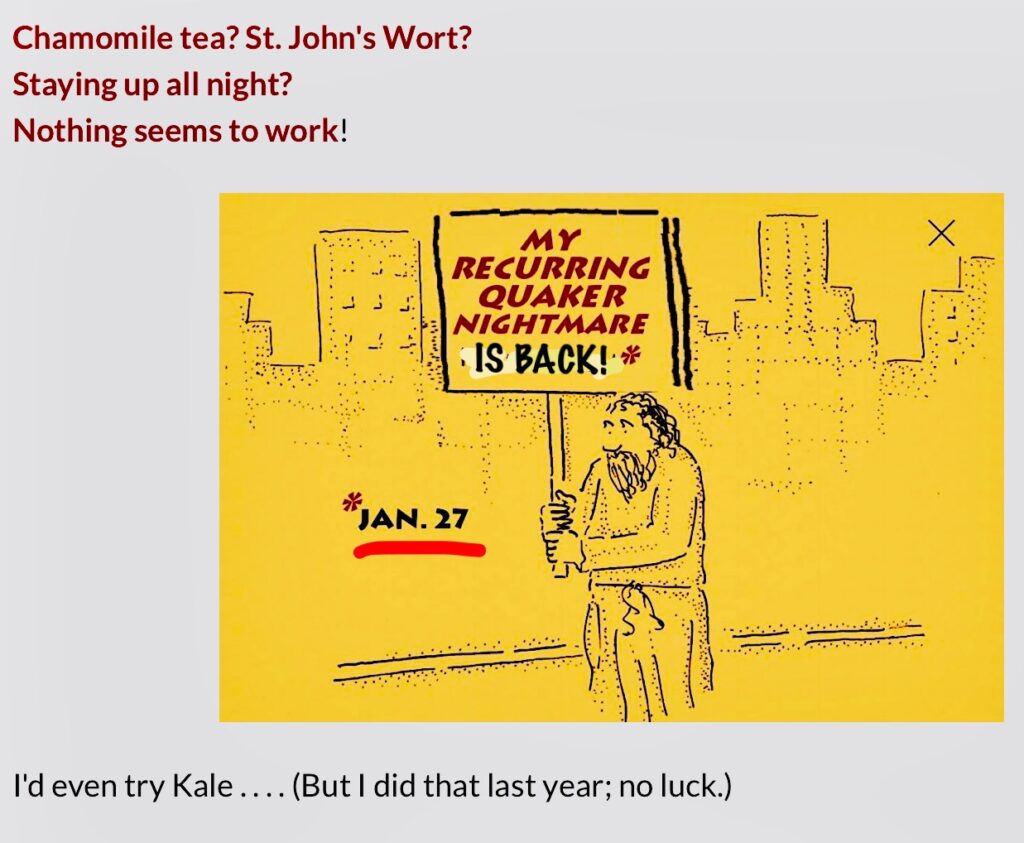
My Recurring Quaker Nightmare — Every January 27th

Yes, January 27 is Mozart’s birthday. He would have been (and IS, in a real way) 250-plus years old today, give or take.

And the nightmare scenario just recounted haunts me because it brings home how drastically poorer my own life would be, had the musician by some miscarriage undergone the kind of conversion it imagines.

How much difference has it made? There was an underground comic strip back in the Sixties about several disreputable characters called the Fabulous Furry Freak Brothers. These fellows had a saying, that “Dope will get you through times of no money better than money will get you through times of no dope.”

For me, tho I enjoyed the Brothers in their time, a truer motto would be, MOZART will get you through times of no money better than MONEY will get you through times of no Mozart!”

And let the church say, “AMEN!”

Read more →

Santa Comes Back to Earth (Sigh)

In many respects, this post, “Santa Comes Back to Earth (Sigh),” is a postscript to an earlier one: “Yes, There Is A Santa Claus Archetype: I’ve Seen Him, Been Him. ”

It’s a reminder of the truth of the old Latin adage, “sic city transit gloria mundi,” or “Thus quickly passes worldly glory.”

And sure enough: Christmas is past. And Santa is “off the radar” for another year, has landed, and gone back to obscurity, resuming his incognito status.
But there’s one important footnote. This, er, de-transformation (aka disguise) was achieved by the masterful fingers of that Michael Jordan of the scissors, Mr. Bryan Brandon of Platinum Cuts, in Durham NC. Take a bow, Bryan . . .

Read more →

Yes, There Is A Santa Claus Archetype: I’ve Seen Him, Been Him

What kind of archetype is Santa Claus? One psychologist says he is the carrier of deep memories of “the Good Father.” Most of us, even many who had overall “bad childhoods”, can summon memories of times, moments, when a father figure was good to us: comforting, bountiful in comfort and generous in things we wanted as well as what we needed. Indeed, the rarer these occasions were, the more tenacious can be the memories.

Others note that Santa’s character accords with various ancient gods: his knowing all our “lists” of hopes; the ability to get all around the planet in a single night; even his ample belly bespeaks abundance and generosity.

Also, he is innocent; we only see him in this time of giving; he asks only that we be good, without getting very specific, or judgmental about our shortcomings. And beyond all the merchandising, we know that even tiny, homemade gifts from him can be as magical as the latest high-end gadgets. Or if we don’t know that, when we learn it, he will still be there.

My own experience this fall points to one more feature, perhaps the most marvelous in these troubled times, verified again and again: it turns out that there seems to be one white man that most black Americans do trust (maybe the only one): not me, but the Santa I have passingly embodied. If he too has “white privilege,” his mission is to give it all away, then make more, for more giving next time.

Santa-Dont-ShootSo I’ve been humbled each time by this repeated recognition: for one thing is clear to me, Chuck Fager, is that I do not live up to that Santa Claus archetype. (And I shall not impersonate it much longer: that fateful, long-delayed Monday visit to the barber, and return to incognito status, is coming again very soon.) But I’m grateful to have had the chance to see that this larger figure is still active.

Read more →

A Quaker Christmas Story: Candles In The Window

Christmas Eve, so called by the world’s people, was always a frantically busy time at the Woodhouse bakery. While the Woodhouse family, being Quakers, did not observe Christmas as a special day, almost all their customers did. That meant orders for dozens more pies than usual, plus hundreds of tarts and ginger cakes, and scores of extra loaves of their rich, thick bread.
So all the week before, the whole Woodhouse family were in the shop almost round the clock, mixing dough, sprinkling sugar and cinnamon, spooning out the cherry preserves, and tending the fire under the big brick ovens.
Abram did all of this, and more: he was often sent out with a basket full of pies or tarts for delivery to the better customers: beef and mincemeat pies to old Tilbury at the Golden Lion Pub beyond the square; or down the cobbles of South Street, through the narrow passage of the Ginnett and past the sturdy old Meetinghouse, with scones for the Blackburns and buns for the widow Kilburn. Sometimes he crossed the river Ribble to Giggleswick, where the vicar doted on Mother’s ginger cakes.
This evening he had been sent to the pub, where Tilbury wanted three more pies for his last round of customers, and it was from there that he had turned to climb the hill Castleberg.
Abram wouldn’t have thought of climbing Castleberg, especially in the cold, except for the candles–two in a window in every house and shop.
“What are they for, this time?” he had asked Father that morning.
“It’s a double illumination,” Father said, “for victories past and victories prayed for. George Cockburn’s troops burning Washington, DC is the victory past, and Wellington beating Napoleon before the end of 1815 is what they’re praying for.”
“That’s a fine thing to pray for, in what’s supposed to be a Christian country” his grandmother had snorted. Laying down her rolling pin, Gran had wiped sweat from her brow. “All it means is more dead soldiers, penniless widows and hungry orphans, from Paris to New York. Love thine enemies, indeed. A terrible, sinful waste.”
She sighed and picked up her rolling pin. With swift, expert strokes she flattened a thick lump of dough into delicate pie crusts. . . .

Read more →

My Quaker 50th Anniversary (Already?)

This month, December 2015, marks the 50th anniversary of my coming among Friends. And much of that whole ongoing adventure can, for this purpose, be boiled down to four things:

A knock on the door;
Getting “The Letter”;
Riding the bus; and
Getting on with it.

The knock on my door came (as best I can recall) in early December, 1965, on Lapsley Street in Selma, Alabama.
Alabama in general, and Selma in particular, were extremely unlikely places for this to happen, among the least likely in the U.S. But it did, reflecting the recurrent tendency for Quakers to turn up where they are least expected.
My wife Tish, answered the knock, and then recoiled in fright. A young white woman stood there — and looked as scared as Tish did.
We were living in the black part of Selma, had been working with Dr. King’s staff in the voting rights movement for almost a year. There had been some violence, plus ominous, heavy-breathing phone calls to the house, that sort of thing. So we were cautious.
But as soon as the young woman spoke, her accent showed she was not a local, and Tish relaxed. In fact, she was a student with a group from a new Quaker educational experiment, Friends World Institute (later College).

At the school they studied problems (like racism) rather than conventional courses; and did this with a lot of “study travel,” trekking off in VW Microbuses to places far away from the school’s initial base on Long Island, New York. Places like Selma, where Dr. King’s office staff sent them out to canvass in black neighborhoods to find people of color who still needed to register. Which brought her to our door.

Read more →