
How college became so expensive, and how we can turn it around, according to a Pulitzer Prize-winning journalist
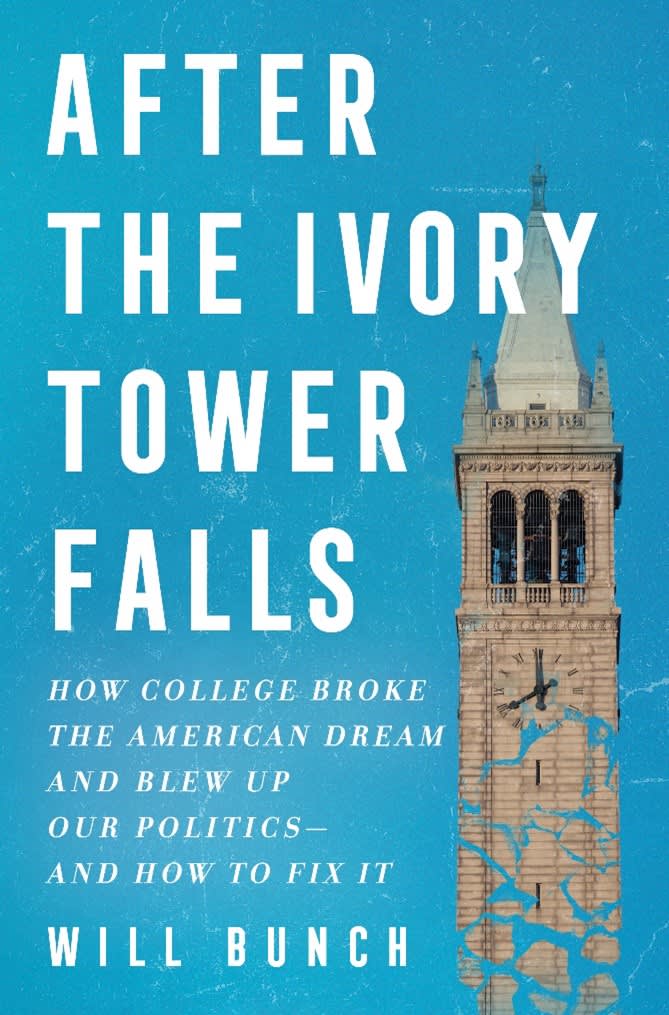
- How college became so expensive, and its consequences on families and U.S. society, are the issues explored in Will Bunch’s new book, After the Ivory Tower Falls.
- “The impact of this decision to privatize higher education, which was done with shockingly little public debate, has been enormous,” Bunch said.

Bunch is a Pulitzer Prize-winning journalist and the national opinion columnist for The Philadelphia Inquirer.
Our discussion below has been edited and condensed for clarity.
‘We’ve chosen to privatize higher education rather than make it a public good’
Annie Nova: What do you see as the top reasons college in the U.S. has become so expensive?
Will Bunch: Some of these administrators do get debatably big salaries. Also, many schools believe the best way to compete for new students is not through price but prestige, offering luxury perks — think: lazy rivers or rock-climbing walls. But the big-picture answer is that we’ve chosen to privatize higher education rather than make it a public good. Taxpayer support for public universities has plummeted in most states. In my own state, Pennsylvania, it’s dropped from 75% of the cost to just 25%. Students and their families are asked to make up the substantial difference. [Emphasis added.]
AN: What have the consequences of these high prices been?
WB: The impact of this decision to privatize higher education, which was done with shockingly little public debate, has been enormous. The most obvious impact has been the $1.75 trillion mountain of U.S. student debt, which is more than Americans owe on all of our credit cards, and which will only be alleviated somewhat by President Biden’s recent move on debt cancellation. Young people with these debts hanging over them have deferred buying or renting a home, getting a car, even getting married. Yet the even bigger impacts are political and social. Lack of college access and affordability has caused enormous resentments and grievances, among both those locked out with no degree and those who borrowed so heavily to get one. [Emphasis added.]
‘Many young people are voting with their feet by shunning a college education’
AN: Where do you see college prices going? Will they only get worse?
WB: In the 2020s, many young people are voting with their feet by shunning a college education because of a perception that it may no longer be worth it. Enrollment has dropped noticeably, even as the pandemic wanes. As a result, more and more schools — especially those in the middle of the pyramid — are looking at ways to lower tuition or offer more aid. That said, I don’t believe the price of college will fall dramatically without states lowering tuition at public universities, and without a renewed push for free community college. [Emphasis added.]

AN: How feasible are those changes at this point?
WB: Making public 4-year universities free or next to free would be expensive and require new funding sources. Sen. Bernie Sanders, [I-Vt.], once proposed a tax on Wall Street transactions, while Sen. Elizabeth Warren, [D-Mass.], has backed a wealth tax. Just a few additional progressive-minded members of Congress would be required.
AN: What role has the government’s student loans played in the rising costs of college?
WB: The government — both federal and state — has played a huge role that isn’t talked about. Ronald Reagan, who was elected governor of California in 1966 by running against student protest, was the avatar of the movement to privatize college. As president, his administration lowered Pell Grants and created a system where Congress pushed more college costs into loans for both students and parents, removing limits on borrowing that factored into the upward spiral of costs. The Parent Plus program, for example, has few restrictions on credit or on how much can be borrowed, and participants eager to send their child to their dream college sometimes end up with hundreds of thousands of dollars in debt. [Emphasis added.]
‘Education is the secret sauce of [political] division’
AN: If it survives the court challenges, how could Biden’s new student loan forgiveness plan impact the cost of college, if at all?
WB: This seems the biggest flaw in the Biden plan, that it included nothing in the way to lower college costs going forward. That means the freshmen entering college in the fall of 2022 are presumably borrowing money at levels similar to those that created the need for this massive debt cancellation in the first place.
AN: In what ways do you blame college for making America as divided as it is today?
WB: College became the American Dream for young people after World War II — when millions saw a lost-cost diploma as a path to a better life. The privatization of college and the enshrinement of the idea that college was not a wide pathway for the middle class has created a society seething with resentments. Today, the Democrats are becoming the party of college-educated folks clustered in cities and suburbs, while the GOP plays to the grievances of the white working class. These groups have less in common, little social contact, diametrically opposed political beliefs — and increasingly hate each other. Education is the secret sauce of this division. [ Emphasis added.]
AN: Beside bringing costs down, how else do we mend some of this?
WB: In the book, I devote the final chapter to the idea of a universal, government-supported gap year of mostly civilian national service for 18-year-olds between high school and what comes next.
This would achieve several things: It would help today’s young people, who are clearly struggling, better decide their future path. These projects — such as conservation work like preventing the next wildfire, or working in disadvantaged schools or communities — would benefit America.
But these young people would also get the benefit of a common, shared sense of national purpose with kids from different backgrounds, red states and blue states. We used to achieve this, unintentionally, through wars and the military draft. This is a way to bring Americans together, without bloodshed.
[COMMENT: The “gap year” idea is promising, but without drastic action to lower college costs and borrowing, it won’t get at the basic problems.]
ADDENDUM: From the NYTimes review:
“After the Ivory Tower Falls,” by the Philadelphia Inquirer columnist Will Bunch, is the story of how the Great Wall of Loans was built and why it divides us, of how higher education went from a beloved guarantor of opportunity to, in Bunch’s telling, a fracturing force of cultural and economic separation. It is ambitious and engrossing, even when the narrative sometimes strains to fit the demands of Bunch’s argument that college has become “a fake meritocracy rigged to make half of America hate it.”
Bunch’s history tracks the missed opportunities to define and finance college as a public good, beginning with the 1944 G.I. Bill’s unexpected success in sending millions of white veterans to college, free of charge. President Harry S. Truman’s Commission on Higher Education followed up in 1947 with a far-reaching vision of enlightened, productive citizens educated by federally financed colleges and universities.
But like so many good things, the idea was spoiled by racists — in this case, Southern lawmakers who worried that federal programs might require them to educate Black people. While an undergraduate named Mario Savio helped found the Free Speech Movement at Berkeley (after registering Black Mississippi voters during the Freedom Summer of 1964), an aging actor named Ronald Reagan saw an opportunity to ride middle-class revulsion toward campus radicals all the way to the California governor’s mansion. Reagan went on to champion an antitax, small-government philosophy that would erode public education revenues for decades to come. . . .
But the Trump years caused, or were provoked by, a wrenching separation of the electorate into opposing camps defined by educational attainment. College-educated Republicans fled the party in droves, while Democrats without degrees ran in the opposite direction. The result was two tribes who disagreed not just about values and ideals but also about basic tenets of science and fact.
While universities always publicly denounce funding cuts, many were not-so-secretly glad for the excuse to become more exclusive, expensive and focused on the wants of the wealthy. That’s how excellence has always been defined in American higher education. Just as tectonic economic shifts left tens of millions of workers needing new training and credentials, the public university system was becoming less affordable and more beholden to “meritocratic” ideas that thinly disguised the interests of the ruling class. Meanwhile, even students who might have been inclined by background and politics to embrace higher learning became disillusioned by the spiraling crisis of debt.
Image