
Schisms over slavery, women and now, sexuality: A history of fractures among Methodists
Raleigh NC News & Observer
Un-united Methodists
The church has long delayed an anticipated split over LGBTQ issues — until now. It’s not going to be easy. As some in North Carolina look to disaffiliate from UMC for more conservative theology, others must grapple with their own stance on how to move forward.
The clash United Methodists face today over gay weddings and ordination is not the first time the denomination has fractured. The original Methodist church was founded out of a split from the Church of England. Methodism has evolved over the centuries in a series of fractures and mergers.
“It’s not the first time we’ve split. It’s not the first time we’ve reunited,” said the Rev. Jennifer Copeland, executive director of the North Carolina Council of Churches and a United Methodist minister.
HISTORY OF SCHISMS
Methodism was founded in the 18th century as a movement by John Wesley to reform the Church of England from within, according to the UMC. The Methodist Episcopal Church split off and established itself as an autonomous church in 1784.
Three years later, the church saw its first division when a number of Black members exited and organized the African Methodist Episcopal Church and African Methodist Episcopal Zion Church. In 1828, the Methodist Protestant Church formed, and in 1841, the Wesleyan Methodist Church launched over social and theological conflicts. The church ruptured in 1844 over slavery. Delegates from the Southern states in the U.S. split off to create the Methodist Episcopal Church South, which became a prominent religious presence in the South through the Civil War.
In the aftermath of the Civil War, the Freedman’s Aid Society and the Colored Methodist Episcopal Church were developed to serve newly freed enslaved people. Over the next four decades, the church would see a campaign to expand the participation of laity and women in decision-making.
The Methodist Church (USA) was created in 1939 to unite the Methodist Episcopal Church, the Methodist Protestant Church and the Methodist Episcopal South. The consolidated church was segregated, with five administrative units divided by geography and the sixth, the Central Jurisdiction, encompassing all African American Methodist churches and annual conferences, regardless of their location.
The United Methodist Church was born in 1968 as a union between the Methodist Church and the Evangelical United Brethren. The merger abolished the Central Jurisdiction and established full clergy rights for women, which were previously approved by the Methodist Church in 1956.
Meanwhile, Methodist missions extended across the globe, with membership growing rapidly in Africa and Asia since the turn of this century.
TODAY’S FRACTURE
The debate on human sexuality in the church began in 1972, when the General Conference, the church’s global governing body, declared homosexuality as “incompatible with Christian teaching.” In 1984, the General Conference prohibited “self-avowed practicing homosexuals” from serving as clergy after failing to institute the rule four years prior.
1996 saw three additions to the church’s stance on sexuality. The points defined the term “self-avowed practicing homosexual,” barred United Methodist clergy and churches from holding gay weddings and called for the U.S. military to not block people from service “solely on the basis of sexual orientation,” according to a timeline by the UMC. At the turn of the century, the General Conference adopted language to “implore families and churches not to reject or condemn their lesbian and gay members and friends.”
The General Conference met in a special session in 2019 to determine how the denomination could remain as one despite its members’ opposing views on LGBTQ issues. The church doubled down on its position against gay marriage and ordination, but left the denomination at an impasse on how to move forward. A group of church leaders then negotiated a Protocol of Reconciliation and Grace Through Separation, which laid out an “amicable separation” of the denomination, according to the legislation.
The General Conference intended to vote on the Protocol in 2020, but the session was postponed to 2024 due to the pandemic. In May, the Global Methodist Church launched as a new denomination catering to churches with a more conservative theology and non-affirming stance on sexuality.
kayla Guo
– – – –
‘Not going anywhere’: How this gay NC man has long sought full Methodist acceptance
Kayla Guo
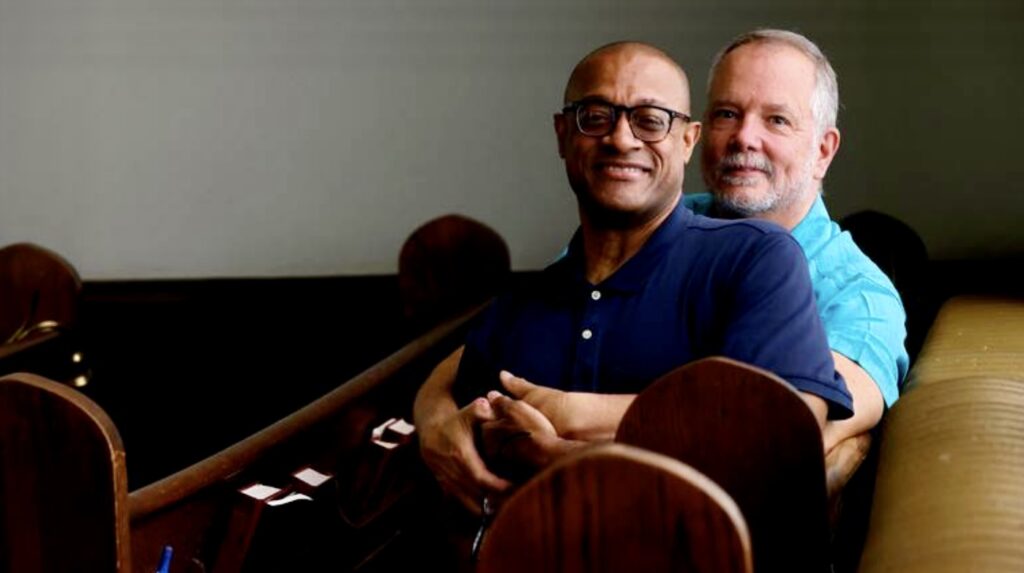
Maxie and Mark Hipps-Figgs are photographed in the sanctuary of Elizabeth Street United Methodist Church on Sunday, July 31, 2022, in Durham, N.C. The Hipps-Figgs were the first gay couple to be publicly married in a North Carolina United Methodist Church. KAITLIN MCKEOWN kmckeown@newsobserver.com
Un-united Methodists The church has long delayed an anticipated split over LGBTQ issues — until now. It’s not going to be easy.
As some in North Carolina look to disaffiliate from UMC for more conservative theology, others must grapple with their own stance on how to move forward.
Mark Hipps-Figgs knew he wanted to marry his husband, Maxie Hipps-Figgs, in a United Methodist church. The problem was that the United Methodist Church long barred its churches from holding gay weddings. But he had devoted so much time and care to the church over the years, he said, that if United Methodist churches were going to turn him and his wedding away, he would make them say no to his face.
A gay minister, who was closeted at the time, warned Mark to be careful. The church will go after you, she told him. “Bring it on,” Mark replied. “I’m not afraid.”
‘MY LIFE CHANGED’
Mark first came upon the UMC via volleyball. On a Wednesday evening during his freshman year at Western Carolina University, Mark stumbled upon a game behind the church, then attended the vesper service that followed.
Two weeks later, he was the food chairperson for WCU’s Wesley Foundation, a United Methodist campus ministry. Before the end of his college career, Mark served as both vice president and president of the foundation.
“I said to God, I’ve never prayed before … I’m not sure how to pray. But I know that I need something in my life,” he said. “My life changed from that moment.” Now 62, Mark has been a devout United Methodist ever since. Today, he is married and out, and he serves as the lay leader of Elizabeth Street UMC in Durham, a Reconciling Ministries congregation advocating for the full inclusion of LGBTQ people in the church.
People know Mark within the church for his extroversion and devotion to the church’s mission, according to the Rev. Julia Webb-Bowden, Elizabeth Street UMC’s pastor. He runs Elizabeth Street UMC’s monthly community meal, which feeds around 60 people from within and outside the faith. He has preached from the pulpit. He became a spokesperson when the congregation marched in protest of Pioneers Church in Durham, whose pastor declared that she believes marriage and sexual intimacy are meant to exist between a man and a woman.
Maxie — who has his own work in the church, such as Elizabeth Street UMC’s blood drive — jokes that being married to Mark is like being a pastor’s wife. “I’m always very supportive of what he needs to do,” Maxie said. “If he needs me, he pulls me in.”
PLANNING TO GET MARRIED
Before same-sex marriage was legalized in North Carolina in 2014, Mark worked as a maître d’ at a hotel that often hosted wedding receptions. Mark was so good at adding little touches to make each reception extra special that the staff knew not to open the doors until he had “marked” up the venue.
“I was making these peoples’ day so special. And I was happy to do that,” Mark said. “But a part of me died every single time because this could never happen for me.” While Mark and Maxie knew other gay couples who celebrated their relationship through commitment ceremonies or who traveled to Washington D.C. or Canada to get married, Mark remained adamantly opposed to either option.
“There’s nothing wrong with me. There’s no reason why I should have to drive 11 hours to do what Joe Schmo can drive 10 minutes downtown to get done,” he remembers saying. But he conceded that if the law in North Carolina seemed unlikely to change by the time of their 10-year anniversary, he would begrudgingly consider a commitment ceremony.
Almost 10 years to the day of Mark and Maxie’s anniversary, on Oct. 10, 2014, North Carolina legalized same-sex marriage. Within a minute of sharing the news, Maxie proposed. They announced their engagement on Facebook, and in the next minute, Jennifer Copeland, Mark’s best friend and a United Methodist minister, called and told him she was going to officiate their wedding.
Shortly after that, Mark got another call, this time from the Rev. Patrice Cheasty-Miller, a minister he had worked with at Sanctuary UMC. She, too, insisted on officiating the wedding. Mark worried Copeland and Cheasty-Miller would be jeopardizing their careers if they performed the ceremony, knowing his and Maxie’s union in a United Methodist church was still illegal in the denomination’s eyes at the time. But neither would take no for an answer.
AN ILLEGAL WEDDING
At the time, Mark and Maxie attended Calvary UMC, the first Reconciling congregation in the Carolinas. After a meeting about the possible legal ramifications of holding the wedding, Calvary UMC’s pastor approached Mark, crying. The fate of the wedding was in her hands, and she was torn over what to do.
A week and a half later, just as Mark and Maxie thought they would have to resort to a back-up plan, the pastor said she would do the wedding. Even if the UMC decided to revoke her credentials as a result, she said, that would not change her sense that God had called her to be a minister. “She became a different, and, in my humble opinion, better minister, because she understood that sometimes, you just have to put yourself out there,” Mark said.
On Oct. 17, 2015, Mark and Maxie were married in a United Methodist church in North Carolina. They had gone from United Methodist churches turning them and their wedding away, to three United Methodist ministers presiding over their ceremony.
“It just became this wonderful, magical moment,” Mark said. At the end of the ceremony, he took the microphone. “For those of you who may not be aware,” he told their guests, “what we have done here today is illegal in the United Methodist Church. So all of you are guilty of aiding and abetting.” The congregation, which packed the church and numbered over 100, burst out in applause.
‘YOU’RE NOT GOING TO RUN ME OFF’
Still, despite Mark’s long-standing devotion to the UMC and the support he has received from his immediate faith community, his life as an openly gay man in the church has not been without its challenges. Mark has some family members, for instance, who continue to see homosexuality as incompatible with Christian teaching. And the fact that the UMC at-large still bars gay weddings and ordination is not one Mark forgets, even if the denomination seems poised to soon adopt a more affirming position.
There was a moment around 10 years ago when he thought about leaving the UMC. That moment was brief.
“I just went, ‘Nope. Not happening. Not going anywhere,’” he said. “You will have to drag me kicking and screaming out of this church. Because I have invested so much time, energy, effort and heart and soul to the Methodist church, and you know what? You’re not going to run me off.”
Kayla Guo is a reporter interning on The News & Observer’s metro desk this summer. Originally from Long Island, New York, Kayla is a senior at Brown University, where she studies public policy and previously served as editor-in-chief of the university’s independent student newspaper. You can reach her at kguo@newsobserver.com or (919) 829-4570