
Prelude
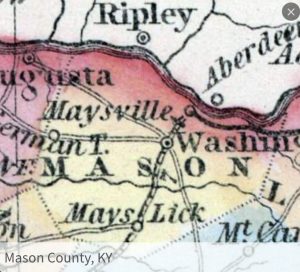
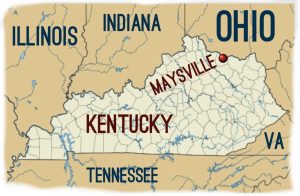
In the 1850s, Maysville was a river town in slaveowning Kentucky, on the watery border with free state Ohio, just across the busy Ohio river.
This border was hotly contested in those years: numerous abolitionists had settled nearby around Aberdeen and Ripley on the Ohio side. Many enslaved people made for the town, to attempt a crossing to freedom. Some succeeded; others did not.
The level of tension was jacked up when Congress passed the repressive Fugitive Slave Act in 1850. Among other things the law gave license to posses of southern slave hunters to pursue escapees across state and regional lines, backed up by the federal courts, and the possibility of federal troops.
 In reaction to such raids, more abolition-minded Northerners gave up on limiting resistance to peaceful means. In September1852, national politics came to Maysville, in the person of General Winfield Scott, presidential candidate of the Whig party.
The Whigs were a fading party, not least because they couldn’t resolve their internal differences over slavery. On a Saturday night, a big crowd gathered in Maysville to hear Scott, including many from surrounding Kentucky farms run with slave labor.
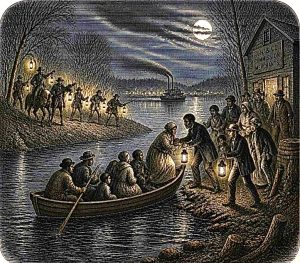
Watching their masters & mistresses leaving for town, more than thirty of the enslaved met and made their own way to the river, to spots where underground sympathizers waited with skiffs and canoes to help. Was the move a well-planned, long-awaited scheme, or a near-reflex that was part of living so near the border at an easy crossing point?
The sources aren’t clear. But I lean toward the reflex, because slave-hunters were quickly alerted, and were closing in by the time the escapes were splashing into their boats. It feels like everybody sensed what was coming, like reading the sky as thunderstorms form: river knowledge. The hunters brought guns.
But the escapees’ supporters brought guns too, and the pursuers were halted a few miles west in the town of Ripley, Ohio, where armed abolitionists blocked their efforts to capture runaways. Besides Ripley citizens, local officials refused to assist the hunters, defying the Fugitive Slave Act, and local freed people hid and protected their fellows as well.
By Monday, the Kentuckians, still furious but with farms untended, gave up the hunt and crossed back across the river at Maysville toward home. It appears most of the runaways kept going north toward Canada.
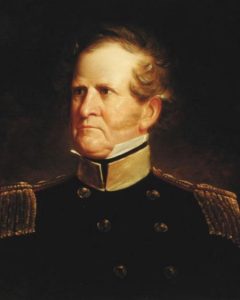
While bloodshed was narrowly averted, the Maysville press denounced the standoff as as “Another Negro Stampede.” Abolitionists and underground supporters who aided in thus robbing enslavers of their “property” were roundly condemned. And General Winfield Scott went on to get trounced in the election by Franklin Pierce. Within two years his Whig party was being shoved aside by an upstart antislavery faction called Republicans.
In the sanguinary annals of abolition, the 1852 standoff was a relatively minor incident. But it was remembered locally, as well as the visit by another national figure, of a very different sort.

From Anna Davis Hallowell, James & Lucretia Mott, Life & Letters. (1884):
[Hallowell]: In the fall of the [next] year [1853], James and Lucretia Mott traveled in New York, Ohio, and Indiana, attending meetings and conventions, and visiting some
relatives. Before returning home, they went into Kentucky to visit some connections of Lucretia’s sister, Martha Wright, who accompanied them.
Lucretia Mott writes of this trip:
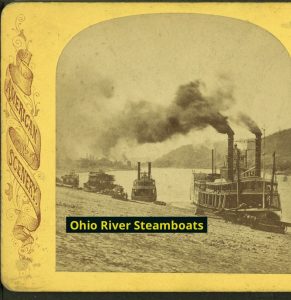
“We left Cincinnati at eleven o’clk, and did not reach Maysville Kentucky] till ten at night. The banks of the [Ohio] river afforded a constantly varying scene, and we enjoyed the day. . . .
John Pelham met us at the landing, with his carriage. The ride out to his home, three miles, in full-moonlight was very pleasant, and the warm reception from the four aunts was grateful. A blazing fire added much to the cheerfulness. We were made so entirely at home by their Kentucky hospitality, that we soon felt like old acquaint-
ances. . . .
“A meeting had been appointed for me in the Town Hall of Maysville, in the afternoon. There was a crowded house. Slavery spoken of without reserve, and well borne.
Much persuasion to have another meeting in the evening —which we consented to—on woman; a great gathering and apparent satisfaction. J[ohn]. P[elham]. seemed satisfied with the meetings, though I learned afterwards that he had felt apprehensive, and had expressed a wish that I should be told not to speak on, or allude to slavery.’’
[Hallowell]: In a letter to Lucy Stone, referring to this journey, James Mott writes:
Steamboat Oakland, 10th mo. 17th, 1853.
My dear Lucy,—Here we are on the way up the Ohio river, in a small but tolerably comfortable boat.. . .
Yesterday after dinner we returned to Maysville to attend a meeting that had been appointed in the Court House at two o’clock. Theology, war, intemperance, and slavery were the topics . . . .
At the close, another meeting was appointed for the evening, on Woman’s Rights. The house was more crowded than in the afternoon, indeed it was a jam ; but quiet and good order were observed, and the gospel on this subject was preached with power and demonstration.
At the close very many expressed their gratification and a desire to hear more.
Lucretia told them they must get Lucy Stone to talk to them, that she was only as a John to prepare the way for Lucy and others, who could do the subject far better jus-
tice. We think thou wilt find an open door at Maysville.
The meetings were both free. As Lucretia has never received money compensation for her own use for preaching or lecturing, she thinks it not worth while to begin to do so in her old age. . . .
To this, Mrs. Wright adds some interesting details:
Dear Lucy,—
I don’t know how brother James has done to write a word, the boat jars so — I must add, however, my wish that you will go to Maysville. A slaveholder said to me, that she thought it a great pity the meeting last night could not be followed by others, there was
such a willingness to hear the truth. I never heard more earnest demonstrations, not by applause, but in remarks afterwards.
My good brother-in-law, John Pelham, said to me before the first meeting, “I hope Mrs. Mott will not name slavery,—notice was given for a religious meeting.”
“Why,” said I, “that is eminently a religious subject, and the people, believe me, will respect the free utterance of opinion far more than an unworthy concealment ; besides,
she considers herself called of God to speak on this very subject ; it was for this she came, on the assurance of Col. Stevenson that she might say what she pleased, and I dare not interfere with any one’s convictions of duty.”
He still demurred, but I think he felt entirely satisfied after hearing her; and she did not spare them. Of course I said not a word to her beforehand of this conversation.
[Hallowell]: It can hardly be out of place to give some extracts from the newspaper reports of these lectures:
“One of the largest audiences ever gathered within the walls of our spacious Court House was drawn thither on Sunday afternoon, to listen to the world-renowned Quaker, Mrs. Lucretia Mott. Curiosity prompted much the greater part ; a few, however, expected, from the reputation that preceded her, to hear eloquently and plausibly set forth principles which found an echo in their own hearts.
For an hour and a half she enchained an ordinarily restless audience (for many of them were standing) to a degree never surpassed here by the most popular orators.
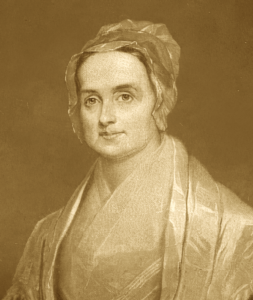
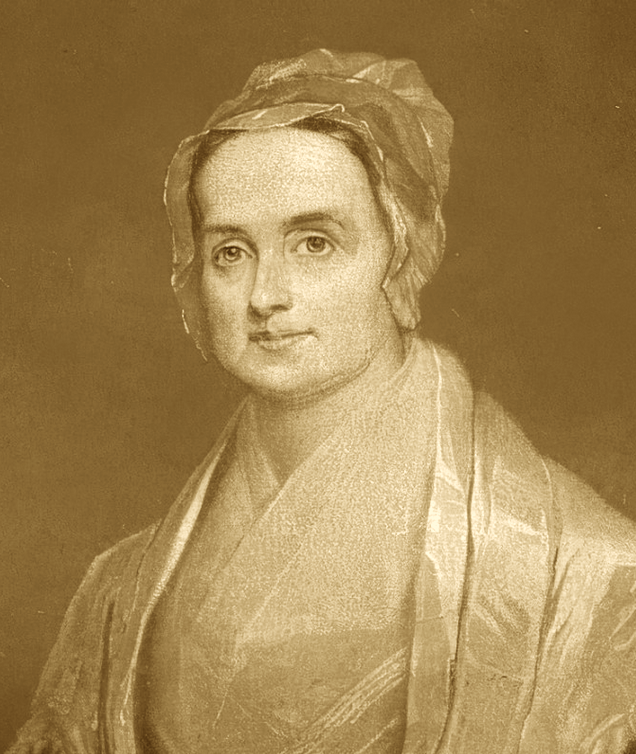
Mrs. Mott is an elderly lady, probably sixty-five, of a fair, full, round, cheerful countenance; a quick beaming eye ; a smooth, even, quite pleasant, and rather musical voice; a calm, quiet, yet sufficiently earnest delivery ; evidently a woman of strong mind, of determined will, an original and bold thinker, with nerve enough for any emergency.
She said some things that were far from palatable to a Maysville audience, but said them with an air of sincerity and of plausibility that commanded respect and attention. She seemed delighted at the great degree of courtesy with which she was received and listened to.
A good many did not know of her appointment for speaking at night, but notwithstanding, the Court House was crowded to its utmost capacity,— a larger, and if possible, more attentive audience than in the afternoon.”
[But then]:
[For the Express.]
LUCRETIA MOTT.
This bad woman, whose infamous calling is a war against the Constitution of the United States, a sacrilegious condemnation of the Holy Bible, preaching disobedience and rebellion to our slaves, was allowed the use of our Court House for the propagation of her infernal doctrines.
We wish every citizen of Mason county to be made acquainted with the fact that the edifice which has been erected at their common cost, only to be occupied by those who were charged with the administration of justice, and the protection of their religious and political rights, has been again defiled by the presence of a foreign incendiary, proclaiming within its walls principles antagonistic to the law and peace of the commonwealth. Not more than a twelvemonth has gone, since its occupation for a similar purpose was the occasion of bloodshed and rancorous feelings not yet healed in our community.
What will be the result of a visit from this female fanatic is not yet known; we should not be surprised, however, if it were the prelude to a heavy loss on the part of the slaveholders of the county, as a score or two of blacks were present to behold and hear this brazen infidel in her treason against God and her country.
—- Slave-holder.
[Note: In the Civil War (1861-1865), about 100,000 Kentuckians fought, 70% for the North, the rest for the South. Some 20,000 died, mainly on the Union side. The large majority of deaths were from disease, rather than actual combat.]
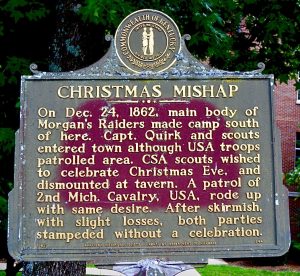
Glasgow, Barren County