
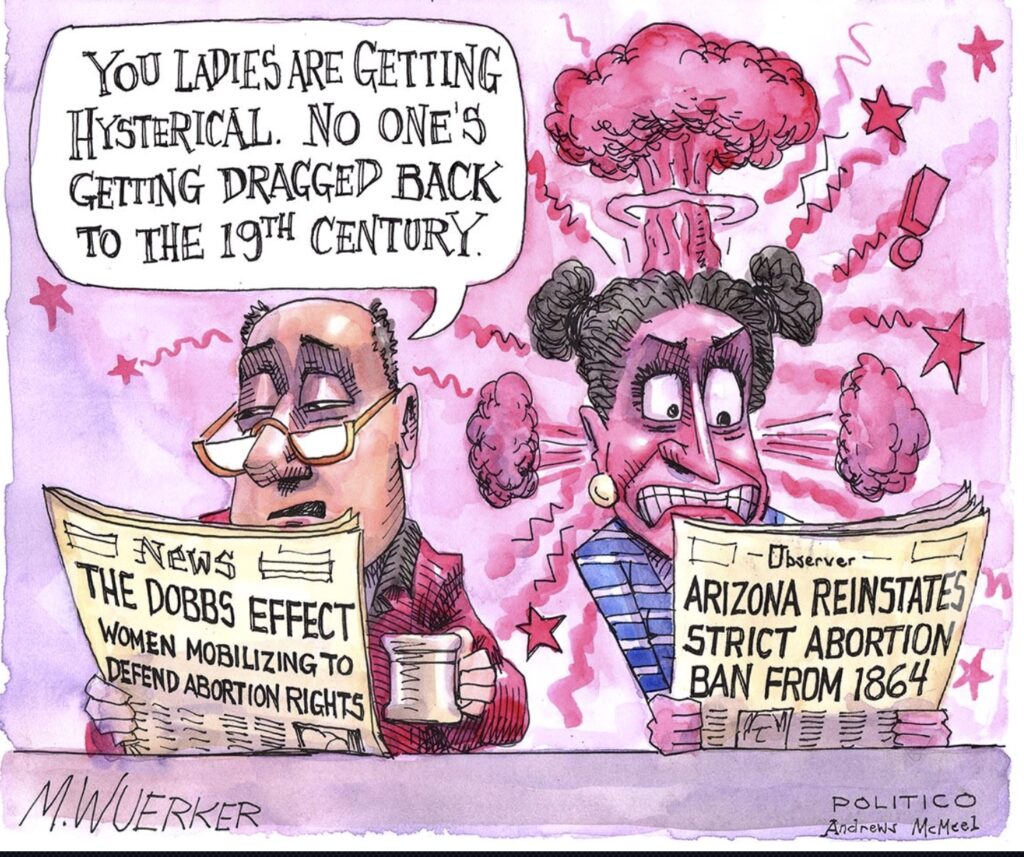
[NOTE: David French is a conservative; I would differ with him on many issues, including Roe. But what he writes here about who is the most “pro-life” president (prepare for a surprise) and the crucial place of hope regarding abortion (and life generally!) is dead-on and relevant every day.]
The Importance of Hope in the Pro-Life Movement
David French
Hope, not power, is the key for the pro-life movement
 This newsletter is ultimately about hope. But I want to start with something else, a question that’s deeply relevant to the Republican Party and its 2024 presidential primary. The perceived answer to this question will likely swing the evangelical vote and decide the nomination.
 A tiny bit of history: According to the Guttmacher Institute, the American abortion rate (the number of abortions per 1,000 women) and abortion ratio (the number of abortions per 100 pregnancies) rose sharply in the years after the Supreme Court decided Roe in 1973. These figures essentially plateaued and then dipped slightly under Ronald Reagan’s presidency, and then began a long decline under each president since then … until Donald Trump. No president saw sharper decreases in the abortion rate and ratio from the first to the last year of his presidency than Barack Obama. In 2016, at the end of a presidency dominated by pro-choice policies and judicial nominations, there were a total of 874,080 abortions — 338,270 fewer than there were in 2008, the last year of the George W. Bush presidency. That’s a remarkable decline of 28 percent. The rate and ratio of abortions at the end of Obama’s second term was actually lower than it was in 1973, the year Roe was decided.
Yet that long trajectory toward lower abortion rates and ratios changed during Donald Trump’s single term. In spite of allegedly being the most pro-life president in American history, he presided over the first overall increase in the abortion rate and ratio during a presidency since Jimmy Carter. As a result, there were 56,080 more abortions in the final year of Trump’s presidency than there were in the final year of Obama’s.
And no, this was not a Covid-induced blip: The abortion rate dipped slightly in 2017, the first year of Trump’s presidency, before rising in 2018, 2019 and 2020.
Has the effect of Dobbs canceled out that increase? The short is answer is yes, slightly. The longer answer is, again, more complicated. According to data from #WeCount, a project from the Society of Family Planning, it appears that there were roughly 24,000 fewer abortions in the United States in the first nine months after the Dobbs decision than there were in the previous nine months.
That decrease is substantially less than some of the leading pre-Dobbs estimates, one of which predicted that the abortion rate would be “at least 13 percent lower without Roe v. Wade.” Such an estimate would have expected to see a decrease of about 100,000 abortions in nine months. Even more troubling, the same #WeCount study found that national monthly abortion rates had rebounded to pre-Dobbs levels by early winter of 2023.
This is but one study, of course, and it will take time to discern the enduring impact of Roe’s reversal. But it suggests that the abortion increases that began under Trump might be more sticky than I hoped, that what could have been a mere blip might be a trend.
I support the Supreme Court’s reasoning in Dobbs. The Constitution is silent on the right to an abortion, and the question properly belongs to the political process. Moreover, Roe worked a great injustice in my view: It prohibited American democracy from fully considering or acknowledging the humanity of the unborn child. It was right and necessary for the court to correct such a substantial error in constitutional law.
But even before Roe was overturned, I was under no illusions about the challenge facing the pro-life movement. That challenge is now proving worse even than I feared, and it’s worse in part because of the very compromises made to secure the Dobbs victory. The pro-life movement was Donald Trump’s mighty political vehicle. Without its support, his cruelty, malice and corruption would be a footnote to history.
Instead, his towering presence has warped almost a full decade of American life, turned Americans against Americans and transformed the culture of the Republican Party, the political home of pro-life America. It remains to be seen how long his malign influence will last. But much of America has experienced Trump’s presence on the public stage as a form of assault, and that assault is ultimately antithetical to the cause of life.
The pro-life movement is not exclusively religious. Indeed, a pro-life liberal atheist named Nat Hentoff was extraordinarily influential in the development of my own pro-life philosophy. But the movement is heavily religious, and many of its members will be familiar with one of the most famous verses in the Bible, from the book of Jeremiah: “‘For I know the plans I have for you,’ declares the Lord, ‘plans to prosper you and not to harm you, plans to give you hope and a future.’”
Hope and future. Those two words are profoundly connected. And when it comes to the decision to have a child, it is hope that provides that future. A pro-life movement that has long affixed its eyes on power must now remember hope.
Otherwise, it may remember this period of American history as the time when it won the law and lost the nation, when the means of its legal triumph also sowed the seeds of its cultural defeat. If there is one thing that we know, it is that the culture in which we live decisively influences whether men and women possess the hope sufficient to have a child.
Missing data point in French’s analysis of reasons for increase in rate and ratio of abortion in Trump years: precipitous decline in Trump years and ongoing, of access to contraception and sex ed and relationship support, for teens and young adults. Like guns, prayin’ don’t get it – facts and intelligent communal action are the Way.
Removing support (outrightly or by adding inconvenience and co$t) is the Republican way. Those who do not contribute to the bottom line of the bank accounts of the monied class that funds politics generally, and the GOP in particular, do not deserve care but should have to earn it.
On the other side of the coin, as it were, when wages rise hope follows. Biden’s infrastructure plans (voted for by the GOP to make it seem that they cared about the effects of Covid) will lead to fuller employment, higher wages, and more hope.
Giving people reason to hope: that is the Way. Hope is what Bo-Katan gave. It is what all true leaders give.