A Holiday Weekend Read: Target — Mustangs — Two Memories and a Nightmare
Target: Mustangs — Two Memories and a Nightmare
Chuck Fager
One
It was like walking into a frontier Disney movie.
“Stallions,” said cowboy Fred. “Stallions are tough. Tough to catch, tough to hold, and tough to place.”
I glanced up at him from the fading campfire, then down at my reporter’s notebook. I could almost read it in the brilliant starlight.
We were sitting somewhere in the middle of the Owyhee Desert, 70 miles northeast of Winnemucca (230 from Reno) in north central Nevada. The sharp scent of sagebrush mixed with smoke in the warm late summer air. The sky was velvet black, stillwater clear, with endless numbers of stars. Now and then a coyote howled in the night’s distance.
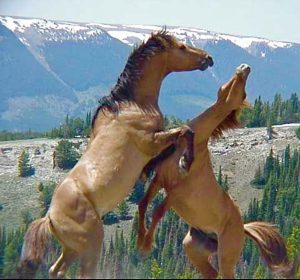
Wild stallions fight – BYM photo
Fred swigged from a can of warm beer. “I was up at Palomino Valley last month,” he said.
“North of Reno, where we keep the horses. Big corrals. People come and adopt them. Some of ‘em, anyway. Big old stallions are usually too mean to get adopted. Had some trouble with a big one.”
The cowboy sitting across from us spoke up. I didn’t know his name.
“I remember him,” he said. “Huge, macho sucker. Some guy wanted him, though. Drove all the way from Oklahoma. Tried three times to get that horse up a chute and into his truck. The fourth try, we got him halfway up. Then he kicked a side panel loose and broke out.”
Fred gestured with the can. “Five of us chased him with lassoes all around the place. But he finally found a post in the perimeter fence that was leaning. Climbed right over it, and got away into the hills.”
“What happened?” I asked.
Fred grunted. “We fixed the fence post. But he’s still out there.”
The other cowboy, ready to help a visiting reporter, said, “The guy had to drive back to Oklahoma with an empty truck.”
“We hear that one some nights, “ Fred said. “He comes down and whinnies to his mares. They all start neighing back, and pawing at the fences. But he’s not too lonesome. There’s a band of 30 or 40 of them up there, and he’s probably taken charge of them by now.”
The other cowboy snickered. “Yeah,” he said, “but his old mares are pretty well hooked on the hay drug by now. Some of ‘em wouldn’t leave today if the gate was wide open.”
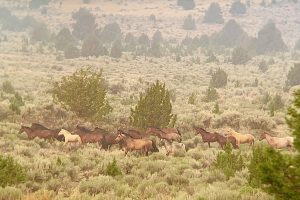
Mustangs running in wildfire smoke – BLM
“Can’t blame ‘em,” Fred said. He sipped the beer. “It’s no picnic for ‘em out here. Especially in this drought.”
The differences between this scene and a Disney movie weren’t visible around the campfire, but they were real enough. Fred and the other cowboys looked like the real thing, with rough hands, weatherbeaten faces and battered, sweat-stained hats. Their Levi’s were faded, but from months of desert sun, not some factory’s bleaching machine. The jeans were cinched tight with wide belts and big tooled buckles.
But these wranglers were actually federal bureaucrats, civil service workers, with clumsy sounding titles like “range livestock specialist”. Some of them probably knew as much about government regulations as they did about sagebrush.
Nor were we out hunting mustangs to catch and break and actually ride. This crew got its orders from Washington, where Congress had decided to have some of the wild horses running loose on these vast stretches of government-owned land be rounded up and put up for adoption by other, non-rancher citizens.
Meanwhile, the horses were hardy and fertile. Their numbers had been growing, despite the grim weather brought on by climate change. Estimates are there may be 50,000 in Nevada, several times more than what some scientists say the land can safely support. They eat up a lot of the sparse desert flora.
The ranchers in Nevada herd cattle, which compete with mustangs for grazing. Ranchers don’t like the horses. They used to round them up and shoot them, or sell them for dogfood.
That’s not legal anymore; but there is reportedly still a clandestine trade of mustangs caught, then smuggled into Mexico or Canada and sold for slaughter. In the frequent years of drought, the weather killed them off almost as fast as hunters could.
This summer of 1977 was a very dry one. The cowboys I was with were actually on a mission of mercy. If they could catch some mustangs, they could save them.
In that campfire scene, I might have been the closest to a Disney character: a citified reporter, along for the ride, having an adventure I planned to turn into an article. Or maybe a story.
The other cowboy stood up and threw a cup of cold coffee into the fire. It sizzled and steamed, as he said something about turning in. I blinked. Government employee or not, this still looked like a movie to me.
The next morning, Joe the pilot swung a little bubble helicopter low over the waterhole, a spot of pale green on the dun of the landscape. Joe handled the aircraft with confidence, but I hung on tight to the edge of the metal dashboard.
“This is a lot easier than Vietnam,” he told me with a grin. “No jungle, and nobody shooting back.” But I was still very aware of how small we were and how hard the desert floor was.
Looking down, I couldn’t see any water, just a wide circle, a line of green on the fringe, dark in the middle where there was some mud left, like a bullseye in the center of a thick outer ring. The rest of the ring had once been wet, too, but had long since sun-dried and cracked into an intricate crazed pattern.
Near the middle of the circle lay the whitened skeleton of a colt. Its small sharp hooves had sunk deeply and fatally into the muck as it searched desperately for water. Unable to move, it had been left to die there by a band that had no way to help.
The helicopter climbed again, and circled. The desert looked to me like an indistinct carpet of tawny grey flecked with dark spots of dusty shrubbery.
But Joe could read the scenery. “There,” he pointed off to the right.
I looked, and at first saw nothing. Then I made out a streak of dust halfway to the horizon. Joe gave a thumb’s up, and reached for his radio.
“They’re coming your way,” he shouted into it. “I think I can head ‘em into the funnel.”
He heeled the chopper hard to the right, and I grabbed again at the dashboard.
Below and a couple miles to the west, a dozen or so cowboys waited, hidden in the bushes on each side of a half-mile of dry stream bed. On each side of it there was now a fence, painted to blend with the sagebrush and juniper. The fences made the stream bed into the long neck of a funnel, which ended in a corral around a bend. The corral’s big metal pipe gate was wide open now, pulled back out of sight.
The copter closed on the swirl of dust, and in a moment we were passing over a band of horses, galloping flat out across the range, already spooked by the strange machine’s noise.
This was movie stuff for sure: hooves pounding, long necks stretched out and manes flying, dust trail streaming. The band extended in a sinuous line, showing colors from off white to spotted to shiny gunmetal black.
“Time to turn ‘em,” Joe said. “Hang on.”
He slowed down, pulling us even with the lead horse, which I could see was a big grey one with a darker mane. The horse in front was always a mare, I had been told, the lead mare. She sets the direction, while the big macho stallions take up safe spots in the rear.
I was still watching her, fascinated, when Joe hit a button on the dashboard.
Suddenly a siren shrieked from under our seats, rising and falling rapidly. It was a sound from the heart of the city; close your eyes, and it was an ambulance or a police cruiser speeding to a scene of everyday urban violence. Open your eyes, and it was an utterly alien intrusion on the quiet of the desert.
The lead mare seemed to flinch from it, veering to her left and increasing her already frantic pace.
“That’s the idea, baby,” Joe yelled over the noise, “that’s it.” He slowed the copter and the band passed under us again, spreading further apart as several colts fell behind.
Joe considered the group for a moment. Then he said judiciously, “I suppose we better turn ‘em a little more. They might miss the mouth of the trap, and ruin my whole morning.”
Pulling ahead, he banked sharply to the left, opened a slot in the door, and dropped several small white tubes through it. In a few seconds what seemed like gunshots rang out below: Bang, Bang, Bang.
Joe grinned at me. “Great firecrackers,” he said. “Works almost every time.”
He was right. The grey lead mare had angled left again, and the band was now closing toward the beginning of the dry stream bed, where the mouth of the trap opened wide but invisibly to receive them.
Joe climbed a bit and then hovered. The lead mare was now past the beginning of the fence. As soon as the lagging colts had passed, several mounted wranglers emerged from behind a screen of rocks on either side of the gully, taking up the chase, shouting and waving their hats.
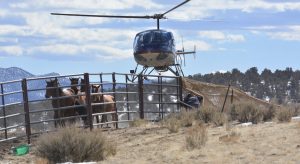
Helicopter completing a roundup – BLM photo
Behind them several more men scrambled across the width of the trap’s mouth, and lifted a chest high sheet of green plastic. The green plastic would look like a fence with human posts if the lead mare turned the band and tried to escape back the way they came. Once the band rounded the bend and found itself in the dead end of the corral, the big gate would be slammed shut and latched with heavy locks.
“Like a charm,” Joe said, and turned the copter toward the camp. “We’re done up here.”
The horses were being loaded up for the trip to Palomino Valley when I got to the corral. Wranglers were perched on either side of a high-walled chute, shouting and slapping at the horses to keep them moving up and into the big truck. I found a spot on the chute and climbed up to join them.
Dust swirled everywhere as the horses milled around the corral. I moved down to the fence to watch them more closely.
Most were thin, even the big ones, with ribs showing through their patchy coats. Their manes were matted and stringy. Many had scars and scabs on their flanks. Some were from scrapes on desert rocks, but others were from bites and kicks, as bigger horses, especially the stallions, fought for dominance in the bands.
They still looked magnificent to me. Specimens of a kind of wildness that was almost impossible not to romanticize.
But the horses were in a blind panic. Born wild, knowing only the harsh freedom of the desert, they must have felt as if they had been captured by aliens and were hurtling into a bottomless void. They reared and whinnied and dashed jerkily first one way and then another, trying to avoid the shouting, arm-waving wranglers.
But the cowboys, who knew what they were doing, kept turning them steadily toward the chute, and one by one the animals stumbled into it and up toward the truck.
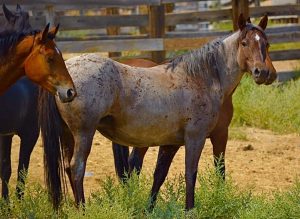
Gray mare in corral – BLM photo
A puff of breeze parted the clouds of dust momentarily, and across the corral I saw the lead mare, the grey with the darker mane. She wasn’t moving with the others. She was just standing there, trembling, her sides heaving, the muscles in her big neck bulging.
What, I wondered, could she possibly be thinking? I had no doubt there was intelligence showing in those wide dark eyes.
In a moment, I had my answer. Nearly all the mustangs were in the truck now; their cries were drifting down from behind its high green plank sides. Only a few were left in the corral. The mare turned her head to the right, then to left, her gaze sweeping around the high corral walls, then stopped when she spied the gate, which was almost directly opposite from where she stood.
What was she seeing? Unlike the board fence, the gate’s metal pipes made a wide flattened X shape in a frame. It was lower, and plenty of daylight showed through it. Beyond it the sagebrush and the hills could be seen. Did it look flimsy to her untamed eyes? Like no barrier at all, a way of escape?
All at once the mare neighed and began to run, full-speed. She easily evaded a shouting, hat-waving wrangler and aimed straight for the gate. She crashed into it head on, full speed.
Her windpipe snapped like a dry twig and she recoiled into a trembling, unnaturally-angled heap. The dust of her collision swirled around her. Neck broken, she died almost instantly, eyes open.
A few days later, my reporting nearly finished, I went to Palomino Valley near Reno to take a last look at the newly-captured mustangs.
Fred was there, and led me through the maze of corrals to where the band was being kept, in a kind of newcomers’ quarantine.
The fences were high and solid here. Just inside the gate an oil barrel had been cut lengthwise and filled with greenish water. A moss-covered toilet tank float ball kept it full. In the center of the corral stood two metal racks stuffed with hay. Horses were munching quietly at it.
A couple paused to look us over, then resumed their meal. Several colts sat on the ground, thin legs tucked comfortably under them.
The scabs were still in evidence, the manes were still matted. But the panic was gone. They blinked calmly at us.
Fred eyed them for a moment. “The hay is like a hard drug,” he said. “This here is the first regular feed and water they’ve ever had. They get used to it real fast. Makes ‘em pretty easy to gentle and train.”
He grinned. “Most of them, that is. The big old stallions are real hard. ‘Lot of them still just want to run and fight.”
“What about that one who escaped?” I asked.
Fred glanced toward the hills. “Still out there,” he said. “Came down just last night, got the place all riled up whinnying back and forth to him.”
He shrugged. “But for these horses, that’s movie stuff now. The desert’s just a memory for them. They’ve lost their freedom; but they’ve got a life.”
I looked back at the horses. “Is that how it always is?” I asked.
Fred, the government cowboy, just shrugged
Two
That Owyhee adventure was really Memory #2. For the first, I reel the life tape back twenty-plus years, to the mid-1950s –lord, as much as 75 years ago:
Northern California, Elm Street in Vacaville (Spanish for “Cow Town”), between Frisco and Sacramento. It was 400 miles, and a couple of galaxies, away from Owyhee, of which I had as yet heard nothing. Pre-interstate, it had morphed from cows into a center for preparing harvested onions.
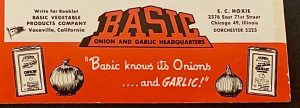
The Basic Vegetable Products Company in Vacaville specialized in dehydrating and powdering onions and garlic, millions and millions of pounds of them. The powders went into soups and other canned goods.
Basic Knows Onions -Vacaville California
Our family had no connection to Basic; father was a pilot at Travis Air Force Base several miles south. But we all breathed the local air, and from end to end Vacaville smelled strongly of onions, all the time.
Onion smell wasn’t the worst; not like fish processing or a kraft paper mill. But it still sticks in my mind when I think of the place.
And I think of Vacaville here because we had a dog then, named Sissy, who will bring us back to horses.
I was a tween, and one of my chores then was to feed Sissy in the evenings. She was a friendly, mostly cocker spaniel pooch who licked me when I leaned over her bowl in the garage, but loved her dog food more. Especially the stuff in cans.
She wiggled and whimpered as I labored to open them with our primitive hand-operated squeeze-and-crank opener, and dove in as soon as I spooned some out.
No onion-garlic smell here: it was meat. What kind or kinds of meat varied. Could be chicken; could be pork, beef, a mix or something that left you guessing.
And one day when I bent back a mostly open lid, the aroma that emerged surprised me: it was almost exactly like my mother’s roast beef, made with chunks of potatoes, celery, carrots and—yes— onions too (not powdered).
It was good. And was mainly for special occasions. Expensive.
So, what was it doing in a dog food can?
I inspected the chunks; nope, no vegetables. But it still smelled like the roast beef.
Or almost; maybe a bit, you know, off. Curious, I raised the can and brought the label up close — not to smell it better, but to make out what was written in the small letters after the bigger word “Ingredients.”
Sissy was really whining now; she wasn’t interested in words, just the food.
Well, she could wait a minute. I looked back at the can. And the label made things, as they say in Washington DC — perfectly clear:
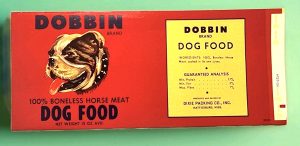
Horsemeat – Dog Food
Horsemeat.
Wikipedia told me much later that horse meat had long been part of American pet food ingredients. But by the Fifties it was on the way out. Nothing really wrong with it, but a lot more sentimental movies were made about horses than cows. So beef was taking over, but not the roast beef kind. Also pork.
Why, I still wonder, why have pigs become such media stars? Is it just Babe and Wilbur in Charlotte’s Web? Miss Piggy?
One of the deep mysteries of my life. But luckily, their stardom hasn’t killed off bacon.
Some can labels were shy about ingredients. Used sneaky phrases like: “meat meal,” or some such.
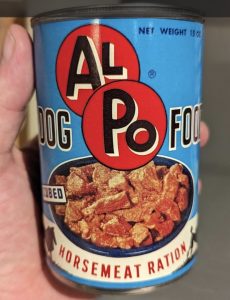
Alpo horsemeat dog food
Not this one. Right there, in front of God and everybody:
Horse meat.
Of course . . . I tasted it.
I looked both ways first: everybody was inside, likely around the small black and white TV screen.
The taste wasn’t so bad. Maybe another —
The back door rattled: my oldest brother, taking out the trash.
I quickly plopped the rest into the bowl; Sissy’s eager snuffling and chewing covered me as I wiped a bit of gravy from my lips; no horse breath if I could help it. And nobody seemed to notice.
Do people eat dog food? (Or cat food?) There’s an urban/rural legend that among the very poor, they do. I did that day, though not in desperation.
In between those two recollections, a lot had happened that I was oblivious to.
Three
The helicopter memory from the late Seventies, twenty plus years later, is when I began to notice where the horsemeat had come from. By then it was long gone from dog food, so we were told, and from restaurants, at least in the USA.
Meanwhile, in mottled stretches of the high western desert, especially in Nevada, Utah and Oregon, bands of wild horses still roamed widely, one side of a long-running, low-level range war with cattle ranchers.
Much of what (and who) became the USA rode in on or was hauled behind horses. And nags had been escaping to, surviving in and propagating in the wilderness since the days of early Spanish explorers. Some estimates put the peak wild horse population in 1850 in the millions.
But as machines replaced horses, hundreds of thousands became “redundant.” Once their high work value was gone, they could still be monetized as a protein source—or, as one company carefully called it on its canned goods,“lean red meat.”
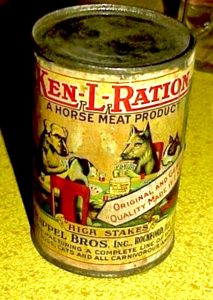
Early Ken-L Ration – The Chappel Co., Rockford, Illinois.
American industry was on it. In 1923 the Chappel Brothers Corporation opened in Rockford Illinois, 75 miles northwest of Chicago. It was soon the largest equine slaughterhouse in the U. S. Its big marketing coup was the introduction of Ken-L Ration canned horsemeat dog food.
Was the horsemeat I sampled in Vacaville Ken-L Ration? If not, it was inspired by the Chappel brothers.
By the 1950s, horse-drawn farm equipment had almost vanished. Thus “the great removal” effort to clear the continent for European settlers expanded the target list. Besides buffalo, Indians, and recent immigrants, the huge nomadic mustang herds were also marked for removal from the Old-New West’s no-longer-wide-open spaces.
Many ranchers welcomed and joined the removal. The feral herds competed for the sparse greenery needed for their cattle.
Further, many herds were on federally-owned land (e.g., roughly 80+% in Nevada, two-thirds in Utah, etc.). Many ranchers also resented federal wildlife bureaucrats as pestering urban aliens, peering over their shoulders, waving more and more regulations.
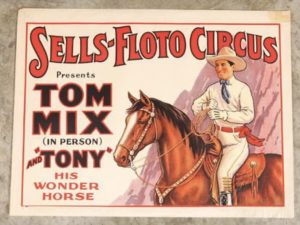
Tom Mix & Tony the Wonder Horse -circus poster
In the meantime, Hollywood and moviegoers made fortunes by creating a seemingly indelible American archetype of the cowboy’s clever, indispensable, noble four-legged sidekick. Three generations of Americans, including me, couldn’t get enough. The numbers don’t lie:
Tom Mix & Tony “The Wonder Horse”; Hopalong Cassidy on his multi-talented Topper and Gene Autry riding his Champion, combined made 300-plus western films; and there were many others, plus TV spinoffs and merch.
No wonder that, by the 1950s animal welfare activists from small towns and big cities, began to take notice outside the theaters. Many may have never climbed into a real saddle. But they had been raised on these “horse operas.” And they began appointing themselves as guardians of the beleaguered bands. In them they saw majestic icons of American history, vitality and always endangered freedom.
And Jenn Suarez, of the American Wild Horse Foundation, who coined the near-genius tagline: “The History of America is Written in Hoofprints.” And there are many others.
I interviewed Velma Johnston shortly before her death. She reminisced about waging what she called “The Pencil War,” when multitudes of schoolchildren scribbled cards and letters to Congress demanding protection for the mustangs, and a smaller population of wild burros.
Congress listened. In December 1971 President Nixon signed the Wild and Free-Roaming Horses and Burros Act of 1971. It had passed unanimously.
“Congress finds and declares that wild free-roaming horses and burros are living symbols of the historic and pioneer spirit of the West; that they . . . enrich the lives of the American people; and that these horses and burros are fast disappearing from the American scene. It is the policy of Congress that wild free-roaming horses and burros shall be protected from capture, branding, harassment, or death. . . .”
It banned hunting or killing the horses on federal lands, or selling them for slaughter. But it permitted roundups of “excess” horses for adoption or, failing that, relocation to horse “reservation” areas at public expense.
That act still stands. On paper at least. But the final “memory” in this trio began as a musing daydream about the previous two, which then took a sharp turn toward waking nightmare.
Project 2025 — targeting the mustangs
It opened in that handbook for plunder, Project 2025’s “Mandate For Leadership.” Its Heritage Foundation authors insisted that maintaining mustang herds was just equine welfare, and in the spirit of, “Graze, cattle graze” (& for oil companies to “drill, mine & Frack”) the mustangs must be taken, as it were, off the table, except for a few living souvenirs (provided their coats are gold-colored)
“. . . the uncontrolled growth of wild horses and burros, the Mandate thundered, “poses an existential threat to public lands” (p. 526) and “Congress must enact laws permitting the BLM to dispose humanely of these animals.”(p. 529)
“Dispose humanely.” An “existential threat.” (They forgot to include “eating the dogs and cats”.)
And they got their chance beginning in January 2025. Here’s what that “existential threat” means here and now, in the Reign of 47 and the Thieves.
The threat is not to the “public lands.” It’s to the mustangs.
Think back to the stallion from the Owyhee roundup, fighting desperately every inch of the way up the slide into the truck, as if there was imminent violent death waiting at the top.
Well, death wasn’t imminent for him, then. Yet today, more likely. Tough stallions mostly don’t get adopted, as well as many others. And the longer they’re in the holding pens, the higher the odds become of their being sold into what has been rightly called the “underground slaughterhouse pipeline.”
It’s a real thing.
A story in the New York Times in August blew its cover:
Thousands of them, from out west. Hunted, rounded and penned up.
Helicopters are still used—but rides like the one that so thrilled me in 1977 now evoke more the masked terror raids of ICE in Minneapolis and everywhere. (So dies one more Disney dream.)
Then they’re trucked like detainees by shadowy routes mostly at night, at the end of which drivers fiddle with the paper trail and send them nameless to slaughterhouses beyond borders north and south, eager to turn the beasts into –
Dog food?
Not yet. More on that in a moment. First, follow the trucks.
There are no active horse slaughterhouses in the U.S. today. Instead, thousands of American horses are trucked across the borders to slaughter plants in Canada and Mexico. And a remarkable amount of the traffic is murky, and apparently deliberately concealed.
Animals’ Angels, (AA) which tracks the slaughter trade through customs and shipping records, found that the largest single category of U.S. horse shipments to Mexico in 2025 was simply:
“UNKNOWN SHIPPERS”—
— about 260 shipments valued at more than $9 million. Its footnote explains “unknown”: “Shipper’s name has been removed or is not legible.”
Then there’s “Ramos Livestock.” AA says that isn’t actually one shipper at all, but a name used on official paperwork by numerous kill buyers who don’t want their own information there.
So much for the mandates of the law. One visible feature of such totally “underground” operations though, is that they are prime candidates for dealings with others accustomed to seeking illicit profits on government business while ignoring the law; such as the current U.S. regime.
At the slaughterhouse, the killing processes are likewise nontransparent. Animal welfare groups have repeatedly insisted the methods are utterly non-humane, bloody, abusive and often like drawn-out torture. (These two short videos here and here describe and show the methods; they may be difficult viewing.)
The feds disappeared approximately 3700 horses in 2025, twice as many as the year before.
2026 – informal reports suggest further acceleration this year.
The Times: “’The federal Bureau of Land Management, aka] B.L.M. is saying to the public that slaughter is off the table, but they’re doing it in plain sight using a third party,’ said Clare Staples, who runs a wild horse sanctuary in Oregon called Skydog Ranch. ‘There are simple steps the bureau could take to end this, but they are turning a blind eye. And the only ones getting punished for what is going on are the horses.’
The bureau did not respond to questions about its sales or make leaders available for comment.”
The Times was only able to say of 2026 that the feds were still selling “thousands” more to many pipeline-connected brokers nationwide.
What happens to that much horsemeat? Almost all is exported: The Italians and French are the top European consumers; but Japan, where many regard uncooked horse is a sushi-like delicacy, is a major market. There are others. China may be the biggest horsemeat consumer of all, but its supply appears to be mainly home-grown.
It doesn’t seem to end up in dog food, though. There’s not enough of it.
Wild horse advocates are suing to stop the federal sales; sometimes they win delays. They charge that the Trump/Project 2025 scheme aims to eradicate the mustangs from the west, a kind of “equicide” campaign to add to the buffalo and Indians, later immigrants among others. But the horses are steady breeders, and herds can replenish quickly.
In the meantime, though, the BLM-slaughter pipeline could pump tens or hundreds of millions of dollars more into the ever-grasping hands of those feasting on the current slaughter of laws and regulations on so many fronts.
Times reporter Dave Phillips commented:
“Wild Horses and burros have a fascinating history in the West.. . .There is a legitimate debate to have about the proper management of wild horses on public lands. I was motivated to write this article because I saw that no debate was taking place. Instead the government was saying one thing and doing another, possibly violating the law in the process, and doing it all at great tax payer expense.”
Such a familiar story.
Except that for me, this one comes with memories: a clear-eyed grey mare taking her last breaths in a dusty Owyhee corral; Vacaville’s onion-laden air; and the taste, stolen from Sissy’s dog-food can, of a horse I knew nothing about.
I know considerably more about where those horses come from now. And too much about where too many are going.