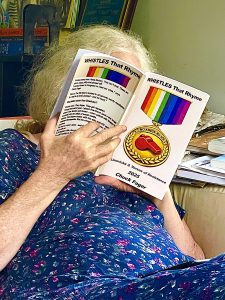
“Write to Congress!”
That’s what our Quaker lobby told us. “Frequently. Your letters make a difference.”
Well, I was skeptical; but I did it anyway. For a year-plus.
Did it make a difference?
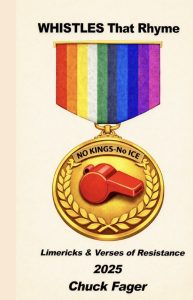
Sort of: it produced my new book: Whistles That Rhyme.
But in Congress?
That jury’s still out. I remain skeptical.
Why? Two reasons.
First, as a journalist, I’d covered some Congresspeople. And it seemed clear that the letters making the most difference to them were the ones that came with (or announcing) checks; checks bearing lots of zeroes after a 1.
And second, I’d been there. Worked in a congressional office: two years of mostly trying not to be swept away in a paper river as wide and deep and roiling as the Mississippi on rampage.
Letters came into every office every day; piles of them. (Even before emails upped the ante bigly.)
In addition, there was an endless flow of resumes from starry-eyed job-seekers, desperately pleading for help landing a gig in the glamorous, thrilling, fast-moving power-soaked sexy world of Capitol Hill.
If only they knew.
So my skepticism was not that of the mere cynic. Believe it or not, it was closer to compassion.
I felt pity for the bobbing swarm of anonymous staffers at daily risk of drowning, trying to stay afloat in this perpetual swirling paper tsunami.
Yet here I was, adding to it. A lot.
Why was that? In the end, it was simple: because, 2025.
2025, as in Project.
You know how that turned out. Not over yet, either.
Also, given my age [redacted], health and diminished mobility, the outside activist responses, fabulous as they were, seemed mainly past for me.
But having studied the army, I knew about its “tooth to tail ratio” — that for every front-line soldier, there are several others playing crucial supporting roles, but low profile and usually not in active combat.
So be it.
For the rest of that year (& then some), I wrote to Congress. Usually several times a week, though (full disclosure) I did slack off some when they were out on their 111-day “August” 2025 recess.
(Quick review of teacher Mike Johnson’s lesson in Congressional math: 4 weeks = 15 weeks [paid, of course], summer=fall — and it all adds up to part of the Great Epstein Stall.)
But my compassionate urges weren’t sidelined. Mail on the Hill doesn’t go on recess, so I pondered how to lighten the burden on the harried staff left tending the store, without blunting the infinitesimal impact the notes might have. My strategy soon boiled down to two words:
Short, and —
Limericks.
Short fits today’s vanishing American attention span. Each of my messages pushed just one main point; making it easier to tally: Bring Obrego Back Now; Stop With The Stupid Tariffs; Musk & Doge Are Dangerous Nuts; etc.
Besides, limericks rhyme (mine, mostly do, as you’ll see).
Rhymes can stick in a reader’s mind like a Kars4Kids earworm.
But some limericks are funny: funny sticks better too.
Not least, I’m a passably proficient limerick generator.
So I got into a rhythm and cooked along through that awful chainsaw/Russell Vought winter and spring.
Then in late April another idea dropped: why not take the messages to a larger audience?
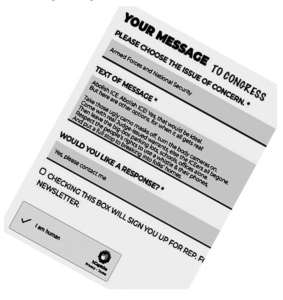 All three of “my” North Carolina congressionals use a stripped-down fill-in-the-blanks email form. But I was on Facebook, Substack & Bluesky too. They made room for graphics; and I knew more people read messages with graphics.
So I began collecting & editing photos to reinforce their prime message in the socials. They’ve achieved wider visibility there. (A few prose meanderings wormed their way in as well.)
Then, on January 20th, 2026, I looked at the calendar, and wanted to go hide.
Three more [bleeping] years to go.
It was cold as hell in Minnesota then. And cold as purgatory in Durham North Carolina my home.
But ICE had massively invaded Minneapolis. To the agents’ amazement (and mine) the city was fighting back fiercely, doggedly, and nonviolently.
A month later, as the ugly snow piles in Minneapolis were beginning to melt, ICE had pulled back, withdrawn much of its occupying force. Its parent agency, the Orwellian Leviathan dubbed “Homeland Security,” was in a long partial shutdown struggle with a Congress that seemed at least momentarily to have recovered bits of its long-mislaid backbone and courage.
The ICE-autocracy struggle is far from over; but the Battle of Minneapolis seems to have been a major — maybe historic —victory for peoples resistance.
Also Hungary.
I figured that was a good time for a review, stocktaking, and something of a report. Whistles That Rhyme is that report, or at least a decent rough draft.
Did writing to Congress help with national survival in 2025?
Maybe. If the current spell of congressional assertion holds up (a big test will be whether it can oblige ICE to unmask; they haven’t yet), that will be a hopeful sign.
And then there’s always what I call the Trumpstein Files.
Some items in this motley collection may be already forgotten: how many of us recall the numbers of pencils (plus one doll) the 47 Santa-Grinch said was enough for 2025 XMAS stockings? Or how long the red carpet was that 47 unrolled for Putin in August at the Drive-by Alaska “summit”? The clues are in this book in the verses and spasmodic snapshots of one obscure participant’s action & reactions in a turbulent year.

There are precedents for such: Collections of abolitionist poetry did much to rouse public conscience in parts of the U. S. before the Civil War (Thus the verses were also banned and suppressed in slaveholding states.)
Quaker poet John Greenleaf Whittier (1807-1892), published many famous and influential antislavery poems. Here’s a clip from one:
What, ho! our countrymen in chains!
The whip on woman’s shrinking flesh!
Our soil yet reddening with the stains
Caught from her scourging, warm and fresh!
What! mothers from their children riven!
.. . . To us, whose boast is loud and long
Of holy Liberty and Light;
Say, shall these writhing slaves of Wrong
Plead vainly for their plundered Right?
***
Oh! Rouse ye, ere the storm comes forth,
The gathered wrath of God and man . . . .
Whittier was technically a pacifist, but when the “gathered wrath” turned into civil war, he did his bit for the Union victory.
We live in very different poetic times, but I can still hear echoes in these lines.
A limerick can be ironic and gay,
but something weighty it also can say.
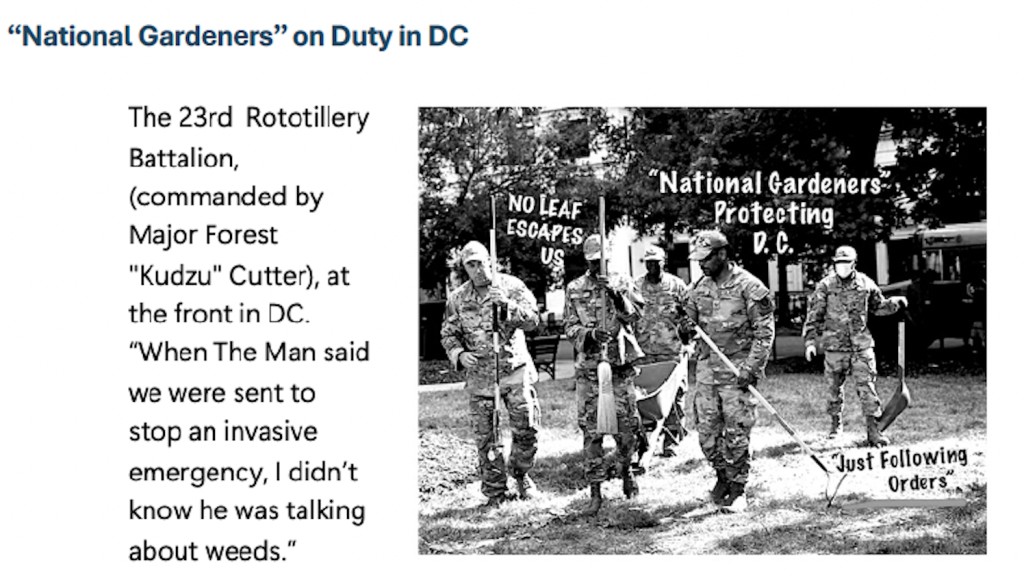 And don’t forget your whimsy: the “National Gardeners,” who spent the summer in D. C. heat, in all-out battle against an invasion of — weeds.
Or the videos from Oregon, where ICE agents ready for battle, were confronted by rolling battalions of protesting bicyclists pedaling through downtown Portland, unviolently and unclothed. [Photo redacted.]
The naked truth there was that, laden with drooping gun barrels and heavy camo kit, the ICE forces looked far more silly and exposed than the bikers.
These were smashing performances, that punctured many ICE delusions, but didn’t smash a thing.
I never matched those routines, and there was much other, somber and heroic stuff to write Congress about in 2025, in verse or prose.
Yet I hope more whimsy and encouragement erupts along with the protests on the streets in this coming year, and next. I’m still writing some limericks. Keep an eye out for them. And check out Whistles That Rhyme.
We still need it. All.