
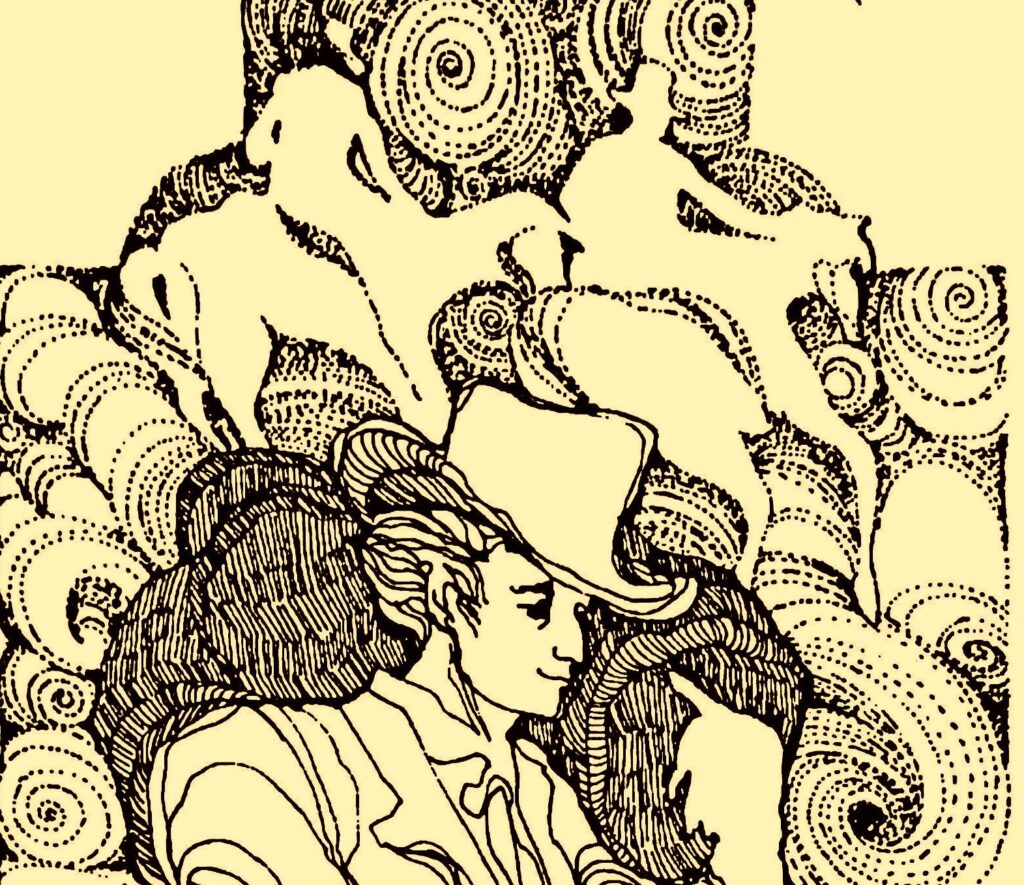
According to some of what I read and hear these days, I definitely should not have written this story, about a young slave girl and the Quaker saint John Woolman.
 Why not? Mostly because of what I wasn’t: I
  wasn’t a girl (& never had been); wasn’t a slave (or even an enslaver, for that matter); wasn’t Black, and (late entry) had no plans to have the tale vetted by an ethnic/cultural sensitivity reader.
But also because of what I was: white, male, urban, not young, more or less middle class
I still am that last batch, except considerably more not young.
Also, I am not some other things that could today be tagged as “problematic”: the story is set on a subsistence farm, and I’ve never been a farmer. It was set in Virginia, where I’d never lived (I got there later, but the damage was done); the action takes place 220 years earlier, and my familiarity with the relevant history was barely at the smattered level. And John Woolman had been both a storekeeper and a tailor, of both of which trades I was ignorant.
Add up this scorecard, and some would say today I’m not eligible to write a story about this, with three of five main characters of color.
Nevertheless, I did write it, and have published it elsewhere, and now it’s going online, at the link below.
What’s my excuse? There are three, all I think legitimate Here are the two that mean the most: first, wonder; second (& equal), imagination. (I’ll get to the third shortly).
Wonder: I had read John Woolman’s famous Journal (it’s online here, free, and if thee claims to be a Quaker, or even Quaker curious, Friend, thee should read it too. Here’s a historian’s sketch of Woolman.). Like so many, I admired the book, and the author’s witness of pleading with slaveowners to unchain their captives.
But I also wondered: we Quakers celebrate the reports of Woolman succeeding in touching an enslaver’s heart. But . . . in baseball, even the top sluggers strike out more than they hit homers. Woolman pursued his quiet crusade until his death in 1772, and his yearly meeting didn’t ban slaveholding til some years after. So in his day, Woolman’s enslaver Friends very likely said No to his appeals much more than they said Yes.
And what about the enslaved? I don’t recall their reactions being recorded.
Here’s where imagination comes in, and melds with wondering: What if Woolman’s leading was called into question, not by a broadbrimmed clearness committee, but by one or more of those still left behind when his speaking truth to power failed to loose their fetters, as it often must have? The idea for the story soon took shape.
This line of thought was turned into the attached fictional narrative in 1977, more than forty years ago. And while they didn’t feel that way then, those were simpler times.
Now, in many editorial offices, the evaluation process includes mysterious but searching reviews for whether such a story might inflict some kind of “harm” on many actual or hypothetical readers, past, present or future, or exclude other authors, deemed marginalized or under-represented. If such putative harms are detected or simply proclaimed, public apologies may be demanded, the more self-abasing and groveling the better.
I acknowledge being a survivor of a different era, in which forthright review and critiques more often resembled a dialogue or debate. The comment section of this blog is open as a still-living specimen of this tradition. This story has circulated for four-plus decades, and to my knowledge, no other story of similar bent has appeared; no other writer has thereby been marginalized.
With that lack of report comes my final rationale for doing it, leading: the story felt “right.” when written, and still does. Besides, plenty of fiction (good and bad) stirs the waters, and challenges conventional notions. Fortunately, as a retiree, I have no job to lose, and no tenure to be revoked. If shown actual errors, I’m prepared to address them, if plainly stated. Otherwise, read, comment as moved, and, I hope readers find some stimulus to their own imagination, wonder, and leadings.
Click the link below to open the story in PDF
John Woolman and the Slave Girl (PDF)

And a special thanks to Diane Faison, who carries The Spirit of Harriet Tubman, for particular encouragement.
A lovely story, Chuck. (Friends/(Quakerism)/Theology! Nicely done. Mickey E.
Thanks, very much, Mickey!
I’d say that you should ‘fess up to the “imagination” aspect, label this “historical fiction” and publish widely with a clear conscience. The life and times of John Woolman (and Chalkley Gillingham and … ) need to be more widely understood, and not just by Quakers. As always, any author’s writing needs to be profread by another before publication, even/especially mine ;^)
Thanks, Walter!
Spoiler alert: Read Chuck’s story first, before reading this comment.
So, Chuck, you’re not claiming Woolman as an early Underground Railroad activist? I’d think you’d be right about that. Teaches us that “continuing revelation” had a ways to go. Always has a way to go, if we are being introspective and still seeking God’s leading and honest about what we find.
Yes, Chalkley Gillingham — I have read some of his Journal. You’re quite right, we should know more of him, and other neglected Friends.
Steve, you’re correct I am definitely claiming Woolman as NOT a UGRR pioneer. He died in 1772, and that was fifty years before Abolitionism and the UGRR became real organized things. Woolman was a manumissionist: appealing to enslavers one at a time, or in carefully-vetted print. The Manumission phase lasted several decades on its own. I don’t say this to criticize or discount his witness; Woolman was outstandingly faithful to his leading and stuck to it til his end. In Woolman’s time the UGRR idea had not yet appeared or had a chance to work on Friends’ minds & hearts. Of course, the UGRR was very controversial among Friends even through its heyday of the 1850s; it was a movement of an often marginalized “fringe” of Friends, many of whom were shunned and disowned for their “radicalism.” The UGRR only became “popular” among more whites AFTER the Civil War and slavery as an institution was gone — then many Friends “discovered” they had really been supporters all along. But many of the stories of UGRR adventures involving whites have, I suspect, been much-embroidered after the fact in self-serving ways.