
 Particularly when it comes to politics, I seem to be a perennial pessimist, even a catastrophist, expecting every election to yield defeat and disaster. The last time this blanket prediction went wrong was in 2012, a decade which feels like an eon ago. (The 2020 election initially seemed better; but that November was followed by the cavalcade of horrors which continues today.)
Peering into the Tuesday fog, I continue to urge all and sundry to do their civic duty to campaign and vote. But most of the Wise Persons tell us that many key races may not be decided for days, or weeks, or without civil unrest. So meantime I am definitely working to prepare myself for the worst.
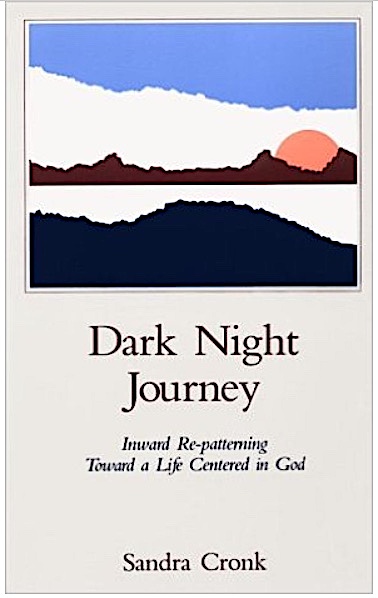
Besides sliding my ballot into the slot on the first day of early voting, this outlook now has me reaching for a book I keep close at hand, Dark Night Journey, by the late Sandra Cronk.
Sandra Cronk (1942-2000) was a Quaker author, spiritual nurturer, teacher, and historian of religions. She taught Quaker faith and thought, spiritual life studies, and religious community at Pendle Hill. She was also a founder of the School of the Spirit, a ministry of contemplative prayer and religious study. She didn’t say much about politics, but her work has implications for it nonetheless.
Her book came out in 1991. I keep not one but two copies of it on the shelf. One is to send out, often anonymously, with a note to someone who is having hard times, saying it has helped me in parallel situations. Then I order a replacement.
The other copy stays home, because it’s for me. (I know which is which, because mine is heavily marked up.)
For this third aftermath reflection, I have adapted some passages from its opening chapters, which talks about the experience named in the title, which I suspect many of us face very soon.
Cronk does not have quick or surefire remedies, or an escape from theDark Night experience. (Escape, she contends elsewhere, is usually no escape.) It’s more about beginning to learn endurance and finding God or Spirit in the process.
But here I should let her speak for herself. As with all such counsel, take from it what speaks to you.

Adapted from Dark Night Journey
We soon discover that there is no way to build our image of the loving, faithful community out of our own strength. We are brought humbly to a sense of emptiness, darkness, absence, and loss.
Paradoxically, it is often then that we turn, in our weakness and repeated failure, to God. In this unexpected via negativa we encounter God beyond all our utopian thoughts, ideologies, or culturally limited expressions of appropriate church life. Only then does it become possible for us to accept God’s gift of life in community.
Inasmuch as all of these spiritual disciplines. . . help tum us to God, their pathways may intertwine. Disciplines which had at first seemed very disparate are in fact closely related. In this last example of choosing and living through a spiritual discipline, we come closer to that which comprises the dark night path rather than the gentle way. We see that our act of voluntarily choosing a discipline may bring us to the experience of the dark night which is traditionally perceived as given or even imposed.
The Dark Night Journey-
On this pathway we do not slip easily into that open and receptive place beyond words. By definition, this path is not initially a voluntary or chosen one, although we may come to say yes to God in the midst of this rugged and painful way. At the beginning there is no intentional spiritual discipline. There is no gentle gift of contemplative awareness; instead we feel stripped until there is only absence and emptiness left.
This is the pathway of crumbling pillars, those finite supports on which we have based our life and our relationship with God. We are used to experiencing God in and through the created world. We find the meaning of God’s love expressed in the love of a spouse, family and friends. We have established ways of understanding the direction and purpose of our lives: 1n our jobs, church work, care for others, etc. Our world has a certain structure and order.
We glimpse the divine through God’s gifts of admonition, consolation, and direction in this order. All of this is good. God does work in these ways.
But what happens when the pillars of our lives begin to crumble?
We face the death of a dear one; marriage ends in divorce; the economy slows down and our job disappears; the doctor announces we have a debilitating illness; a clear look at the international situation reveals that nuclear holocaust is not only a remote possibility but a growing probability; our beloved church community forsakes the ways we have always seen as signs of faithfulness, believing itself to be more relevant to the modern world; advanced age brings extreme frailty and loss of ability to take care of ourselves, or we discover that our membership in a dispossessed minority group will probably entail poverty and frustration throughout our entire lives.
Suddenly our nicely ordered world can fall apart into meaninglessness. Not just the emotional shock of a particular tragedy strikes us. Along with the shock we discover that those pillars which we used to feel were so strong as manifestations of God’s love and purpose are taken away. We discover that our very way of perceiving God has disappeared as well.
All we experience now is darkness, emptiness, and meaninglessness. There is no place to turn for help. All the finite things we used to cling to are now revealed to be incapable of bearing the weight of the infinite. If we do not have these pillars, how do we know God? How does life have meaning? We are left in confusion.
Not only traumatic events may cause this radical upheaval in us. Sometimes it comes unawares, with no great outer changes. The old ways of prayer no longer seem to bring us closer to God. Meditations and devotional readings bring no sense of God’s presence. Participation in the church, family, or job no longer conveys God’s purpose in our lives. The sense of absence and emptiness is as great with these inner changes as in any situation of outward loss.
The language of darkness and emptiness may be very close to the experience of dark night journeyers in a variety of circumstances. This language is not just a conceptual system about the nature and limitation of human language. Consequently, many people find it helpful both in providing them with a way to express their experience and to understand how God may be at work in their lives when all the heretofore customary signs of that work are missing. It helps them to begin to see beyond what may have been the old avenues for knowing God.
Dark Night: Part of All Spiritual Pathways
For some people the dark night is a temporary, sometimes recurring, part of a broader spiritual pilgrimage which receives nurture largely through the “positive” symbols of the gentler mode. For these people their first encounter with the path of emptiness may be in the dark night. Taken in the context of a person’s whole life, the dark night may be seen as a counterpo1nt to another primary melody. Indeed, even in the midst of the dark night itself there are usually periods of light and the gift of the experience of God’s presence. Such times of respite are great aids to those who must continue on this path . . . .
The phrase dark night journey is not intended to describe the situation of those who have not yet become aware of God’s call in their lives or those who are unsure whether there is a God and are just beginning to search for an answer. . . .
The dark night describes the situation of those who have had a growing sense of relationship with God and are suddenly bereft of God’s presence, direction, and consolation. This unexpected change can be devastating.
Our reaction is usually to flee from the emptiness to find some sense of meaning again. We search for something to fill the void. We try harder to engage in all the old pursuits and types of prayer. We attempt new techniques of prayer or search for new activities to give life meaning. We assume that we can manipulate ourselves, the world, and even God to bring meaning into our lives again. We believe we can force the answers to our questions if we try hard enough.
Unlike other occasions in our life, when more initiative on our part did yield new openings, this darkness does not give way before our pressure. It only becomes more intense. The old forms of prayer do not “work.” Instead of God’s presence, we experience only absence.
All that we may have lost remains lost: a loved one, health, a job. In their place seems to be nothing. All that we had known before is now taken away. This is a time of great stripping. All those places we had looked to for our security and meaning are gone. All that had given us a sense of personal achievement has disappeared. There is only an empty space inside and outside us. . . .
The AFTERMATH Series
Aftermath —Part 1
Aftermath — Part 2 A Constant Struggle; What Mrs. Boynton Saw
Aftermath Part 3 — Crumbling Pillars? Or the Dawn of A Long Dark Night?