

 It was in the second session of our anti-racism class, if I remember right, that the teacher drew a diagram on the big flip chart. I’m going to call it TUD, for The Unforgettable Diagram. I’ve forgotten a lot about the class, but not that. Definitely not that.
The class met in the library at Pendle Hill, the Quaker study/retreat center near Philadelphia. The teacher came all the way from Chapel Hill, North Carolina’s iconic college town.
She was said to be a notable figure in the anti-racism field, and was certainly good in the classroom: kept things moving, encouraged us to speak up, didn’t mind questions, could laugh, and still seemed to keep us on track.
The TUD was important for this last. It was meant to identify and differentiate the distinct arenas in which racism was rooted and manifest, and from which it needed to be eradicated.
 Of these, she said, uncapping a marker, there were three, which could be summarized in a simple sketch.
First she drew a stick figure, in the center. This androgynous/nonbinary image represented the personal: what each of us said and did, and how we said and did it. That seemed clear enough.
Then she drew a triangle around the stick figure. It stood for institutions 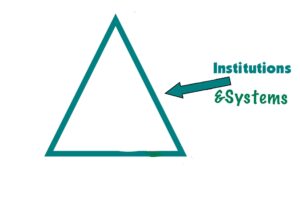 or systems, of which there were many and with which we were all connected directly or indirectly: education, churches, law, health, business, etc. Racism showed up in all these too, in many forms. We were caught up in its far-flung web, in various ways and different degrees. I recognized that as well.
Finally, she drew a large circle around the other two images: this circle, she told us, encompassed and shaped both the personal and systemic: it was, in a word, culture.
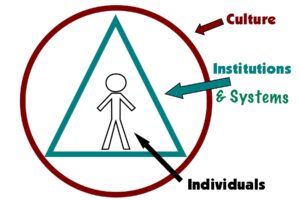
When she said the word “Culture,” I wanted to jump from my chair, raise a fist and shout “YES!”
Til then, I had been somewhat skeptical about the class. After all, I had been in the civil rights movement, published books about it, worked with multiracial groups, yada yada. As an old white male, I didn’t dare say I had overcome the effects of racism; but hey, at least I wasn’t a beginner.
At the same time, maybe the most important thing I had learned, starting almost fifty years earlier, was an inkling of how much I didn’t know. Since then, I had learned a lot: read a lot, interacted a lot, traveled and so on; and on the way I kept re-learning that there was so much I still didn’t grasp, or even see.
But I had seen segregation driven from lunch counters; I had watched black students enter formerly all-white schools; I had done my bit in the long struggle to open the ballot box to millions who had been excluded. I’d seen the first Black president elected and re-elected; in fact, that fall he and his lovely family were still in the White House, safe and sound.
Those were the days, my friends.
And yet — and yet. . . .
Much had changed in this half century. But too much had not. Fifty years after I worked in the Alabama Black Belt, the Black poverty rate there was essentially the same. Police killings of unarmed Black people still almost always went unaddressed.
And most ominous, a long-gathering campaign to roll back the advances had claimed the Supreme Court as its bastion. It enabled new racist demagogues, not even from southern but northern roots, who were reviving the old bigotry in new and increasingly successful garb, and broadcasting it from speakers and screens everywhere.
Although I retired in 2012, I wasn’t watching this retrenchment from the sidelines. Fate had delivered me to North Carolina eleven years earlier. On the great American Map of Cool, NC is stamped as flyover Country. But in our expanding cultural/political conflicts, it was smack in the middle of most of them, and remains a ringside seat.
During the decade-plus since, I had witnessed the rising of this revanchist tide, until in 2010 it overran the state government. Since then, til this writing in 2023, the drive has taken down the pillars of the last century’s progress, one upon another.
 They have collapsed like the sturdy-seeming beach houses along the Outer Banks, falling not in one great hurricane sweep, but piecemeal, dismantled by the muted daily battering from a relentlessly rising Atlantic.
Through it all, I kept wondering: what help is there for us whose finest life work is being demolished right before our eyes?
Where can we turn to begin to understand how and why this keeps happening, and find ways (to at least begin) to change it?
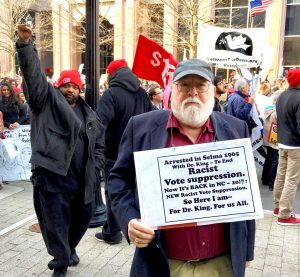
Conventional politics and mass protest has only briefly blunted the rollbacks. I went out and got arrested with the Moral Monday activists in summer 2013; but the voter suppression tide rolled on. After six biennial state elections, it continues unabated, and even seems to be gaining momentum.
Numerous other states, not all in the South, are on the same rollback-minority rule trajectory. Despite Obama’s years of success, the resulting gloom was already pretty thick in 2013, as I sat in the Pendle Hill library, watching a flip chart epiphany take form.
The teacher finished the circle, and wrote the name:
“Culture.”
I wasn’t sure what that was, entirely, but I clicked with the image as it took form. If I had learned anything from the years in Carolina, it was that Carolina culture was far more than barbecue and NASCAR.
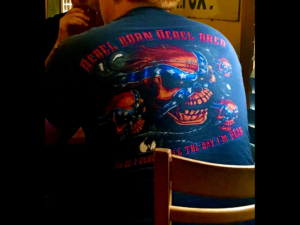
You can’t buy it in a bottle, but you can’t escape it either. It was the surrounding, supporting medium for racism. It was the “soil” from which racism grew, generation after generation. The culture of racism reproduces and sustains the attitudes and habits that produce winning margins for racists election after election, in one party or the other, as political winds shifted.
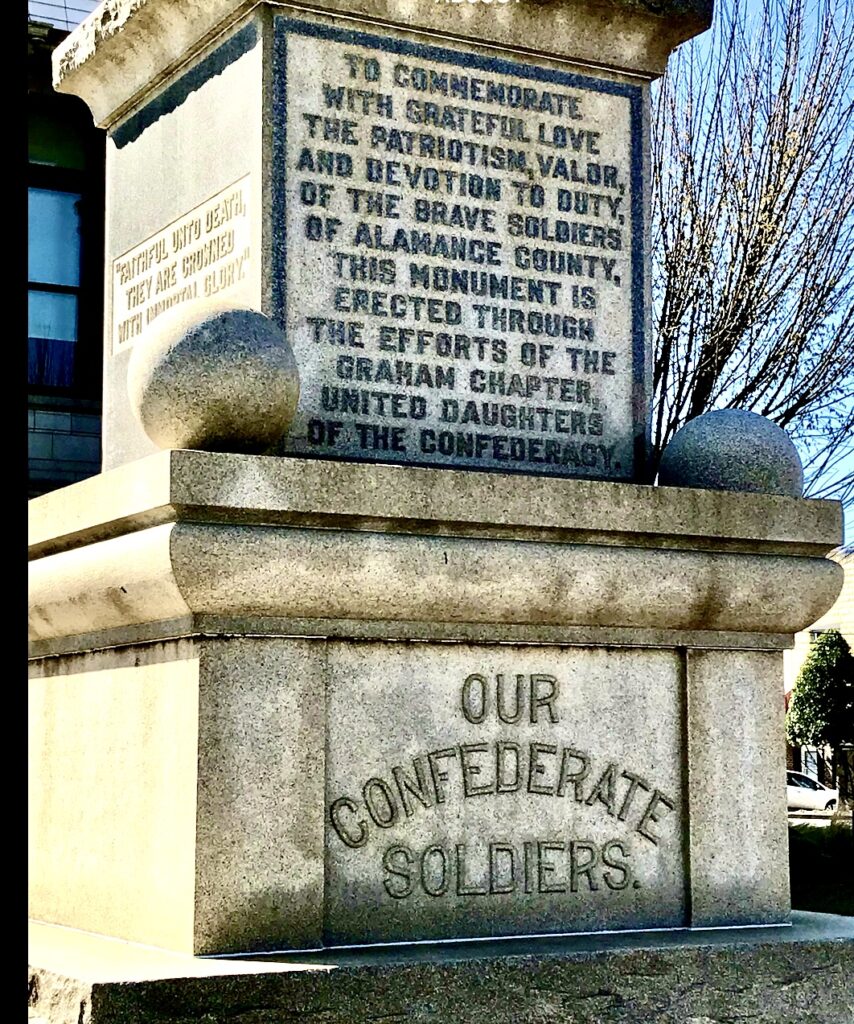
Culture reinforces the perennial undercurrents of fear that keep guns and assault rifles flying off store shelves. It feeds the abiding sexual panic that has moved seamlessly from “protecting white women,” to “saving” them and children from lesbians and gays, to the latest iterations targeting trans people, drag queens and “groomers.” And it blesses them all weekly, “in Jesus’ name.” It was the well-greased hub around which all the rest of it keeps turning.
There’s more, but you get the idea. On the long list of things I didn’t know, or understand, events had repeatedly underlined the key importance of something beyond or behind the daily noise of politics, preaching and protest. I had increasingly sensed it, but hadn’t been able to name it.
But now, at least I knew what to call it. Maybe when we get to Culture in class, I thought, we’ll begin to learn how to identify it, what maintains it, and what can start to change it.
The sense of dawning optimism was bolstered by what I believed was a real-life example: the acceptance of same sex marriage (SSM) by the majority of Americans. I remember writing in support of SSM back in 1985, then again in 1988 — and at that point it was still being hotly debated even among my tribe, the “Liberal” American Quaker meetings. As late as 2004, when Republicans supported 11 proposed state bans on SSM as part of the push to re-elect George W. Bush president — they won all 11, and kept Bush in the White House.
Yet by June 2015, after several states had legalized it, the Supreme Court made SSM legal nationwide — and the popular opposition to it had shriveled into practical irrelevance.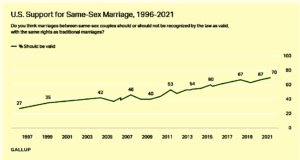
Some reactionaries hope the current Supreme Court might reverse that approval. But if it does, there will be little public support for it, and likely much resistance. That’s because in this case, American culture has changed.
To be sure, SSM and racism are different in many ways, and there’s no time here for an in-depth comparison. But even by the fall of 2013, SSM’s acceptance by several states had raised hopes — and a lawsuit would add North Carolina to the list in 2014. Besides, among Liberal Quakers, the debate was by then pretty much settled.
So cultural change could happen. But frankly, SSM seemed to me like a relatively small mountain to climb compared to the Denali slopes of racism, the highest U. S. peak of all.
Yet now, there it was on the flip chart. As the class finished, I was eager for the next one, sure we would get to that outer circle, and I could begin finally to find out more of what I didn’t know, get equipped to do my bit again, to help reshape it. To help bring down the culture of persistent racism.
—SPOILER ALERT—
We never got to it.
Week after week, I left the library thinking, “Next time for sure, right? We can’t pass this by, right?”
Wrong. The teacher never brought it up. The closest we came was a brief round on “systems,” the items inside the TUD triangle.
We agreed there was plenty of racism to tackle there. But we quickly ran aground on the facts of how hard it was to change them.
For instance, I know a Quaker attorney who has spent much of his career fighting to help indigent Black prisoners who were railroaded onto Carolina’s death row.
I admire his work and dedication: he’s saved some lives, and righted some wrongs. I noted, however, that before taking on the legal system, he had to invest close to ten years in education: pre-law in college; 3 years in law school, and then two or more years clerking and learning on the job.
Or take a doctor who wants to serve poor patients: another ten years prep.
Or public education, at any level: first, college; grad school; and then grappling with political machinations that are driving out the best in droves. Even to become an involved school parent, it can be almost a fulltime side job to learn the ins and outs of grappling with administrators and boards and pressure groups (not to mention the latest innovations, such as, you know, frequent death threats).
Did I forget to mention police accountability? Or controlling gun violence? Persistent poverty?
Systems are usually strongest when it comes to protecting their status quo; systems are complex, technical; many have been in place for generations.
In the class, we quickly veered away, back into personal anecdotes. Which, in fact, was our usual bent. Many of us were new to serious consideration of racism, including our own gnawing sense of complicity; there were anguished confessions.
I wasn’t interested in guilt-tripping anyone, though; we’ve all screwed up. I wanted to get beyond navel-gazing to the big circle.
Hope glimmered even into the opening of the final session. But no, it was a wrapup, again mostly devoted to personal anecdotes and reflections.
At the end of the term, all I came away with was TUD, and the suspicion that the teacher didn’t know much about changing culture.
This doubt was reinforced a few years later, when I saw a widely-circulated brief by her about identifying “white supremacy culture”. I began reading it eagerly, but soon slowed down: the “cultures” it talked about were those of “liberal” non-profits; churches; colleges; and companies looking for inoculation against discrimination lawsuits — that is, present and potential clients able to pay the hefty fees of DEI consultants. Essentially a sales pitch. Those most closely identified with the culture of racism weren’t buying.
 In the meantime, while many DEI consultants were criss-crossing the state making bank, five elections have came and went in North Carolina, and the culture of racism has won almost every race, every time. At this writing, it seems poised to cement the pillars of a racist minority rule regime that could last as long as some of the 200-plus Confederate statues and memorials which still loom across its 100 counties.
Yet in these ten years, the TUD has stuck with me. I think I’ve gotten some clues about the pillars of Carolina Racist Culture, or CRC: a certain kind of religion, or theology, is a key component—and you don’t even have to go to church to absorb it. In tallying them up, I frequently recall, like a mantra, two classic adages from Sun Tzu’s The Art of War:
“If you know the enemy and know yourself, you need not fear the result of a hundred battles. If you know yourself but not the enemy, for every victory gained you will also suffer a defeat. If you know neither the enemy nor yourself, you will succumb in every battle.”
Here we’re focused on knowing the enemy, which, remember, is as much a set of systems as individual persons: among them I include, besides racist religion, the continuing dregs of the “Lost Cause” mythology and pedagogy; an economy (and its legal/political infrastructure) all rigged to benefit the wealthy; an authoritarian secession-inclined state regime, welding the latest digital technologies to the service of reviving  southern forms of hierarchical serfdom, which, some shocked whites here are discovering, is a multiracial project; the worship of long guns (and the nihilist violence they embody), especially the AR-15 . . . .
There’s more, but that’s a start. None of these are new, of course, but novelty is not the goal here; it’s roots. Jesus said: “Judge a tree by the fruits” (Matthew 7:16); yes, and dig up [the evil ones] by the roots. I’m looking for where the roots of this evil tree are spreading, and what feeds them.

Further, among the roots, where are the soft places, the openings? (Sun Tzu’s other relevant adage is: “So in war, the way to success is to avoid what is strong, and strike at what is weak.”)
Where are that culture’s weak points? I suspect, for one, that the racist culture-supporting churches are leaking boats. For another, the galloping inequality spawned by the rigged economy has grim side effects, in middle class decline, youthful demoralization, and the resulting pathologies and deaths (including suicides/massacres) of despair, from which ever fewer neighborhoods are spared.
How do we deal with these in ways that move toward overcoming racism? I don’t know yet, and doubt I’ll be around when full-fledged strategies come about: that takes time.
But getting the targets right is progress; and there’s a clue in the admission that cultural change takes patience and determination.
After all, the shift to acceptance of same sex marriage was comparatively quick — and it took about thirty years. After the historic 1965 Selma to Montgomery march, the Voting Rights Act passed the same year, as if in the blink of an eye.
But that’s an illusion, mainly afflicting us oblivious whites: Selma was the culmination of a Black struggle that began sixty five long years earlier (with decades of bloody prelude); that’s three-plus generations. And now we know, to our pain, that the civil rights years were mainly an interlude.
I expect culture-oriented work will also involve changing tactics: for instance, let’s imagine a class that flipped the 2013 script: takes TUD and starts from the outside (Culture) in. One last word from Sun Tzu: Ponder and deliberate before you make a move.

Yeah: what if we forgave the participants their personal sins, and de-emphasized the navel-gazing, carefully reviewed the example of the SSM campaigns, learned about both the culture of racism and its key systems, assessed our own strengths and weaknesses, laid careful, multigenerational plans — then took aim, and began to make our moves?
What a concept; radical.
The biggest cultural cancer that have dragged the United States backward has been FOX “News”–which is not news but propaganda masterminded by an Australian billionaire with retrograde views, happy to stoke racism, sexism, fear, hatred and know-nothingism. Much of America drinks it in like a toxic drug. The lies and the distortions are mixed in and absorbed in the daily dose of TV. The failure of our culture to support educators, to pay teachers an appropriate salary and promote the teaching of critical thinking is also at fault.
I, like you, shall never forget TUD. Thanks to you and that Pendle Hill teacher for planting it firmly in what I see as an ever spreading network of individuals. Of course I hoped as I read that you were going to make the changing of culture come clear and we could get to work! But really no surprise that your teacher never moved much beyond the individual stories of your classmates. I guess culture can only change as individuals change. Individuals tend to change, if they do, only as they gain understanding and personalize what they learn. Institutions are people. Schools and churches and governments have leaders and followers and workers. What happens depends on the individuals in those roles and how they spread their influence. It’s plenty complicated! All of that seems the only way culture changes. We can only “make” it change by the ways we can influence institutions, from within them or outside them.
That’s all I’ve got so far, but you’ve struck a chord with me. TUD will stick and maybe culture will move along as we would hope.
Thanks for what you do.
Thanks, Chuck. You’ve nailed it.
In looking at the infrastructure of culture, you correctly identify religion (whether practiced or not) as one of the many components.
Imagine if you can, a Quaker Meeting which had forms (more than one) of worship that met “where they are” folks from one’s own community. Heretical, I know. I have heard “they can go elsewhere” from members of my own meeting and my yearly meeting. I have also heard “how?” — I (and others) are working on it.
If one wants to lead a horse to water, one first has to connect with the horse in some fashion. If one wants to bend a culture toward the arc of justice, the same applies.
Yours is a remarkable chronicle, not only of your own life’s journey, but of major historical events that still affect all of our lives. Thank you Chuck.
Were you or anyone else in the class able to ask the presenter your burning questions? Did she hear the urgency in your voices?
Many years ago I wrote to a Friend (a letter, by hand) who had written a Viewpoint in FJ. In a few months he replied (also in a hand-written card which I saved). The gist of his response: “clearly we are called to do God’s work here on earth. The mistake most of us make is in thinking we are the very ones who will see it finished”.
We wrestle not against flesh and blood, but against principalities and powers.
The quest to root out individual racist beliefs and attitudes is a mug’s game. Individuals come and go, but the circle goes on forever unless we see it for what it is and work to break it up.
Which is the work, not only of a lifetime but almost certainly of more than any of our individual lifetimes. As Rabbi Tarfon is recorded to have said, “It is not our responsibility to finish the work of perfecting the world, but neither are we free to desist from it.”
Don’t forget Family. As the song in South Pacific goes “You must hate those your relatives hate.”
Excellent point, Marc.