
Graffiti artist appears to confirm presence in war-torn country after unveiling latest work on Instagram
From The Guardian, November 12, 2022
 Banksy appears to have confirmed he is in Ukraine after revealing his latest artwork on Instagram.
Speculation had been mounting that the anonymous graffiti artist was in the war-torn country after a series of murals appeared in the town of Borodianka, near Kyiv.
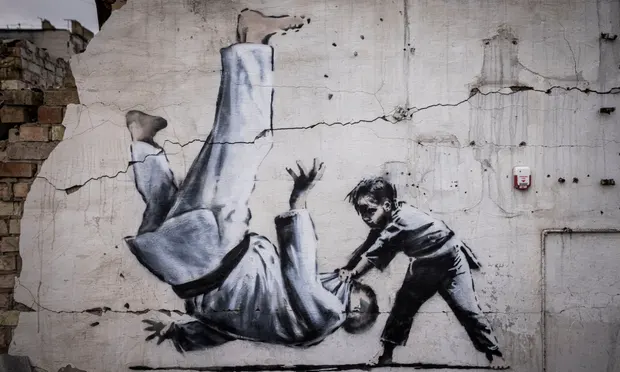
One mural depicted a man resembling the Russian president, Vladimir Putin, being thrown to the floor during a judo match with a young boy.
Another showed two children using a metal tank trap as a seesaw.
However, the mural that Banksy used to reveal his presence in the country is of a female gymnast balancing on the rubble of a damaged building.
The Bristol-based artist, whose work sells for millions of pounds, posted three images of the mural on Instagram on Friday, with the caption simply reading: “Borodyanka, Ukraine”.
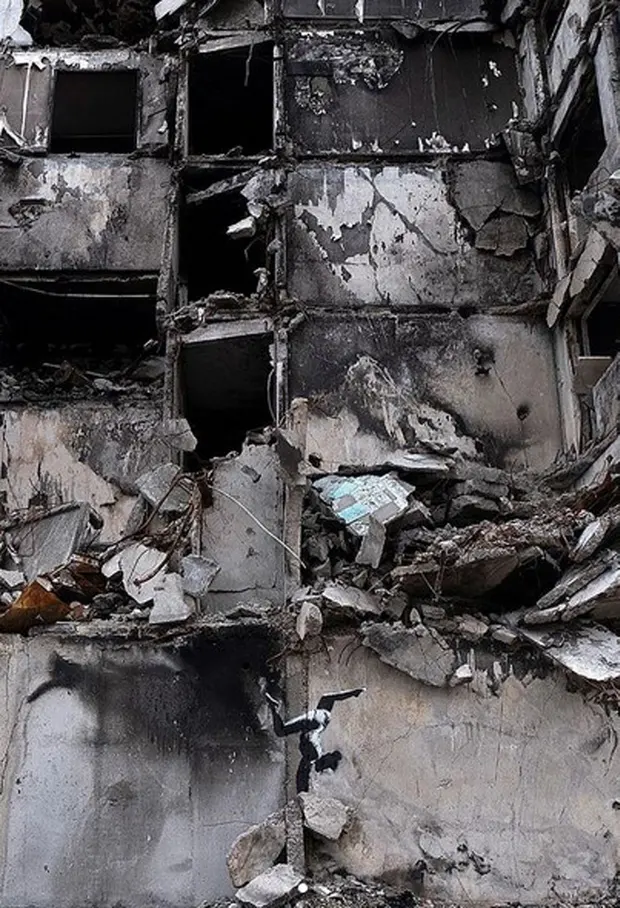
Borodianka, a town north-west of Kyiv, was pummelled by Russian bombs at the beginning of the invasion.
Russian troops, rolling in from the Belarusian border 200 miles to the north, occupied the town in February. Together with Bucha, Irpin and Hostomel, Borodianka was one of the towns hardest hit by Russia’s bombardments. It was liberated in April.
Ukrainian investigators found dozens of mass graves where the bodies of civilians – tortured and killed – had been buried. Moscow had unleashed cluster munitions and powerful unguided bombs in the populated areas of Borodianka, destroying dozens of buildings, with some being gutted and split into two.
 Since then, the town has been the focus of reconstruction efforts, with several tower blocks demolished as a result of damage caused by the fighting.
Where will it all end? The conflict in Ukraine appears further than ever from resolution. Nuclear threats, mass graves, the sense that both sides are “all in”.
It’s our job at the Guardian to decipher a rapidly changing landscape, and report the facts in sober fashion, without getting carried away. Our correspondents are on the ground in Ukraine and Russia and throughout the globe delivering round-the-clock reporting and analysis during this fluid situation.
We know there is no substitute for being there – and we’ll stay on the ground, as we did during the 1917 Russian Revolution, the Ukrainian famine of the 1930s, the collapse of the Soviet Union in 1991 and the first Russo-Ukrainian conflict in 2014. We have an illustrious, 200-year history of reporting throughout Europe in times of upheaval, peace and everything in between. We won’t let up now.
Tens of millions have placed their trust in the Guardian’s fearless journalism since we started publishing 200 years ago, turning to us in moments of crisis, uncertainty, solidarity and hope. We’d like to invite you to join more than 1.5 million supporters from 180 countries who now power us financially – keeping us open to all, and fiercely independent.
Unlike many others, the Guardian has no shareholders and no billionaire owner. Just the determination and passion to deliver high-impact global reporting, always free from commercial or political influence. Reporting like this is vital to establish the facts: who is lying and who is telling the truth.
And we provide all this for free, for everyone to read. We do this because we believe in information equality. Greater numbers of people can keep track of the events shaping our world, understand their impact on people and communities, and become inspired to take meaningful action. Millions can benefit from open access to quality, truthful news, regardless of their ability to pay for it.
Whether you give a little or a lot, your funding will power our reporting for the years to come. Support the Guardian from as little as $1 – it only takes a minute. If you can, please consider supporting us with a regular amount each month. Thank you.