It was the headline that caught me: “Shocking and Ominous Talk,” it blared. Really? Such language was rare in the Selma Times Journal (STJ), but I found it there, on the editorial page of the New Year’s Day edition, for January 1, 1965. The Alabama headline shone up at me from a cloudy gray background, … Continue reading Back to my Future: Vietnam, Afghanistan, Wherever, Forever . . .→
So: I went in for a thorough cardio checkup, a long overnight at Duke Med. As the capstone of the process they stuck me in this MRI machine for a long hour of lying stock still on my back, eyes closed and hands slowly going numb under the barrage of whanging and zapping aimed at … Continue reading For A Hearty Holiday: Our Democracy Is Approaching Cardiac Arrest→
Let’s see: Racism & U. S. History. 1776 or 1619? The New York Times, or Trump’s “Patriotic Education” commission? The truth is rising, or the sky is falling? Pick your side, get in line, join the Culture War’s latest rehearsal for Armageddon. Really? As some once-legendary movie mogul once said of another sketchy deal, “Include … Continue reading U. S. Black History: 1619, 1776, or What? How About 1962?→
Friend (or rather, ex-Friend) Joshua Ashlyn Humphries, a banished Quaker and Anabaptist prophet/theologian, is dead, at 39. Dead, and it’s a damn shame. A shame for Quakers, Mennonites, and some others. I feel shamed too. But he was not an ex-Friend to me. The official obituary does not say how or where he passed; presumably … Continue reading A Banished Quaker Prophet: Josh Humphries (Updated)→
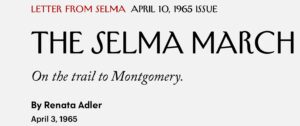
Apropos of Dr. King’s birthday, and looking toward Black History Month, an email came In Monday telling me the New Yorker magazine had posted on its website an article from the April 10, 1965 issue called, “Letter from Selma,” about the voting rights march from Selma to Montgomery, Alabama.
And I was mentioned in it.
Sure enough; it’s the only time I have appeared in the magazine.
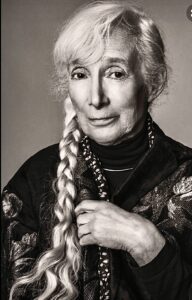
I barely remember what was in that “Letter,” though I can still see the writer, Renata Adler, appearing by the edge of U.S. Highway 80.
Renata Adler
I do recall how strikingly out of place she seemed, on its rough and rocky shoulder, crowded with disheveled marchers, and lined with armed troops eyeing the nearby scrub forests for snipers.
Adler looked as if she had been plucked from a stroll on Fifth Avenue and teleported to Alabama, in a colorful and almost slinky sheath dress, with a broad voguish hat bending under the stray breezes, notebook in hand.
We talked for just a few minutes. It’s a good article. Only time my name ever appeared in the New Yorker, as far as I know.
I think you can read it for free.
And there’s more: on Jan. 18 I was asked to speak to the good people of Life’s Journey UCC Church in Burlington NC, and tell them the title story from my memoir, “Eating Dr. King’s Dinner.”
Telling a story that’s 56 years old — and as up to the minute as the latest headlines.
Of course, I didn’t get to go to Burl-Ing ton, which is about 40 miles west of Durham. Instead, I ZOOMed in from home in Durham; that’s This American (Pandemic) Life, 2021.
and explain how for a long time after that year in Selma, it had a happy ending. But then, in 2013, that ending was erased, and the story of fighting for voting resumed.
Only this time, the wear and tear of age had me on the sidelines, but still connected, reminding the young that this continuing story is now theirs too, and it was their turn, not yet to tell it but to write the decisive next chapters with their lives.