
Cloudy Skies for Friends General Conference — Part II
[Part I of this post is here.] The Central Committee of Friends General Conference is gathering today, near Baltimore, for its annual meeting. To judge from the scene at its annual Gathering in St. Joseph Minnesota this summer, the skies over this autumn meeting ought to be cloudy.
In Minnesota, to the surprise of many, racial tensions, both external and internal, took up much attention. They were a surprise because the Gathering took place far away from the Deep South, the stereotypical locale for such. I expect they’ll be heavily discussed at the Central Committee sessions. Yet while it may be heretical to say so, I hope these don’t predominate, because FGC has other problems to worry about as well, some of which I suspect may be more serious. This too I learned more about at the Minnesota Gathering.
One other problem, which popped up in Minnesota with some energy behind it was a concern for FGC’s overall future. I ran into this inadvertently, following a reading session in one of the classrooms. Immediately after my reading, the seats refilled with a circle of those drawn, it turned out, by the next stated topic, “The Future of Friends.”
Usually, such discussions don’t interest me much. Worrying about whether Quakers and Quakerism are disappearing has been a recurring trope for at least 150 years. The complaints are tediously familiar; the nostrums offered have mostly turned out to be quackery, or variations on group self-immolation.

But this session held my attention, because the stated subject was quickly discarded by Friends who insisted on talking instead about the future of FGC. And several of them made plain that they thought there were big problems facing FGC — beyond those involving race which were already stirring the pot. Indeed, one older Friend, who has attended many Gatherings, declared that it was time to replace FGC altogether.
Some of the other complaints raised seemed predictably vague, alleging a lack of deep feeling and commitment, an excess of individualism among FGC Friends, and the recent laying down of some FGC programs, such as Quaker Quest, and cutbacks in the FGC bookstore.
This latter at least had some substance: FGC’s budget has been cut significantly since 2015, and programs and staff have been cut as well. The Clerk, Frank Barch, gets points for speaking with considerable candor about this in FGC’s 2015 Annual Report:
“. . . We learned that FGC needed to be more clear about our core mission and tighten the focus of our programs and services in order to fulfill that mission. We needed to lay down good work in order not to be reliant on periodic special fundraising campaigns. This was not easy to hear, nor to implement.”
 Even so, this statement needs some unpacking. Over the past two decades, FGC has conducted a series of multi-million dollar fundraising campaigns, and done so with much success.
In general, the way these campaigns come about is like this: a professional fundraising consultant quietly canvasses major donors (i.e., wealthy people or foundations) with some connection to the client group, and assesses their readiness to write big new checks for them. Then the consultant prepares a feasibility report, suggesting how much could be raised, and what themes or issues would be most effective in picking the Deep Pockets — err, I mean eliciting the potential major donor support.
I recall many years ago, as a member of the FGC Central Committee, watching the preliminary work on one of these campaigns take shape. It was aimed at bringing in several million dollars, and ultimately did so. Someone, in informal discussion, asked about it: “What will FGC do with all that money?” The general answer from the inner circles came down to a shrug: “Don’t worry; we’ll think of something.”
And they did. The Deep Pockets were generous, and FGC thought up new projects. And this happened again, repeatedly over the ensuing years.
But then in 2014, when FGC got ready to run yet another big fundraising effort, they found the Deep Pockets zipped up tight. The wind had changed. The feedback indicated the Deep Pockets felt FGC had been doing too much, with too little in the way of real direction and few lasting results to show for it.
This is a familiar pattern among nonprofits that have a plentiful supply of grant funding, and are devoted to “doing good” in a general way. And for sure, with a fat grant, it is not hard for intelligent people to think up many ways to spend it while apparently “doing good.” But like new business ventures, many new projects don’t work out: they run through their money, and when it is gone have little to show for it but a lot of paper, thick reports, and a well-padded staff payroll.
There are problems with this way of running an organization; we’ll get to a big one for FGC shortly. But it is not a pressing issue as long as the Deep Pockets stay open; one project can be “phased out” or “devolved,” and another can take its place.
But without warning, Deep Pockets can turn empty; lose interest; or get picky about results. The gravy train can sputter and even get derailed.
Then — whoops!—projects have to be “re-evaluated;” belts are tightened, and supervisors’ talk soon includes ominous euphemisms about “new opportunities” for staff as the payroll faces the knife.
Been there, done that; had it done to me. (For further reference? Cf. AFSC)
When those lean times come, an organization like FGC, if it’s wise, finds its attention turning from all those exciting things they could Think of to do with new funding, to a more sober consideration of what the group actually does that brings in steady money — that is, what the group does that can be, or become, self-supporting.
And that’s a question I’ve heard being asked about FGC recently; in fact, I’ve been asking it myself. Another way to put it is: what does FGC do that Friends — that is, rank-and-file, not-poor-but-not-Deep-Pocket Friends— are actually willing to pay for — pay enough that it carries its own weight? And then be willing to pay for it again and again?
There’s one obvious answer for FGC: the Gathering. Year after year, many of us non-Deep Pocket Friends scrape together the fees, and the cash for gas or train or airfares, and go. Plus, many Friends further subsidize the Gathering by doing some of the work involved there as volunteers. Sometimes it even makes a profit — err, excuse me, yields a surplus, as I’m told it did in 2015, to help prepare for next year.
FGC does some other things, but most of them lose money. Their Bookstore is a sad example. It has shrunk and shrunk, til now it has been “merged” with the (likewise shriveled) bookshop at Pendle Hill; and it’s still teetering. Why is that?
I have no complaints about the bookstore’s staff or management. But I think the answer comes down to one hard, six-letter word: Amazon. And I don’t know how to fix that; indeed, I doubt it can be fixed. Further, Amazon’s radical disruption applies to book publishing as well as selling.
So it appears that FGC is now expected to transition from a grant-fundraising-windfall-guided programmatic path, to one in which its services to Friends are underwritten primarily by a large number of loyal non-Deep Pocket Friends with enough regular cash to keep them afloat. In that case it makes sense that FGC may focus increasingly on the Gathering. That’s because, to borrow a phrase from the tacky realm of commerce, it has long been FGC’s “cash cow”; indeed, as far as I can see, it’s their only one.
But having said that, I must add that this cow is in trouble. It’s sickly, not quite emaciated but anemic, and losing weight.
I’ve attended almost all the Gatherings since 1979, so I have some data to work with here. And just two numbers will illustrate what I mean:
I was on hand in Rochester, New York for FGC’s Centennial Gathering in 2000. Indeed, I was on various committees for it. I recall that the attendance target there was set at 2000; not only because of the symmetry, but because in those days that was not an outlandish number. Indeed, I’ve seen figures from the fabled Golden Years of the Gathering –then still called a conference — at Cape May, New Jersey, when it topped 3000; but who was really counting?
 Well, we were, in truth. And in Rochester attendance came close, but did not quite make it to 2000.
The second number is from last summer in Minnesota: 900+. The year before I believe it was 1100. [Note: in 2019, the last pre-pandemic Gathering drew about 800.]
So the trend has not been continuous, but it has been chronic, and its direction is unmistakably down.
Why? What’s the problem? There has been hand-wringing, and some surveys, and FGC faithfully collects attenders’ evaluation feedback. But the trend is still down.
No doubt there are many factors: the Gathering fees have gone up (though it’s still on the thrifty end of summer conferences); the non-Deep Pockets middle class in which most FGC Friends live has, as we know, been squeezed steadily, and then there was the great crash. These are inescapable (pre-pandemic) facts.
Yet for me they don’t get to the heart of it. In my experience two other related factors have made more of a difference.
Yes, while I did not join in the complain-orama about FGC at the noisy discussion in Minnesota, I too have become disenchanted. The thrill is mostly gone. Now why is that?
Here’s my thinking: first, the experience of big grants and Deep Pockets-support has “gone to the heads” of those in charge. It’s easy to think, with all this financial success, that one’s ideas and outlook are, well, above average. Considerably. As they say around the stock exchanges, in a rising bull market, every investor thinks they’re a genius.
Then add in this: a very large segment, likely a majority of FGC’s constituency, is either in or pretty close to American university culture. Look at our meetings: outside Philadelphia, the bulk of them could be mistaken for barnacles growing on the sides of the barques of academe.
Further, college culture in the U.S. is remarkably uniform, and, despite pretensions of cosmopolitanism (after all, every day on their flagship radio news show they Consider All Things, at least all that matter), this culture is very provincial. And in too many ways the attitudes about the masses outside those invisible walls are benevolent, well-intentioned, yet, in truth, often patronizing or even paternalistic.
From this combination, I believe, was loosed a ghost, a zombie, or maybe a slow-acting vampire that has been sapping the lifeblood from FGC’s central service. I speak of the burgeoning FGC Nanny State.
Yes, over the years the Gathering has become less and less an experience of fellowship, and more and more like one of the post- Civil War schools I read about, founded by high-minded and dedicated Quaker schoolmarms in the Deep South, not just for education, but also for the “moral uplift and enlightenment” of those who had so recently been freed from bondage.
I admire and even revere some of these projects, and those who devoted much of their lives to them. Yet I’m not so sure I’d want to attend one. After all, at least I’m literate. Allegedly.
Nevertheless the Gathering has taken on, not only the work of facilitating fellowship and worship; but now includes, on practically every hand, an extensive experience of imposed improvement. Indeed, more than an Indian boarding school, it’s becoming like a week in rehab.
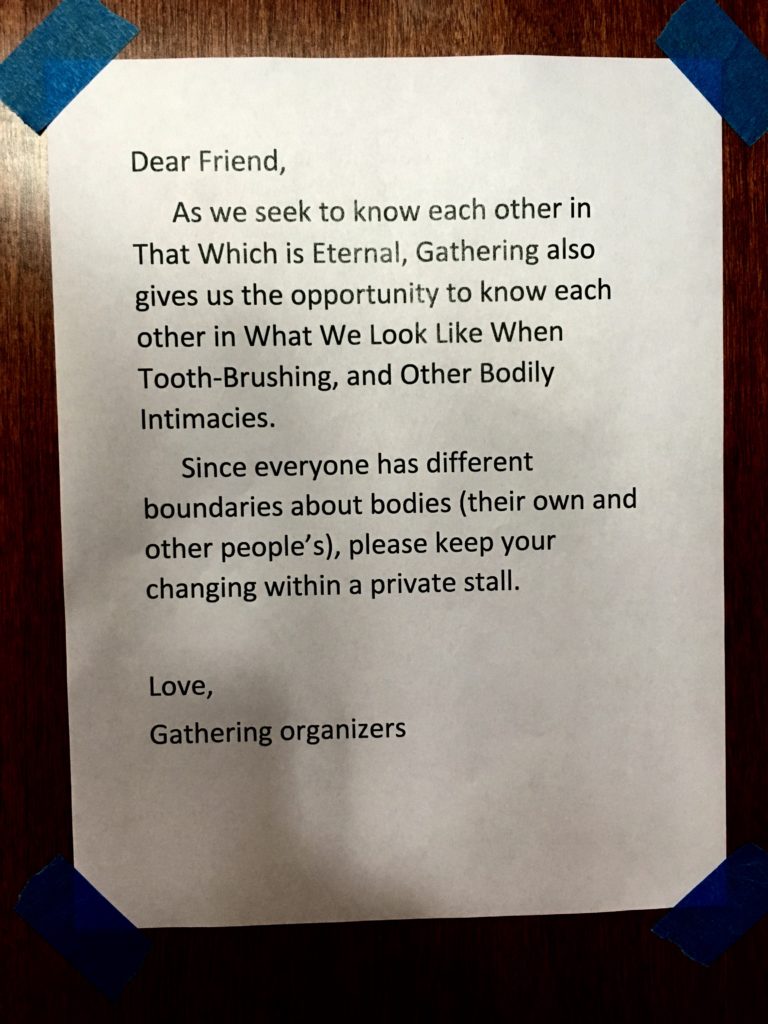
Let me count some of the ways this manifests: The Gathering tells me what kind of soap and shampoo to use, what kind of water not to drink. It repeatedly bids me to mind and shrink my carbon footprint, insists we take naps on Wednesday afternoon, and shames those who dare to stay awake to gather and talk instead. It instructs me on bathroom etiquette, and the hazards of proliferating pronouns.
And this is not to mention that it has shouldered the even heavier burden of curing all my (must be) deeply ingrained retrograde attitudes: racism, sexism, homo- and trans-phobia, cultural appropriation, plus the myriad ways I am personally destroying the planet, with classism on the rise but not quite on the list yet — along with the stern advisement that any demurral is a sure sign of guilt on one or more scores, from which there is no appeal.
Oh — and when someone raises their arm in the dining hall, I am to shut up and sink instantly into a “transforming” silence.

This increasingly oppressive reform effort did not happen all at once; rather bit by bit. But now its burgeoning has almost totally obscured the presence among us of an older, much more sucessful alternative, namely that regarding diet.
In the cafeteria, FGC’s Food Committee has been doing remarkably successful work at making available a wide range of dishes for the nearly infinite variety of Friendly food fetishists, and doing it conveniently, quietly, and non-intrusively. As one of this multitude, I was silently grateful to them three times every day.
The calm, successful diversity of the food line points up one of the key problems with the rise of FGC Nannyism: FGC was created to be a service body, quietly helping its constituent Friends to fellowship and, as moved, work together.
It is not, and was never meant to be, the liberal Quaker denominational headquarters. It is not our leader, or moral/political/social guru. It has neither the warrant nor the competence for such a role. Adult FGC Friends are able to think and act for themselves, almost as much as other ordinary folks. Really. (I even buy my own shampoo.)
Once FGC knew this; it has by now largely forgotten, and the resulting hubris and “mission creep” are growing threats to it.
For me the shift from fellowship and worship to hectoring and paternalism has passed a key point: once I was a devotee of the Gathering and FGC; now I am but a customer. And not a very contented one. I’ve skipped a couple recent Gatherings. As for next summer — I’m not yet sure.
Maybe these complaints are no more than my personal crankiness. But even stipulating to that, I doubt I’m alone. I’ve got those downward numbers in my corner. Friends tend to be passive aggressive; so they have walked away from the Gathering in ones and twos; but the attrition has been substantial, and continues. I say that sadly, because the Gathering was for a long time, the high point of my year.
Can it be fixed? I’m doubtful. But in the spirit of hope I’ll offer one suggestion, just one, in that regard.
I call it The Nag-Two Rule, and I don’t think it would cost any money. Here it is:
Each year, at the Central Committee sessions which are underway now, the various committees will consider a list of issues and concerns, such as those many “reforms” mentioned above, and mark on them two (2) that they feel are the top priorities for the coming year.
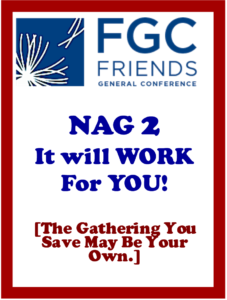 These preferences will be tallied, and the top two selected. Then these choices are the only two betterment- Nanny items that will be pushed at the coming year’s Gathering by FGC itself.
(All the others, and the many more that pop up each year, may of course be freely discussed by Friends informally; information about them can be made available by advocates; books and pamphlets in the Gathering bookstore; etc.)
Would this do the job? Probably not by itself. But it’s worth a try. And really, I bet I’m not the only one who’s had just about as much of the imposed uplift and rehab from the FGC Nanny minions as I can bear.
Mark 4:9: “Whoever has ears to hear, let them hear.”
A Postscript: I’ve had this blog for several years. Then in early 2015 I upgraded and re-launched it, and included a stats plug-in. This week the stats meter said the blog had passed 152000 hits. That feels like a lot.
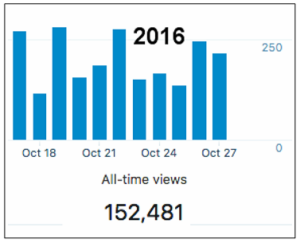
[Update: as spring bloomed in 2022, the total was north of 460,000 hits.
Some very funny sentences.
Rather sad commentary,
but Chuck, you win the creative phrase award of the day!
You wrote, “outside Philadelphia, the bulk of them could be mistaken for barnacles growing on the sides of the barques of academe. ”
LOL;-) and still laughing.
May I quote you?
Sure.
The bathroom door thing would really make me angry and difficult to deal with. I believe this sort of thing has not made it’s way to PYM quite as much, but it is moving that way and real people are moving away. I grew up with Quaker Order and have great tolerance ( or had once) for everybody to have their say, no matter how boring or repetitive. It has helped alot in doing those dang activist things, but I’m old now. How could I tolerate that bathroom door? There simply isn’t time to put up with that and do anything else.
sigh
Thanks for writing this, Chuck. This tracks with what I’ve heard, unfortunately.
One other data point to consider with respect to FGC’s problems is the Quaker Cloud service that many Meetings use for their websites. Initially FGC offered a range of prices, depending on the Meeting’s size. More recently, however, they have begun saying that the *true* cost is much higher and that Meetings should adjust their payments accordingly. There’s also been a staffing change, with technical support now being contracted out. (For details, see: https://www.quakercloud.org/cloud/quaker-cloud-admins/announcements/quaker-cloud-update-october-2016)
Here, at least, it’s easier to see how to right the ship: get Meetings to pay more, reduce overhead. But then we should ask, if we’re paying more, what is the value of this service such that we should pay almost twice as much as we would for a Squarespace account? Honestly, I’m not sure. The idea of a hosting service made by Quakers for Quakers is enticing, but in practice I don’t know how much of a difference that makes.
Chuck, I dare say this environment of pettiness and control is not just an FGC thing; rather, it permeates most liberal Quaker meetings and gatherings. I venture that it also consumes pastoral and evangelical Friends – although I don’t really know about their state, first-hand.
So, it is no surprise that FGC just emulates its constituent meetings. There is a root cause for this behavior that must first be addressed at the local meeting level, so the right spiritual behavior can bubble up to FGC, as they respond to the meetings they serve.
Liberal Quaker meetings must let go of much! But first, they must do some “soul-searching”, starting at the root of what they are about. Literally, they must have a “come to Jesus session” to understand the underlying purpose of their meeting’s existence.
Our religious society was first begun because 17th century seekers were drawn to the universal message of ‘Love and Light’ first put forth by Jesus some two thousand years ago. That message resonated within them and they were finding no support for it within the established churches of the day. Those churches had become sidetracked into all sorts of advices and rules to ensure ‘accepted’ behavior occurred. Just as the Pharisees in Jesus’ day these advices and rules supplanted the living Presence of ‘Love and Light’ that was available for the experiencing.
And within the first fifty years of existence, a slow slide back to that human-centric behavior began for Quakers. Instead of priests, doctrine, and pastors regulating the masses, we Quakers attempted to ‘sanitize’ such control of others by assigning committees this authority.
And today we are left with the ‘monster’ we have inherited from previous generations of Quakers, missing the point of our purpose as “friends of Jesus”. And our committees softly enforce control by nagging Friends to “do good”. We would do better to implement ‘simplicity’ and return to our root of creating and sustaining a meeting environment that only supports the experience of ‘Love and Light’ in the world. And no committee should attempt to gently enforce what they think is a manifestation of that ‘Love and Light’. The “enforcer” is the Inward Light, the Presence that we each have in our heart.
Today, we need to ask ourselves as communities of Friends: Why do we exist? How best can we be true to our root reason for being in this 21st century, first experienced by those early seekers of Light? Even if we don’t resonate with the PERSON of Jesus, can we at least agree that we resonate with his message of ‘Love and Light’ as our purpose for being? Have we gotten lost; effectively acting as just another church telling people how they should act?
My meeting, after a crisis of hollowness, began many years ago asking ourselves these questions. And we began to let go of much Quaker baggage that did not support that two thousand year old life-giving message of ‘Love and Light’. The list uncovered was long, as we continued to seek the Spirit of Truth in ‘expectant waiting’ worship and collective discernment as a whole spiritual community. Perhaps the most important change we made was to start utilizing our committees as tools of the whole meeting. No longer do these committees “suggest” or gently implement any ‘passively aggressive behavior control’ mechanisms. Our Meetings for Business have taken control of the care of Friends and the spirituality of our meeting. No longer do we care what politics Friends support, how Light is manifested in their personal lives, whether they arrive at meeting for worship late, whether they bring coffee or a snack into worship with them, etc. The list of pettiness we have let go of is quite long.
Instead we are striving to simply create an environment that supports the action of ‘Love and Light’ that is already present within Friends – just waiting to be manifested towards others, as their own hearts direct.
I am impressed with the leading your meeting has taken. I imagine that if more meetings did so we would see a growth, instead of decline, in members of current Friends meetings.
Howard Brod, I would very much like to know more about this process you describe in your Meeting. Do you have more written about it?
Thank you, Chuck. I agree that Quakers can easily be tempted to try to control the behavior of others.
For those who have requested more information about the journey of Midlothian Friends Meeting that I’ve alluded to, please email me at howard_brod@msn.com and I will provide you with some links to articles that might help. (I tried to include the links in this blog of Chuck’s but my entry was rejected as “spam”).
In his most recent issue of “A Friendly Letter,” Chuck Fager offers his take on the “Cloudy Skies” blanketing FGC. Chuck is correct that Friends General Conference has, and will continue to, face some serious challenges as we endeavor to live up to our purpose of “with Divine guidance, nurturing the spiritual vitality of the Religious Society of Friends (Quakers) by providing programs and services for Friends, meetings, and seekers.”
“Cloudy Skies for Friends General Conference — Part II” also has some conjecture and misstatements of fact. One example is about QuakerBooks of FGC. In his piece, Chuck says, “…now it has been ‘merged’ with the (likewise shriveled) bookshop at Pendle Hill…” This is not true. Yes, QuakerBooks of FGC did open a walk-in bookstore on the Pendle Hill campus. It is in space we rent from Pendle Hill – which happens to be the space formerly occupied by the Pendle Hill bookstore. The two stores were not merged and Pendle Hill, other than the rent FGC pays them, does not have a financial or governance stake or say in the bookstore.
We’d invite readers concerned about the state of FGC to read our most recent annual report (https://www.fgcquaker.org/news/read-our-2015-annual-report) and to look at the newly launched Spiritual Deepening Project (https://www.fgcquaker.org/deepen/enrichment/spiritualdeepening) which is now available to our members across the United States and Canada.
We are grateful for the many volunteers who have gathered over these next few days for our Central Committee meeting. They are involved in helping discern direction for FGC and will be participating in the committees that carry out the work around the year. We are also grateful for our many donors – “Deep Pockets” or not – who support the ongoing work and mission of FGC. We embrace the challenges before as together we work to nurture the spiritual vitality of the Religious Society of Friends.
–Brent Bill, Associate Secretary for Communications, Publications, and Outreach for FGC
Thanks, Brent! I appreciate your confirmation of my main point: “Chuck is correct that Friends General Conference has, and will continue to, face some serious challenges . . . .” I note that the specifics mentioned in the post are left as they were presented.
I also appreciate the clarification about the organizational evolution of the Pendle Hill and FGC Bookstores into one facility at PH; not “merged.” The PH shop has shriveled out of existence then; I stand corrected.
And your suggestion that Friends read FGC’s 2015 Annual report was apt, which is why I linked to it in my post as well.
Best wishes to the Central Committee as it labors away. If it comes up with some version of the “Nag Two” policy or other adjustments that can make the Gathering less directive and onerous for many who have fallen away, I hope we’ll hear more specifics about that in a timely manner.
I don’t think the nagging has changed in quantity much over the years. Some of the issues have changed. I don’t know all the reasons for declining attendance, but it could be related to declining membership and attendance at Friends Meetings. Cape May had 3000 people but did it have LGBTQ gatherings, music galore, an art gallery, etc. ? My family is enjoying the Gatherings and we intend to keep coming.
I have experienced the patronizing and paternalistic “Nanny State” at different larger Friends Organizations without putting a name to it. Thank you Friend for naming it.
I have never attended FGC Gathering. I have considered attending, but never felt ‘led’ to go. It appears to me expensive and exclusive. Based on descriptions, I , rightly or wrongly, developed a vision of a Friendly ‘Club Med.’
I’ve never been to Club Med; but I expect, at the price, it’s more fun. If I were forty-some years younger, and a Yuppie, I’d think seriously about it . . .
Don’t forget that there are larger issues in play. Membership has been declining for years in all the liberal mainline-Protestant denominations (and I think FGC is close enough to them, socially and theologically, to count as part of this trend). Younger generations are less connected to institutions of all kinds of than older generations have been. There are many more options for summer sojourns than there used to be, including family camps. Declining participation isn’t just a Friends’ problem.
I remember the lovely days in Cape May and how formative those conferences were. I hope the Gathering can be sustained in some form.
To be sure, there are larger issues in play. Not least, much of the rising generation is hobbled by student loan debt, and has less disposable cash for such optional items as Gathering. And the fraying of institutional ties is a fact.
I might quibble about the Mainline thing, tho: in my view, Quaker-Mainline connections are primarily evident in the pastoral FUM yearly meetings, and on the FGC side, in Philadelphia, New York, & somewhat less New England YMs. And it is those with concrete Mainline connections that have suffered most from the ravages of “Mainline disease.” The rest of the FGC YMs, the largest of these being Baltimore, have not really been part of the Mainline, and many have not shrunk the way the others have.(Indeed, Baltimore has been growing for most of the nearly forty tears I’ve been in and around it; rather a religious phenomenon, I’d say, which confounds the Decline & Disappearance scenarios.)
What’s their special sauce? That question is worth more careful attention than I have been able to give it but I can say one thing: the YM has maintained a light touch with its member meetings, and I believe that has helped. If it should turn toward the FGC-Nanny model — and there are those who want to do so — then I fear they may begin to undermine their momentum. That would be a shame.
And I too hope the Gathering can be retooled & renewed. I suspect that will require new leadership in the Central Committee, among other things.
I enjoy Chuck’s writing, wit, and humor. I want to say also that I have loved attending the Gathering for two years now and have been so grateful to have been able to. The signs and this and this did not detract from or lessen my experience of love and gratitude to see my Friends, new and familiar, to be together, to browse books, walk, sing, play Frisbee, to enjoy many serendipitous moments. I loved my class and am thankful to my Meeting for making it possible for my son and I to attend. Praying with and getting to hear the nuns’ stories was very cool also. I appreciate all the volunteers and all the hard work that makes a conference like this possible. I was new to conferences of this type and so appreciate being able to have these experiences now. A member of my Meeting described FGC as “family camp.” I was honored also to be able to volunteer how I could. I also enjoyed getting to see Chuck at FGC.
Good talking to you, Christine! The networking and fellowship remain the best parts.
Dear Chuck, I don’t know you personally, since Facebook friendship doesn’t quality in my mind as much “knowing” personally. I was hoping someone else who does know you well would speak up, but I’m also not comfortable with the silence.
“nanny” “nag-two” “control” ….. Are you really saying you are nostalgic for the good old days when we had better invisibility of all those marginalized people for whom we as friends have progressively been trying to See better over the years? Including trans people. I am very troubled by this interpretation, that you want to erase people but would like to hear what you say to clarify.
thank you for your consideration.
“Are you really saying . . .”
No, I’m not.