Considering My Marian Pilgrimages, on Guadalupe Pilgrimage Day in Mexico
Our Lady of Guadalupe, festooned with her trademark roses.
Even after all these years, I find it a somehow appealing story: 491 years ago, in December 1531 near Mexico City, a humble peasant named Juan Diego told the archbishop of Mexico City he had been visited while climbing a hill by a heavenly woman, now known as Our Lady of Guadalupe. The lady told Juan Diego she wanted a church built in her honor nearby, and directed him to deliver this message to the archbishop.
The archbishop scoffed (fake visions were plentiful in Catholic cultures). Juan iego reported the rebuff to the lady at her next apparition, but she sent him back. The bishop, a Spanish-born bureaucrat, was still dubious, and insisted that Juan Diego bring a miraculous sign from this alleged heavenly lady before his story would gain any credence.
So Juan Diego went back again., wearing a cloak against the December chill. This time the lady told him to gather flowers for the bishop from another hilltop. The hill, it is said, was normally barren at that season, but Juan Diego found roses blooming there. And not just any roses, but Castilian Roses, common in Spain but not then familiar in Mexico.
The roses, which Juan Diego carried in his cloak, got the bishop’s attention. So did his cloak: when he opened it, there was an image of the heavenly woman on its inside.
There’s more to the story: the lady spoke to Juan Diego in his own tongue, Nahuatl; and her visage on his cloak is said to look both Spanish and indigenous. Her image soon became a cherished icon for Catholic Mexicans: a church was built, and what is said to be Juan Diego’s supernaturally-decorated cloak is on display there; many healings and other miracles have been attributed to it. In December pilgrims gather in huge numbers there. As the Associated Press puts it:
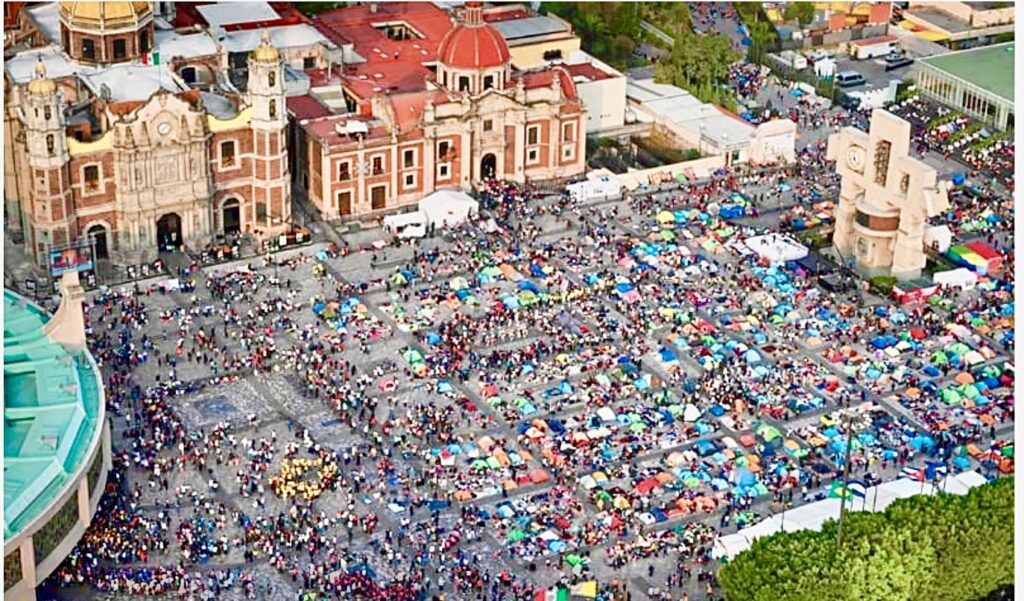
At left, the Basilica of Our Lady of Gudalupe, and the plaza packed with pilgrims for December 12.
It is one of the world’s most visited and beloved religious venues – the Basilica of Our Lady of Guadalupe, with a circular, tent-shaped roof visible from miles away and a sacred history that each year draws millions of pilgrims from near and far to its hilltop site in Mexico City.
Early December is the busiest time, as pilgrims converge ahead of Dec. 12, the feast day honoring Our Lady of Guadalupe. To Catholic believers, the date is the anniversary of one of several apparitions of the Virgin Mary witnessed by an Indigenous Mexican man named Juan Diego in 1531.
The COVID-19 pandemic curtailed the number of pilgrims in 2020. Last year, even with some restrictions still in place, attendance for the December celebrations rose to at least 3.5 million, according to local officials. Bigger numbers are expected this year.
I won’t be among the multitude of pilgrims there, but I find the site and the image displayed to them intriguing. And I have made my own kind of “pilgrimages” to other sites of what the church calls “Marian apparitions,” real or imagined.
Such phenomena were a staple of my old-style Catholic upbringing. I didn’t hear much about Guadalupe, but there were lots of others. The best-known for many years was Our Lady of Fatima, who had appeared to three peasant children in Portugal in 1917.
Fatima has been in movies and books, but I best remember a 1951 comic book version (Price: 15 cents!) which has recently been updated in a slick 21st century animé look.
By my junior year in high school, I had shed any belief in Catholic dogmas. Yet these apparitions continue to intrigue. Did any of these strange things really happen? Had any scientists ever examined Juan Diego’s 1531 cloak? (Yes, with mixed results. The Skeptical Inquirer decided the painting was by an unnamed folk artist; the rest of it, including Juan Diego, they said was just myth. Two other examiners, using infrared & ultraviolet photography, reached a split verdict: one vote each for folk and supernatural, but both were doubtful about Juan Diego.)
I’m not that interested in haggling over the miracle part; sometimes strange things do happen, and 491 years makes for a long & confusing chain of custody. What’s more compelling to me is the force and persistence of the devotion by followers; in this regard Guadalupe is unmistakably world-class.
I don’t know if I’ll ever get to Guadalupe. But I’ve made my own pilgrimages, and they were memorable.
The first was in New York City, in the mid-1970s. Blame it on Bobby Kennedy that one day I pulled up next to a Catholic church in the upscale Queens neighborhood of Bayside, and circled the building, looking for a tree.
Kennedy ended his life as a U. S. Senator from New York, so he must have been familiar with Bayside; it had lots of Democratic votes around, and likely some well-heeled donors too.
I don’t know if Kennedy ever appeared at that church. It’s named for Robert Bellarmine, a sixteenth century Jesuit who served on the Inquisition and gave Galileo the order to shut up about his weird heretical idea that the earth rotated around the sun, rather than (as church dogma then insisted) vice versa. But never mind Kennedy — I was there because the Virgin Mary had supposedly visited it, or at least a tree next to it, and She was coming back, weekly.
I didn’t find the tree, but did see where it had recently been: at the hub of a light brown circle of dirt. Like the period at the end of a huge invisible sentence, it interrupted the church’s moat of silent grass. Pilgrims, bent on taking home a relic, had torn the poor tree apart, literally limb from limb, crown to stump, turning it into sanctified artisanal toothpicks.
Veronica Lueken, receiving and narrating a vision at Bayside. Her “heavenly messages, mostly condemnations and warnings, fill six fat volumes.
The seer who brought them there was a previously unknown housewife and mother, Veronica Leuken. In mid-1968, like many another American, she had been battered by the crashing waves of social and cultural turmoil we now call the Sixties: civil rights agitation and urban riots, libertine hippies, thousands of Vietnam war casualties, and militant antiwar protests. To all this was added earthquakes in the Catholic Church in which she had been a lifelong loyal exponent of its PPO mantra: Pray, Pay, and Obey.
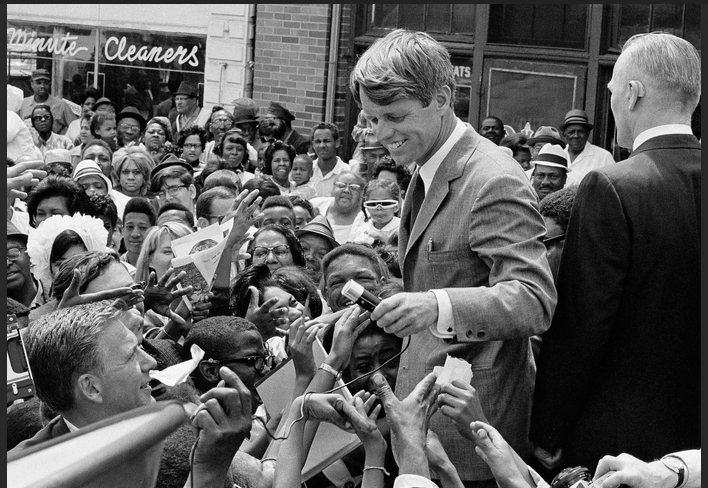
RFK campaigning, 1968.
And like many, she had found hope in Robert Kennedy’s demonstrated ability to speak across these deepening divides. Shaped in the crucible of grief over the murder of his brother JFK, Bobby’s hard-won empathy was eloquently displayed when he worked to quell violence in April 1968 after the assassination of Martin Luther King.
This breadth was perhaps the strongest aspect of his appeal as a presidential candidate. Thus when, in June 1968, just as his campaign had won the crucial California primary, he was cut down by an assassin’s bullets, the shock was too much for many.
It was clearly too much for Veronica Leuken (1923-1995); even as Bobby lay dying, she began seeing things — were they hallucinations?
A cross in the sky; the pervasive smell of roses; visits from various saints. Then repeatedly she heard from the Virgin Mary, one of whose titles is “The Help of Mothers.”
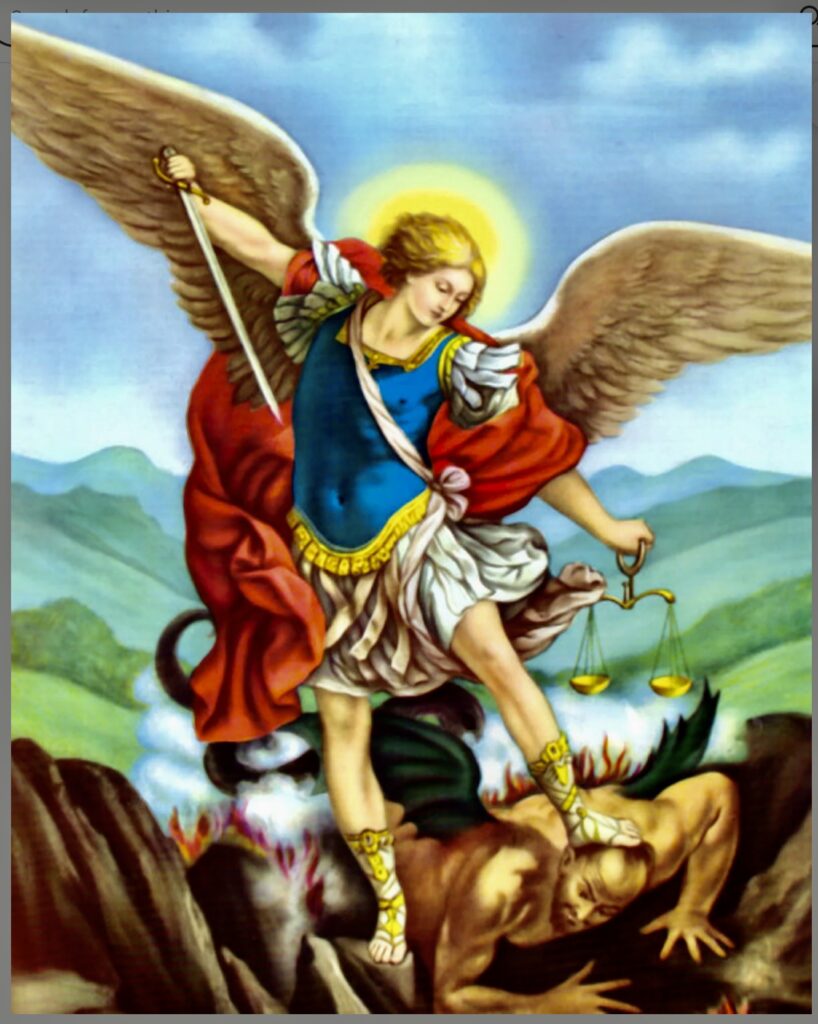
Michael the Archangel, Veronica’s wingman
With the ballast and hope of Bobby Kennedy now gone, Leuken began careening into the wilderness of reactionary, conspiracy-minded Catholic mystico-pietism. For several years she held regular prayer vigils outside the Bellarmine church, at which she entered a trancelike state, and narrated her visits and conversations with Mary, and often Michael the militant Archangel, who was usually armed with and brandished a sword or spear, and delivered warnings of coming tribulations for sinners and heretics.
In Lueken’s accounts of Mary’s messages, She condemned the many signs of public moral degeneracy, including such horrors as women wearing slacks, plus all the changes made in traditional Catholicism authorized by the Second Vatican Council in the early 1960s. She even insisted that Pope Paul VI had been kidnapped and displaced by a Communist imposter who had undergone plastic surgery. And so forth. Much of this was recorded and transcribed, and six thick volumes of these diatribes are still available in online editions.
I wasn’t in Bayside trying to prove Leuken a fake; I think I could recognize a derangement of despair when I read it, especially in context. And 1968? The times had driven me close to the edge too.
I hoped to find her and talk, not argue, see if she could open up.
It didn’t work out. She was like a fragile popstar dodging the papparazzi; It took a day or so of work after seeing the tree to get an actual address. (No Google yet; but she was a registered voter, and that was public.)
She was also often ill, from a host of maladies, including chronic fatigue. When I finally knocked on the door of her row house, a young woman with an unwelcoming expression opened the door, and muttered that Veronica didn’t want to talk. Then someone called out from inside, and she said, “Wait a minute.”
Shortly she was back, stuffed something into my palm, and shut the door.
I turned away and looked down. There was a pastel plastic blue rosary in my hand. The Virgin Mary’s color. Probably bought them by the gross at a nickel per.
Veronica Leuken died in 1995. Then her followers — hundreds showed up for her annual vigil/rallies on the anniversary of the first message — split into two rival sub-sects; who was to be boss, or some such.
Their website is still up, getting decrepit, and on it they sell a Heaven’s Home Protection Packet (Mary said we should all glue crucifixes on the outside of each exit door on our houses). The crosses repel demons. Some demons anyway.There was another pilgrimage: about twenty years after my venture into Bayside, early 1997. I was in Tampa, Florida, for some Quaker consultation. While there, I remembered an item in the local news; in December 1996, an image had appeared on several big windows at a local finance company building, near Clearwater, about 25 miles west of Tampa:
The image, two floors high, first emerged last Thursday on the tinted windows of a finance company office. It glows and shimmers, turning from green to blue, to red, and there is a distinct outline of a head, a hooded robe and most of a torso.
Skeptics say it is caused by the sun reflecting off water left by sprinklers. But others believe it is a true miracle.
“God is telling us it is time to change our ways,” said Sister Christian of the same order. “(It) looks exactly like all the paintings of the Blessed Mother.”
As the nuns moved closer to the window, reciting the Holy Rosary, dozens of people crowded around, some on their knees in prayer, others just curious. The wall in front of the image has become a shrine, piled with candles, photos of children, handwritten prayers and funeral notices.
Police barricaded the front entrance of the building, which during the morning rush hour, creating gridlock.
By early Wednesday morning the parking lot was full of mothers and children, elderly couples, people in suits or work clothes and youths who had camped out all night. A local radio station has threatened to send people to the building to clean the windows.
I punched Clearwater and Virgin into my laptop and there it was, and the image was still there. So I went.
And sure enough. The likeness was hardly exact but if you were familiar with Guadalupe and others, it jumped right out. There were candles all around it, new, half melted, guttered, and scribbled notes stuck here and there. I arrived in midday on a weekday, but despite the fact it was working hours, there were people around.
One thing I liked was that there had been no “seer” step forward; no “messages from above” were delivered; no group was hustling us around it. (That did happen, but it was later.) This thing, whatever it was, just appeared. I thought; “If you build it, and make it sacred-looking and iridescent, they will come.” I don’t know what all the hullabaloo was about, but it was fascinating.
The image just stayed there, for more than seven years. Then in March 2004, a teenager came with a slingshot and some ball bearings, and shot “Mary’s” head off: three glass panels, gone in a couple of minutes, shards on the ground.
That was a damn shame. But I suppose Mary goes on, and i felt somehow grateful that I’d been able to see it.
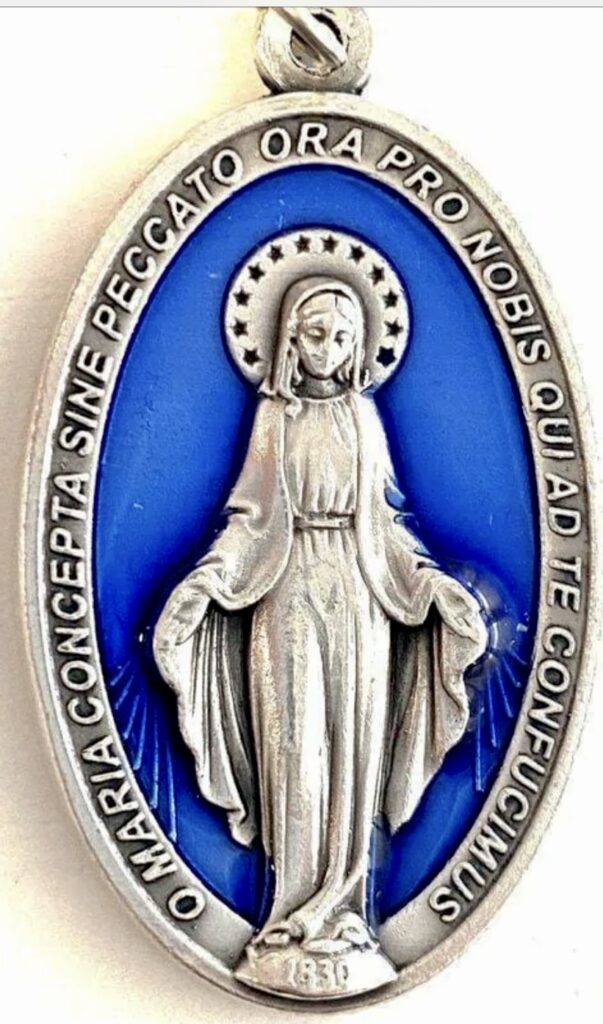
And a short postscript: Veronica Luekens’ successors are also selling a Heaven’s Personal Protection Packet. It features among other pious trinkets a Miraculous Medal — a gewgaw introduced in 1830, by Catherine Labouré (1806-1876). She was a nun in Paris, who said Mary had appeared to her, showed her the design and commanded Labouré to get it made into a devotional medal, because, “All who wear them will receive great graces.”
The Miraculous Medal
Again, church authorities were at first skeptical. But they too eventually gave in, and once it was made, the Miraculous Medal was a monster hit: millions of Catholics wore or carried them.
Actually, many still do.
In fact — good grief — I have one, it’s small, in my pocket change holder right now. I’ve carried it since — forever?
Have I received “great graces”? Well . . .no Castilian roses, alas. But . . .
Hmmm. I just turned 80, have almost all my teeth, and can still remember my name. Who can argue with that?


 I won’t be among the multitude of pilgrims there, but I find the site and the image displayed to them intriguing. And I have made my own kind of “pilgrimages” to other sites of what the church calls “Marian apparitions,” real or imagined.
 Fatima has been in movies and books, but I best remember a 1951 comic book version (Price: 15 cents!) which has recently been updated in a slick 21st century animé look.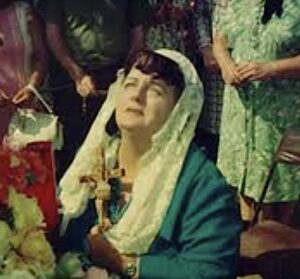
December 19, 1996
The image, two floors high, first emerged last Thursday on the tinted windows of a finance company office. It glows and shimmers, turning from green to blue, to red, and there is a distinct outline of a head, a hooded robe and most of a torso.
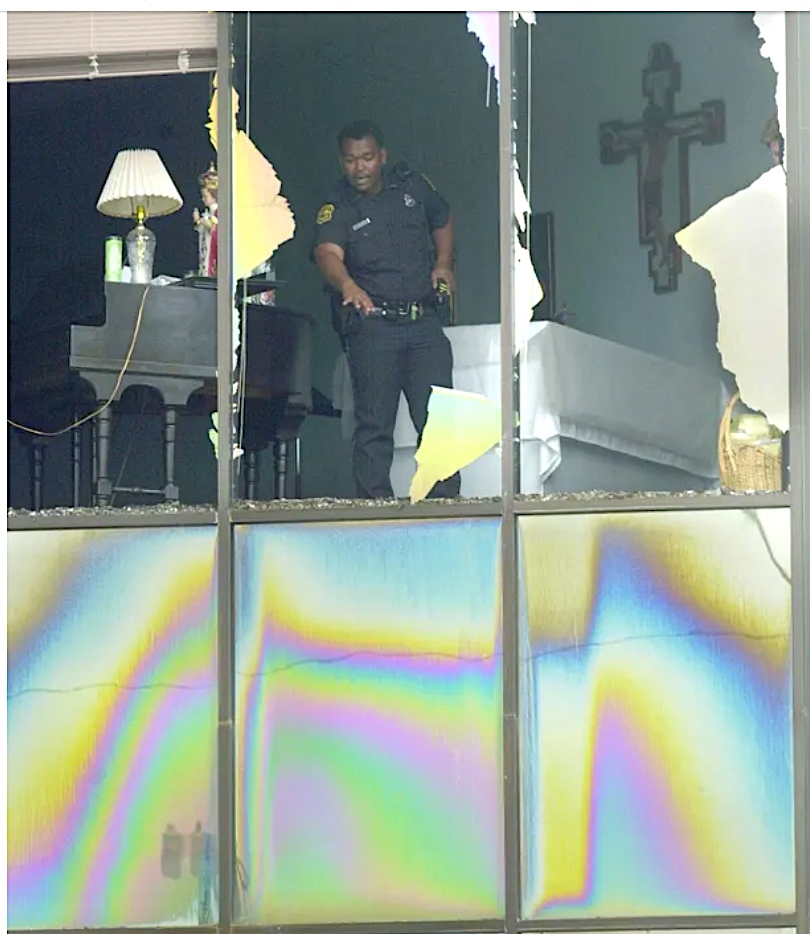 The image just stayed there, for more than seven years. Then in March 2004, a teenager came with a slingshot and some ball bearings, and shot “Mary’s” head off: three glass panels, gone in a couple of minutes, shards on the ground.