


War clouds were gathering as winter arrived in 1990. President George H. W. Bush was mobilizing a huge military strike to roll back Saddam Hussein’s occupation of Kuwait. War fever was being ginned up on every side, ignoring huge protests and objections even from Pope John Paul II.
I was working at a large post office in northern Virginia, moving sacks and bundles and mails, on shifts that stretched into the cold nights. I was surrounded by many coworkers who were traumatized Vietnam veterans, being triggered in numerous ways by the approaching battles. My opposition to the war was very much a minority view there; mainly I kept quiet about it.
But I wanted support, and relief from the nonstop barrage of war propaganda. And finally I got some, five nights a week, from 10 to 11 PM, via an unexpected outlet: WAMU-FM nearby in Washington, which I listened to at work. It was unexpected because WAMU’s parent network, NPR, was all in with the war propaganda line, spoonfed by the Pentagon, day after day.
But at 10, the on-air staff clocked out, and WAMU hooked into CBC Radio, the Canadian network, and a news show taped up north a few hours earlier, “As It Happens.”
 As a grizzled NPR news junkie, AIH was a stunning breath of originality for me. NPR news in those days was mostly hour after hour of smooth Ivy Leaguers & a few dulcet wannabes in DC, talking to a circle of mostly cultural clones here and there.
AIH, by contrast, had no correspondents or bureaus. Instead, they had curiosity, chutzpah — and telephones. They called people around the world, the great and the humble, asked good, sometimes tough questions, got revealing answers, then had actual conversations.
And night after night, despite their quirky accents “aboot” for “about,” “shedyouell” for “schedule, — AIH beat clubby conformist NPR all hollow.
They did it because they elicited real stories from real people. They did it on the unfolding war buildup news. And on special occasions, they also told some stories; Canadian favorites.
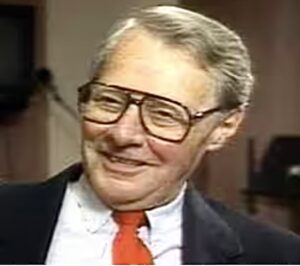
Their chief storyteller then was a longtime announcer, the late Alan Maitland (1920-1999). In summer, he did it as “Front Porch. Al”; in winter, as “Fireside Al.” (The photo here has him suited up for corporate PR purposes; but my imagination assures me I’d seen him reading in winter, cozy in an open-collar heavy checked flannel shirt, with the firelight glinting off his glasses. Sure, right there in the earbuds I used with a Walkman , moving mail at the post office.)
Their most memorable story was broadcast annually, just before Christmas,. It’s called The Shepherd.
And Spoiler Alert—there isn’t a sheep in sight in the tale. But it has suspense, war, fighter planes, British-Canadian connections, and maybe even a carefully-camouflaged religious allegory subtext.
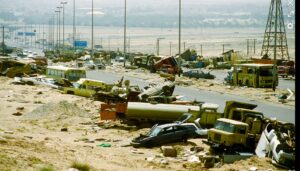
Finding AIH and CBC was like gaining a shepherd in 1990, helping me get through the war madness around that Christmas. Then as the real war, soon to be called “Desert Storm” neared the starting gate, the program and the network abruptly disappeared from WAMU. They were replaced — without explanation — by a bland slice of BBC News. Their reports immediately made clear that the Brits were entirely “on side” with the Pentagon war line. My guess was that CBC was deemed too independent for the U. S. Radio gods: the AIH phone calls too often reached people who were not vetted and in sync with the Pentagon line, and said things too close to its many inconvenient truths.
Anyway, as I mourned the loss of AIH, the first Bush had his splendidly brief victorious war, covered here by a tamed and censored media, which followed it up with months of jingoistic national self-congratulation, including nonstop bragging about how it had been won with hardly any U.S. casualties (officially less than 200 killed).
The government then ignored and denied for as long as it could the vast tide of delayed onset injuries and disabilities which came to known as Gulf War Syndrome. It ultimately engulfed as many as 250,000 U.S. veterans of that war, and proved once more that war indeed, is hell, and Karma is still something that rhymes with Rich.
At length WAMU brought back AIH — or was it that I figured out how to get it on the net? I’m not sure now. But Desert Storm had broken the spell of public radio for me, and I began drifting away from it.
But AIH is still on, now also in podcast form, and yesterday morning I saw a notice for an episode, featuring The Shepherd. Of course it was by Maitland, though he died in 1999.
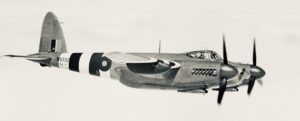
And it’s the time for it, both on the calendar, and in our collective fate. I listened rapt, and could imagine the cockpit of its threatened Vampire fighter, and the mysterious Mosquito appearing above the impenetrable fog bank along the British coastline. The echoes of distant wars melded with memories of Desert Storm, and their successors today, and the combination had me wiping my eyes throughout.
While my reactions are my own, there’s nothing exclusive about this experience. Anyone with a net connection can listen to The Shepherd, right now, at this link. or search for CBC podcasts. It’s only 32 minutes. And then if you’re still curious, there is an interview with the author here. In it you can learn about what a mysterious diamond ring had to do with it all. . . .
[P.S. Earlier this month, Disney+ began streaming a 39-minute movie version of The Shepherd, with John Travolta and Ben Radcliffe. I haven’t watched it; reviews are friendly yet mixed; and I think at my age I may prefer the version I “saw” on AIH.]
Glad you like it.
Canadian