
22 November 2023
Israel-Hamas Ceasefire
By Gwynne Dyer – Author, Historian & Independent Journalist
 There are really three parties to the ‘pause’ – nobody is officially using the word ‘Author, Historian & Independent Journalistceasefire’ – that brings at least a temporary end to the fighting in the Gaza Strip. Two of the three parties, Hamas and the United States, would very much like it to turn into a permanent ceasefire, but Israel emphatically does not.
Israel’s prime minister Binyamin ‘Bibi’ Netanyahu definitely wants the war to continue in order to “complete the elimination of Hamas and ensure that there will be no new threat to the State of Israel from Gaza.” What proportion of Israel’s population really wants the war to continue, however, is less clear.
The United States urgently wants a ceasefire, because its strong support of Israel, although politically essential at home, is placing an intolerable strain on its relations with the Arab and Muslim world. And it wants this to be a permanent end to the fighting, for the same reason.
Hamas wants the war to stop now because it has achieved both its major objectives and would like to leave the table while it is still winning. The drift towards closer collaboration between Israel and the major Arab states has been slowed, if not entirely stopped, and Hamas has reaffirmed its status as the leader of the Palestinian ‘resistance’.
14,000 Palestinians have been killed in the Israeli counter-attack, most of them civilians, compared to only 1,400 Israelis, but the 10-to-1 kill ratio is normal in Israeli-Palestinian wars. A third of Gaza’s buildings have been destroyed or damaged, including the homes of about half a million people, but that was also foreseen and discounted by Hamas.
Now Hamas has nothing more to gain by fighting and would like to preserve the lives of its own remaining fighters. It knew this moment would arrive, which is why it seized several hundred Israeli civilians (240 is the current estimate) as bargaining chips at the beginning of its attack.
It knew the Israeli government would be under huge pressure to save them, and that it would have to accept a temporary ceasefire to do so. That is the point we have now reached in Hamas’s strategy.
Both Israel and Hamas insist the ‘pause’ is only temporary. “We are at war and we will continue the war until we achieve all our goals. To destroy Hamas, return all our hostages and ensure that no entity in Gaza can threaten Israel,” said Prime Minister Netanyahu on Monday.
Hamas wants to sound just as determined, but look at the nuance in its statement: “We affirm that our fingers remain on the trigger, and our victorious fighters will remain on the look-out to defend our people and defeat the occupation.” The fact is that they can only lose more people if the fighting resumes. They cannot ‘win’, so they’d like to stop now.
 Look at the structure of the deal: ten hostages released each day that the ceasefire lasts. That’s three weeks of ceasefire before all the Israeli hostages are home, and no Israeli government would dream of re-starting the shooting until they are all safely home.
Ten-a-day was Hamas’s bottom line for the deal, because it thinks the Israelis will find it politically impossible to start the war up again in mid-December if there has been no shooting in the meantime (and there won’t be any).
By contrast Israel, or at least the Netanyahu government, wants to fight the war to the end. Something ‘Bibi’ can call a victory is the only thing that could possibly keep him in office – which is where he probably needs to stay if he hopes to avoid jail on corruption charges.
The ‘settler’ fanatics in his coalition, who have been running wild in the occupied West Bank driving Palestinian from their homes (at least a dozen villages have been emptied out) needed the Gaza War as cover. A long ceasefire will make their crimes more visible, and if Bibi can’t restart the war they will probably abandon his coalition in revenge.
The prognosis, therefore, is that the ceasefire endures, Netanyahu falls, and Hamas keeps control of Gaza (although only from its underground tunnels, for the moment). Game, set and match to Hamas?
Not necessarily. It has won a major tactical victory over the Israelis and enhanced its reputation in the Arab ‘street’, but it may have snookered itself strategically.
The last thing Hamas wants is a ‘two-state solution’ that divides Palestine between Jewish state and an Arab one. It wants to drive all the Jews out of Palestine and unite it as an Islamic republic. Yet the carnage of the war and the shock to the international system have forced the long-moribund two-state idea back onto the table.
If this is really success, what would failure look like?


#2 – AP News: With the world’s eyes on Gaza, attacks are on the rise in the West Bank, which faces its own war
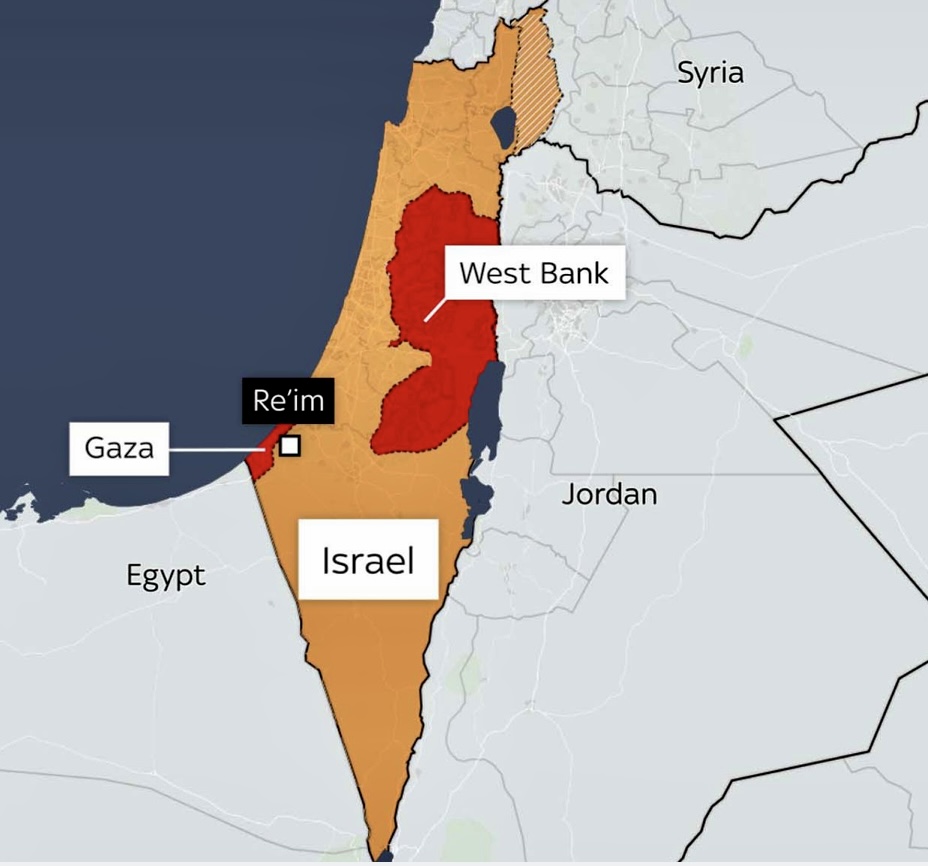
QUSRA, West Bank (AP) — When Israeli warplanes swooped over the Gaza Strip following Hamas militants’ deadly attack on southern Israel, Palestinians say a different kind of war took hold in the occupied West Bank.
Overnight, the territory was closed off. Towns were raided, curfews imposed, teenagers arrested, detainees beaten, and villages stormed by Jewish vigilantes.
With the world’s attention on Gaza and the humanitarian crisis there, the violence of war has also erupted in the West Bank. Israeli settler attacks have surged at an unprecedented rate, according to the United Nations. The escalation has spread fear, deepened despair, and robbed Palestinians of their livelihoods, their homes and, in some cases, their lives.
“Our lives are hell,” said Sabri Boum, a 52-year-old farmer who fortified his windows with metal grills last week to protect his children from settlers he said threw stun grenades in Qaryout, a northern village. “It’s like I’m in a prison.”
In six weeks, settlers have killed nine Palestinians, said Palestinian health authorities. They’ve destroyed 3,000-plus olive trees during the crucial harvest season, said Palestinian Authority official Ghassan Daghlas, wiping out what for some were inheritances passed through generations. And they’ve harassed herding communities, forcing over 900 people to abandon 15 hamlets they long called home, the U.N. said.
When asked about settler attacks, the Israeli army said only that it aims to defuse conflict and troops “are required to act” if Israel citizens violate the law. The army didn’t respond to requests for comment on specific incidents.
U.S. President Biden and other administration officials have repeatedly condemned settler violence, even as they defended the Israeli campaign in Gaza.
“It has to stop,” Biden said last month. “They have to be held accountable.”
That hasn’t happened, according to Israeli rights group Yesh Din. Since Oct. 7, one settler has been arrested — over an olive farmer’s death — and was released five days later, the group said. Two other settlers were placed in preventive detention without charge, it said.
Naomi Kahn, of advocacy group Regavim, which lobbies for settler interests, argued that settler attacks weren’t nearly as widespread as rights groups report because it’s a broad category including self-defense, anti-Palestinian graffiti and other nonviolent provocations.
“The entire Israeli system works not only to stamp out this violence but to prevent it,” she said.
Before the Hamas assault, 2023 already was the deadliest year for Palestinians in the West Bank in over two decades, with 250 Palestinians killed by Israeli fire, most during military operations.
Over these six weeks of war, Israeli security forces have killed another 206 Palestinians, the Palestinian Health Ministry said, the result of a rise in army raids backed by airstrikes and Palestinian militant attacks. In the deadliest West Bank raid since the second Palestinian intifada, or uprising, of the 2000s, Israeli forces killed 14 Palestinians in the Jenin refugee camp Nov. 9, most of them militants.
While for years settlers enjoyed the support of the Israeli government, they now have vocal proponents at the highest levels of Prime Minister Benjamin Netanyahu’s coalition. This month, Netanyahu appointed Zvi Sukkot, a settler temporarily banned from the West Bank in 2012 over alleged assaults targeting Palestinians and Israeli forces, to lead the subcommittee on West Bank issues in parliament.
Palestinians who’ve endured hardships of Israeli military rule, in its 57th year, say this war has left them more vulnerable than ever.
“We’ve become scared of tomorrow,” said Abdelazim Wadi, 50, whose brother and nephew were fatally shot by settlers, according to health authorities.
Conflict has long been part of daily life here, but Palestinians say the war has unleashed a new wave of provocations, disrupting even their grim routine.
THE SETTLERS IN FATIGUES
Israel captured the West Bank, east Jerusalem and Gaza in the 1967 Mideast war. Settlers claim the West Bank as their biblical birthright. Most of the international community considers the settlements, home to 700,000 Israelis, illegal. Israel considers the West Bank disputed land, and says the settlements’ fate should be decided in negotiations. International law says the military, as the occupying power, must protect Palestinian civilians.
Palestinians say that in nearly six decades of occupation, Israeli soldiers often failed to protect them from settler attacks or even joined in.
Since the war’s start, the line between settlers and soldiers has blurred further.
Israel’s wartime mobilization of 300,000-plus reservists included the call-up of settlers for duty and put many in charge of policing their own communities. The military said in some cases, reservists who live in settlements replaced regular West Bank battalions deployed in the war.
Tom Kleiner, a reservist guarding Beit El, a religious settlement near the Palestinian city of Ramallah, said the Oct. 7 Hamas attack’s brutality cemented his conviction that Palestinians are determined to “murder us.”
“We don’t kill Arabs without any reason,” he said. “We kill them because they’re trying to kill us.”
Rights groups say uniforms and assault rifles have inflated settlers’ sense of impunity.
“Imagine that the military supposed to protect you is now made of settlers committing violence against you,” said Ori Givati, of Breaking the Silence, a whistleblower group of former Israeli soldiers.
Bashar al-Qaryoute, a medic from the Palestinian village of Qaryout, said residents from the nearby settlement Shilo, now wearing fatigues, have blocked all but one road out. He said they smashed Qaryout’s water pipeline, forcing residents to truck in water at triple the price.
“They were the ones always burning olive trees and creating problems,” al-Qaryoute said. “Now they’re in charge.”
THE CURFEW
“Close it!” a soldier barked at Imad Abu Shamsiyya when he met the young man’s eyes through his open window. Then, he pointed his rifle.
Over 52 years, Abu Shamsiyya has witnessed crises strike the heart of Hebron, the only place in which Jewish settlers live amid local residents, not in separate communities.
He thought life in the maze of barbed wire and security cameras couldn’t get worse. Then came the war.
“This terror, these pressures,” he said, “are unlike before.”
The Israeli military has barred 750 families in Hebron’s Old City — where some 700 radical Jewish settlers live among 34,000 Palestinians under heavy military protection — from stepping outside except for one hour in the morning and one in the evening on Sundays, Tuesdays and Thursday, said residents and Israeli human rights organization B’Tselem.
Schools have closed. Work has stopped. Sick people have moved in with relatives in the Palestinian-controlled part of town. Israeli settlers often roam at night, taunting Palestinians trapped indoors, according to footage published by B’Tselem.
Checkpoints instill dread. Soldiers who in the past just glanced at Abu Shamsiyya’s ID now search his phone and social media. They pat him down, he said, gawking and cursing.
“Hebron is a blatant microcosm of how Israel is exerting control over the Palestinians population,” said Dror Sadot, of B’Tselem.
Asked about the curfew, the Israeli military said that it had set up more checkpoints “as part of the security operations in the area.” Palestinian militant attacks have increased significantly since the war, it added.
THE SETTLER RAID
The grinding of a bulldozer’s gears. The crack of a gun. With a glance, parents let each other know the drill: Grab the children, lock the doors, keep away from windows.
Palestinians say settlers storm the northern village of Qusra almost daily, covering olive orchards in cement and dousing cars and homes in gasoline.
On Oct. 11, settlers tore through dusty streets, shooting at families in their homes. Within minutes, three Palestinian men were dead.
Israeli forces sent to disperse armed settlers and Palestinian stone-throwers fired into the crowd, killing a fourth villager, Palestinian officials said.
The next day, settlers heeded social-media calls to ambush a funeral procession the village coordinated with the army. They cut off roads and sprayed bullets at mourners who sprang from cars and sprinted through fields, attendees said.
Ibrahim Wadi, a 62-year-old chemist, and his 26-year-old son Ahmed, a lawyer, were killed. The funeral for four became one for six.
Settlers’ online posts rejoicing at the deaths, shared with The Associated Press, stung Ibrahim’s brother, Abdelazim, almost as much as the loss.
“The mind breaks down, it stops comprehending,” he said.
THE GHOST TOWN
Finance Minister Bezalel Smotrich said Israel should “wipe out” Palestinian town Hawara after a gunman killed two Israeli brothers in February, sending hundreds of settlers on a deadly rampage.
Another far-right religious lawmaker, Zvika Fogel, said he wanted to see the commercial hub “closed, incinerated.”
Today, Hawara resembles a ghost town.
The army shuttered shops “to maintain public order” after Palestinian militant attacks, it said. Abandoned dogs roam among vandalized storefronts. Posters with a Talmudic justification for killing Palestinians adorn road blocks: “Rise and kill first.”
From the war’s start, much of the West Bank’s main north-south highway has been closed to Palestinians, said anti-settlement watchdog Peace Now. Commutes that took 10 to 20 minutes now take hourslong detours on dangerous dirt roads.
The restrictions, said Palestinian politician Mustafa Barghouti, “have divided the West Bank into 224 ghettos separated by closed checkpoints.”
The 160,000 Palestinian laborers who passed those checkpoints to work in Israel and Israeli settlements before Oct. 7 lost their coveted permits overnight, said Israel’s defense agency overseeing Palestinian civil matters. The agency allowed 8,000 essential workers to return to factories and hospitals earlier this month. There’s no word on when the rest can.
“My grandfather relies on me, and now I have nothing,” said Ahmed, a 27-year-old from Hebron who lost his barista job in Haifa, Israel. He declined to give his last name for fear of reprisals.
“The pressure is building. We expect the West Bank to explode if nothing changes.”
THE OLIVE HARVEST
Palestinians wait all year for the autumn moment that olives turn from green to black. The two-month harvest is a beloved ritual and income boost.
Violence has marred the season. Soldiers and settlers blocked villagers from reaching orchards and used bulldozers to remove gnarled roots of centuries-old trees, they say.
Hafeeda al-Khatib, an 80-year-old farmer in Qaryout, said soldiers shot in the air and dragged her from her land when they caught her picking olives last week. It’s the first year she can remember not having enough to make oil.
In a letter to Netanyahu this month, Smotrich called for a ban on Palestinians harvesting olives near Israeli settlements to reduce friction.
Palestinians say settlers’ efforts have done the opposite.
“They’ve declared war on me,” said Mahmoud Hassan, a 63-year-old farmer in Khirbet Sara, a northern community. He said reservist settlers have surrounded it. If he ventures 100 meters (yards) to his grove, he said, soldiers standing sentry scream or fire into the air. He needs permission to leave home and return.
“There is no room anymore for talking to them or negotiating,” he said.
The military said it “thoroughly reviewed” reports of violence against Palestinians and their property. “Disciplinary actions are implemented accordingly,” it said, without elaborating.
THE EVACUATION
Rights groups say the goal of settler violence is to clear Palestinians from land they claim for a future state, making room for Jewish settlements to expand.
The Bedouin hamlet of Wadi al-Seeq was pushed to its breaking point by three detained Palestinians’ ordeal over nine hours Oct. 12. The harrowing accounts were first reported by Israel’s Haaretz daily. Weeks of vigilante violence had already forced 10 families to flee when masked settlers in army uniforms barreled through that day, slamming a Bedouin resident and two Palestinian activists onto the ground and shoving them into pickups, villagers said.
One of the activists, 46-year-old Mohammed Matar, told AP they were bound, beaten, blindfolded, stripped to their underwear and burned by cigarettes.
Matar said reservist settlers urinated on him, penetrated him anally with a stick, and screamed at him to leave and go to Jordan.
When released, Matar left. So did Wadi al-Seeq’s 30 remaining families. They took their sheep to the creases of the hills east of Ramallah and abandoned everything else.
The Israeli military said it fired the commander in charge and was investigating.
Matar said that to move on, he needs Israel to hold someone accountable.
“I’d be satisfied with the bare minimum,” he said, “the tiniest shred of justice.”
#3 – How can I, as a leftwing Jew, show support for both Palestinians and Israelis?
Jon Lansman
My sympathy is for the people, not the politicians. It should not be so hard to make that clear
Jon Lansman is a co-founder and former chair of Momentum
The Guardian – Mon 20 Nov 2023
To speak out as a leftwing Jew on any aspect of this century-old conflict is to risk isolation and hate from both sides. That much I know, having directed Jeremy Corbyn’s leadership campaigns and called out the antisemitism of that period. So, on 8 October, absorbing the emerging details of the Hamas massacre the previous day, I feared the consequence of speaking out again.
It turned out that in such circumstances I could not have been in a more supportive place during the Labour party conference than at a joint-faith meeting organised by a Jewish and Muslim women’s group in a Liverpool synagogue. Grief shared in such a setting was great comfort and some relief for all of us together – Muslims and Jews.

It used not to be difficult to support both peoples who live in Israel and the Palestinian territories, as I did, by distinguishing their needs and aspirations from those of their leaders. But the rise to power of former rightwing terrorists Menachem Begin and Yitzhak Shamir to the highest office in Israel was where a supremacist philosophy began to take hold in the politics of Israeli Jews. It appealed, as far-right politics always do, to those who felt let down or ignored by their governments, as Mizrahi Jews (of Middle Eastern or north African heritage) and more religious Jews did by the secular Ashkenazi (European) Israeli Labor Party establishment.
Palestinians in the occupied West Bank and Gaza also began to lose trust in their leaders from Fatah and the Palestinian Authority who were seen as self-serving, even corrupt – a shift that benefited more religious candidates and Hamas. Tensions increased within and between both communities.
However, the Israeli left is not without its share of responsibility. In Israel’s prehistory, those who led the Jewish government-in-waiting before the state’s establishment observed the Holocaust from British-administered Palestine. Their attitude to the 6 million murdered and the 1 million survivors who found their way to Israel can be characterised by the phrase they used to describe the manner of their deaths: “They went like sheep to the slaughter.” A contempt for weakness was embedded in the Israeli left, which now in the hands of its far-right successors, has created a culture of permanent war that is supremacist and authoritarian towards Palestinians. A culture mirrored by Hamas.
And so, in the war that was certain to follow the Hamas attacks, how can a leftwing Jew best maintain support for both peoples when your family, friends and comrades take opposing sides?
These two peoples are crammed into a tiny space in the former British mandate of Palestine, about 7 million of each. Each of them astonishingly resilient after almost a century of conflict. Wars. Terrorism on both sides. Shoah and Nakba. Pogroms and “transfer”. And each side with leaders they would do better without. Benjamin Netanyahu and Ismail Haniyeh. Lions led by donkeys.
I immersed myself at an early age in the history of centuries of Jewish suffering. Expulsion from England in 1290, from Spain in 1492 alongside the Muslims. On and on until the ultimate destruction, before, finally, sanctuary arrived with the 1947 UN decision to partition Palestine and create a refuge for Holocaust survivors. In the UK, Labour’s conference had supported partition, especially the left. The Attlee government ignored the conference – some things don’t change. It resisted partition, pleading its duties as the mandate authority.
I do not accept the official narrative curiously shared by both Zionists and anti-Zionists that Israel was created because of a chain of events from Theodor Herzl’s inspiration through to Balfour’s declaration and the UN partition. It was driven more by guilt than principle: no one would take the Holocaust refugees, and there was no other option. To have the Holocaust now often thrust in your face by people on the left as a reason for your failure to have “the right line” on Israel (whatever that means) is hard to take.
In the 1960s, the left backed Israel. Aged 10 in 1967, I cut out news stories each day of the six-day war. In 1973, Israel, caught off guard by Egyptian and Syrian forces in the Yom Kippur war, was again the underdog, supported in Britain by the Labour opposition but not by the Heath government. The fact that Israel was still being attacked by its neighbours 25 years after it was established as a refuge for Holocaust survivors is the root of my sympathy for the Jews of Israel/Palestine, the people, but not necessarily for their government.
History itself is a weapon in the present. My generation remembers when Israel was led by the left and supported by the left elsewhere. My children’s generation see an Israel where there is not a sizeable left to speak of.
I might have no religious faith and I do not believe that the land was given to Jews by anyone other than the UN, but I celebrate the same festivals they do and eat the same food. I still feel an affinity I cannot explain.
There is no military solution to this conflict. But 7 million Jews and 7 million Palestinians are not going to go away. They need leaders who will work for peace, and bring Palestinians and Israelis together. There can be no role for those who want perpetual war.
Jon Lansman is a co-founder and former chair of Momentum