

There’s a story about an earnest young Quaker grad student and a wise and wizened elder scholar. One day they were working in one of the best Friends archives, and —
“I’m having trouble making sense of this old Quaker journal,” said the graduate student to the venerable Quaker historian. “The Friend who wrote it keeps talking about going from one place to another, but she doesn’t really tell what she did there.”
“Read an example,” prompted the historian.
“Okay, try this,” said the youth: “‘At Sandy Spring, we had a very precious meeting.’ So what does that mean?”
“It means, I think,” said the historian, “that she preached for an hour.”
The youth was amazed. “Well then, what about this: ‘At Pipe Creek, we had a very precious and blessed meeting.’ What’s the difference?”
The historian took off his glasses, and polished them with his necktie. “That means,” he said after a significant pause, still squinting into the lenses, “that at Pipe Creek, she preached for two hours.”
The story may be legendary; but long sermons by Quaker ministers, well into the nineteenth century, were definitely not.
Adapted From the Marginal Mennonite Society:
Happy [275th] birthday, Elias Hicks (March 19, 1748 – Feb. 27, 1830).
Quaker. Pacifist. Abolitionist. Universalist. War tax resister. Carpenter. Farmer. Traveling preacher.
In 1778, Elias helped construct the Jericho Friends Meeting House near his home in Jericho, Long Island. The building still stands.
Elias held many views that were outside the Christian mainstream. He believed Jesus was not born the Christ but rather became the Christ. He dismissed the traditional view of the atonement. He rejected the concept of original sin. He denied the existence of hell and the Devil. He valued the use of reason. He was an effective and popular preacher, gaining admirers wherever he went.
In 1827, a contentious business meeting in the Arch Street Meeting House (still standing, 320 Arch Street, Philadelphia) led to a split within the Quaker community. Elias was not present at the meeting, but–
[NOTE: The Quaker weighties who forced the split blamed him and his widely-followed preaching for spreading the “Hicksite heresies” which, they thought, made a purge necessary. The best history of this devastating and dismal division is Quakers In Conflict by H. Larry Ingle. Hicks did not want or “lead” this split, but stuck to his views, and wanted or not, it became his legacy –]
–one group became known as Hicksites while the other group became the Orthodox Friends. The schism spread to Yearly Meetings throughout the country, creating a division that lasted 128 years. Reunification finally occurred in 1955, though fault lines remain to this day.
Born in Hempstead, New York. Died in Jericho, New York. Buried in the Jericho Friends Burial Ground, alongside his wife, Jemima.
~The Marginal Mennonite Society Heroes Series
Hicks was also very influential on a young poet, Walt Whitman. More from the Walt Whitman Archive:
From 1779 through 1829, [Hicks] the Quaker minister journeyed more than forty thousand miles [on horseback!] to locations primarily in the Northeast; but he also made trips to Virginia (1797, 1801, 1819, 1828), to the northern shore of Lake Ontario, Canada (1803, 1810), and to Richmond, Indiana (1828). Hicks spoke outdoors and in meeting houses, barns, schools, homes, and taverns to overflowing crowds of Quakers and non-Quakers.
He preached that people could experience salvation without the aid of ordained clergy. God dwells within every person, he explained, and reveals truths to each one by means of the Inner Light. Employing their free will, people could choose salvation by submitting to the will of God revealed to them, or they could choose sin by rejecting God’s will to follow their “independent will” (Hicks 336).
[Walt] Whitman believed in the Inner Light. In 1890, he told Horace Traubel, who recorded Whitman’s conversations from 1888 until the poet’s death, that he subscribed to Hicks’s views of spirituality.
Neither Whitman nor his parents were Quaker. However, Whitman’s mother, Louisa Van Velsor Whitman, had often spoken to him about Hicks, and Whitman’s father, Walter Whitman, admired Hicks. Moreover, Whitman’s paternal grandfather, Jesse Whitman, and Hicks had been friendly as youths, and his maternal grandmother, Naomi Williams Van Velsor, had been born into a Quaker family and followed Quaker traditions. In November 1829, Whitman, at his father’s invitation, went with his parents to Morrison’s Hotel Ballroom in Brooklyn, where they heard Hicks speak about the Inner Light.
Whitman was so impressed with Hicks’s ideas and speaking ability that for decades he vowed to write about Hicks. He finally fulfilled this commitment with the publication of his November Boughs essay “Elias Hicks” (1888); he used Hicks’s Journal as one source for the essay.
Walt Whitman, from November Boughs
NOTES (such as they are) founded on
ELIAS HICKS.
Prefatory Note.– As myself a little boy hearing so much of E. H., at that time, long ago, in Suffolk and Queens and Kings Counties–and more than once personally seeing the old man–and my dear, dear father and mother faithful listeners to him at the meetings–I remember how I dream’d to write perhaps a piece about E. H. and his look and discourses, however long after ward–for my parents’ sake–and the dear Friends too ! And the following is what has at last but all come out of it–the feeling and intention never forgotten yet !
There is a sort of nature of persons I have compared to little rills of water, fresh, from perennial springs– (and the comparison is indeed an appropriate one)–persons not so very plenty, yet some few certainly of them running over the surface and area of humanity, all times, all lands.
It is a specimen of this class I would now present. I would sum up in E. H., and make his case stand for the class, the sort, in all ages, all lands, sparse, not numerous, yet enough to irrigate the soil-enough to prove the inherent moral stock and irrepressible devotional aspirations growing indigenously of themselves, always advancing, and never utterly gone under or lost.
Always E. H. gives the service of pointing to the fountain of all naked theology, all religion, all worship, all the truth to which you are possibly eligible–namely in yourself and your inherent relations.
Others talk of Bibles, saints, churches, exhortations, vicarious atonements–the canons outside of yourself and apart from man–E. H. to the religion inside of man’s very own nature. This he incessantly labors to kindle, nourish, educate, bring forward and strengthen. He is the most democratic of the religionists–the prophets.
I have no doubt that both the curious fate and death of his four sons, and the facts (and dwelling on them) of George Fox’s strange early life, and permanent “conversion,” had much to do with the peculiar and sombre ministry and style of E. H. from the first, and confirmed him all through.
One must not be dominated by the man’s almost absurd saturation in cut and dried biblical phraseology, and in ways, talk, and standard, regardful mainly of the one need he dwelt on, above all the rest. This main need he drove home to the soul; the canting and sermonizing soon exhale away to any auditor that realizes what E. H. is for and after.
The present paper, (a broken memorandum of his formation, his earlier life, is the cross-notch that rude wanderers make in the woods, to remind them afterward of some matter of first-rate importance and full investigation. (Remember too, that E. H. was a thorough believer in the Hebrew Scriptures, in his way.)
The following are really but disjointed fragments recall’d to serve and eke out here the lank printed pages of what I commenc’d unwittingly two months ago. Now, as I am well in for it, comes an old attack, the sixth or seventh recurrence, of my war-paralysis, dulling me from putting the notes in shape, and threatening any further action, head or body.
W. W., Camden, N. J., 7 July, 1888.
NOTE: Whitman wanted to write a full-fledged biography of Hicks, but poor and declining health prevented that. The rest of this 16-page essay is here.)
One more legendary anecdote:
In the late 1800s, as the generation involved in the Hicksite-Orthodox split was dying out, a visitor stopped at a meetinghouse in a town near Philadelphia. He saw an elderly caretaker raking up some fallen leaves and called out to him:
“Sir, didn’t I see another building just like this one around the corner, with the sign also saying ‘Friends Meeting House’?”
The caretaker leaned on his rake. “Aye thee did, Friend,” he nodded.
“But why are there two,” pressed the visitor, “instead of one that’s big enough for both?”
The caretaker shook his head. “Walll,” he drawled, “that’s because this here is the Hicksite Friends, and that other one is for what they call the Orthodox Friends.”
The visitor was intrigued. “Hicksite and Orthodox, eh?” he asked. “What’s the difference? I came past here Sunday morning, and saw people coming and going from both, and they all looked the same — you know, bonnets and broadbrims and all sayin’ ‘thee’ and ‘thou’ . . . ?”
The caretaker took off his cap and wiped his brow. “Oh, no,” he demurred, “it’s not about clothes. They say it’s about going to heaven.”
“Really,” the visitor said. “So one group thinks the other won’t get there?”
“Not that simple,” said the caretaker. He donned his cap, stepped closer to the visitor and lowered his voice. “It’s more about what’s gonna happen up there.”
“You don’t say,” the visitor said, listening closely now. “What is it?”
The caretaker shook his head. “Thee didn’t hear this from me,” he muttered in a confidential tone. “But after hearing about it most of my life, I b’lieve it all comes down to this: For the Hicksites, heaven will be one grand feast, an endless potluck.”
“And the others? Not a feast–?”
“Oh yes,” the caretaker said. “But their heavenly feast — thee can count on this — theirs is gonna be catered.”
Quotes by Elias Hicks:
The more strictly and faithfully every man and woman lives up to the guidance and teaching of this Inward Anointing – and never turns aside to the right hand or left for the precepts and traditions of men – the more instruction and help they afford one another. . . .
In reading the scriptures of truth, we often put wrong constructions upon them, and apply them improperly; and I apprehend it has often been the case in relation to this portion, particularly that part in relation to man’s seeking out many inventions. . . .
And the law of God is written in every heart, and it is there that he manifests himself; And in infinite love, according to our necessities, states, conditions. And as we are all various and different from one another, more or less, so the law by the immediate operation of divine grace in the soul, is suited to every individual according to his condition. . . .
And so about many other things of the same nature, we are trying to make people believe these things, and we make creeds of them; and thus we continue to do our own will, which is the ground of all sin. . . .
Love the Hicks post!
|
To whom is credit deserved
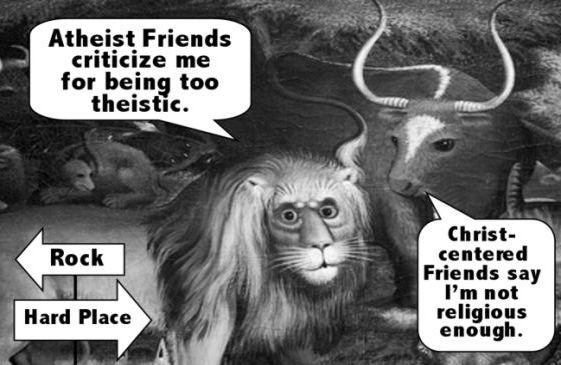
for the b&w rock & a hard place drawing
In the manner of cousin Hicks?
Thanks for the kind words, Stephen. I confess that I cobbled together the “Rock/Hard Place image, using a piece of an Edward Hicks painting as raw material. It’s part of a book called “Quakers Are Hilarious,” more about which is here: https://tinyurl.com/z2xrnk8c
I’m putting in this comment so I can receive notices of other Friend’s comments. This is a really interesting subject and I find myself in unity with most of E.H.’s ponderings.