

In case any liberal U. S. Friends haven’t yet noticed, FGC (aka Friends General Conference) is flailing. Its crowning event, the annual Gathering, is on life support; the prognosis is grave.
As at Balmoral Castle a week or so ago, key “family” members are gathered: some keeping vigil at the bedside, as others huddle over spreadsheets and in focus groups, in a desperate effort to revive and save— err, “re-imagine” — the centenarian patient.
This “re-imagination” effort is aimed at bringing a treatment plan to FGC’s annual Central Committee sessions in October. What that plan might look like is anybody’s guess.
But here is one Friend’s simple proposal, after much thought and attending thirty-plus Gatherings since 1979:
Face the music, and pull the plug.
If that’s not clear enough:
Stick a fork in it.
Ring down the curtain.
Say it Bought the farm.
Let it bite the dust.
Turn up its toes, for
Its number is up.
Let it kick the bucket.
Give up the ghost
Cross the Rainbow Bridge,
Shake hands with Elvis, and
Meet its Maker.
Or in traditional Quaker parlance, “Lay it down.”
Why do I say that?
There are many reasons. In fact, one could point to fifteen hundred and twenty of them, give or take a few.
1520?
Yeah. That’s the difference between 1970 and 440.
1970 was the attendance at the 2000 Gathering, in Rochester, New York (That figure is from memory, but quite close; I was there, and on the planning committee for it.)
Four hundred forty is the reported tally for the summer 2022 Gathering, initially set to meet in person in southwest Virginia, then switched to remote.
Yes, but — Covid.
Sure. But step back to 2019, the last Gathering in the halcyon days before the pandemic struck. At lovely Grinnell College in Iowa’s vast rolling farmland.
The tally there was 800.
That’s off 1150, a 60% drop (again give or take a few) from Rochester. (And 440 marks an almost 80% decline.)
I don’t have all the attendance numbers since 2000, but sufficient to make the trajectory clear enough that even the Central Committee should be able to see it. 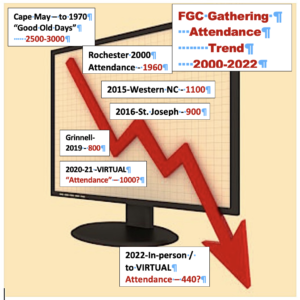 Not that the Committee has been unaware. Like many other Gathering alumni, I’ve been surveyed by them about the Gathering’s condition, more than once. And I’ve not held back.
But my personal experience and feedback is not the point here. While the Gathering strove to be “open to all,” it was never everyone’s cup of tea. I know devoted Friends, more introverted than even me, who could never bear the Gathering crowds and exuberant noise.
So be it. Different strokes: for decades Gathering was still the biggest draw in Quakerdom.
But that was then. In an effort to stem the precipitous decline, FGC commissioned a professional to conduct a detailed marketing study in 2019. (You can read it here.)
There’s much interesting data in the report, numerous numbers crunched, charts, graphs & suggestions.
But the report is missing one crucial feature, the absence of which makes it not much use for real understanding of what has happened and why.
What did it miss? One word sums it up:
Context.
There was no comparison/contrast between FGC Friends and any other group, religious or secular.
This is not an unusual stance for Friends who chronicle or analyze Quakes. Retired Quaker historian/theologian Douglas Gwyn, who published a book, A Gathering of Spirits, describing FGC’s conferences (the Gathering’s name before 1978) thru 1950, put it this way:
“[My] chapters also emphasize wider cultural influences on FGC developments, partly as a corrective to many Quaker histories that are written as if nothing came before Friends and nothing else was going on around Friends. I hope readers will appreciate the occasional references to wider context, even if they make Friends look a little less ‘special.’” [Emphasis added.]
A “little less special”? How dare he.
No doubt it would have cost FGC more to include comparisons to other churches in the report . But while Friends indeed have our peculiarities (or, more elegantly, “distinctives”), we are at the same time in many ways quite similar to other churches and groups; perhaps more so than we prefer to acknowledge. And there is, in fact, much to be learned from such comparisons, especially now.
What? Here are a few examples:
1. We too are getting older (like everybody else). The FGC report did note that two-thirds of Gathering attenders surveyed were over 60, and half of those over 70. (I’m not knocking elderly Friends, as I’m one of them. But still.)
2. Family size is shrinking in the U.S., with only 2.52 members per household on average in 2019, the smallest average size ever in the country’s history. This shrinking process describes liberal Quakers too, which means there are progressively fewer Quaker kids to bring to Gathering.
3. Furthermore, young people, including teens, are leaving most churches of origin in droves heading into the ever-expanding “Church of Nones.” This includes a large hard core of “Dones” who say they’re never coming back. Such shrinkage has occurred among older cohorts too. Even churches like the Southern Baptists, who still preen about being the biggest Protestant denomination, have shed millions of members in recent years.
4. Much of the American middle class, especially families with kids, is being relentlessly squeezed, both for money and time. Even though the in-person Gathering still costs much less than many other national church assemblies, lots of Friends, especially “squeezed” families, struggle with both the fees and the calendar.
Even the FGC marketing report highlighted this:
“For never attendees, lapsed attendees, infrequent attendees and respondents with children living in their household, competition from work, family obligations and summer activities for kids are a significant barrier to attending gathering.” [Emphasis added.]
IMHO that’s an understatement. The so-called “middle class” today includes a growing sub-segment of “precarious”(aka, heavily “squeezed”) workers, those without an equivalent to tenure in teaching, union or civil service protections, many juggling school loan debt, not to mention the near-disappearance of old-style pensions. This raises the stress level of everything else, particularly on families; and it doesn’t take summers off.
 5. Cultural conflict and polarization is widespread in churches and nonprofits, and affects both liberals and conservatives. Other liberal churches are losing members: Unitarians were down 15% since 2000; Brethren and United Church of Christ are hemorrhaging members. American liberals are also notorious for their habit of forming circular firing squads; and it’s happened among Friends too.
6. The Gathering has always depended on a high number of volunteers; that helped to promote community, and decrease staff costs.
However, it’s been well-documented that volunteering, especially in U. S. church groups, has been declining steadily for decades, exacerbated by the Middle Class “Squeeze.” The pandemic only increased the losses, which have begun to bounce back, but are still lagging.
For the Gathering, a drastic decline in volunteers was one of the main reported reasons for canceling the in-person Virginia Gathering.
None of these items indicate mistakes or failures by FGC, except maybe #5, as it reported that internal disagreements helped force cancellation of the in-person Gathering; conflicts over, yes, wearing masks.
But otherwise, might these “outside” factors have affected the FGC Gathering? Have they contributed to the growth of the 1520 gap? I very much believe so. We are not that different from all the other groups mentioned here.
And what was FGC supposed to do about them? Float a Testimony of having more kids? Wave a wand and end the time/money squeeze on so many “middle class” Friends? Write a minute against “competition from work, family obligations and summer activities for kids”? Then reverse the nationwide decline in volunteering?
No, I have no complaints about FGC performance to offer here. But the combination of these outside factors, given a big kick by two years of pandemic, seem to have brought them to what we like to call an inflection point in its history, with two major implications:
1. The Gathering, which gave me so many great memories, is no longer viable. Whatever they said in answering surveys, 1520 Friends have now made that clear with their actions. I’m sorry about it, and it’s not their fault; nobody’s really. But there it is.
2. Yet what will replace the Gathering?
Speaking plainly, I haven’t a clue.
And it doesn’t bother me to admit that. Being a Quaker history nerd, I found out something that perhaps many may not be clear about: Quakerism existed and grew for two hundred-plus years before the first FGC event came together (in Waynesville, Ohio, in September 1882). And that small gathering was a seed that grew and changed, experimented and evolved. Doug Gwyn described some of that in A Gathering of Spirits. I told the story from a different angle in a book, Remakng Friends.
And I’m confident that if we Mind the Light, don’t Outrun Our Guide (and skip the next opportunity for a circular firing squad), we can figure out something else to put in its place. It might take awhile, but Quakers have been imaginative and enterprising for a long time too.
4.95 million. That’s the number (2021) of female heads of households living in poverty in the US. And that’s an improvement.
I have never heard a word in Quaker meetings about “working class” poverty being a wrong that must be corrected. (Note: I don’t hear my messages, can rarely remember them.)
The course correction starts there, and in other similar, mundane matters that lack the intellectual stimulation of getting (rightly, but fruitlessly) up in arms about intellectually and emotionally stimulating matters.
We deserve to fade away: we have no relevance to the daily lives of those most vulnerable — the subject of all the world’s major religions (cf. Hans Kung’s Tracing The Way).
There are folks working to create a non-Theological, Spirit-led model of communities come together. Wish us luck. Or join us.
Well said, Chuck. A cogent analysis.
Thanks, Brent!
As a Quaker by history, a Transcendentalist by love of nature and Thoreau’s Journals, and a Unitarian-Universalist by practice, I appreciate your analysis here. Conditions change, we adapt, while trying to hold to a belief in that of God in every person, and/or a belief in the inherent worth and dignity of every person. It is a discipline.
Thanks, Barbara— we can figure it out.
True, true, and true. Just as one example, the last time I considered attending in person, the only Sunday flight that would have gotten me underway on my multiple-flight trip home that entire day departed at 6:00 AM. Getting to the airport at the suggested two hours previous would have meant leaving FGC at about 3:00 AM, and no shuttle leaves at such a time. If I’d taken the very first shuttle out Sunday, I’d have had to spent all day and all night at the airport till the next 6:00 AM flight, Monday morning. Since FGC thoughtfully books reasonably priced small colleges far outside big cities, I suspect this situation isn’t unusual. So many reasons, none of them unique to Quakerism, why FGC is no longer practical. Reminds me of the old joke about the driver asking directions and being told, “You just can’t get there from here.”
Ann— Yes, yes & yes! I bet lots of us in the 1520 have To-and-from Gathering horror stories. Sometimes I enjoyed the long drives, sometimes I endured them. Now I don’t drive anymore.
Sadly, dropping the FGC Gathering would mean the demise of one of the best ways to help our Quaker children to interact with other Quaker children in fairly large groups. We need that, if we’re to have a future as a Society!
I see those from my “baby boomer” generation fail — year after year, in institution after institution, Quaker and non-Quaker — to understand or meet the needs of younger adults and their families. I fear that the enduring principles on which these groups were founded may not survive.
Then I think: They’ll figure it out if we leave them a reasonable legacy of democracy and equality.
Then I ask if our generation is leaving that legacy in the “big picture” (especially in the USA as a whole) and I worry even more….
Thanks, Chuck, for sounding a needed alarm!
Dave, Thanks for responding. I agree that the Gathering inits day was great for Quaker kids and building community among them. But it’s not a question of “dropping” it. The 1520 Friends have made it nonviable; the task is to face that and create something else.
The movement is dying for the same reasons that the Green Party of Canada is dying. When the loudest shout but do not listen they trample the landscape eventually replacing what was once a garden by a desert.
https://www.cbc.ca/news/politics/green-party-president-quits-tells-members-the-dream-is-dead-1.6579335
Hi Friends. Chuck, thank you so much for this post. I appreciated reading it.
I’d like to ask Friends to strongly consider attending one of the remaining Gathering Anew focus groups even (especially!) if you feel like it’s time for the Gathering as we know it to end.
I think all thoughts about this are valuable and must be heard.
Disclosure: I work for FGC, but my vested interest is in the truth, not a specific outcome.
Thanks for this note, Rashid. Hope the other focus groups go well. I’ve had my say. As for being heard, that’s up to FGC, isn’t it?
Methinks thee protesteth too much.
Dire yes, deathly and moribund, not quite.
I disagree with your conclusion, but then, I’m an optimist.
Could be white privilege leaving, but far more likely that persons within the FGC command structure want to get rid of this leftover from the past to make way for some new grand thing of equity.
Do you really think many people really welcome the woke revolution, and being called racists by the few? I doubt many do, but keep up the work gang. FGC will in time be as much a going thing as those ‘Progressive Friends’ of the past.
Yearly Meeting is the closest I’ve had to a “vacation” in years, and both time and cost are dear considerations. FGC is one step beyond that.
A familiar tale, Jnana.
I keep thinking about this post, especially the tongue-in-cheek remark about writing a minute against “competition from work, family obligations and summer activities for kids.” One aspect of our testimony of simplicity is that we are called to remove from our lives any obstacles to a deeper relationship with Spirit. I myself don’t always heed this advice, but I think it’s worth reflecting on it and spending time in discernment. I keep remembering how Eric Liddel refused to train or compete on the Sabbath, and how it may have cost him an Olympic medal. Where does our spiritual life fit into our overall priorities?
Hi Sabrina, I think you’ve got Simplicity right, and I would only add that in my Quaker experience, Simplicity has for me long been the most complicated testimony to grapple with. Not that it’s mistaken or irrelevant, but that my world seems organized for distraction, confusion, and overload, in ways that are in the very air, and whatever my aspirations, I have to keep breathing, don’t I? What to do?