

 Friday June 30 was a major anniversary. Did you see the parade past the Capitol? Catch the huge fireworks display? Watch the big superstar concert? No?
Me neither. But I’m kidding about the hoopla: June 30, 2023 will rightly be remembered for bad Supreme Court decisions, with anger and resistance, not any big national celebrations.
But I’m not kidding about the anniversary: June 30, 2023 marked 50 years since the end of the last military draft.
For Americans of a certain age, the draft is a living, often traumatic memory: in its 25 years (1948-1973) it subjected at least two million men (& their families) to involuntary military service, in and between the Korean and Vietnam wars. In these conflicts 90,000 U. S. troops were killed, at least 250,000 wounded, and millions more grappled with often crippling PTSD.
Anti-draft agitation went from a fringe phenomenon to a mass movement. Some 200,000 were indicted for draft evasion or refusal, and 8,000 convicted. Thousands also fled over the northern border; the Canadian government estimates as many as 40,000 came; most were welcomed as immigrants. The last draft calls came in January 1973. But that was only a “suspension”; the law authorizing it lasted through June 30.
Among those who recall this draft, some wonder, and not a few worry about whether conscription might return. Occasionally would-be soothsayers have predicted it.
I was one of those. In 2003 I published an essay predicting that the imminent invasion of Iraq would strain U. S. troop strength to its breaking point, and force Congress to re-institute conscription.
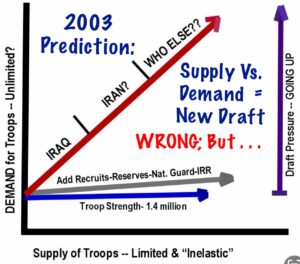 My reasoning was simple: demand for troops would soon exceed supply, and when the gap between them got wide enough . . . . I prepared a graph to illustrate it.
But no draft happened; my prediction (fortunately) was mistaken.
But the growing supply-demand gap on my chart was real, and costly. How did the military close it, and stave off the draft pressure?
Mainly they “closed” it on the backs of the troops: “demand” was restrained by sending many fewer than the invasion/occupation planners had urged. And “supply” was expanded by such draft-like tools as “stop-loss” orders, which involuntarily extended the enlistments of many thousands of troops. (Yes, the military can do that; it was noted in the small print on the back of enlistment forms, a section routinely passed over by recruiters).
Among the costs were: more casualties, higher rates of PTSD, rampant soldier suicides, a hidden epidemic of domestic violence in military families, and, not least — that they lost that war (also the parallel fight in Afghanistan.) A pretty damned big bill.
But the upside: no draft.
So now it’s twenty years later. Where surviving worrywarts once fretted about a new draft coming for their generation’s sons, they can now wonder about the fate of grand and even great-grandsons.
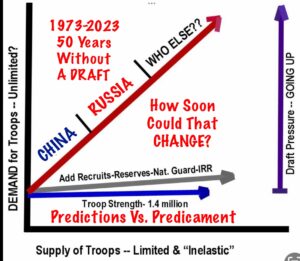 Is there reason to worry? No predictions from me this time.
But predictions aside, the predicament seems similar: the list of potential adversaries is long and weighty: China, Russia, Iran, to name a few. A war with any of them could generate major “demand.” And anyone who has been paying attention to the U. S. Military knows that its recruiting (the “supply chain”) has for years been dismal: in 2022 the Army’s shortfall was equal to losing two divisions without a shot being fired. My 2003 graph was easy to update.
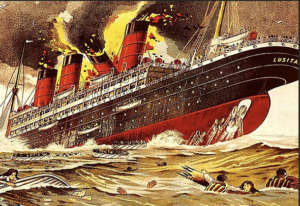
It’s clear enough that there’s currently no measurable public support for a revived draft. But that was also true prior to both world wars. A combination of external blows (sinking the Lusitania, the Pearl Harbor attack) plus skillful domestic propaganda, overcame that reluctance. The fact that tens of millions continue to believe the 2020 election was stolen suggests that contemporary propaganda techniques have not lost their potency.
So let’s imagine (not predict) that some crisis blew up and confronted the U. S. with an enormous military challenge. How would a new draft happen?
The expiration of the draft law marked on June 30 means that Congress would have to vote to authorize it, and that raises a big question:
What kind of a draft?
Here there’s an easy answer and a more complex one.
The easy answer is what can be called the Instant Draft, or as I like to put it, the Draft-In-A- Box.

What’s that? When Congress reestablished Selective Service registration (not an actual draft, but the database for one) in the early 1980s, it told the Selective Service bureaucrats to design two model draft systems – forms, regulations, procedures – and keep them on the shelf within easy reach, for use when Congress (not the president alone) gave the word.
The differences between these two versions of the Draft-in-A-Box are mainly matters of timing: one is supposed to be ready to go in about two weeks; the other in six months. (Neither model, by the way, has many deferments, nor do they offer much to those who would hope to be conscientious objectors.)
Thus, the easy answer to the question of what kind of a draft we could get is: One of the off-the-shelf models. This is what many of my military counselor colleagues expect to happen.
But I don’t. Instead, I look to the second, more complex Scenario: Congress says Yes to the draft — but not until after it has tinkered with (mangled?) the Draft-in-a-Box, so that it comes out with significant (and unpredictable) differences from the off-the-shelf models.
Different how? Who knows? The draft is one issue that hasn’t (yet) been defined in current polarized terms, with Democrats wanting one version, and Republicans the opposite. That’s good, but it also adds to the unpredictability.
My sense is that whatever came out of the Hill, it would include lots of new (or refurbished) deferments and exemptions, aimed primarily (but covertly) at protecting the sons of the upper middle and upper classes, which are, when we speak truthfully, the main constituency of both parties. (By the way, I speak here of sons intentionally. The Supreme Court has already said that Congress may exclude women from a draft. And I’ll make this one prediction: they will. )
This second forecast is based on two related considerations:
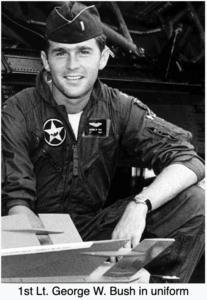
First, along with two draft-dodger presidents (G. W. Bush and Clinton), we have had many a draft-dodger in Congress.
And second, the consistent track record of Congress has been one of providing and protecting special benefits and privileges for the well-heeled. This observation, by the way, applies across party lines. And across generations. During the Civil War, for instance, Congress allowed those with money to simply buy their way out of the draft, for $300 (about $7200 in 2023 cash).
Today rebranding is much slicker, but think about it: after giving the affluent and near-affluent tax breaks after tax breaks, exempting them from estate levies, and handing them other bennies too numerous to mention, will our solons really turn around and force-march their darling boys away from the prep schools, orthodontists and name-brand colleges to boot camps and actual war?
My view: Not while they can still spell “dark money.”
Thus, if and when we got a new draft, I would also dare to predict this: it would be riddled with much the same range of loopholes which helped make previous ones odious (and fatal) to so many of its less-privileged subjects.
These loopholes will be repackaged, of course, and carefully camouflaged. Congress could count on the support of the incumbent beneficiaries of these perks, and the Members will know well enough that large chunks of the target population won’t remember the Vietnam draft, and don’t vote anyway.
One possible form a new, ostensibly more class-sensitive draft could take was prefigured in 2003 by Rep. Nick Smith, a Michigan Republican. His HR 3598 proposed to set up two tracks of service; a one-year, “army camp” option, whose members would mainly do guard duty around sensitive installations within the US.
The others would be steered by the usual bag of recruiting incentives (promises — often not kept — of college money, technical training etc.) to take the other track, into the actual combat arms, heading overseas and into harm’s way. Is it necessary to spell out how such an arrangement would dovetail with class interests?
Smith’s proposal caused flutters among peaceniks and some grandparents. Yet the bill went nowhere, and he retired two years later.
But the point here is not political probabilities, rather that if Congress were to reconsider the draft, there’s no telling what would emerge from its sausage-making machine. For instance, if the House was in the hands of the punitive antiwoke caucus, they could skip any provisions for those, like me, who declared themselves conscientious objectors to the last one.
During World War Two, the government approved a Civilian Public Service program for COs, which sent most (including numerous Quakers) to work camps in rural areas doing road or forestry work. But many of the COs wanted to do relief work in war areas overseas; that felt more in line with the peace witness. Their church sponsors, and even president Roosevelt and his wife Eleanor, supported this idea, and a few COs actually went to China for a pilot project, and more prepared to go after a year’s training.
But the idea offended some powerful congressmen, including a committee chairman named Richard Starnes from (wait for it) Alabama. Starnes did not like the Roosevelts or COs; and in July 1943, he inserted a provision in the military appropriations bill prohibiting use of any government funds for any support of COs working outside the continental U.S.
That killed the war relief idea. One elderly Quaker CPS veteran told me that he and several other were enroute to join the China relief project when the Starnes amendment passed. They were obliged to get off their ship and board another headed back to the States. (Many CPS veterans eventually took part in overseas relief work; but they had to wait for the war’s end to do so.)
For me this story is a reminder of the saying that while man proposes, God (or in this case, Congress) disposes. And if Congress has rather less grandeur than the Almighty, its ways are often equally unsearchable and seemingly capricious. If that body ever emits a draft program again, my sense is that its character and impact will be as unpredictable (and hazardous) as previous versions.
I hope that does not happen. But I can’t predict it.
While 1973 did mark the last draftee being discharged, Nixon halted selected in 1971. Having graduated in June 1971 I was ordered to work as a CO. Some of my Earlham College classmates objected to the Federal District Court in Cincinnati. Because no one was being drafted into the army, the court agreed that drafting COs was unfair, and I was ordered to stop my alternative service in December 1971.
The worst thing to happen to the rest of the world was the end of the US draft. It meant that Americans would become entirely complacent about their country’s foreign policy, which has the moral compass of the Atlantic Slave Trade. So long as Americans are not drafted to fight and the poor are enticed to enlist and broaden their horizons, the US can function as the worst imperialists the world has yet seen. The MIC can steal half the taxes we pay for their lucrative exploits, and as long as there is no draft, the American public will happily swallow all the propaganda it is fed.
My cousin from Hamburg reports that Germans at large recognize the US provoked the war in Ukraine, and feel like they are puppets to the US. Even the Germans, one of the largest economies in the world, feel like pawns to US designs.
Does that mean that the best thing that could happen to the rest of the world is that the draft is reconstituted? I don’t want to find out at the expense of my own sons, but the question is out there. If our sons were forced to man the 85 military bases the US runs on foreign soil, would we be so willing to see them there? Russia and China have only a dozen each, in countries bordering their own. Where do we get off with this entitlement to bully everyone else in the world? We don’t get drafted to enforce it. That’s how we get off.
Jan ’72 I was in AF basic and headlines said “draft to end soon.” Summer of ’73 I was new at NSA base on Turkey, draft ended, Yom Kippur war, SecDef Laird issued memo saying cannabis use was no longer enough for a discharge. Lifer threat of sending attitude problems to Vietnam disappeared. So…
Is it possible for a country to have a mandatory period of national service without calling it a military draft, Chuck? I think that could help bring youth together who might not otherwise get to
know someone outside of their circle. Or am I being naive?
Claire, what’s in a name? They could call it anything; they could call it cheese grits. If it’s “mandatory,” it’s a draft. What’s more significant is the nature of the service: for war, or for something else. Yes,the government could draft people for a period of “national service,” working on many other kinds of projects. Maybe someday that will happen; I’m not holding my breath. When I was young, I thought, I’m not really an anarchist or a hard libertarian: if the government wanted to draft me to work on cleaning up environmental hazards, or building Habitat for Humanity-style housing for the homeless, I might not enjoy the labor, or be very good at it, but I would have no principled objection to it, so I’d go. That’s also why I submitted to doing “alternative service” instead of being drafted into the military: two years working for a non-military, but government-approved Quaker project. Some Vietnam era draft objectors refused to let the government tell them to do anything like that, and either went to prison, faked an injury, or took off for Canada. The same attitude surfaced during the pandemic among some who refused on principle to get shots or wear masks if the government told them to. I did both masks and shots; for me they were a hassle, but not “oppression.”
I’m not sure how to interpret your response, is it your view that there are those who will rebel against any mandate, without regard to its purpose?
My point had to do with trying to bridge the polarization afflicting our country by expecting everyone aged 21-25 ( or some such designation) to devote a couple of years of service. If possible, the “draftees” should be able to have a say in the area they prefer or are most fitted for. Admittedly that’s a stretch. In my utopian vision, the young people thrown together would appreciate the things they have in common.
Hi, Claire. Yes, my sense is that there would be some folks who would not want to comply with mandatory service programs; the resistance to masks & vaccines are recent examples, and resistance didn’t start with Covid. Maybe such resistance could be managed; but I wouldn’t bet the ranch on that; maybe not even the ranch dressing.
Bringing diverse folks together is definitely a good idea; but universal and mandatory? I’d lean toward incentivized voluntary versions.