Ukraine might yet repel the Putin invasion. Or it may be ground under by Russian forces, then snuffed out as a nation and culture.
Either way, the Ukraine war appears to be redrawing the strategic map of northern Europe, with implications reverberating far beyond Scandinavia.
A double strategic earthquake is underway, without a shot having been fired (yet), in long-neutral Sweden and Russian-tilted Finland. This Nordic pair now appear poised to dump generations of policy and join NATO.
The Guardian’s Patrick Wintour examines this sudden, seismic switch, and weighs its potential impact.
Meantime, we hear also from Gwynne Dyer. An independent Canadian reporter/analyst, Dyer is now based in London. He has a doctorate in military & strategic history, and has served in several military forces, and I have long admired his work.
Here he considers the pause in the war due to the spring thaw (aka Mud Season), and another possible European earthquake, if French president Macron is defeated by a nakedly pro-Putin challenger in next weekend’s electoral runoff.
The Guardian: Putin thought Ukraine war was a missile to Nato. It may be a boomerang Analysis: To turn stolidly non-aligned Finland and Sweden into members would join pantheon of great strategic blunders Patrick Wintour Diplomatic editor — Friday, 15 April 2022
It is conceivable that by the end of the year Nato’s land mass, GDP and territorial borders with Russia may expand by nearly as much as they would have if Ukraine had achieved its distant goal of eventual membership of the western defence alliance – if not more.
The brutal manner in which Vladimir Putin has tried to foreclose Ukraine’s security options has led to a sudden change in thinking in Finland and Sweden that has been all the more powerful since it seems to have come from below, as opposed to from the political elites.
It is not yet a done deal. Opinion so volatile, and previously so settled in its opposition to Nato membership, could swing back towards the comforts of semi-neutrality. Russian nuclear threats, already starting, may intimidate voters into having second thoughts.
The process may be fraught. Many brands of Nato membership exist, and have yet to be fully explored by the Finns and the Swedes.
But by Nato’s Madrid summit in June, Nato will be on course to expand its population by 16 million, its GDP by €800bn and its land mass by 780,000 sq km. Ukraine, by contrast, has a population of 41 million, a land mass of 603,000 sq km and a GDP of €155bn. A new 1,300km border with Nato could be formed, the precise opposite of what Putin set out to achieve in the treaties designed to shrink Nato that he ordered the west to accept last year. What is worse for Moscow, Nato could have strengthened itself in the Baltic Sea, right next to Kaliningrad enclave, the strategic Russian naval base.
By invading Ukraine, Putin thought he had hurled a missile at the west. It has emerged to be a precision-guided boomerang. To have turned two stolidly non-aligned countries into Nato members would join the pantheon of great strategic blunders of wartime.
It is all the more extraordinary since the turnaround has been so rapid. Finland, with its brand of semi-neutrality for the past 70 years and emphasis on consensus-building, tends to shift foreign policy with glacial speed. Finland’s tolerance of Putin was so embedded that some on the left claimed it strayed close to collaboration as the Finnish political elite shunned the Russian opposition.
In the government’s annual survey in December, Finnish support for Nato membership stood at 24%.
Four months later, Finnish politics has somersaulted. Support for Nato membership stood at 68%. Surveys now show more than half of the 200 parliamentarians back Nato membership. In the 2015 Finnish parliamentary elections, 91% of SDP candidates were opposed to Nato membership. The Finnish SDP prime minister, Sanna Marin, said everything had changed. Russia is “not the neighbour we thought it was”, she said.
Alexander Stubb, a former Finnish prime minister, said Finland’s membership is based on rational fear, created on the day of the Russian invasion. He predicts the Finnish application will be with Nato HQ by the end of May. “The train has left the station.”
In a speech earlier this month to the council of the largely agrarian Centre party, Annika Saarikko explained that sometimes history moved fast, measured in weeks rather than years: “In the foreseeable future we cannot rely on a mutually agreed to international order or a functioning relationship with Russia for our security.” She added that Nato membership came with obligations. “Finland would not just be buying some fire insurance. It would be joining the central fire brigade.”
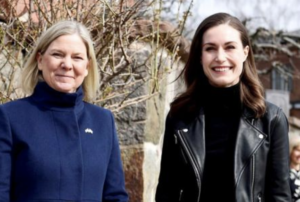
Such has been the Finnish turnaround, it has adopted the unusual role of exemplar to the larger Sweden. That requires the two countries respecting the relationship, sensitivities, and different political cultures. The ideal from Nato’s perspective is that the two countries join simultaneously, and polls show support for this. But Finnish diplomats say they cannot be seen to be interfering in sovereign Swedish decisions. Marin stressed at her joint press conference in Stockholm with the Swedish prime minister, Magdalena Andersson, that coordination with Sweden “is sought but is not a prerequisite”, adding: “Finland does not dictate schedules or conclusions to Sweden nor does Sweden dictate to Finland.”
Left: Swedish Prime Minister Magdalena Andersson; and Finland PM Sanna Marin, talking about NATO.
It is vital for the ruling Social Democrats, now launching an internal policy review, to be seen to be in charge of its own destiny. After all, last November the party had clearly affirmed its position that it opposed a foreign policy of alliances. Yet four centre-right parties now support Nato membership and two parties to the left are opposed to membership, claiming joining Nato implies coming to the defence of the authoritarians running Turkey and Hungary. With parliamentary elections looming in September, the SDP will want the review completed without the party descending into left-right splits.
One of the difficulties is that given Russia’s behaviour, no plan B such as greater Swedish-Finnish defence cooperation, or the Nato partnership for peace, looks as concrete as full membership. Most Nato countries see Sweden and Finland as huge military and intelligence assets. “It would complete a missing piece of the puzzle of Nato strategic planning”, said Mika Aaltola, the director of the Finnish Institute of International Affairs.
But Finland would have to apply for Nato membership not knowing the precise future relationship. In its security document published this week, Finland insisted: “Membership would not oblige Finland to accept nuclear weapons, permanent bases or troops in its territory.
For example, in the early stages of their membership, founding members Norway and Denmark imposed unilateral restrictions on their membership and have not permitted permanent troops, bases or nuclear weapons of the alliance in their territory during peacetime. Nato’s enlargement policy, which took shape in the latter half of the 1990s, has been based on the principle that it will not place nuclear weapons, permanent troops or permanent bases in the territory of any new member country.
But if Finland, or indeed Sweden, did set a mass of limiting preconditions concerning nuclear weapons, permanent bases or forces, the application process might be extended.
A lengthy accession process in turn carries risks since Russia, using the full spectrum of war’s grey zone, will seek to harass, and even paralyse. On the day the Ukrainian president, Volodymyr Zelenskiy, spoke to the Finnish parliament, Russia was accused of cyber-attacks and invasions of its airspace. Finland has already canvassed Nato members for security guarantees in the four months to a year that it was in the Nato ante-chamber awaiting full acceptance.
So there is an incentive to speed the application without delegitimising the domestic consultation.
For those who fear Nato escalating the conflict inside Ukraine, a sudden extension of article 5 obligations in the north remains alarming, and may make Putin even more convinced he was right to confront a Nato policy of encirclement.
But for all its talk of red lines and the stationing of nuclear weapons, can Russia really open a second front to the north when the primary front to its south-west is proving so costly in lost lives, reputation and treasure?
Ukraine wants more tanks, self-propelled artillery and combat aircraft from NATO countries for its war with the Russian invaders, but it won’t be getting them in the tranche of military aid that is being decided in Washington right now. There is a good reason for that.
Kyiv will be getting bigger and better drones, lightly armoured vehicles like Humvees, and maybe some anti-ship missiles, but Joe Biden’s administration is still playing Mother May I?/Grandmother’s Footsteps with Moscow. He moves one cautious step up on the list of weapons he gives Ukraine, watches for the Russian response, then takes another step.
It doesn’t matter at the moment, because this is the “rasputitsa,” the season of rain and mud in eastern Ukraine when off-road travel for heavy vehicles varies from difficult to impossible. The Ukrainian forces won’t be attempting any grand offensives and the Russians are very likely to get bogged down.
The mud season will probably last for another six weeks. Strict military logic would argue for postponing the Russian offensive in eastern Ukraine until then, but Putin probably can’t wait that long. The defeats and losses he suffered in his first attacks in northern Ukraine will gradually but inevitably leak out to the Russian public, so he needs a quick victory.
He might get lucky, but there is unlikely to be a decisive Russian victory for two reasons. First, the Russians in the east will be attacking the best-trained, most experienced part of the Ukrainian army, well dug into defences that have grown every year since 2014. It can probably stand its ground and inflict heavy casualties on the Russians.
That would not save the main Ukrainian army if other Russian forces can make a “pincer movement” behind it and cut it off, which is precisely what they will now try to do.
The Russian troops now besieging Mariupol on the south coast will advance to the north as soon as it finally falls. Other Russian troops are already attacking south from around Kharkiv.
If they succeed, Ukraine will have to seek a ceasefire, ceding all the lost territory to Russia, and Putin will have his victory. But first, the Russians will have to advance about 150 kilometres on a single, two-lane road that passes through villages ideal for ambushes. And it’s the rasputitsa, so you can’t go around the villages.
This is precisely the task that the Russian army spectacularly bungled in its attempt to seize Kyiv last month. What are the odds that it will do better this time?
Assume that it’s late June, the ground is drying out, and the Russian troops are exhausted, overextended and demoralized. In Kyiv, they will be thinking about taking back their lost territory — at least the territory they have lost since February, but some will also be thinking about recapturing the territories that Russia conquered in 2014.
That’s when the extra tanks and self-propelled artillery that the United States is not giving Ukraine now would come in very useful. But it would also be the moment of utmost humiliation for Vladimir Putin, and it is always wiser to leave your defeated enemy an avenue of retreat.
Perhaps this entire article is an exercise in counting one’s chickens before they hatch, but you may be sure that they are also being counted in Washington and in NATO right now. Nobody will admit out loud that Ukraine is being kept on a leash, but of course it is.
Six weeks ago it had not occurred to anybody that doing that would be necessary, because they all expected Ukraine to lose. You can sympathize with its desire to take revenge if it wins, but for the sake of peace in the future it cannot be allowed to do that.
Gwynne Dyer
GWYNNE DYER on the French Election — April 14 2022:
French President Emmanuel Macron won the first round of the presidential election last Sunday, but he’s still in trouble. He knew he would be. Here’s what he said on Saturday.
“Don’t believe the pundits and the pollsters who tell you that it’s impossible (that the far right will win in the second round of the election). Look at Brexit and so many elections, all that seemed improbable and yet came to pass. Nothing is impossible.”
In fact, it’s not even unlikely. Strategies have consequences, as Macron is now learning.
The strategy that made Macron president last time (2017) has succeeded so well that it may cost him the election in the second round this time, on April 24.
Macron’s strategy has always been to exaggerate the difference between the centre and the rest. If the left was too far left and the right was too far right, then the politician representing the centre (him) was the only rational choice.
It worked for him in 2017, when he waltzed into the presidency with a 66 per cent majority of the vote, despite the fact that he had never held elective office before. Fast forward five years, however, and the fantasy has become the fact.
The traditional moderate left-wing party, the Socialists, has been devoured by Jean-Luc Mélenchon’s extreme left La France Insoumise (Rebel France), which advocates withdrawal from NATO and also, in effect, from the European Union.
The Socialists only got 4.8 per cent in the first round of voting on Sunday, which means they don’t even get their election expenses reimbursed. The party may actually declare bankruptcy and disappear.
The traditional centre-right party, the Republicans, is suffering exactly the same fate. It too has fallen short of the five per cent threshold and may go broke. Its place as standard-holder of the right has been taken by Marine Le Pen’s National Rally, which remains ultra-nationalist, racist and anti-immigrant, despite a cosmetic makeover that downplays its uglier policies.
Le Pen also benefited from the fact that an even harder-right candidate, xenophobic television pundit Éric Zemmour, made her look moderate, if only by comparison. She will inherit all his votes in the second round of voting, naturally, but Macron’s problem is that she may also inherit some of Melenchon’s hard-left supporters on April 24.
That sounds crazy, but it’s Macron’s own fault. By occupying so much of the centre ground and driving the moderate parties of the centre-left and centre-right to extinction, he left all those who wanted something more than his pragmatic, unexciting centrism no options except the extremes.
And the two extremes have some things in common.
They have a shared hostility to the European Union, for example, and most left-wing voters can remember that, even though Le Pen has been downplaying it recently. They both have a strong populist tone: Le Pen may be a woman of the right, but she’s promising that people under 30 won’t have to pay income tax and everybody can retire on full pension at 60.
Fully half of France’s voting population has just voted for extremist parties, and according to the polls Le Pen is heading into the run-off still holding most of those votes. The latest numbers say Macron 51 per cent, Le Pen 49 per cent, which is effectively neck-and-neck.
She is much more than Donald Trump in a skirt. She is far more intelligent than he is and not at all corrupt. She is racist and Islamophobic, but much better at dog-whistling her true convictions.
This does not bode well for Macron, especially because it has always been hard for French presidents to win a second term. And, while the other losing parties told their supporters to back Macron in the second round, Mélenchon just told his supporters “You must not give a single vote to Marine Le Pen.” (But you could abstain, if you like.)
Despite Covid, France is actually in good shape after five years of Macron. Investment is up, inflation is low, jobs are plentiful, the country is even opening more factories than it closes. But the French do not feel good about their lot and Le Pen could actually win.
If she does, a great deal will change, and not just in France.
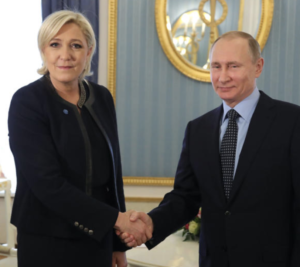
The newfound unity of The West in the face of Russia’s invasion of Ukraine will vanish: Le Pen’s campaign pamphlets feature a picture of her with Vladimir Putin, another hard-right icon.
Le Pen & Putin: enchanté
She has stopped talking aloud about Frexit, but it’s still there in the background somewhere, as is the anti-immigrant racism her party has always peddled.
She is much more than Donald Trump in a skirt. She is far more intelligent than he is and not at all corrupt. She is racist and Islamophobic, but much better at dog-whistling her true convictions.
If the League of Authoritarian Leaders ever needs an honorary president, she would be the best candidate for the job.
Despite all this, I think Macron will win, because the French aren’t fools. But it may be a near-run thing.
Gwynne Dyer’s new book is The Shortest History of War.