
Update: Two Russians flee Ukraine draft by crossing Bering Sea by boat to Alaska
Individuals landed at beach on remote island to avoid compulsory military service and have appealed for asylum, reports saying 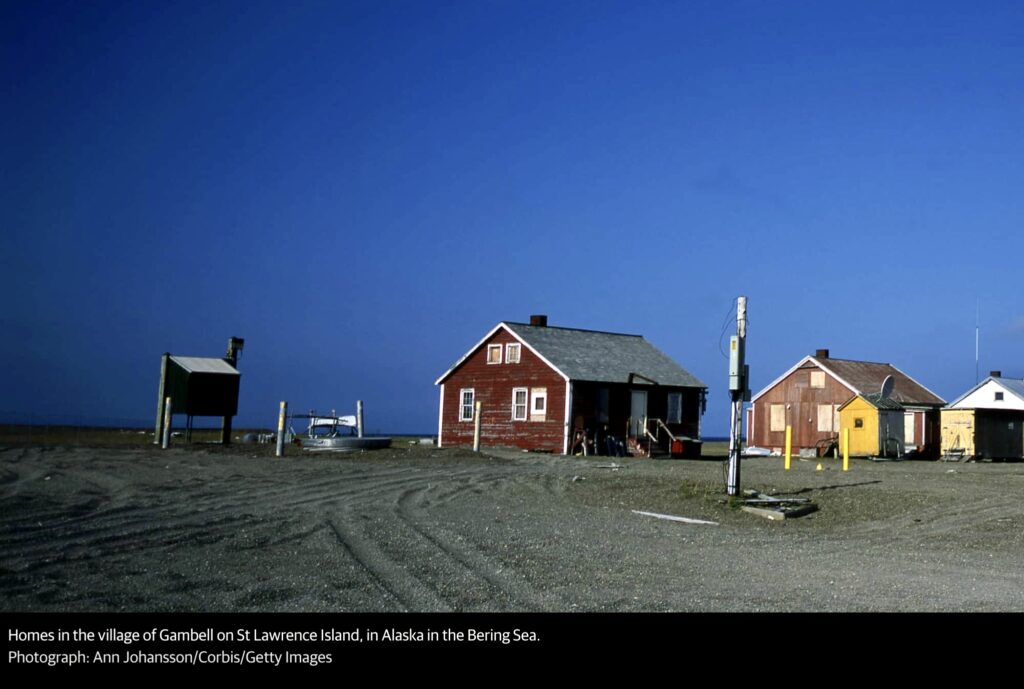
Two Russians have crossed the Bering Strait by boat in order to avoid conscription to fight in Ukraine and landed on a remote Alaskan island where they have appealed for asylum, according to reports from the region.
The pair beached their small boat on Tuesday near Gambell, a settlement of about 600 people on St Lawrence Island, 46 miles from Siberia’s Chukotka peninsula, earlier this week.
Town clerk Curtis Silook told the Alaska’s News Source websitethat the men said they had sailed from the Russian town of Egvekinot, approximately 300 miles by sea. They were flown off the island later on Tuesday, he said.
A spokesperson for the Department of Homeland Security said: “The individuals were transported to Anchorage for inspection, which includes a screening and vetting process, and then subsequently processed in accordance with applicable US immigration laws under the Immigration and Nationality Act.”
“These two individuals that came over from Russia in a boat and were detained in Gambell … my understanding is they are in Anchorage now being dealt with by federal authorities,” Alaska’s governor, Mik Dunleavy, said. “We don’t anticipate a continual stream of individuals or a flotilla of individuals. We have no indication that’s going to happen, so this may be a one-off.”
Dan Sullivan, a Republican senator from Alaska said that US Customs and Border Protection (CBP) had yet to decide whether the two Russians would be allowed to stay in the US.
Sullivan said he encouraged the CBP “to have a plan ready with the Coast Guard in the event that more Russians flee to Bering Strait communities in Alaska”.
His fellow Republican senator from the state, Lisa Murkowski said that a CBP plane had to fly 750 miles to reach the scene and said it “underscores the need for a stronger security posture in America’s Arctic”.
[The Washington Post added: “Murkowski and fellow Republican Sen. Dan Sullivan said the incident has exposed a need of greater security in the Arctic, where Russian military ships and aircraft have increasingly asserted their presence. Seven military vessels from Russia and China were spotted in the Bering Sea last month sailing in international waters. “We are actively engaged with federal officials and residents in Gambell to determine who these individuals are, but right now, we already know that the federal response was lacking,” Murkowski said. “Only local officials and state law enforcement had the capability to immediately respond to the asylum seekers, while Customs and Border Protection had to dispatch a Coast Guard aircraft from over 750 miles away to get on scene.”]
Karina Borger, a spokeswoman for Murkowski told the Associated Press “the Russian nationals reported that they fled one of the coastal communities on the east coast of Russia to avoid compulsory military service”.
A spokesperson at the Russian embassy in Washington has told Russia’s Tass news agency that they are aware of the case and plan to have a phone conversation with the two men soon.
Many Gambell residents are ethnically closer to Siberian Yupik coastal communities than to other Alaskans. Such crossings across the dangerous seas of the strait are rare in recent decades. Twelve Siberian men made the crossing in 2014, marking the first such crossing in 14 years.
In 1948, the FBI director, J Edgar Hoover ordered a stop to crossings by traditional communities, suspecting some of the visitors were Soviet spies. The ban was referred to as the “Ice Curtain”. Crossings resumed after the cold war but then were banned by Russian authorities after a father and son drowned on their way back from Gambell to the Siberian coast.
Russians, especially men of draft age, have been flooding out of the country since Vladimir Putin declared a mobilisation to prop up his failing invasion of Ukraine. There are reports that conscription has been imposed much more broadly and severely among poorer rural communities and ethnic minorities in the Caucasus, Mongolia and Siberia.

| January | April | July | October | |
|---|---|---|---|---|
| Daily max | 12 °F (−11 °C) | 20 °F (−7 °C) | 50 °F (10 °C) | 34 °F (1 °C) |
| Daily min | 3 °F (−16 °C) | 10 °F (−12 °C) | 41 °F (5 °C) | 29 °F (−2 °C) |
Villages
Thanks for posting this. I’m perplexed and confused and disturbed at the truth of how perplexing and confusing and disturbing matters of immigrants struggling to breathe free or simply survive is, and always has been. Just when you think you’ve seen it all, thanks to Gov Rick, you see that you’ve not yet seen it all. I’ll pay attention to what happens next in Alaska, with fingers crossed.
Thanks, Judith! Perplexing, indeed! As they say, this is a “developing story” — stay tuned.
Without knowing full details, I believe that these two Russians who braved the cold waters between Siberia and the US to St. Lawrence Island ought to be admitted with open arms as refugees fleeing their country for freedom and asylum. This is what Emma Lazarus’s poem on the Statue of Liberty is all about.
America historically has always been a haven for those seeking liberty, freedom and democratic ideology. They had a tough voyage. All things being equal, we should incorporate them into our society. John Spitzberg, North Pole and Anchorage, Alaska