
The Zombie Apocalypse is here.
Or at least it is in Phoenix. And the Z’s are hot & famished.
But that’s not the biggest news. The real kicker is that they’ve refined their taste: keeping up with the times, they still want to feed on brains.
But they’ve discovered a new source of french fried or rotisserie crisped concentrated brain matter — fresh hot and smokin’ — in Phoenix data centers.

Well, okay I made up the zombies; but there’s more about the apocalypse. I began uncovering this story on Thursday morning, I was thinking about doing a blog post. So I touched the Firefox icon, and when it opened up touched the link for this site, A Friendly Letter, which has been my baby since sometime in 1998.
Then a thin blue line starts inching across the top of my Ipad screen. When it gets all the way to the right side, the WordPress menu will open up, and once i touch “Add Post,” I’ll be on my way:
Text, graphics, editing & finally “Publish.”
I’ve done it just about 2000 times. A post can take a long time & a lot of work, but today’s should be short. I’m thinking of a farewell verse to Karoline Leavitt; the lines are already written & the photo is ready. Piece of cake.
Except . . .
The blue line seemed to have stalled about an inch in.
Sometimes it’s slow. Internet is crowded or something. I wait, not patiently.
But 5 minutes later the blue line gives way to an error message: couldn’t connect, something like that.
Hmmm. What about my other main site, quakertheology.org?
Same deal: stall, no connection.
Long story short: I’m eventually on the phone to Hosting.com, where I rent space for the sites, talking to a tech support fellow with a vague but intelligible Asian accent. Hosting,com has its planetary headquarters in Luxembourg, its U. S. Offices are in Jupiter, Florida, and eventually he admits he’s talking to me from the Philippines.
“So where are my websites and files,?? I ask, getting nervous.
“Phoenix,” he says.
Phoenix, where — the weather site tells me, it was 100 degrees, yesterday, and feels like 110, and headed back there today.
So after my electronic voyage through Luxembourg to Philippines, and Houston back to North Carolina, the visible end result? Here’s a real notice from the Hosting.com status page:
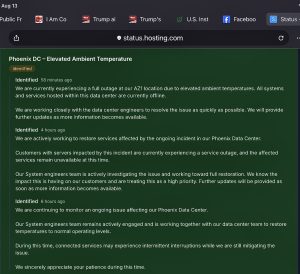 Sorry about the small print. Here’s the key takeaway: “We are currently experiencing a full outage at our A21 [Phoenix] location due to elevated ambient temperatures. All systems and services hosted within this data center are currently offline. We are working closely with the data center engineers to resolve the issue as quickly as possible.. . .”
My websites popped back up on my screen about 9:30 pm. The Big Chill worked.
This time.
Today I asked ChatGPT about the news headlines in Phoenix today, especially about data centers. There were LOTS. One was that Metro Phoenix includes the #2 largest number of data centers (next to northern Virginia), with around 180 in all.
And the more I read, the creepier and scarier they got. Compared to what’s below, a Zombie Apocalypse might be less of a disaster.

Here’s a sampling:
AI news aggregation:
The Namecheap and Hosting.com outages [in Arizona] on August 13, 2026, were caused by a massive cooling system failure at the RadiusDC data center facility (housing phoenixNAP) in Phoenix, Arizona. Heavy overnight monsoon storms triggered severe power anomalies and grid fluctuations that knocked out the building’s industrial chillers.
Because server racks generate intense heat, the loss of air conditioning caused temperatures inside the facility to spike rapidly into the danger zone, forcing engineers to execute a preventative emergency shutdown to save hardware from melting.
The disaster exposed a critical single point of failure and severely disrupted global internet infrastructure:
24 Million Domains Blinded:
Namecheap’s central identity database and domain name system (DNS) routers are concentrated in this specific Phoenix facility. When it went dark, millions of websites globally could no longer resolve traffic, even if they were physically hosted on functional servers elsewhere.
Massive Collateral Downtime: Hundreds of thousands of hosted websites, 1.4 million email inboxes, and major digital footprints like ELLE Magazine and Hyundai USA were knocked completely offline.
15-Hour Recovery Effort: Technicians had to deploy temporary backup chillers and source replacement parts to repair the permanent cooling infrastructure before safely restarting server clusters one by one.
The event coincided with intense local scrutiny regarding data centers in the Phoenix metro area. Separate Arizona State University (ASU) studies released earlier this year revealed that the massive volume of hot air exhausted by data center cooling units is actively super-charging Phoenix’s urban heat dome, raising temperatures in downwind neighborhoods by up to 4°F.
The Hosting.com and Namecheap infrastructure never came close to a physical “meltdown” (such as fires or warped silicon), because aggressive fail-safes worked exactly as designed.
However, the event was a severe operational crisis. The data center came incredibly close to suffering widespread hardware destruction, which was only averted by emergency interventions.
The Timeline of the EmergencyThe Thermal Danger Zone: When the overnight monsoon storms knocked out RadiusDC’s main industrial chillers, temperatures in the server rooms began climbing rapidly. Modern high-density server racks can heat a sealed room to over 100°F in just minutes if cooling drops.
The Forced Shutdown: Rather than letting the ambient heat trigger automatic, hard thermal shutdowns on individual motherboards—which can corrupt databases and permanently fry delicate chips—engineers made the controlled decision to forcefully pull the plug on over 5,000 servers.
The Race Against Residual Heat: Even after servers are turned off, trapped residual heat inside the racks can cause localized damage if the air remains stagnant. Technicians had to rush to deploy temporary floor cooling equipment and emergency backup chillers just to stabilize the room’s environment before they could even think about restarting.
Staged Recovery: The servers had to stay offline for roughly 15 hours. Once cooling was partially restored, engineers could not simply flip a master switch. Turning thousands of power-hungry servers back on simultaneously would have caused an electrical surge or created a new thermal spike. Instead, they had to be methodically inspected and booted up in manual stages.
Can This Happen Again During the Current Heatwave?
Yes, the risk remains highly elevated for the remainder of this summer’s heatwave. While RadiusDC has patched its cooling loop and added temporary backups, several systemic vulnerabilities across the Phoenix metro area make a repeat incident entirely possible:
The True Culprit Wasn’t Just the Heat: The data center did not fail simply because it was hot outside; it failed because severe monsoon storms caused power anomalies (voltage sags and grid fluctuations) that tripped the heavy electrical breakers feeding the chillers. With Phoenix currently trapped under a heavy summer heat dome, the collision of ambient high temperatures and humid monsoon storm cells will continue to trigger grid instability.
During an Excessive Heat Watch, cooling infrastructure has to work twice as hard just to keep baseline internal temperatures stable. If a data center loses power for even a brief moment, there is zero “thermal overhead”—the rooms heat up significantly faster during a 115°F afternoon than they would on a cooler day.
Overnight Relief is Vanishing: Forecasters warn that metropolitan areas are increasingly struggling to cool down overnight, with nighttime lows staying in the 80s or 90s. Data centers rely on cooler nighttime air to relieve stress on their industrial chillers. Without that nocturnal break, cooling equipment runs at maximum capacity 24/7, vastly increasing the mechanical wear-and-tear and risk of secondary component failure.

Interesting post, thanks. Data centres being built across England (not sure about the rest of Britain), needing too much water for cooling when there are increasing water shortages (partly due to privatisation greed and inefficiencies, as well as hot weather).
Relatedly, or not, on Thursday a 90-second power cut at the Manchester Rail Operating Centre in NW England caused widespread rail chaos. An emergency backup generator failed to kick in as expected, forcing a slow, manual safety restart of digital signalling and communication systems across north-west England, the Midlands, and Greater Manchester. No battery back-up it seems.
Apocalypse = the revelation of something that had been hidden. The tipping point has been reached. Last night’s news was mostly about droughts, wildfires, and floods. Plus a little bit about earthquakes; I don’t know if they’re related to the other stuff. The question is, what is the human (humane?) response to what we have created?
A “humane” response? Here’s mine, one old, one new: the old: living in a house halfway up on a hill, to dodge the flash floods (which “never” happen here, right??) The new: moving my web hosting & files to a company with data centers way way NORTH of Phoenix, in cooler country; that’s underway now.
Very individual, probably not personally risky or maybe high-minded enough for some. And no real guarantees, for sure . . . .
Thank you for alllllll that research and information . . . .
Hi, Mary Kay,
Thanks! Research used to be fun. But this time, it seemed like every new paragraph was scarier than the last. So it goes, I guess.
The future keeps arriving sooner than expected, no matter how often we adjust our expectations to compensate for this effect.