
 After sixty years among Quakers, I’ve developed a few seat-of-the-pants markers for evaluating yearly meetings (or YMs) annual sessions.
These events are busy. Days are filled with committee meetings, workshops, fund appeals from service groups, wordsmithing save-the-world minutes to be sent to (& ignored by) the powerful, and in between, endless chatter.
My Evaluation Form, though, is short, and asks two key questions, to wit:
1. Are there many kids present? And
2. Are they having fun?
If the answers to 1. and 2. are “Yes,” then my sense is that the group is basically on track.
Of course, grownups have a regrettable tendency to screw up YMs now and then. That pleases none but the odd muckraker or Quaker historian. OTOH if a YM’s elders can mind their manners and know their place, then the group can get on with its most important task, namely growing some new Quakers to replace them.
By this measure, the fifth annual session of Piedmont Friends Yearly Meeting (PFYM) in early June showed much promise. Of 150 Friends registered, 19 ranged from pre-K to ready-to-register-to-vote. And they were still in frolic mode even at the closing session.
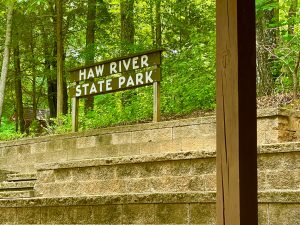
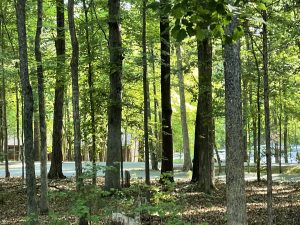 The setting was an asset: 90+ degree weather outside, with drought and wildfire warnings, was eased by the green oaks sheltering the Haw River family camp, near Greensboro North Carolina.
Besides hosting kids, PFYM was also expanding its roster, by taking in a homeless Meeting, Swannanoa Valley, from farther west near Asheville. Others from Greenbrier Worship group and Charleston WV Meeting were exploring a similar course.
The formalities were handled smoothly: the clerks detailed a round-dance of preliminary visits, and “discernment” with Swannanoa that resulted in favorable committee action.
But absent from their report, and the ensuing discussion, was any mention of the migration’s larger context. That involved those messes grown-Quakes make, and their fallout.
This lack was evidently intentional, and unexplained: was it the ingrained liberal Quaker habit of denial/avoidance about internal conflict? Reluctance to puncture the upbeat vibe? All of the above?
Whatever. Informal conversations confirmed this context was on the minds of many PFYM.
In brief, Swannanoa was at PFYM because its former home, the older, liberal Quaker body next door — Southern Appalachian YM & Association, or SAYMA — has been tearing itself apart for years. Besides Swannanoa & Charleston, several other MMs have left SAYMA, or are on the brink.
This bitter, extended feuding is unusual, maybe unprecedented among liberal Quaker groups, and ongoing.
The issues are double-edged: on the one hand, SAYMA was confronted by a dogmatic form of “anti-racism” advocacy, pursued with an intrusive belligerence that sowed disorder and division. On the other, SAYMA’s leadership was chronically unable to protect its integrity and good order. (Several blogposts on this unhappy saga are linked below.) Swannanoa left SAYMA in early 2022.

Nature added insult to injury, on September 27, 2024: Swannanoa’s comely but plain meetinghouse, built between two picturesque mountain creeks in 2003, was destroyed by Hurricane Helene. As it smashed through Asheville and western North Carolina, the creeks became a deadly double-barreled flood.
No Friends were among the hundred-plus killed by Helene’s fury. But Swannanoa was left literally as well as organizationally unhoused.
And 21 months later, as PFYM convened, Swannanoa Friends (like too many others) were still awaiting promised — and shamefully delayed — federal disaster aid, to enable them to seek a new physical home. Meantime they meet in a nearby welcoming church.
PFYM did the Quakerly (indeed, the Christian thing, though no one called it that) and took them in. Yet at least three questions quietly lingered around the welcome:
First, will Swannanoa and perhaps other SAYMA refugee meetings be safe in PFYM from a recurrence or contagion of SAYMA’s traumatic disruption? (Helene after all, struck but once; SAYMA’s anti-racist divisions have boiled over repeatedly, and may not be finished.)
Second, unlike SAYMA, could PFYM do better at curbing such disruptive behavior, to protect its good order — and the kids?
(Such difficult incidents are not new among Friends, albeit rarely reported in depth. For instance, Lucretia Mott [1793-1880] noted in the arrest in 1834 of several quarrelsome Philadelphia Friends by other Friends, and later physical ejections from worship in 1840, with guards at the doors . . . . Mott was a dedicated pacifist, and wrote of these reluctantly, in hushed private missives (see her Selected Letters, pp. 9, 72ff. ) Other similar incidents have been documented by a few hardy Quaker scholars, but buried by many.)
And third, could PFYM safeguard good order while still fostering constructive witness for racial justice?
Such conundrums of Quaker community felt abstract and distant amid PFYM’s general high spirits and good feeling. The nearest they came to being voiced was in the single business session. That’s when a “Vision Statement” for PFYM came up.
This one-page proposal could be the seed that someday sprouts into a handbook of Faith & Practice, such as are widely used by other liberal YMs.
Or maybe not. Piedmonters are of the “Herding Cats Hicksites” Quaker stream. Generally peace-loving, they can be quick and fierce in resistance to anything redolent of creed, evocative of dogma, or smacking of church hierarchy.
They (we) can be quite doctrinaire in our rejection of doctrine, especially when handed down from above.

For that matter, PFYM’s own origin in 2021 came from another shattering controversy, over LGBTQ affirmation and a forced creed, in the older, pastoral North Carolina Yearly Meeting (NCYM). That fracas ended with NCYM’s complete dissolution, after 320 years.
Several meetings now in PFYM were caught up in NCYM’s theological “hurricane,” which dragged on for three years. (More on this in the book, “Murder at Quaker Lake,” or in blog posts cataloged here.)
The PFYM Vision Statement’s drafters were mindful of this background. Hence a subtitle, “Core Elements” — certainly not doctrines, nor convictions, beliefs, affirmations, not even the familiar “testimonies” — headed its minimalist list of six tenets. (Perhaps “Hunches” might have worked, but I’ll not quibble,)
Anyway, even in just 330 words, the Vision draft left room for questioning and Quaker wordsmithing.
Were the drafters striving to minimize the risk of SAYMA-ization? They certainly tiptoed down a euphemism-strewn path, particularly in the one-sentence section headed:
“INCLUSIVENESS – Recognizing that inclusiveness enriches our spiritual lives, the body of Piedmont Friends welcomes and affirms individuals, monthly meetings, and worship groups from a wide variety of social and theological backgrounds and experiences.”
In the session were staff from outside groups (AFSC, FGC, FCNL), some clinging to the tatters of once-vaunted Anti-Racism crusades and cadres. But all were quiet. The formerly fiery enthusiasms of many previous years for all things DEI are now widely reduced to barely smoldering embers.More unacknowledged context.
The contrast was stark, but not surprising: the sizable PFYM member groups are “college meetings,” close by and thickly embedded in campus culture. That culture nationwide is undergoing a relentless purge of faculty, finances and fervor, for all things “woke.”
And there’s more: other programs have fallen to the curricular death squads of Project 2025 (which have not ended in 2026).
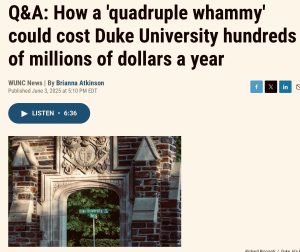
A prime example here is Duke University. PFYM’s largest founding member is Durham NC, whose meeting is surrounded on all sides by it. Last year, mighty Duke was forced to cut 600 faculty and staff, and lost almost half a billion dollars in federal research funding; 2025 was a higher ed analogue to Helene’s flooding rampage.
Other major universities in Raleigh, Charlotte, Greensboro and Chapel Hill, all with PFYM meetings nearby, are still taking their share of lumps. Three smaller colleges in NC have shut down completely; others are teetering.
Reverberations from this ongoing seismic upheaval are beginning to shake up settled practices and outlooks in many campus Friends meetings; budgets are tightening, to say the least.
Thus at PFYM, the “Inclusiveness” section evoked tentative — not objections, exactly, but troubled questions. A couple of Friends wondered if its scope might be expanded with a reference to, um (no, no, not “oppressed”) but maybe, er, “marginalized” persons & groups?
The clerks gently deflected these halting queries, hinting broadly that “marginalized” could lead to “victimized,” which had competitive potential and could set off a cascading scramble of competitive acronymic acrimony.
Everyone spoke calmly, but many were somewhat unsettled. To be sure, DEI is currently moribund and radioactive, and the campus culture is in a defensive posture. Yet the Quakers in its orbit are hardly ready to give up their long focus on racial justice, going back to 1688.
Still, few are yet able to articulate a detailed response.
This observation is not a complaint; the current official racial assaults, unprecedented since 1861, will not be thwarted by a few memes, workshops or hanrnging over obscure minutes. Besides, any closer, candid look at Quaker racial history shows a long and winding road, with heroes, but also potholes. Much thought, study and practice may yet be needful to shape new and viable responses.
Furthermore, many forces are showing that not every crisis is all about race. Look around: the oceans are turning on us, droughts, wildfires and toxics spreading. Nuclear weapons are proliferating, and for that matter our imperfect but precious republic totters. Friends’ attention and effort — what they consider their divine leadings — cannot help but be drawn or pulled in many directions.

This multicrisis atmosphere was somewhat softened by the serene Haw River greenery. But it could easily have sunk the tentative Quaker deliberations in PFYM into despair or agitation.
Yet as an old Quaker saw goes, “they were favored,” and the clerks soon concluded (rightly) that there was not “unity” on the “Vision Statement,” and the labor on it was postponed..
My sense is they also realized two other things: first, the Vision Statement will keep. And second, if PFYM stumbles into the bog of grownup hassle, a la SAYMA or the recently dead North Carolina YM, they could, worst of all, default on their real top priority, and spoil the weekend for the kids.
After all, vision statements can be tinkered with ad infinitum; but ruined community gatherings can inflict generational loss and trauma (as SAYMA and the dead NCYM demonstrate).
In this time of galloping shrinkage in many faith groups, schemes promising “church growth” abound. But the most reliable source of church growth is internal, resulting from guiding, inspiring and thus retaining more of their own progeny.
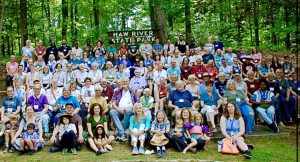
PFYM’s elders managed to keep these priorities straight that weekend. Thus its odds of surviving the current outside troubles should be at least, like its kids, above average.
Thank you Friend. I am a refugee from SAYMA.
Thanks, Errol. Maybe there’s now someplace for you to go?
Such a sad, dispiriting story.
I like your simple test for the health of a yearly meeting—looking at whether children are present and genuinely enjoying themselves says a lot about whether a community is building for the future instead of just maintaining traditions. It also made me think that creating meaningful roles for young people, rather than just activities to keep them occupied, can help them feel like they truly belong and encourage them to stay involved as they grow older.
Aloha, Chuck! Aloha, all!
I too am disturbed by what has been going, round and round, among Friends. I came up with a Peace Study Group which has focused, each month on basics: Violence vs Non-Violence; Just vs. Unjust Wars; Integrity vs. Corruption; Kingdom of God or Hell on Earth, etc. At first, some wanted to stake a position then require others to deal with that position. As time has gone by, more and more people have noticed how the questions raised are haunting them beyond the meetings. In a lot of ways, we are asking basic human questions, which are impacting all of us, without any easy, breezy retorts replacing honest, soulful answers. We are going back to the basics, by-passing pre-packaged formulas. At our last meeting, there was such an open flow of love, circulating among all of us, because — although we were facing tough questions and even tougher answers — we were doing it together. There are no easy answers for glib experts to impose on bedazzled neighbors. Equality remains important even when we are NOT speaking directly about it. Amazing, how that works!
The center of the Bible is still love of God and neighbor as self. That should still be clear to see and a joy to share.
Question: Might Quakers need to love one another much, much more, and criticize each other much, much less?
Just a thought, because love has worked for me even when I did not know the language and, in fact, represented that feared nation called America. This idea of regime change — by force — seems to be operating at micro- as well as macro-levels among all of us in America, and around the world.
I think our kids are happy when we surround them with love. Some of us adults like love, too!
Amazing grace! How sweet …..
Aloha,
Kalei Luyben
Thanks Kalei, and Aloha! I like the sound and evolution of your meeting discussions — keep them going!!