
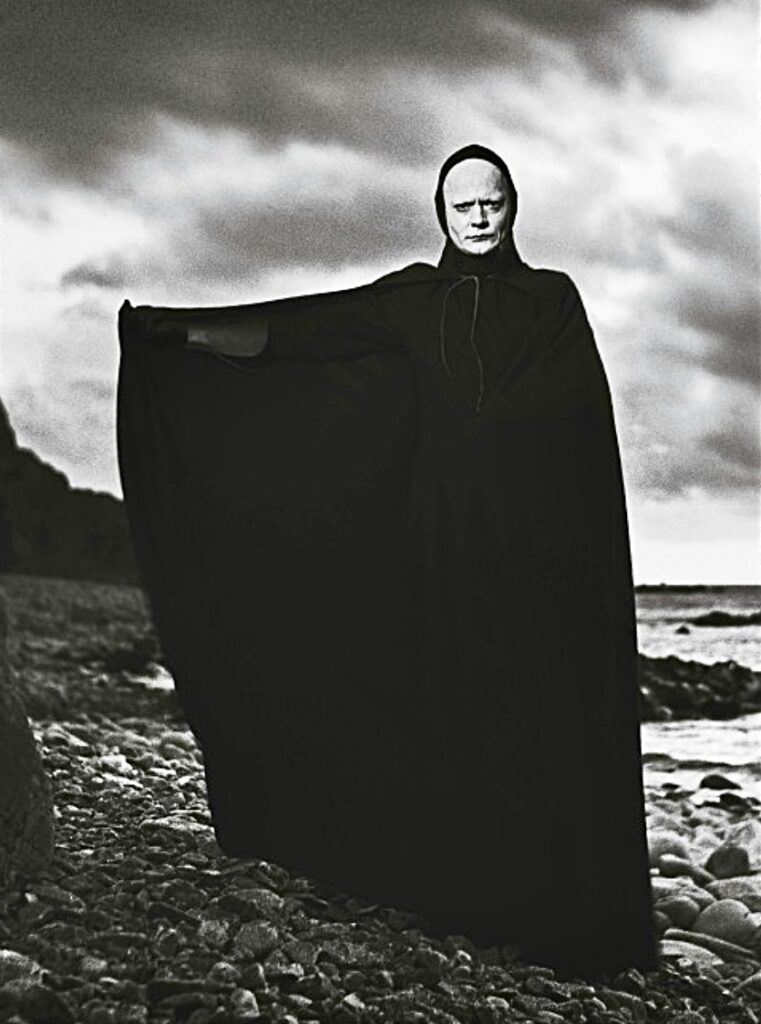
Okay, this initial bit is a scenario:

I’m at the keyboard, just finished what feels like a pretty good blog post. Pressing Return to upload it, I hear a strange noise on my left. That’s my foggy side, a fuzzy mist since the 2019 stroke. So I wheel around, to face the bookshelves against the wall with the good eye.
He’s standing there, in a solid charcoal gray robe, the piercing dark eyes, not even the hint of a smile, with a short black cape, topped by a black hood pulled tight around his face, but no long scythe in his hand.
I recognize him.
“The Seventh Seal,” I say. “I’m honored. I was afraid they’d send some murderous termagant from Agatha Christie.”
Does his non-smile twist a bit? I can’t tell, and try again. “Can I just finish this piece I’ve got here?” I nod at the screen. “It won’t take long. The working title is “War and Peace: The Sequel. I’m already on page four.“
The eye-roll is slight, but makes plain he’s heard this, and all the other stalling-for-time ad libs, likely hundreds of times. No, thousands.
I give up. “Okay,” I say, “let me just do this limerick.” I type fast, despite shaky fingers:
When the Reaper comes, I won’t get sappy,
I’ll tell him, “Ok, make it snappy.”
And If he shows when I’m writing,
I won’t go down fighting,
Your best guess: I’ll be sorta happy.
Now my eyelids are heavy. I think I’ll just put my head down on the keyboard, facing the back window, with the shade pulled down, sunlight slanting through the blinds, as I’ve occasionally done before, and rest them a bit.
There’s a slight rustle behind me, and the last I remember is the touch of a finger on my shoulder . . . .

Now, a few hours later, a more realistic scene: The Fair Wendy peeps in at dusk, and finds me slid off the chair, crumpled on the floor. She shrieks, but knows what to do: checks for breath and a pulse, then grabs her phone and dials the long-agreed magic number: 911.
Soon an EMT driver barges in, no siren, but red and blue lights flashing in the hall behind him and across the front of the house. He touches nothing until a cop arrives.
The officer checks me and the room: no signs of forced entry, struggle, blood, gunshot, stabbing or choke wounds. No empty pill bottle, or handwritten farewell note among the many visible papers.
Looks like natural causes. An everyday, no-drama demise: the local TV van slides past our neighborhood, seeking a video-friendly scene, maybe with crime scene tape, better a wrecked car that has a bullet-pocked windshield.
Soon I’m zipped up and out of there. Wendy is left to deal with the shock. And in an hour or two, what’s left of me is on the brink of Gehenna, or rather Greensboro, like a COSTCO chicken facing the Rotisserie of No Return.
[Now we’re live again!] “Seventeen hundred,” said Fred. He works for a sizable cremation/funeral service in central North Carolina.
That’s degrees, not dollars. (This is seriously hot: the typical kitchen oven tops out at about 500.) But $1700 is not a lot to pay for a cremation funeral. The rungs on the guilt- and grief-driven spending ladder into the Valley of the Shadow go both ways, deeper than your pockets, and higher than your credit limit,

Now at my other end, $1700 is also a price one can beat. And I was under orders to beat it. The Fair Wendy, who is younger and expected to outlast me, told me flat out, “Chuck, It’s your job to call the funeral place. I don’t want to have to deal with that stuff when you’re dead.”
I could relate. She has agreed to handle my estate, which will be peanuts money-wise, but complicated by my being a writer, with copyrights and such. That’s enough.
Besides, we’re Quakers, with this complex notion we call Simplicity. It was once very stern about death —as a saying goes, “No pomp in any circumstance.”
I’ve visited the Quaker burial ground on Nantucket Island, which for more than a century was a thriving, prosperous Quaker center. The burial ground is a big, uneven grassy expanse, mown but not landscaped, within a low weathered gray rail fence. It’s reliably said to be seeded with the bones of several thousand Friends, rich and poor, devout and nominal.
There’s only a scattering of markers in it, maybe several dozen, planted by renegade relatives who defied the local elders to know where some of their kin were placed. But for the rest, likely the 99%, there’s nada but the grass, doing its usual work.
It’s not a gloomy spot, but thought-provoking: a silent Quaker homily on the true human equality, all ultimately alike under the skin, and under the ground.

So I told Fred plainly that I wanted the low end, and had googled “economical cremation” to find it, and him. Although behind him one wall was lined with shelves of colorful burial urns that ran as much as $300, he didn’t skip a beat or apply any pressure.

The most basic package, he said, includes picking me up, and doing the paperwork for an official state-stamped certificate — in North Carolina, you can stop breathing whenever you like, but you’re not officially dead til the state in its un-elizabethan majesty issues you a properly stamped certificate saying so, and that will likely take weeks, and cost $10 a copy, please.)
In the meantime, however, you do get your Ticket to Ride the Rotisserie of No Return (and you won’t care), where the 1700 degrees deliver a quick and permanent weight loss program guaranteed to leave only 4 to 8 pounds of ground bone and ash to be scooped out and poured into a clear plastic bag, dropped into that fliptop black container, snug in that sturdy cardboard box, ready for pickup in a couple days. (Hmmm. Only a day or two, with actually just a handful of hours on the Rotisserie? Maybe that 1700 degree part is not really Hell, but only Purgatory. Well, that’s okay— I was raised Catholic, and shortening our time in Purgatory was a serious thing then.)
But ”What?” I said to Fred. “Just four to eight pounds at the end? But I’m more than two hundred and—“
Fred cut me off. “Fat all goes up the chimney,” he said. “We do cases of people at 300, 400 pounds, even more, no problem.”

I eyeballed the black plastic box with what looked like a flip-top lid, noting that it was on a shelf opposite the gaudy pricey urns. I didn’t mind its plainness. But, all (that’s left of) me will fit in that little space?
Well, so it goes. Yet there’s one more step: what to do with the ashes? Many people keep their fancy urns on display, a family heirloom. Hmmmm. Others have themselves scattered; that skips the expenses of an actual burial, which involves dealing with cemeteries and grave markers or headstones. Fred emphasized he was not in those businesses, but knew them well and had many useful money-saving tips to offer (above all, crank up your search engine and shop smart.) As for me, I’d like for the box to be planted, and maybe have a somewhat simple marker, being a somewhat renegade Quaker. (Not too renegade, I hope there will also be a party, and will be sorry to miss it.
But that’s for another day. Now, I told Fred, I was ready to deal. The actual transaction for this, what is called a “pre-need” arrangement, was that I wrote the $795 check to an insurance company, which will actually pay Fred’s crematorium when the time comes.
But what if I hang around for some years? (After all, I mostly feel okay now, with no terminal diagnoses hanging over me, and was doing this mainly so I could quit nagging myself about it.)
The insurance company was way ahead of me here. The policy came with an ALL-CAPS “No Inflation” guarantee, rather a timely fillip. If Fred’s crematorium emporium charges twice as much when the call comes for me, the insurance company will cover the difference.
So: in one day I beat the funeral racket, stopped inflation, and eased the mind of The Fair Wendy to boot.
And had some interesting dreams. When I jerked awake, the keyboard rubbing against my cheek, the first thing that came to mind was another limerick:
When I go, let me go in simplicity.
With oppression and war less complicity.
So the man in all black
On the day he comes back
May find in me a certain felicity.
As an alternative to wasting all that fossil fuel and compromising the local air quality, consider a “conservation cemetery” like Bluestem, in Cedar Grove NC. A bit pricey though. https://www.bluestemcemetery.org/
There are other such places around.
Please stay a diamond in the rough
I found some of your remarks very funny. I have a request Friend, if you are inclined. Would you write a limerick in which the Bringer of Death is female? I’L MHO ‘Twould be oddly unique and perhaps just as enchanting.
Well, sure, why not? This is a bit rushed, but:
The woman who knocked was named Death.
She muttered something under her breath.
She moved here from Yonkers,
But then she went bonkers,
And now goes around selling meth.
A great limerick to end with. Hope you live longer and prosper!
A few years ago I got an interesting glimpse into cultural adaptation. A man from an expat Indian family had died. If in India, the body would have been burned on a funeral pyre and the fire would have been lit by the oldest son. No such option here. The body went to a crematorium and the family had a suitable Hindu service there with the oldest son pressing the Start button.
Episode 6 of the Sandman on Netflix speaks to thy condition. You can safely skip episodes 1-5.