

Gwynne Dyer: India, Pakistan & the Impacts of a Regional Nuclear War
OPINION: Last Tuesday, August 16, marking the 75th anniversary of Indian independence, Prime Minister Narendra Modi promised to turn India into a developed country within the next 25 years.
If all goes well, that could actually come to pass, but it would have to go very well indeed.
The demographic and economic signs are positive. The country’s population has grown fourfold since independence in 1947, but population growth has now dropped to ‘replacement level’: 2.1 children per completed family.
The current youngest generation is so large that the population will keep growing until 2060, when it will have reached 1.7 billion.
The upside of this is that India will continue to have a rapidly growing young workforce for another generation, while its only rival, China, will have a rapidly ageing and dwindling population (1.2 billion and still falling in 2060).
India’s GDP per capita has been growing at about 5% for years, and if that continues for the next 25 years it will have grown to $7500 per person.
That’s certainly within the lower ranks of developed countries (like Mexico, South Africa or China today). Given the size of India’s population the economy would certainly rank in the world’s top five.
So Modi’s prediction was certainly within the realm of possibility, but there are two big wild cards.
One is climate: although only half of India technically falls within the tropics, all of it except the very far north suffers long, very hot summers.
This summer has been the hottest ever, with many of the largest cities experiencing temperatures above 45 °C (113 C) for days at a time.
Whatever we do about climate in the future, it can only go on getting worse for India for the next 25 years.
That will bring the country into the zone where it literally becomes unsafe for people to do manual work outside at the height of summer; death rates will go up, and food production will go down.
Nobody knows exactly how bad it will get, but it will certainly get much worse that it is now.
The other wild card is war. Since the Indian and Pakistani tests of nuclear weapons in 1999, the subcontinent has lived under the threat of a ‘local’ nuclear war that would devastate both countries (and also cause global food shortages lasting for at least four or five years).
An Indo-Pak nuclear war is not inevitable, but unlike the major nuclear powers these two countries have fought real wars against each other – three in the past 75 years.
The likelihood of such a catastrophe actually happening is certainly a lot higher than zero.
Each country now has about 160 nukes, and although both are now working to move beyond the dangerously unstable ‘use them or lose them’ phase where a surprise attack might disarm the other side, there is no real stability to be found when the adversaries are so close and the hostility is so intense.
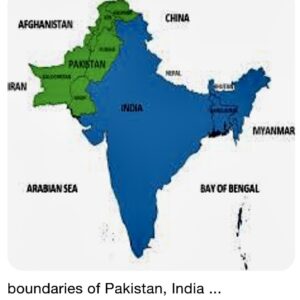
So there is no harm in considering whether it might have been better to keep the entire Indian subcontinent, first united by the British Empire, in one piece at independence rather than splitting it into two countries (and eventually three, counting Bangladesh).
The split was by no means inevitable. Both Mahatma Gandhi and Jawaharlal Nehru, the two main Hindu leaders of the independence movement, wanted an inclusive, non-sectarian republic including all of British India, although they failed to offer Muslims sufficient guarantees to ensure their support.
Muhammad Ali Jinnah, the main Muslim leader in 1947, did want to carve a Muslim-majority Pakistan out of the country, but there was no obligation for the British government to satisfy his demand.
He got his way because the United Kingdom was virtually broke after World War II and in a great hurry to dump its responsibilities in India.
Sir Cyril Radcliffe, a British lawyer who had never been east of Paris, had five weeks to draw the dividing line between the two new countries.
About 15 million people who found themselves on the wrong side of that line became refugees, mutual massacres followed, and within weeks India and Pakistan had their first war. But it could have been different.
The undivided ‘big India’ would have 1.8 billion people today, about ⅓ Muslim and ⅔ Hindu.
That would virtually guarantee both groups would be represented in every government and in most political parties.
Lots of countries elsewhere in the world manage to be both democratic and prosperous with comparable religious and/or ethnic differences.
The ‘big India’ would not have wasted 75 years’ worth of high defence spending, and there would be no risk of nuclear war.
All those energies would have been devoted instead to civilian priorities, and that united India might already rank as a developed country.
Might-have-beens.

‘Nuclear twilight’: Something else to worry about
Gwynne Dyer — Dec 30 2021
OPINION: As a dreadful year draws to an end and the Omicron variant turns out to be less lethal than its predecessors, premature outbreaks of cheerfulness have been spotted in many quarters.
As I am under a contractual obligation to keep the readers worried, I was at my wit’s end – but then I interviewed Professor Alan Robock of Rutgers University.
He’s a renowned climate scientist, but recently he led a team of researchers who re-examined the phenomenon of ‘nuclear winter’.
That’s not really a climate phenomenon. It would be the by-product of a superpower nuclear war, in which the smoke from a thousand burning cities blocks out the sun and leaves the world freezing in the dark for years.
A different team of researchers discovered nuclear winter almost 40 years ago, and it helped to convince the great powers they must never fight a nuclear war.
The reason we don’t worry much about nuclear winter now is that we think they have finally learned that lesson.
True, there are now other countries with nuclear weapons that don’t seem immune to outbreaks of major war, like India and Pakistan. However, everybody assumed the damage would be confined to their own region.
If we don’t let it escalate into a superpower clash, the rest of the world should be all right.
Wrong.
The Indian and Pakistani nuclear arsenals each amount to about 150 warheads now. That’s a modest number compared to the thousands held by the superpowers, but it turns out to be quite enough to cause…let’s call it a nuclear twilight.
What makes this so worrisome is that India and Pakistan have already fought three full-scale wars and half a dozen major skirmishes since they got their independence.
Another is entirely possible, and the risk of escalation to nuclear weapons would be very high, for two reasons.
First, most of their nuclear-capable aircraft and missiles are vulnerable to being destroyed on the ground in a surprise attack.
Secondly, the two countries are so close together that only a very brief warning time is available. In these circumstances, a policy of ‘launch on warning’, with all the risk of mistakes that entails, is the only rational option for both sides.
The first victims of such a war would be Pakistani and Indian civilians, because cities will be on the target lists: that’s where the major ports, airfields and critical infrastructure are.
Robock’s team calculated that those burning cities would loft enough ‘black carbon’ into the stratosphere to create a shroud of soot over the whole world within a few weeks.
It wouldn’t be the full-dress nuclear winter of superpower war, with ‘darkness at noon’. However, 300 nuclear explosions in the Indian subcontinent, most of them airbursts over cities, would dim the sun enough to drop temperatures and severely damage crop yields in the main food-producing regions of the planet.
The main effects would be a severe drop in the average global temperature and a comparable decline in global food production – with the worst-hit areas being in the Northern Hemisphere, north of latitude 30°N. (Almost all of India and Pakistan are south of that.)
It’s counter-intuitive, but that’s the way the climate system works.
The most important ‘breadbaskets’ of the planet – grain-growing areas that produce a big crop surplus for export – are the United States, Canada and Europe (including European Russia) – and they are all just north of 30.
The dimming effects of an Indo-Pak nuclear war in 2025, say, would drop the average global temperature by 5 °C over all the continents, but in the key regions of North America and Europe it could reach 10 °C colder.
That maximum cooling would be reached in the fourth year after the war, and would gradually return to ‘normal’ by around year 15.
Australia, Brazil and Argentina, the Southern Hemisphere’s bread-baskets, might still be able to export some grain, but they would not be remotely capable of compensating for the huge shortfalls of food in the Northern Hemisphere.
Tens, maybe hundreds of millions would starve in the poorer parts of the north, and scrabbling for food in the cold and the dark would certainly take our minds off our longer-term problem: global heating.
But when the effects of the local nuclear war in the Indian subcontinent finally faded, it would be right back to that bigger climate crisis.
And it would be bigger, for carbon dioxide would not have stopped accumulating during the hungry years. Indeed, the world might find that it was returning not to the average global temperature of +1.3 °C that prevailed when the Indo-Pak war started, but to a climate that was now hovering on the brink of +2.0 °C.
Just thought you’d like to know. . . .
People are already dying from climate change.