

[NOTE: Some politicians are crusading against U. S. military programs to overcome residual racism and make space for LGBT persons in the ranks (& even a few who do drag in their out-of-uniform hours).
Not only is their crusade silly (folks of color & LGBTs can shoot as straight as any), it also ignores the fact that among major American institutions, the military is more authentically integrated and “diverse” than many (looking at YOU, campus purists). Not that it’s even near perfect, but the progress is real and that’s not a new discovery.
The crusaders argue that military “wokeness” is hurting recruiting, which indeed is falling dismally short. But military surveys tell a different story: potential recruits say they’re not worried about bases shedding traitorous Confederate base names, but enemies with bombs & guns. That is, the military’s business is, after the hoopla, war; war is hazardous, and many folks are opting for safer lines of work.
This response could change if, say, the Japanese bombed Pearl Harbor . . . . But shunning the combat meat grinder is hardly a new phenomenon. During our own Civil War, there were plenty of young men who favored one side or the other, but weren’t ready to join the fighting that took half a million lives. Many avoiders simply wanted to keep breathing. But there were some who had moral/religious convictions against warmaking. Like some Quakers, Anabaptists and such.
A goodly number of those with hesitations, particularly Quakers, dwelt in North Carolina. In such inward struggles amid the outward tumults, some went one way, some went another, and many zigged and zagged.
Speaking as one of these Quaker strugglers (but not old enough for the Civil War), my sense is that Quakers today don’t pay nearly enough attention to these major chapters in our history. So I was gratified to come across the article below about my own adopted home state, and the travails in what some call its Quaker Belt, where I have landed not far from the Buckle.
This history is abidingly full of potential learning for us Friends (and others!) spiritual as well as worldly. It’s also newly timely: look around — the USA and its major rivals are now launching new versions of the Cold War, with very dangerous (and expensive) arms buildups. The risks of more new wars involving us is rising fast.
I don’t know how to stop all that: the Quaker efforts to “end war” haven’t exactly been a great success, yet. But I am confident that we and many others will be better able to cope with coming troubles if we come to grips with and seriously learn from this rich and sobering history. 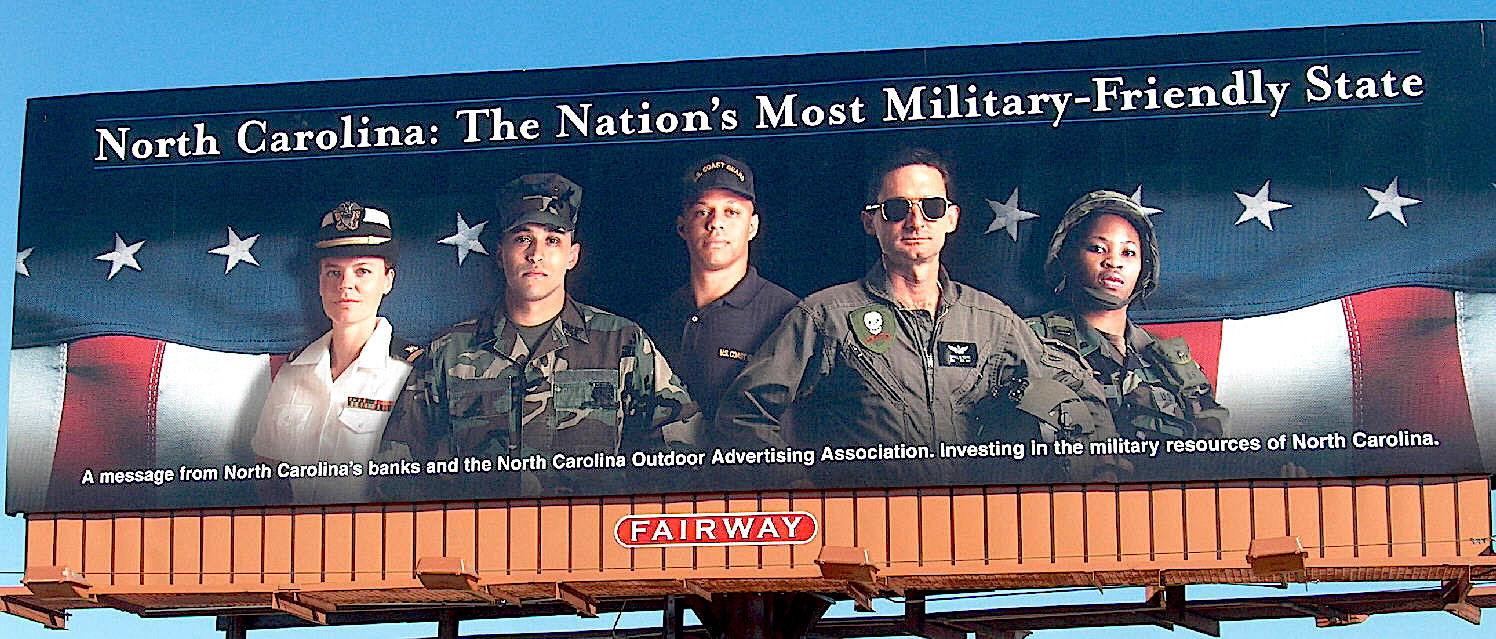
Here are two concise but substantive pieces about that.]
 AP News: Army sees safety, not ‘wokeness,’ as top recruiting obstacle
BY LOLITA C. BALDOR — Feb. 12, 2023
WASHINGTON (AP) — While some Republicans blame the COVID-19 vaccine or “wokeness” for the Army’s recruiting woes, the military service says the bigger hurdles are more traditional ones: Young people don’t want to die or get injured, deal with the stress of Army life and put their lives on hold.
 They “just don’t see the Army as something that’s relevant,” said Maj. Gen. Alex Fink, head of Army marketing. “They see us as revered, but not relevant, in their lives.”
Addressing those longtime issues has taken on greater urgency as the Army tries to recover from its worst recruiting year in decades, a situation aggravated by the tight jobs market. The Army is offering new programs, advertising and enticements in an effort to change perceptions and reverse the decline.
One incentive gives recruiters bonuses of up to $4,500 per quarter if they exceed their baseline enlistment requirement. A pilot program allows young enlisted soldiers — those in the three lower ranks — to get a promotion if they refer someone who enlists and goes to basic training. Only one promotion per soldier is allowed.
The Army fell about 15,000 soldiers, or 25%, short of its 60,000 recruitment goal last year, when all the branches struggled to meet recruiting goals.
Army Secretary Christine Wormuth said the Army has set a difficult goal for this year: aiming to bring in 65,000 recruits, which would be 20,000 more than in 2022. It’s difficult to predict how it will go, she said, adding that recruiters need to do all they can to surpass last year’s numbers.
“I would say it is a stretch goal,” she said.
Wormuth said she and Gen. James McConville, the Army’s chief of staff, believed they needed to set a big goal.
“I think we are seeing some forward momentum. But it is still too early to tell where we will likely land at the end of this fiscal year. I know we will do better than we did last year,” she said.
Guiding the Army’s efforts are surveys intended to help pinpoint why young people dismiss the Army as a career.
Those surveys were conducted over four months last spring and summer. They involved about 600 respondents, ages 16 to 28, per month. The Army discussed the general findings with The Associated Press but declined to provide detailed methodology, saying the surveys were done by a private research contractor and that licensing agreements limited the public release of some data collection details.
Officials said that based on the surveys, young people simply do not see the Army as a safe place or good career path, and believe they would have to put their lives and careers on hold if they enlisted.
Army leaders said very few say they are deterred from enlisting due to “wokeness.” In fact, concerns about discrimination against women and minorities is seen as a bigger issue, along with a more general distrust of the military.
“Wokeness” is a slang term that originally described attentiveness to issues of racial and social justice. Some people and groups, especially conservatives, now use it in a derogatory sense implying what they see as overreactions.
Republicans in Congress, including Rep. Jim Banks, chairman of the House Armed Services subcommittee on military personnel, have pledged to target “wokeness” this year. Banks, R-Ind., has said “exposing and dismantling the Biden administration’s woke agenda that is driving down military recruitment and retention” will be a top priority for him this year. His spokesman, Buckley Carlson, said combating “wokeness” at the Defense Department will be a key issue for the congressman.
Banks and others have complained about the Pentagon’s efforts to target extremism in the military, provide courses in critical race theory and other efforts to expand diversity. They say focusing on partisan issues pushed by the left takes away from the Pentagon’s core missions, weakens the military and turns off recruits.
But the Army says that on average, only 5% of the respondents in the surveys listed “wokeness” as an issue, compared with 13% who say they believe that women and minorities will face discrimination and not get the same opportunities.
Wormuth said the survey data is a tool to “assuage the concerns that some may have, whether influencers or members of Congress, about wokeness or the vaccine mandate — which is now rescinded — and show they are not, by any means, primary drivers of the recruiting challenges we’re experiencing.”
She said the information from the surveys also provides insight on how the Army needs to better explain its benefits.
Fink, the Army’s marketing head, said the top three reasons young people cite for rejecting military enlistment are the same across all the services: fear of death, worries about post-traumatic stress disorder and leaving friends and family — in that order. He said the Army wanted a better understanding of any additional barriers to service, beyond those top three.
By a “significant margin,” he said, the most common response beyond Nos. 1-3 was, “I will be putting my life on hold.” That was cited by more than 1 in 5 people surveyed.
Many young people do not know anyone in the Army and are unfamiliar with the jobs or benefits it offers. Fink said trust in government institutions, including the military, has declined, particularly among this group.
“They just don’t perceive the Army as being in touch with the modern, everyday culture that they’re used to,” he said.
Fink said about 10% in the surveys say they do not trust military leadership, based on the way recent events or missions have been handled. That could include the Afghanistan withdrawal or use of the military during racial unrest and protests in the United States.
Other reasons get much smaller mentions. They include concerns about living conditions on military bases, getting assigned to unwanted jobs, the coronavirus vaccine and the “wokeness” issue.
In some cases, those reasons vary by region. But Fink said the “wokeness” issue was pretty consistent — between 4% and 5% across the nation, without much variance by gender or ethnicity.
Was It “Woke” When Carolina Quakers Didn’t Want to Die In The Civil War?
New York Times — Feb. 28, 2013
DISUNION: Blood in the Carolina Hills
By Jean Huets
In much of the South, the issue of the Civil War was not slavery or the legalities of whether a state had the right to secede. For many white Southerners, the issue was: Which is my true country, the United States or the Confederate States?
In many places, loyalty to the Confederacy was the rule. But in Yadkin County, N.C., fierce conviction gripped both sides of the question, culminating in a February 1863 gun battle that traumatized the county for generations.
Yadkin County lies at the western end of the “Quaker Belt,” a clump of counties in the Piedmont region of North Carolina. An intricate web of kinship and economic interdependence knits together the region’s family farms, many of which were first tilled by frontiersmen and veterans of the Continental Army. In the Civil War, thousands of their descendants remained loyal to the Union they helped to found.
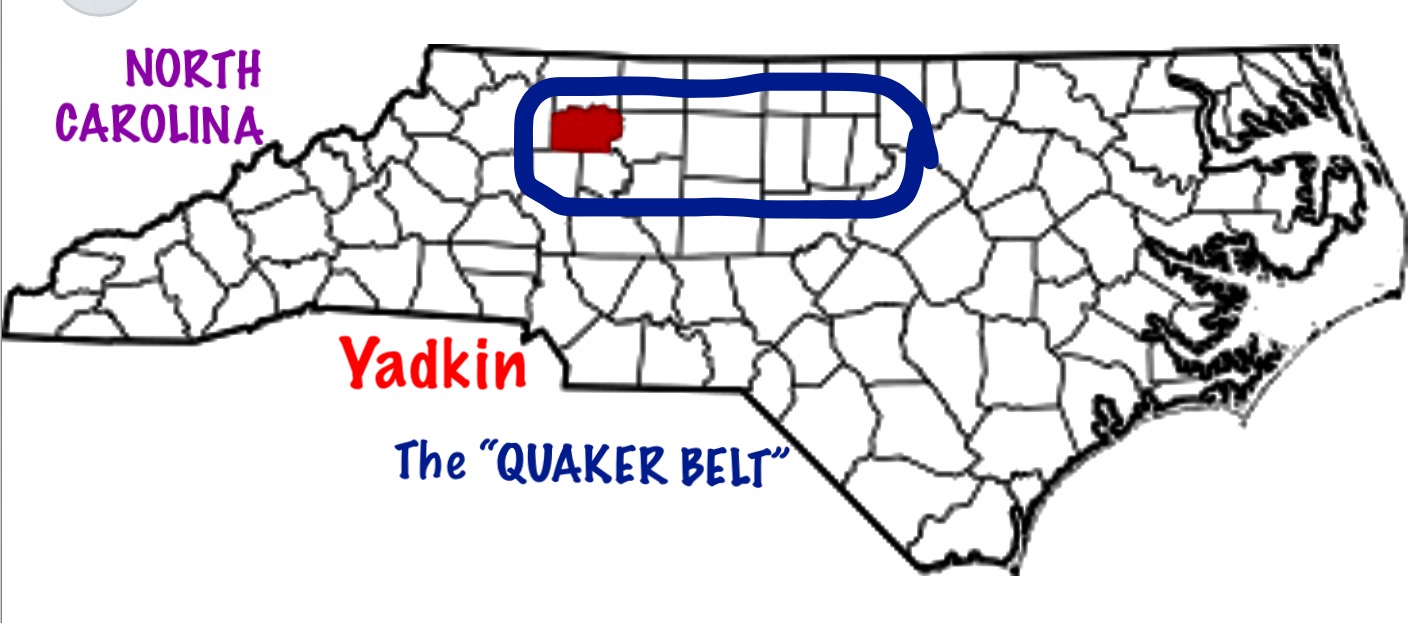 While Yadkin County Unionists were not usually avowedly pacifist or abolitionist, a strong Quaker and Moravian presence ran through the region. On family-run farms, as opposed to Tidewater plantations, slavery was unwanted and, for many, immoral. Most Unionists were content with neutrality, however, until conscription laws decreed that able-bodied men who held fewer than 20 slaves (later, 15) must fight for secession.
Jesse Dobbins, a Yadkin County miller and passionate Unionist, wrote, “I think the Union men had the same cause to rebel against the so-called Confederacy as our fore fathers had to rebell against the british government.” Dobbins himself rebelled by refusing conscription. His fellow “skulkers” and “shirkers” — deserters and draft resisters — “layed out” in the woods or in the barns and sheds of friends and kin to avoid arrest by militia or Home Guard troops.
Indeed, Yadkin County’s many families with entrenched Union loyalties gave it a reputation for being one of the safest places in the state for avoiding conscription. Still, “bushwhackers” who lived on the land by robbing, murdering and burning barns and homes made people more likely to cooperate with fugitive-hunting militiamen and members of the Home Guard.
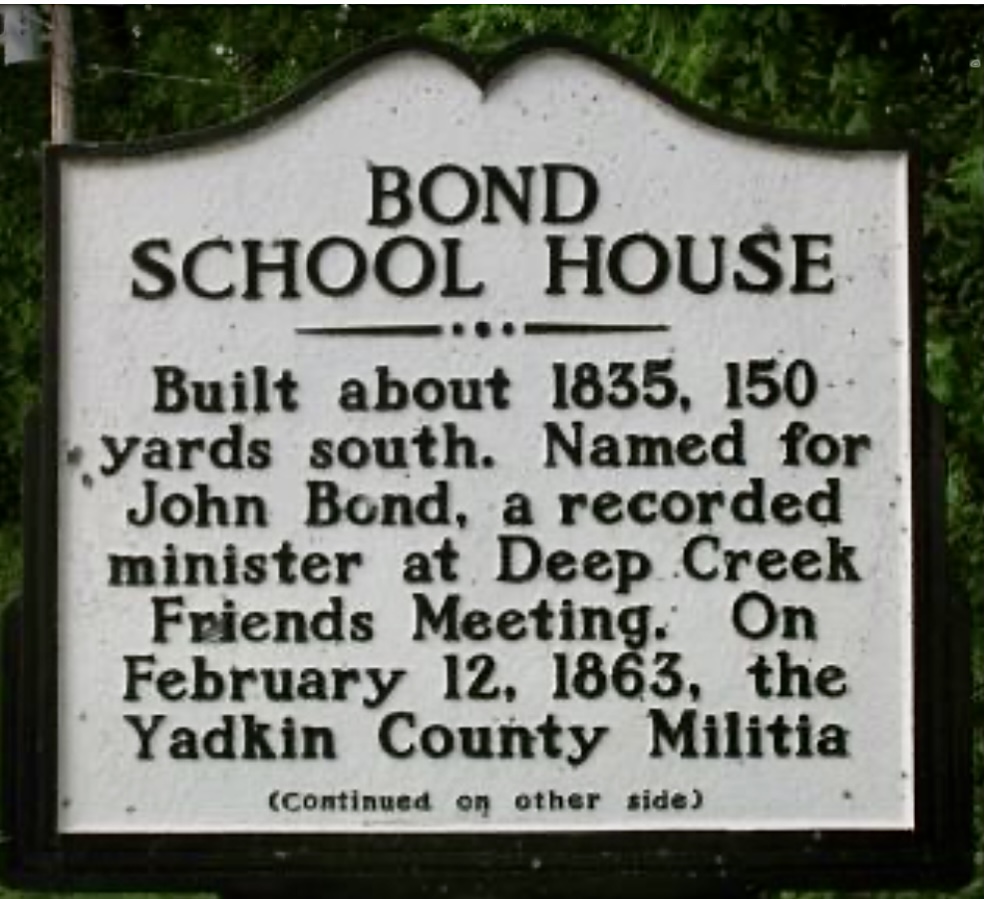 North Carolinians bled richly for the Confederacy, too, and many despised dissenters as traitors. The two sides simmered uneasily along, resentment
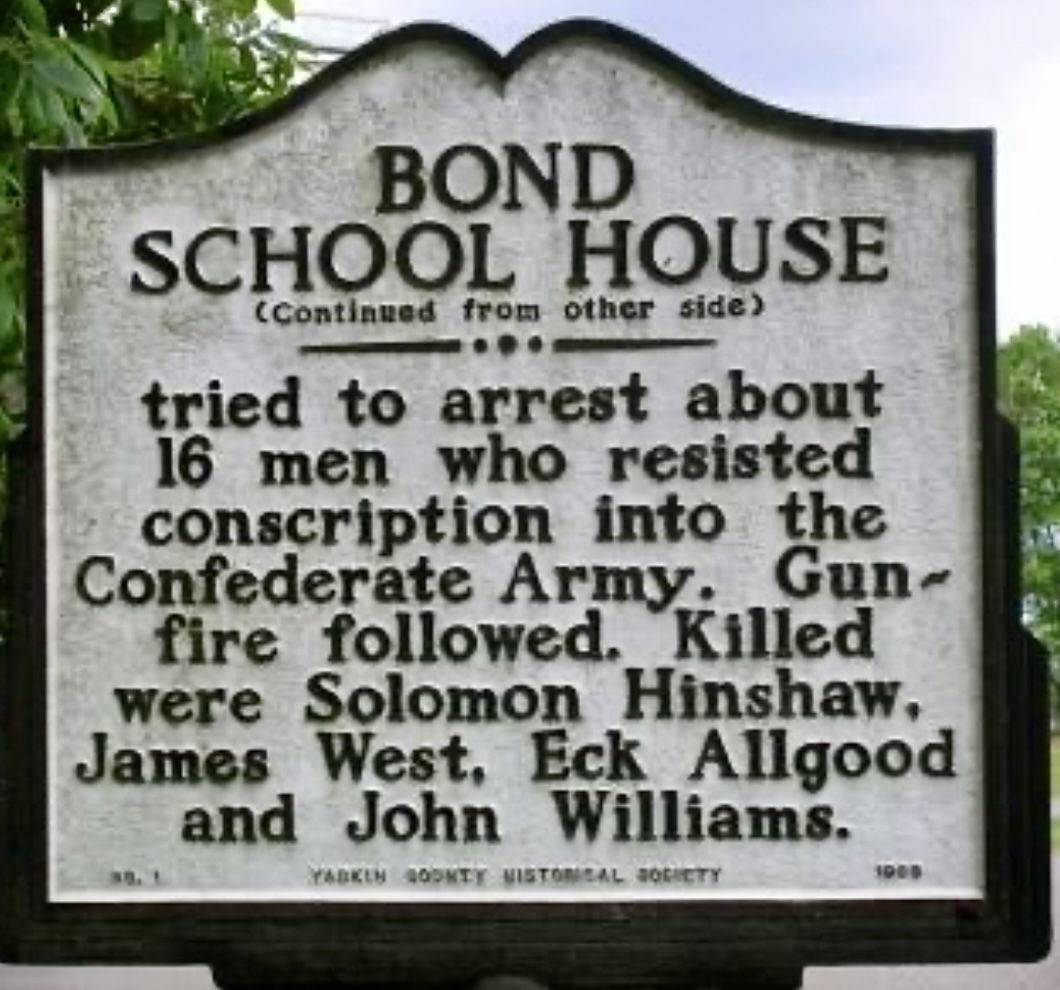 mounting on each side, until Feb. 12, 1863, when Confederate and Unionist loyalties collided violently at the Bond Schoolhouse, near Yadkin’s Deep Creek Friends meeting house.
The day dawned gray and chill, but by midmorning, the sun dispelled the clouds and coaxed forth a springlike breeze, melting a frosting of snow into rust-red mud. Inside the log schoolhouse were not children, but Dobbins, who had recently been conscripted, along with about 13 other conscripts and one deserter. A “Col. Ham,” probably a nephew of the Willard brothers in the schoolhouse, gave an account of what transpired that morning.
Lulled, perhaps, by the warmth and sweetness of the day, and too confident of their safety, the men had neglected to set a picket. As they listened to a fellow conscript reading news of the war, about 15 militiamen quietly approached the schoolhouse. A “passer-by” had informed the militia where the conscripts they’d been hunting were holed up.
The militiamen placed the muzzles of their guns to the chinking between the logs and fired. “Solomon Hinshaw fell near the hearth with a bullet wound through his heart and died instantly without a groan, with a morsel of victual in his mouth,” Col. Ham wrote.
No one else was hit, and when one of the militiamen, James West, appeared in the doorway and demanded surrender, the men were ready for him. “One conscript answered, I will surrender you d__ you, and leveled his gun, but just as he pulled the trigger, West pushed the gun up the contents almost cutting a joist in two over the door.”
West defended himself in vain. Another conscript fired, and “James West sank upon the stone door step a lifeless, and headless form, almost all of his head being shot off.”
The redundant description of West’s head is not merely gory sensationalism. On their way to capture the conscripts, West’s men had stopped to rest and water their horses at the home of the Vestals, a family of “old-time Quakers.” West boasted that “he was going out there and take ever D___ one of them prisoners.
Mrs. Vestal answered, ‘Yes, and thee will get thee head shot off thy shoulders too.’” Ham comments, “Whether or not the spirit of prophecy was upon Mrs. Vestal, we leave to the conjecture of the reader.”
Col. Ham’s emphasis on Mrs. Vestal’s prophecy and the manner of West’s demise may have been an allusion to the Heroes of America, a powerful, secretive Unionist organization that originated in the area. [See Wikipedia “Red Strings” at:
https://en.wikipedia.org/wiki/Red_Strings ]
When inducted into the Heroes, a man bound himself to loyalty and secrecy “under no less penalty than to have my head shot through.”
The Heroes of America undermined the Confederacy primarily by encouraging and aiding draft resisters and deserters. An “underground railroad,” operated in cooperation with abolitionists, led deserters and conscripts to safety in Tennessee and Kentucky, where many enlisted with the Union. The organization’s badge, a red string attached to a coat lapel or a home’s threshold or window, gave the Heroes the nickname the Red Strings.
The device was adopted from the biblical Book of Joshua, in which a woman in Jericho concealed from capture two Israelites on a reconnaissance mission, then helped them escape by lowering them down the city wall on a red rope. They promised that on their return as conquerors, she and her family would be protected by a “scarlet thread” she was to fasten to her window.
The Heroes of America concealed their identities and operations through signs and countersigns, oaths and passwords modeled on those of Freemasonry, which continues to flourish in the area. Their secrecy endured past the war; in Yadkin County many pulled a veil of silence over painful memories and loyalties that fractured families and friends. The Bond Schoolhouse affair, as local historians gently call it, was particularly off limits. Even today, bits and pieces of the affair are just surfacing from family archives.
In all, two conscripts and two militiamen were killed at the Bond Schoolhouse, and one on each side was wounded. Although Dobbins was indicted for firing the shot that killed West, a granddaughter of another of the men, Solomon Hinshaw, later claimed that “the Willard boys [brothers William, Benjamin, Leander, and possibly Milton] did most of the shooting,” with Benjamin rumored to have killed West. The Willards escaped the schoolhouse, but three were captured months later as part of another group fleeing the state.
It proved harder to keep the Willards jailed than to keep a beagle in a pen. When the brothers were in custody at nearby Camp Vance, three Yadkin deputies appealed to the local commander to take custody of them: “Our jail is entirely unsafe, to say nothing of the danger of their being rescued by their friends as heretofore.”
Despite precautions, Unionist and local loyalties prevailed, and the brothers escaped – and, after being recaptured, escaped again. The final time they broke jail, literally one day ahead of the hangman, a sister had smuggled in an auger and chisel despite a “rigid examination” by the jailer.
One Willard brother didn’t share the luck of his kin. In 1864 Milton Willard, who ended up enlisting in the Confederate Army, deserted and joined 60 to 100 other men, including two members of the Vestal family, heading for Federal lines to enlist in the Union Army or stay neutral until the end of the war. An encounter with a Confederate detachment scattered the group. Willard was captured and sent to Petersburg. He escaped and “was making fair headway toward home” when he was recaptured.
From prison, Milton Willard wrote to his wife, “This is the last Sabbath I am ever to see on this earth, but I hope I am going where Sabbath will never end and I hope you and my dear children may meet me never more to part.” He was executed by firing squad a few days later.
Sgt. Horace Eddleman of the 38th North Carolina Infantry later wrote to Willard’s sister Claresy, “I was mighty sorry to see him shot for he looked mighty cut down. But he said that he was prepared to die.” Eddleman promised to “put a board to his head,” to “go with you to him,” and to help her in any way he could, “though you are a stranger to me.” He closed his letter, “Times is hard here and they are shooting lots of men. I hope that this unmerciful war will soon stop.”
Jesse Dobbins, his brother William and three other conscripts evaded capture and travelled 500 winter-icy miles to Kentucky, helped on their way, as Dobbins recalled, by “a friend that had been a pilot” – that is, an Underground Railroad guide – “for the Union men all the time since the war begun.” About 20 months in, William died of an illness that, Jesse believed, was brought on by the privations of their winter journey.
Jesse Dobbins returned home after the war with an honorable discharge from the United States Army. The Union military authority in North Carolina ordered all charges dropped against the Bond Schoolhouse men, and Dobbins resumed farming and milling.
As a founder of the Yadkin County Republican Party, he was spectacularly successful: unique in the South, Yadkin County has voted Republican in every presidential election since North Carolina re-entered the Union.
A folk hero in the minds of some, a murderous traitor in the eyes of others, Jesse Dobbins lived out the rest of his days as a Friend, but had no regrets about his three-year military service. He wrote, “I was willing to join the United States army for the purpose of fighting for the Liberty of my Dear country that is more preshus than gold. The rebs say that I am a traitor to my country. Why tis this, because I am for a majority a ruling and for keeping the power in the people.”
Sources: Jean Huets wishes to extend her deep gratitude to Judy Vaughn of the Yadkin County Historical Society for her kindness in sharing information and her congenial company and guidance on our rainy day exploration of Yadkinville, N.C.
Follow Disunion at twitter.com/NYTcivilwar or join us on Facebook.
Frances H. Casstevens, “The Civil War and Yadkin Country, North Carolina”; Philip Gerard, “A Separate Peace,” via ourstate.com; Carl C. Hoots, “Descendants of Jacob Hoots”; Phyllis Roberson Hoots, “Heroes of America / The Red Strings”; interview with Andrew Mackie and Judy Vaughn, Yadkin County Historical Society, on the possible connection between the Red Strings and the Bond Schoolhouse affair; Allen Paul Speer, “Voices from Cemetery Hill”; Yadkin County Historical Society, “The Heritage of Yadkin County.”
Jean Huets is publisher of Circling Rivers, an independent press dedicated to historical fiction, nonfiction and poetry. She is writing a family saga set in the 19th century.
My thanks for this little gem of history.