
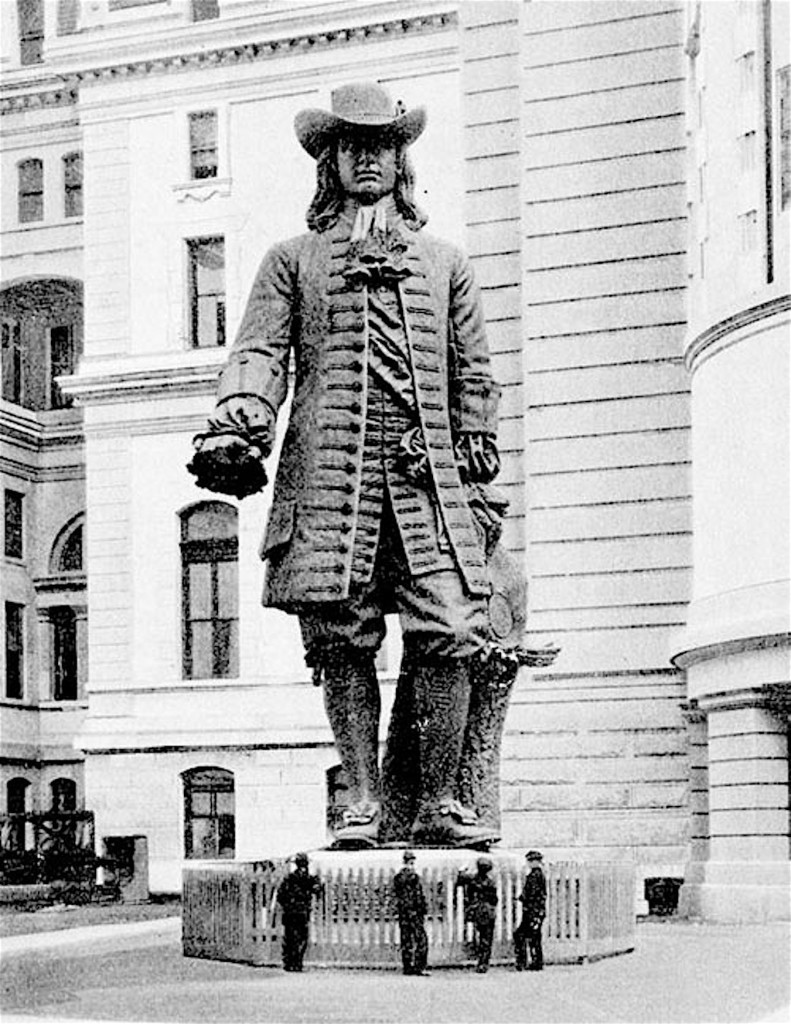
I don’t hear or read much about William Penn among Friends these days. It appears he has been canceled and erased, wiped away in the Great Dismantling. (Indeed, Penn seems to get the most attention today from ultra-right wing activists, who are busy trying to turn him into an avatar of their drive to turn the USA into a Christian nationalist theocracy.)
Meantime, in 2016, a long-running Penn lecture series in Philadelphia was redubbed the “Seeking Faithfulness” lectures.
Then, in late 2020, a Washington DC Quaker hostel and conference center, founded as William Penn House in the late 1960s, was scrubbed and rechristened “Friends Place.”
In April of 2021, across the pond, Friends House in London, which has twenty or so rooms named for various Friends, deleted Penn’s name from the list; I’ve not seen if the space has been renamed.
[Update: it has been renamed for Benjamin Lay, the very dramatic early slavery protester, who was disowned for his disruptive actions.]

In the abstract, I have no problem with renaming (or no-naming) Quaker facilities; our buildings are not sanctified, but functional; memories and attitudes about the dead evolve, and even reverse.
One instructive case is the Quaker burial ground on Nantucket island off the Massachusetts coast. Thousands of Friends are interred in it, with no name markers at all, except for a few headstones placed later by some renegades, described as “heretics” by earlier worthies.
That was the Nantucket way: however different while alive, in personality, position, wealth or poverty, all those Friends ultimately testified to equality in the anonymity of their graves. So it goes.

But not always.
I find I can’t go along with erasing Penn. It’s not “principle” in this case, but practice: his figure keeps popping up in my mind.
He popped up again for me over the last weekend in July: the 30th was the 304th anniversary of Penn’s death in 1718. I don’t know if anyone else noticed that “anniversary”; I did.
I notice Penn, or his thumbprints on Quaker and wider history, often:
–Every time I sit in worship with my meeting, and we’re not attacked by militant Catholics, Presbyterians, Episcopal or other sectarian militias.
If that sounds odd or silly, such attacks are in the record, against Friends and many others. Penn was a major figure in helping end most such warfare, at least in the places where he had influence. He spent years of labor promoting a broad freedom of religion in his native England. And he wrote it into the basic laws of his Pennsylvania colony, which became an important model for the USA and many other societies.
— Also, I remember Penn each time I reflect on the courage of Friends, especially of the founding generation, who faced prison for their peaceful witness. Penn was imprisoned numerous times for speaking and acting on his convictions (vigorously but nonviolently). I started to make a tally of his many imprisonments to add to this post, but concluded it would take up too much space here.
— Besides facing jail, Penn also exercised his reason, his mind and eloquence with voice and pen as a defender of the still-developing theology of Quakerism. Penn had many exalting, and perhaps some mystical religious experiences; yet his faith was much more than emotion or inchoate feelings: he thought about it, organized his thinking, then expressed it forcefully in person and in print. When I sample the mostly very thin gruel of recent Quaker theologizing or apologetics, Penn’s example looms large, and our record pitifully small.
— One of his other achievements I haven’t yet had to use is a trial by jury, where the jury reaches its own verdict, independent of pressure from the judge or prosecutors. Penn was one of two defendants in a famous trial, where he stood up for jury freedom. In it the jury pushed back against oppressive courts to vindicate religious freedom for himself, and Quakers, and other dissenters as well. With today’s legal system still riddled with injustices, the freedom of juries is a right that continues to benefit many, more than three hundred years later.
–Further, as bad as owning slaves is, and I won’t diminish it, Penn’s record with what are today crudely lumped as people of color was more complex than that. He established peaceful relationships with the Indians in the new colony, and that unique era of peace outlasted him by several decades. And when it was later being undermined, by greedy Quaker settlers and others, the chiefs repeatedly reminded the whites of how fairly Penn had dealt with them, and called them, increasingly in vain, to return to those practices.
Yes, tragically Penn’s “Long Peace” was eventually destroyed by settler exploitation and the wars of French-British imperial rivalry, but it lasted longer than other such arrangements. And no, I can’t forget or denigrate that.
–Penn’s ideas of government, even limited as they were to white male settlers, were remarkably humane compared to others, and took important steps toward democratic practice when a new nation replaced the colony with a new state. He abolished the death penalty for all but two offenses. He insisted on a very broad religious toleration, not as simply a personal preference, but as a policy that became one of the foundations of religious freedom in the new country, in which Pennsylvania was regarded by many as the “Keystone State.”
That principle has come down to us in a contested and often battered condition; but it’s still critical to our hopes of maintaining a future of domestic peace and justice.
Even Penn’s faults offer some consolation: raised in landowning luxury, he hoped to make a fortune in Pennsylvania land sales and rents. But while he was a visionary who could see and write prophetically of how a European federation could help keep peace there, he was hopelessly inept when it came to managing and profiting from his own real estate. He spent most of his adult life in deepening debt, which finally culminated in 1708 in de facto bankruptcy.
This personal crash also meant that Penn’s final term behind bars was not a noble sacrifice for the Testimonies, but instead a humiliating stretch in debtors prison.
Wealthy British Quakers feared that publicity about the famous Penn’s bad debts would tarnish their efforts to rebrand Friends as a respectable, honest and prosperously industrious group, whose “peculiarities” were sometimes rude but overall harmless. They quietly paid off many, and put Penn on the equivalent of welfare, and edged him out of the Society’s inner circles. (Soon enough, bankruptcy would become grounds for formal disownment from the Society; but Penn escaped that disgrace.)
In 1712, after 50 years of action and witness, he suffered debilitating strokes which left him unable to write, speak much, or handle any business at all, His wife Hannah cared for him (and managed both Pennsylvania and what remained of their family estate), and he was essentially treated like a “simple”child until his death six years later.

As for slavery, Penn did purchase several as workers to work on the estate, Pennsbury, he had built north of the new city of Philadelphia. Penn’s most recent major biographer, Andrew Murphy, depicts Penn not as a ruthless exploiter, but rather as an oblivious one:
“In all this talk of workmen and servants and Penn’s “family” at Pennsbury, one thing becomes clear: William Penn owned slaves, and displayed no sign of a troubled conscience over it. In this sense he was not unique, neither among Pennsylvania Quakers nor among Quakers more generally. . . . If anything, the “bother and expense” of dealing with sick and infirm slaves seems as likely as principled objections to the practice to have discouraged Pennsylvania Friends from dealing in slaves, and a tax on importing slaves aimed as much at raising revenue as making a stand against the practice.
For his part, Penn seems neither to have been troubled by slavery nor, frankly, to have given it much thought. In [a scholarly] catalogue of “Pennsylvania’s antislavery pioneers” from 1688 through the Revolution, William Penn does not play a central role.”
This sounds right; Penn was not in the “slave trade.” He was no John C. Calhoun, propagandizing for a white “republic” based on the backs of a nation of enslaved laborers; he bought several because that’s what some people did, without thinking much about it. I realize that in our day, when “doing the work” is urged on us as a universal, daily (if not hourly) duty, Penn’s obliviousness may appear as one of the most offensive attitudes to have.
But here I look beyond Penn himself, out of action in those last years, to his legacy. Take Pennsylvania: its founding pillars of toleration, Quakerism and a budding democracy, all the results of Penn’s labor and ideals, made it after his death (along with Massachusetts, a very different civic culture) the seedbed and nursery of the American abolition movement. In 1780, it became the first state to adopt a slavery abolition law, which was gradual, but worked. In 1816, the AME church was formed as the first Black Protestant denomination in the U. S., in Philadelphia.
That is, Penn’s obliviousness was yes, a blot on his worldview and record; but history shows me that, in many other ways, his other values became subversive of slavery’s status quo. When I ponder this, my thoughts are full of “If only” –
— “If only” Penn had not gone bankrupt, and was able to think beyond his earlier concerns;.
— “If only” his health had held up for more years, perhaps the Inner Light he believed in so passionately might have led him to cross paths with young Friends like Anthony Benezet and John Woolman. They were rising to call Friends like him to wake up from their oblivious acceptance of slavery, and once woken, to re-think and repent of it. And in their wake were Lucretia Mott and so many others.
So if Penn’s name must now come off the walls and events and signage, so be it. But no such boycott can get him out of my Quaker memory and vocabulary. “If only” I understood how much evil I am oblivious to today, maybe I could feel justified in erasing him. But I have had too much other personal and collective benefit from even his imperfect and foreshortened witness for me to do that. Even 379 years since his birth, the good gifts from Penn are still working for me, and, I believe, for all of us.
Thank you for your retrospective of William Penn. I, too, am sad to see him “go”. In my (simple) mind, confederate monuments are in a totally separate categories from our religious Friend. The confederates were traitors to the country of the United States. Mostly traitors were hanged, not elevated in monuments. Sadly, that group would have included Robert E. Lee who seemed to be a very principled person, depending on the topic.
Herein lies the global issue, We all, humans that is, have a lack of insight and perspective on a myriad of topics. I try to live as a “good” Quaker. I really have no idea where I may be failing in anyone’s eyes except my own. Will I be discredited in 200 years by some “unwoke” behavior in 2022?
I don’t have time to write an extended dissertation right now, but I am convinced, based on research, that slaveholder Penn was more responsible for the elimination of slavery among Friends than any other single individual. More than Woolman, more than Lay, more than Benezet.
WOW! Amen! I could compliment myself by saying “great minds think alike”, but that would be egotistical of me. I don’t think I could put it as clearly as you have. Point by point I agree. William Penn has always seemed a tragic but heroic man to me. His vision was way a head of his time. When he tried to put his vision into practice (which we all should do) It often failed because of too much trust in his fellow man (or woman). Some things were beyond his control, like the French-Indian war. Although some see him as a minus, I eee as one of our heroes.
If he had not encouraged all those people in what’s now Germany, Switzerland and Alsace to move to Pennsylvania, I would not exist today, and among all the other things Penn did, I’m grateful for that.
One more reason to celebrate!
I agree with you, Chuck. Thee, Friend, speaks my mind! Mickey, E.
Thanks, Mickey, good to hear from thee!
Thank you for this.
Thank you for reading, Friend.
My hope is that at some point in the future, people will get beyond the current craze for “presentism,” that is, the habit of judging actions in the past by our standards of ethics and morality. Guess what? People 200 or 300 years from now will be able to condemn us for our current moral blind spots. It is sad that many of our contemporary co-religionists are unable to appreciate and honor the enormous contributions of our Quaker forebears, even if they did not have the benefit of all of the continuing revelation that we have today. And we should recognize that future Quakers will be the beneficiaries of revelation we have not been given.
Thanks Chuck.
Wm Penn’s life has also been disappeared by the city of Philadelphia. The tourism industry here intentionally focuses myopically on the Revolutionary War period. Ignoring Penn after a sentence or two nod in his direction, and also overlooking the tumultuous and creative heyday of 19th century Philadelphia when it was an industrial powerhouse, and when many Quaker families “did very well”. I encourage Friends to visit the revived Penn Plantation and its excellent museum. It’s way out in waste-dump land and few people seem to know it is there. They try to give an honest view of what the lives of Penn’s “free” and enslaved servants may have been like. AND they lay out how much we owe Penn in other ways.
Also, it might behoove us to stop naming edifices and rooms and even chairs after individual people, especially wealthy ones. It’s not very Quakerly, IMHO. But that’s a topic for a whole n’other essay.
Thanks very much for this, Jenny, tho I’m sorry to hear of the urban erasure. Maybe there will be an opening for a Penn Rehabilitation Project (with tours)one of these years. And I’m ambivalent about removing all names from everything; sure they all have “baggage,” but it feels to me like collective memory loss, which is not much more appealing than individual Alzheimers. I have visited the Fairhill cemetery, and was moved by the quite modest marker for Lucretia & James Mott there; they are particular heroes to me.
This need to purge is endless and is mindless. No one was or is or ever will be perfect, and yet this ever-growing push to remove goes on. William Penn wasn’t perfect – just like all of us, and this certainly includes those of want to purge. It’s a urge better left for those dreadful movies.
Will just it end? When enough people stand up, and say no to these political puritans who believe they know best. They will only go on and on – until there is nothing known left.
And oh – I had several ancestors who knew Penn. One, he met in what is modern Germany, and followed him to his settlement. And several who were directly involved in setting up and running his colony. These persons were just like him – not perfect, but that create what is still here in this age. What the political puritan make will not last.
Enough is enough.
I love Quaker History so much. I am always energized by the key Quaker figures of history, William Penn being of them. I have learned a lot from this. Thanks alot.
As a historian, I’m fascinated by this discussion. On this particular issue, we see a telling example of too many modern Friends’s embrace of secular liberalism, occasioned by its abhorrence of slavery and consequent willingness to discard anything or anyone touched by is lamentable influence.
Another example is the current effort to abolish “oversight” from Quaker parlance and committees, even though Friends were using it before slavery was codified with “overseers.”
Thanks, Larry! Secular liberalism, eh? Can you say more about that, and its origins among U. S. Friends?
No Cross, No Crown completely changed my life and shaped my understanding of Quakerism as a prophetic tradition. Reading it within my first year of attending a Friends meeting was revolutionary. For that alone, I would cherish William Penn. A man can be a faithful servant and yet deeply imperfect – arguably, that’s the best any of us can hope for.
Thanks, Adria. For me, the key Penn insight was #519 from “Some Fruits of Solitude”:
“The Humble, Meek, Merciful, Just, Pious and Devout Souls, are everywhere of one Religion; and when Death has taken off the Mask, they will know one another, tho’ the divers Liveries they wear here make them Strangers.” Still rings true.
The rush to sever ourselves from our imperfect forebears has meant that quite a few well-intended souls have been demoted by their descendants. Margaret Sanger’s name has been wiped from a Planned Parenthood clinic while John Muir has been condemned by the Sierra Club. Alice Paul does not get the attention given to Stanton and Anthony despite being just as instrumental in gaining the vote for women.
In 2027 when MLK’s remaining papers are unsealed will there be a similar move to defrock someone now honored with a Federal holiday who represents the best intentions of Americans despite his personal flaws? Is positive witness and constructive social change possible without heroes, as imperfect as they maybe? I think we should avoid making the search for perfect heroes the enemy of the good. If my Anabaptist ancestors had not availed themselves of the invitation to Penn’s Woods I would not be here to write this so for me Penn, despite his flaws, was heroic.
If one is going to be evaluating or “judging” people in the past, the simple question should be whether they were moving thing forward or moving things backward. To my mind, with such a criterion, it is very easy to distinguish the legacy of William Penn from the legacy of John C. Calhoun.
I agree with your general argument, Chuck. Just as flawed people can make great art, through the grace of God, so flawed people can advance his kingdom.
I have always thought this passage from the testimony penned by his Monthly Meeting to be a fair summary:
“He was a man of great abilities; of an excellent sweetness of disposition; quick of thought and ready utterance; full of the qualification of true discipleship, even love without dissimulation; as extensive in charity as comprehensive in knowledge and to whom malice and ingratitude were utter strangers, so ready to forgive enemies that the ungrateful were not excepted.
“Had not the management of his temporal affairs been attended with some deficiencies, envy itself would need to seek for matter of accusation and yet in charity even that part of his conduct may be ascribed to a peculiar sublimity of mind.”
Thanks for this, Chris. Sorting out the “mixture” in others is difficult; facing up to it in ourselves and those we love may be harder still. Yet sorting must sometimes be done, using our best (not perfect) information & judgment.
Throughout Northern European society, and its colonial counterparts well into the 19th century, the institution of slavery was assumed to be as essential to their economies as the internal combustion engine and fossil fuels have been to ours.
What?!! Are we now to go cold-turkey and completely abandon any use of (“complicity with”) anything that adds to the world’s CO2, even with the knowledge of its harm? Impossible, many would say.
I shudder to think how we present car-drivers and natural-gas-burning Quakers will be judged by our hoped-for descendants of several hundred years from now. Is our defense that we weren’t as bad, negligent, or ignorant as the less-enlightened? Who among us can escape judgment when the standard is so absolute… especially in hindsight.
We all have blind-spots, and eventually may be delivered from them and forgiven for them, by God’s Grace. Do we truly believe that “The Power of the Lord is over all”? as Fox was saying all the time?
“Liberal” dogmatism will not be our salvation. The Guidance of the Living Christ, however, can be — if only we open ourselves to that Light.
I will continue to keep Penn’s writings in my own, much-consulted, collection of inspired Quaker contributions to the unfolding “canon” of our own totality of Scripture, for all its human errors.
We can all use an extra dose of humility right now, I believe.
Grateful for this eloquence, Chuck.
I appreciate this message, David. Who among us can escape judgment, indeed?
My thanks for this piece, Chuck, and I also want to thank the Friends who have responded so thoughtfully. Amen to all.
I appreciate this, catherine. Thee speaks my mind.
It is good to find that you too are uncomfortable with the removal of Penn’s name from public display. Attempts to cleanse the past so we may feel more comfortable about our current public image does little service to the real problem of transforming ourselves and our societies. We need the discomfort. We need the dissonance, because we need to act. Hiding him away, rather like a bad uncle that we would rather not talk about, will not lead to deeper understanding. Far better to engage more intelligently with the past, avoiding the decontextualizing that comes from projecting our modern values over it. We need to realise that equality is a work in progress. Penn’s generation made the first, and in some ways crucial, step: accepting spiritual equality. The rest cascades down from there.
Quakerism is a process, not a set of fixed beliefs or values. It takes a lot of hard work of self and collective reform to which each successive generation contributes, but which is never complete. That is what continuing revelation is.
Left swiping Penn is at best superficial, at worst virtue signalling.
Like you, I have attempted to provide a better context in which to understand Penn’s slave ownership on my blog: as a man of the seventeenth century when bonded and forced labour was the lot of about 80% of the world’s population.
David, thanks very much for this, and the link to thy blog post: it adds much of value to the discussion, and I commend it to all who are concerned with this. Here is the link again:
http://dlockyer.blogspot.com/2022/06/william-penn.html
Friend Chuck
I was on the ad hoc committee of the FCNL executive committee that recommended the name change for what used to be called William Penn’s House. We did not come to that decision lightly. There was considerable research and interviews as well with supporters of WPH from over the years. While one of our reasons and (probably the primary reason) was Penn’s ownership of slaves (not always as benign as some have suggested another important reason was our recognition of the avoidance of worldly honors that certainly would have guided Penn’s decisions on his time. There is a wrinkle to this that avoids the charge of cancel culture I believe. FCNL has retained the corporate name for the building ownership. It is the William Penn House non-profit corporation and the facility has the name you identified. We will be reminded of William Penn and his human frailty even as we weigh the good he did in his time in the balance.
Peace
WRH
Hi Bill,
I read something similar on Facebook about the lecture series, stressing the process. My response was to note that I don’t know who was involved in the three instances of erasure of Penn referred to. I am not familiar with, nor did I call into question their decision making processes. And I won’t be drawn into second-guessing those processes now. In each case, it was their call, your call, and they made it.
What I differ with is the decisions; however sincerely made, I feel they were not beneficial for Quakerism. Both my personal experience and historical studies show that it is quite possible and not rare for a Quaker body to reach what seems to be a clear sense that turns out to be mistaken.
My view is that we will be better served if the stories of Penn, his involvement with and thoughts about slavery, and those of the people he enslaved are researched and told as fully and widely as possible.
Thanks for writing!
Thank you. I learned a lot about Penn that I didn’t know. It is a complex journey living a life as a human being. We all make mistakes and need compassion from others as they view us at the end.
Hi Chuck, Once again, your penchant for history through storytelling raises the background issue wonderfully to the surface. Whether “we” consciously mean to or not, it seems that quakers along with a large part of the liberal white population, have got the idea that removing fallen heroes from thee limelight is the way to absolve us of our collective shame. It strikes me as rather similar to a codependent response to addiction in a family: let’s hide the problem inacloset rather than acknowledging the elephant in the living room. God forbid we Friends admit we have been as tainted as everyone else in this troubled land! Let’s hang out laundry on the line for all to see, complete with stains. Then let’s publicize our process for dealing and healing. Not just for Friends, but for all to see. In that way we act as the beacon of Light we have always been meant to be. After all, God is still speaking, right?
Thank you, Linda—I think you’re spot on!
This only showed up in my FB feed today (10/26), so I’m a bit late to the party.
I’ve been a professional in the field of historic preservation and cultural resources management for over 40 years, a specialist on Quaker culture, and a convinced Friend.
“Canceling” historic figures is a sadly misguided effort for many reasons. We are all products of history in that our understanding of the past determines how we understand the present and what we think is possible in the future. Who from the past that we commemorate and celebrate needs to be examined, of course, but not solely though the lens of current perceptions and values. Historic figures are products of their own time and place. No one is or was just any one thing. Life is complex and messy.
Yes, William Penn owned slaves. George Washington owned slaves. Ben Franklin owned slaves. Slave-owning was a wide-spread and accepted means of acquiring labor until its evils became widely recognized and the practice abandoned. Friends were among the first to recognize the evil and act accordingly.
Someday wage labor (wage slavery to my Marxist fiends) may be viewed as just as evil for its expropriation of the value produced by labor and the predilection of owning class to shun responsibility for the welfare of their workers when not needed. The Welfare State ameliorates somewhat, but it does so by making us all share the burden of the welfare of others, not just those wo benefit from labor.
When evaluating historic figures we should try to view them in their totality and consider the why and what for of commemoration and memorialization. Perhaps it is righteous to remove memorials to those who are “celebrated” for their support for and defense of slavery and the role of such memorials in creating a culture of repression of those formally enslaved. In other cases it may be just as righteous to remember individuals DISPITE having been slaveowners. Yes, recognize that fact, do not gloss over it, but recognize as well other characteristics and achievements. Penn, Washington, Franklin, and many others should be remembered for their acts and achievements that DID move society forward toward greater freedom and equality.
Freedom and equality are not a done and perfect things. Not yet; the struggle continues. Perhaps it will never end. Right now the forces of darkness and repression are actually having a resurgence. We need to gather our forces and energy for the current struggle.
Thanks, John, glad to have your perspective; this post still seems to be circulating, so you’re not too late.
I think parts of William Penn were cancelled long ago, by Friends, turning him into an untouchable saint. He is much more interesting, and his legacy more helpful, when we consider his faults as well as his successes. Hopefully the pendulum will cease swinging, and we will be left with a more real William Penn, loved and forgiven without the bad or good erased or cancelled.
Questions that I have: Pennsylvania was granted to him by the Crown in settlement of war debts to his father. Would it not be likely that the war money here was used in other acts of colonization? It is a strange arrangement, isn’t it? This made him the largest private landowner. One man, owning the rivers and lakes and forests as his private property. But he also came to own human beings as his private property. While I get that slavery is with us today, there is something abhorrent about individuals buying, selling and owning slaves as their personal property. And the land he was given was stolen land, via the evil of the principle of the doctrines of discovery. Giving money and other things to indigenous peoples to keep the peace is something, though not unique to Penn or Quakers. And of course his descendants, other Quakers and other settlers would ethnically cleanse Pennsylvania of its indigenous peoples. His great holy experiment was at the expense of indigenous peoples who had their own dreams, built long before Quakerism was founded, long before Jesus was born. They were not truly included then, or now, in this supplanting dream. And much later, Friends believed that forcing private ownership on Indigenous Peoples was part of the solution to the “Indian Problem” as they called it. The evil that was there at the founding of the colony lives on.
Hopefully if there is a tide to “erase” William Penn today, it will subside, and we will be left with a more accurate picture of Penn and Quakers, than the sanitized version Quakers have upheld for so long. Let’s not cancel William Penn, let’s learn from him, and let’s tell the full story, though with forgiveness and understanding.
Well said.