
I’m
So. Joe Biden loves Nantucket for Thanksgiving.

Been going there for decades. He’s staying at some billionaire’s place.
How do I know? Why, Politico tells me so.
Doesn’t surprise me. I’ve stayed there a few times. Not in the billionaires’ section, of course; or with a security detail. But I loved it too, like Joe.
When I visited, if you did your research, made a few of the right contacts, and went, as Joe does, not during the summer season, you could find a room that was not completely over the moon in price.
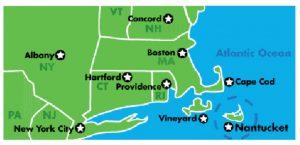
But that was in another century, and another millennium. One of my visits was in the fall of 1976, when I watched a presidential debate between Jimmy Carter and Gerald Ford on a B &B family’s black and white TV.
It was other centuries on the island that drew me. The 1700s and 1800s. When it was a working seafarers’ outpost. Before it turned into a millionaires’ private preserve.
That was because in those centuries Nantucket was also a Quaker center: in fact, the third wealthiest Quaker community of all, after London and Philadelphia.
Shipping made it that; for whaling and commerce. Plus hard work and a thrifty, plain but enterprising spirit. Old-time “Quaker values.”

And guts too. Quakers weren’t persecuted there, as they were elsewhere in early New England; and they did their best to stay out of the fighting in the Revolutionary War. But they always had to contend with the sea, and with whales, and storms, and plagues.

All very dangerous. The men went off on voyages that could last years; and many never came back, swallowed up by the deep or disease somewhere far away. It’s not for laughs that the railed roof lookouts many families built on their houses were called “widow’s walks.”
While the men were gone, or lost, many of the women started businesses of their own, some from their homes, others from shops selling all sorts of things. A block of Centre Street downtown was long nicknamed “Petticoat Row” because of the many women-operated shops there and nearby.
Such pursuits were not consciously proto-feminist — they were meant for survival. Commerce was open to Quaker women, who were also included as speakers in worship and even traveled in ministry. This was rare and radical stuff in religion at that time — though doubtless the day-to-day of local commerce was often as humdrum for women shopkeepers as for men.
Perhaps even more significant, though less visible to outsiders, was the fact that in the island’s large Quaker community, the long absence of many menfolk perforce put women into leadership roles in church affairs.
In those days women Friends normally had their own separate meetings, which had jurisdiction over mostly family-related matters. But this was not “equality” — that notion is a modern invention. The Women’s Meetings were subordinate to the Men’s Meetings. Even so, they were real organizational turf, a base in which to learn skills that were kept away from most other church women (other than abbesses in Catholic convents).
What did they do with this base? One eyewitness wrote of it in 1855, with unconvincing understatement:
“As to Nantucket Women, there are no great things to tell. In the early settlement of that Island Mary Starbuck bore a prominent place, as a wise counselor, & a remarkably strong mind.
“—Divers Quaker women since that time, have been eminent as preachers . . . . In the Mo. Mg. of Friends on that Island, the Women have long been regarded as the stronger part—This is owing in some measure to so many of the men being away at sea—During the absence of their husbands, Nantucket women have been compelled to transact business, often going to Boston to procure supplies of goods—exchanging for oil, candles, whalebone—&.c.—This has made them adept in trade—They have kept their own accounts, & indeed acted the part of men.
“—Then education & intellectual culture have been for years equal for girls & boys so that their women are prepared to be companions of man in every sense—and their social circles are never divided. Successive generations of this kind of mental exercise have changed & improved the form of the head, and the intellectual portion predominates**—Set down as much of this to partiality & self-praise as thou please.”
**[This reflects the tenets of Phrenology, a then-popular pseudoscience that believed the shape of the head indicated various attributes of intelligence and such.]
No great things to tell about Nantucket women? Tut tut & piffle.
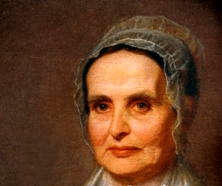
This sketch is in a letter from one of Nantucket’s most eminent daughters, Lucretia Mott, to her pioneer women’s rights collaborator, Elizabeth Cady Stanton. Mott was born on Nantucket in 1793.
Although she became a renowned public speaker, Mott disliked self-promotion. But she knew whereof she wrote: her own mother had opened a shop in their house during a two-year period when her father was stranded on a voyage to South America, and it was uncertain if he would ever get back. (He did, finally.)
Besides a strong work ethic, Lucretia also breathed in Quaker reformism with the bracing island air. Slavery was ended there by 1775, and Nantucket soon became a well-known refuge for escaping enslaved people and an abolitionist bastion. One such new escapee received a historic launch there. An island historian tells of Frederick Douglass’s arrival:
In the spring of 1841 Nantucket banker William C. Coffin traveled to New Bedford to attend an anti-slavery meeting. There he met a 23 year old runway slave named Frederick Douglass who briefly spoke to the meeting. Impressed by the young man’s composure, Coffin invited Douglass to attend a Massachusetts Anti-Slavery Society convention at the Nantucket Atheneum that summer. Douglass accepted and on August 11, 1841, at the urging of convention organizers, he rose nervously and addressed the audience.
“It was with the utmost difficulty that I could stand erect, or that I could command and articulate two words without hesitation and stammering,” he later wrote in his 1845 autobiography Narrative of the Life of Frederick Douglass, an American Slave, Written By Himself.
It was the first time Douglass had given a formal speech and his remarks so ignited famed abolitionist William Lloyd Garrison’s passion that he rose and addressed the audience.“Have we been listening to a thing, a piece of property, or a man?” he yelled.
The gathering of 500 people shouted back “A man! A man!”
“Shall such a man be held a slave in a Christian land?” Garrison then asked. “Shall such a man ever be sent back to bondage from the free soil of old Massachusetts?’
The crowd stood up and shouted “No! No! No!”
After that meeting Garrison invited Douglass to join the Massachusetts Anti-Slavery Society and travel the country on a lecture circuit.

The rest, as they say, is oratorical and agitational history.
The achievements of Nantucket women in home, business and religion were such that they have given rise to some amusing tales. Such as this one, likely apocryphal, but still telling:
In the early 1830s, a young man went to sea, hoping to make his fortune. A Presbyterian by birth, he read his Bible each night in his shipboard hammock, and he was haunted by a verse in the fourth chapter of Proverbs:
“Wisdom is the principal thing: Therefore, get wisdom: and with all thy getting, get understanding.” Wealth, the youth piously decided, was nothing without this seasoning of wisdom. But where was such a combination to be found?
Presently his ship sailed into the harbor of Nantucket Island. Nantucket was then a wealthy and vibrant community, built and largely populated by members of the Religious Society of Friends, or Quakers.
As he walked the bustling, cobbled streets of Nantucket town, observing the fine grey shingled houses and the plain but prosperous inhabitants, another verse from Proverbs came to him. It was something about “I am Wisdom, and in my right hand is riches and honor.”
The more he saw of Nantucketers, the more he felt sure that here was a group that genuinely understood and knew how to apply this kind of Wisdom.
When he turned down one street, which was earning a nickname as “Petticoat Row,” he saw a succession of neat, prosperous-looking shops and stores. Almost all were operated by Quaker businesswomen.
The sailor was so impressed with this commercial tableau that he impulsively entered one of the shops, a kind of grocery store. He walked up to the counter and said to the plain-dressed woman behind it, “Madam, I want to know why you Nantucket Quakers seem so wise in the ways of the world.”
The Quaker woman said to him, naturally very humbly, “Well, of course, it’s mainly because we follow the Inward Light.”
“But,” she added, “it’s also because we eat a special kind of fish, the Wisdom Fish.”
“Wisdom Fish?” the sailor exclaimed. “What’s that? Where could I get some?”
“Friend,” the Quaker shopkeeper said, “thee is in luck. I just happen to have one here, which I can sell thee for only twenty dollars.”
Twenty dollars was a lot of money in those days, but the sailor didn’t hesitate. He pulled out his purse, counted out the money, and she handed him a carefully wrapped parcel, which he carried out of the shop with an excited smile on his face.
He returned a few minutes later, however, looking puzzled and a bit disturbed.
“Excuse me, madam,” he said, laying the half-opened package on the counter. “This is nothing but a piece of ordinary dried codfish.”
Under her modest white bonnet, the Quaker shopkeeper raised one eyebrow.
“Friend,” she said quietly, “thee is getting wiser already.”
After the Civil War, both shipping and seaborne commerce underwent what are now called major “disruptions”: larger, metal ships were built that could not fit into Nantucket’s modest harbor. Then the prized whale oil candles they had long made were displaced by lanterns lit with oil pumped from wells in landlocked places like western Pennsylvania. (Plus, alas, the island’s Quakers, like many elsewhere, fell to quarreling among themselves, and split into factions.)
The upshot was that most islanders migrated to the mainland. For some years, many of the fine houses they had built stood empty. Then the island was discovered by the winners of the “Gilded Age,” who liked to sail for fun. The harbor still worked for their smaller luxury craft, and Nantucket soon morphed into a swanky summer resort destination, which it remains today.
On another of my visits, a friend pointed out to me a middling-sized white house on the edge of town. It was well built, but not palatial. I was told that was where the famed liberal Supreme Court justice William Brennan spent his summers in quiet seclusion, resting up between the rigors of the court’s October to June schedule.
I doubt that loyal Catholic Joe Biden pays much attention to the island’s plentiful Quaker landmarks during his visits, though much of its ambiance was shaped by them. But that’s okay; he’s got lots of his own history there.
But there’s one old Nantucket custom I hope he has noticed: when leaving on the ferry back to the mainland, some people will gather at the stern as the craft approaches the Brant Point lighthouse, which marks the harbor’s entrance. Just as they pass it, they raise a hand and toss coins into the water.
The sailors did this in the belief that, if they thus symbolically “repaid” the ocean for the bounty their ventures hoped to reap from it, they would always return to Nantucket safely.

A legend, surely. But that’s what I did the last time I was leaving. I still have Quaker nooks and crannies there to explore, steep myself in and learn about.
It’s been a long time since that visit, but I’m still hoping.
Lovely post, Chuck!
Thanks, Kristin!