It turns out, there was more to this story, which further digging has at least partially exposed. I want to share that here.
This episode could be said to have begun a month earlier, in mid-July, with pistol shots and bursts of machine gun fire in downtown Graham, the county seat. This confrontation serves as our opening segment:
Act One: The Battle of Alamance Court House
On Sunday July 18,1920, North Carolina’s adjutant general issued the following order:
STATE OF NORTH CAROLINA
ADJUTANT GENERAL’S DEPARTMENT
RALEIGH
SPECIAL ORDERS
No. 200.
July 18, 1920.
1. Under the provisions of Section 11, Chapter 200, Public Laws of North Carolina, Acts of 1917, the Commanding Officer of the Machine Company, 1st North Carolina Infantry, Durham, N.C., is hereby directed to assemble his Company and to report to the Sheriff of Alamance County, for the purpose of upholding the law of the State, and guard the jail of said county until relieved by proper authority.
2. Upon completion of this tour of duty, the Commanding Officer will make full report to this office of the duty performed. . . .
The “machines” mobilized by the unit were machine guns, hence the unit’s nickname, “the machine gun company.”
The Governor who gave the order was Thomas W. Bickett, who served from 1917 to 1921, through World War One.
In these years, the Great Migration of Black citizens heading north, seeking better jobs and some refuge from racist terror, was burgeoning: as many as 20,000 Blacks had left the state during the war. Governor Bickett tried to slow the exodus by reminding Blacks about racial violence in the North, and pointing out that there had been no [recorded] lynchings in NC during his time in office.
Any sense of racial calm, however, was soon shattered: the war’s end in Europe in November of 1918 was followed by a wave of violent race riots and massacres in dozens of U. S. cities, during what Black author and activist James Weldon Johnson called the “Red Summer” of 1919.
It was red with the blood of the dead and injured; red with the flames of burning Black-owned homes, farms and businesses; and “Red” with panic over a feared leftist “Red” revolutionary uprising — which never actually happened, but which triggered the notorious “Palmer Raids” in which thousands of suspected radicals were rounded up. The raids were led by U. S. Attorney General A. Mitchell Palmer (a Philadelphia Quaker, by the way), and added to the seething racial tensions.
North Carolina was largely spared from this round of major outbreaks, though riots erupted in Norfolk, Virginia and Knoxville Tennessee; too close for comfort. And Bickett’s no-lynchings-in NC boast was soon quashed, when George Taylor was lynched in Wake County (near Raleigh) in November 1918, and again on July 7, 1920, when a masked mob stormed the jail in Person County north of Durham, and lynched Ed Roach, who had been arrested on a charge of assaulting a white woman.
Roach worked on a road crew, and his employer told the Durham HeraldRoach had been at work at the time of the alleged assault. This posthumous alibi didn’t help Roach, but did embarrass authorities. And not even two weeks later, a similar situation was boiling over only two counties away, in Alamance:
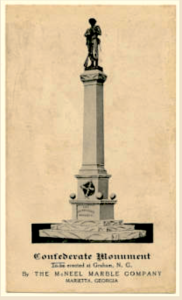
The Confederate monument in Graham, early 1900s.
On Saturday July 17, a White woman there alleged an assault. Reportedly, bloodhounds tracked the assailant to a nearby hospital, where three Black men (left unnamed in all the sources I have yet seen) were found “in bed together,” and arrested. They were shown to a purported witness, who failed to identify them, but were kept in jail pending “further investigation.”
Capt. Marion Fowler: Gentlemen of the Commission; I don’t know just how to start. I am the Commanding Officer of the Durham Machine Gun Company. . . .
On the afternoon of Sunday, July 18th, I was called with some of my Company to go to Graham under orders of the Assistant Adjutant General, to protect three prisoners who were held in jail there, to report to the Sheriff upon my arrival for instructions. I got the Company together and left here at 4 o’clock by way of auto and arrived at Graham by 6:30, and proceeded to go to the jail.
I placed a machine gun at each entrance of the jail, three doors, one gun at each door; placed sentinels on duty up and down the sidewalk; and after conferring with the Sheriff and the County Attorney we decided to allow no one to pass the road beyond the cement sidewalk around the jail, except on lawful duty, and we established that as the deadline.
When we reached Graham there were 2,000 people on the jail yards, on the porches and all around; and we had quite a hard time keeping the people from pushing beyond the cement sidewalk.
During the rest of the evening the crowd gradually diminished, and the crowd dispersed when it commenced to rain, but we had quite a crowd until midnight. During the afternoon and evening, from 6:30 till dark, the men of my Company suffered threats and vile language to be directed to them, and all kinds of remarks, and I ordered them not to speak to anyone except in the line of duty, and I don’t think any of my men returned any remarks. I was there and heard these remarks and paid no attention to them. The Guard was established and, of course, I reported to the Sheriff before I did that, and that was all we decided to do at that time. I had no further orders from the Governor at that time.
Gradually the crowd [went] away until about 2 o’clock Monday morning there didn’t seem to be many people around, just a few autos and people there. Previous to that time I received orders from Governor Bickett from Asheville to protect the prisoners at all hazards and to shoot straight, if necessary.
I immediately gave orders to my men to fire if fired upon, or if a mob tried to attack the jail. About 2 o’clock, I aroused the Sheriff, who was sleeping in the jail and suggested to him that it would be a good idea to get the prisoners to Raleigh before daylight, and that I would make arrangements to keep them in and have autos to carry them to Raleigh, and I offered all the protection necessary from my Company. He told me he didn’t know what to do about it and he wanted to see Mr. E. S. Parker, the County Attorney, about it; and we went to see Mr. Parker, and we reached his house, and he told us after about an hour’s conference that he wanted to keep them there for further investigation.
He asked me what I thought about it; I told him while it might be more convenient to have the investigation take place there, I thought it very dangerous because we didn’t know what would happen. We decided to keep them there, so we kept them.
The next morning the Sheriff and County Attorney were in the jail, they came for an investigation together with other prominent men of Graham, and we guarded the prisoners in the jail during the investigation, in one of the living rooms. We got the prisoners there and had no trouble. There weren’t many people around the hail on Monday morning; and I again suggested that perhaps it would be best to carry the prisoners to Raleigh while it was quiet, that we might have some trouble.
CAPT. FOWLER: To Sheriff Storey. The Governor’s office informed me over the phone that they had phoned the Sheriff that morning to carry the prisoners to Raleigh. In the afternoon things were comparatively quiet except for the fact that there were continually rumors brought to me that we were to be attacked that night at 9:30.
CAPT. FOWLER: From men of my Company who had been uptown. I would try to let three or four men at a time go uptown to get a little rest from duty. I tried to discountenance these rumors, and I cautioned the men not to be excited, and after several came to me with those reports, I took the precaution to put the most level-headed and experienced men on guard.
After dinner than evening – I hadn’t had any rest from Saturday night – I left Lieut. Barbour in charge of the Company and went upstairs to the jury room and laid down across a bed without taking off anything except my pistol and cap; and tried to get some rest. About 9:25 I was awakened by Sergeant Cole who was sent to me by Lieut, Barbour, with the information that a crowd of several masked men had been seen lurking around the jail. I put on my belt and started downstairs.
Before I got to the door I heard one shot. It seemed to come from back of the jail. Before I reached the bottom steps I heard 5 or 6 stray shots. I do not think they were fired by the men of my command.
From the information I gathered from my company, these shots were fired before my men fired. Coming down the steps I heard one of the shots hit the jail right near the window, and by the time I reached the bottom of the steps, Sergeant Price, who was commanding the machine gun in the rear, I heard him give the command to start firing.
I reached the back porch in time to see a flash of a pistol from the cornfield directed toward my men; and the machine gun fired the first 25 shots and then stopped. Then there seemed to be a rush from the cornfield; then a volley of 25 shots more and then I commanded to cease firing.
I saw the rush from the cornfield and I saw no further flashes, and I looked all around, and the firing had ceased immediately upon my command to stop. I don’t believe the firing lasted altogether over two minutes. We fired two volleys of 25 shots each, about 50 shots, directly into the cornfield.
CAPT. FOWLER: No, sir. The muzzle of the machine gun was trained toward the ground nor more than ten feet high. I gave this precaution by reason of the fact that there was a house about 50 yards back of the cornfield, and I didn’t want to fire into the house. The gun cut the corn down within two feet in front of me.
At the same time the gun was firing, the men on the back porch were firing their pistols into that cornfield, and they fired further than the guns. The pistols were 45-automatics. I immediately rushed to the front of the jail in time to see 5 or 6 men rush around the house immediately in front of the jail in a corn patch.
CAPT. FOWLER: Yes, sir, some had on white shirts and some raincoats, they were civilians. Immediately after the firing I got a telephone message from a gentleman in Graham, Captain Scott, that great crowds of people were sending out for men to Burlington and Graham to attack the jail.
So I threw out my guards again as they did before the firing and cautioned the people to keep away. Several people hollered back at my men. That was after the firing. I told Lieut/ Barbour all we could so was to warn them. After I received this telephone information, I ordered the guns placed inside the jail and all the guards withdrawn from the outside, and the rest of the guards were placed at windows inside and the lights turned out.
I had 37 men including officers there. I placed men at all the windows and turned the lights out ready for any attack that might be made upon the jail. Captain Scott informed me he thought the crowds assembling were going to attack the jail. This was after the firing about 9:45.
After the shooting I also received information over the phone that two men had been wounded, and Mr. Ray had been wounded and was expected to die, and afterwards got the information that Mr. Ray was dead.
After taking these precautions and getting the jail well guarded and receiving this information from Captain Scott, I called up the Adjutant General and told him that I was expecting an attack and if he could render any assistance I wish he would do it by sending troops out.
He said he would order out further troops and he would be there himself, leaving Raleigh by auto. During the rest of the night I spent most of the time talking over the telephone. However, just after firing the Chief of Police and Jailor – one man occupies both positions – came down the street in an auto, and I recognized him and passed him into the jail.
During the firing there was no official of the City or County in the jail; the family of the Jailor was there, but the Sheriff was not there, nor any of his deputies, nor the Mayor or any county or city official.
As soon as the Jailor got there, we immediately got his family out in safety, and I told him to call up the Sheriff. He tried to call him for about two hours. After about two and a half hours, he got him, and the Sheriff said he would come down but he never came.
Then I talked to the Sheriff about 2 or 3 o’clock and he asked me if it was necessary for him to come down, and I told him I thought then we could make out without him, but he could come if he wanted to. He said he would, but he was afraid he might be shot, and I told him he would not be harmed by any member of my command, that previous to that the jailor had come past the boys and I knew no harm would come to the Sheriff in passing.
About 12 o’clock midnight Monday or a little after, there were then three shots, several people firing at the jail and struck close by where I was sitting at the window on the northeast corner of the jail. We didn’t return the fire because we couldn’t see where the bullets came from and saw no crowd, except we did see some people in the fire-house, but could not tell where those shots came from. Then the Adjutant General came here reached Graham about 4:30.
CAPT. FOWLER: About twelve midnight. We then decided to remove the prisoners to Raleigh, and I divided my Company into two sections. I put the men and the machine guns in two trucks. I was ordered to be ready to leave at a quarter of six, and I was ready, and about 5:30 or 5:45, the Sheriff, General Metz, Colonel Scott and the Deputy Sheriff came into the jail. They came and got the prisoners out, and we placed the prisoners in among the men and put them in the machines that were waiting outside in front of the jail.
The auto with the prisoners was between the two trucks, and we put a machine gun on each truck. When the trucks rolled up we started for the station where they had a special train waiting, and we got them to Raleigh; turned them over to the penitentiary authorities; came back to Durham and dismissed the Company. That is just briefly a complete resume of the whole affair. . . .
Fowler’s “resume” was not quite complete. He does not say who appealed to the governor for troops; Fowler wasn’t involved in those discussions. But other reports and news articles are also very vague on this point: there were a couple of oblique references to the county commissioners, but none were queried, or identified. The determination of Sheriff C. D. Storey to steer as clear of the whole imbroglio as possible is evident.
Such official running for cover was frequent behavior among local elected officials (then and now); but mobs of white men likely included many of their voters, and 1920 was an election year.
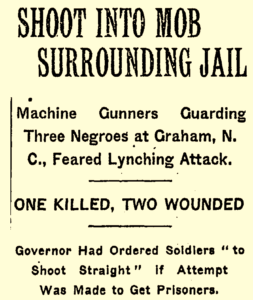
NY Times article on Graham confrontation, July 1920
The exception here was Governor Bickett, whose orders to “protect the prisoners at all hazards and to shoot straight, if necessary” were firm, forthright, and well-attested.
But Bickett was then a lame duck: in the final year of his term, he had not sought re-election, and his successor had already won the all-important Democratic primary. Whatever his racial views, Bickett evidently disliked lynching and race riots, and the Carolina elite agreed that they were bad for business and tourism. (This was confirmed by the fact that the New York Times reported — and garbled — the story.)
One more item missing from Fowler’s account was a casualty count, In the gunfights, one man, James Ray, was killed, and two others wounded (all were White.) Later, uncorroborated testimony said Ray was merely a bystander. No witness in two days of investigative hearings identified anyone, soldier or masked gunman, as their shooter.
Another lack was the names of the three Black prisoners; and no other available document includes their names or fate after their rescue.
With the prisoners’ transfer to Raleigh, outward calm returned to Graham.
But the bloodlust in Alamance was not slaked. Five weeks later, those driven off by the Durham machine gunners had their trophy.
ACT TWO: “not inclined to be severe”
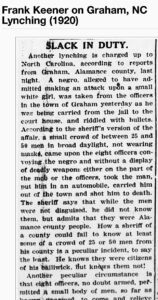
From the Durham NC Herald-Sun, August 25, 1920
By Walter N. “Frank” Keener, Editor, in the Durham NC Herald-Sun, on Graham, NC Lynching (1920):
SLACK IN DUTY.
Another lynching is charged up to North Carolina, according to reports from Graham, Alamance county, last night. A negro. alleged to have admitted making an attack upon a small white girl, was taken from the officers in the town of Graham yesterday as he we being carried from the jail to the Court house, and riddled with bullets.
According to the sheriff’s version of the affair, a small crowd of between 25 and 50 men in broad daylight, not wearing masks, came upon the eight officers conveying the negro and without a display of deadly weapons either on the part of the mob or the officers, took the man, put him in an automobile, carried him out of the town and shot him to death.
The sheriff says that while the men were not disguised. he did not know them, but admits that they were Alamance county people. How a sheriff of a county could fail to know at least some of a crowd of 25 or 50 men from his county is a peculiar incident, to say the least. He knows they were citizens of his bailiwick, but knows them not.
Another peculiar circumstance is that eight officers, no doubt armed, permitted a small body of men, so far as known unarmed, to come and relieve the officers of a prisoner.
If those officers had the least desire to protect their prisoner they could have done so. The Alamance sheriff was subject of considerable criticism for the way he handled conditions growing out of the affair at Graham last month when a woman was assaulted, two [sic] negroes arrested, and because of threats of lynching the Durham machine gun company was called out.
Yard sign, Alamance County, circa 2018.
In defending the prisoners one man was killed. On top of that comes the giving up without a protest, so far as is known, of the negro yesterday, who was in his custody. And it is not calculated to give the officer any better standing as a guardian of the law. If the facts are as reported, there should be an investigation and prompt action taken by the governor.
We are not inclined to be severe in censuring the members of the mob who lynched the negro yesterday, though we contend that they should have let the law take its course. Feeling over the assault last month has not died down, and to have a small child attacked by a brute in a little more than a month after was calculated to stir up bitter feeling against the fiend. The law should be upheld at all hazards, but as long as red blood courses Anglo-Saxon veins, there is always the possibility of human feeling dethroning calm judgment.
The mob did not have the usual excuse of fearing that the accused would not be brought to trial. According to the report, the crime was committed about 10 o’clock yesterday morning, and the suspect, arrested two hours later. The Alamance county superior court being in session a bill was drawn, sent to the grand jury immediately and in a brief time a true bill was returned. At 3:30 yesterday afternoon, five and one-half hours after the alleged crime, the prisoner was ordered to the court house for arraignment. Despite that quick work on the part of the judiciary the negro was lynched. That is a feature of the affair that is not creditable.
The man Ray who was killed in the attack on the Graham jail last month would probably have been living today had Alamance officers displayed judgment that the situation seemed to have demanded. Yesterday’s lynching would not have been charged against the county if the officers had displayed a little grit. But none of these things took place and the county, with its thousands of most excellent people, will have to bear the blame for the act of a small body of men and spineless officials
EPILOGUE: “There appears to be no Race feeling.”
As usual, there were no charges or convictions. But a few points can be added:
The talk about “letting the law take its course” seems in retrospect to have been unlikely to have long extended Jeffress’s life. As the Raleigh News & Observer summarized, county officials had set it into hyperdrive:
Alamance superior court in regular session was ready for the negro’s trial, and Judge Allen, of Kinston, and solicitor Sam M. Gattis immediately decided to put the wheels of justice in motion. The father and mother of the little girl was summoned, the stage all set and everything put in readiness.
Court addresses crowd.
Quickly the news had spread and from everywhere the crowds had gathered. Every inch of space in the courtroom was taken, while outside the people jostled each other on every street. If there were thoughts of a lynching they were not discussed publicly.
At 4 o’clock the court announced the readiness to begin with the trial and Sheriff Storey and his deputies went to the county jail 100 yards away to get the prisoner. Judge Allen in his fatherly manner talked to the crowd in the courtroom urging them to be calm and to see that justice took its course.
He spoke of the great provocation to violence under which they labored and declared his sympathy with it but felt it would be extremely unfortunate to yield to it especially since the court was already to administer justice.
When the officers have gone a few yards from the jail a mob of angry citizens, variously estimated in number appeared, and quick as a flash overpowered the sheriff and his assistants. The Negro was whisked away in a big automobile to a section of Woods on the Bellemont Road and there shot to death.
The men declared responsible for the killing are said not to be natives of this county and their names are unknown here tonight. It is it is claimed that they came in a big automobile.
Grand jury returns bill.
The grand jury had already returned a true bill against the negro and all was ready for the trial. The father and mother of the little girl had identified the negro as the man they say they saw run away to the woods. The little girl has said he was the negro.
Physicians had testified before the grand jury that an examination of the victim of the tragedy showed that the negro had accomplished his purpose. The girl is said to be a few days less than seven years old.
After the negro was shot down, his body was left beside the road and thousands of people from the surrounding country visited the place.
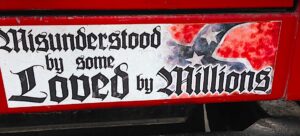
A Neo-Confederate bumpersticker, Alamance County NC 2018
It was a determined set of men that pursued the negro from Elon college this morning, but they had no other side than to just let justice take his course. President Harper was one of these men and was in the courthouse to appear as a witness. The father said the outraged girl had no other thought then that the negro would be fairly tried.
Solicitor S. M. Gattis was in the court room this afternoon ready to prosecute in the name of the state. His feeling over the outcome was one of extreme disappointment.
Not a shot fired.
There was not a shot fired; not even a gun drawn during the minute struggle between the mob and officers. Sheriff Storey said tonight that resistance would have been folly as the mob was made up of between 25 and 50 determined men. There were at least 150 additional men nearby whose sympathies were with the mob, he stated tonight.
Answering a direct question, Sheriff Storey declared that he did not know anyone in the mob. The man who led the mob and took the prisoner away, the sheriff said, must have just moved into the county and was not known to him. There have been no arrests in connection with the negro’s death. Whether there is a likelihood that there will be arrests the sheriff did not know.
Sheriff Storey said tonight that Graham is quiet. There appears to be no Race feeling. The negro was not a resident of Alamance county.
A quick quiz: Governor Bickett quickly appointed a commission to investigate the Battle of Alamance; it met for two days of testimony in early August. In its proceedings, can you guess the two questions that were asked most often, particularly of Captain Fowler, the machine gun company commander?
They were:
1. Did your men drink or smell of whiskey or moonshine during their days in Graham? And
2. Were your men ever heard to use profanity, particularly in retort to the many jibes and insults from the mob?
His answers were singular and consistent: “No, sir.”
Point to Ponder: Could this be why the mob’s favorite sneering jibe at the troops was calling them, “Boy Scouts?”
Here’s a more, er, sober unanswered query: had the mob not assembled to snatch Jeffress, how much longer, I wonder, would he have lived anyway? Given the more than deliberate speed of the proceedings that they interrupted inside the Graham courtroom, how long might jury have deliberated then? Minutes? What would have been the interval between a death sentence and an official execution? My mind estimates that in hours, or a few days, and could not call that justice.
Whatever. The vagaries of fate continued. Governor Bickett left office in early 1921, moved to Raleigh, bought a house, opened a new law practice — and in December that same year died suddenly of a stroke.
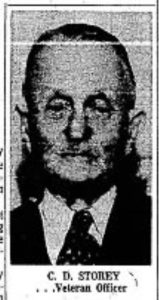
Sheriff C. D. Storey continued as Sheriff until 1928, when he was swept out of office in the Republican landslide led by the new president, Herbert Hoover (also a Quaker). Afterward Storey worked as a constable (aka security guard) in Burlington, and died in 1964.
The Alamance Confederate Memorial still stands. Two years ago it was surrounded by a heavy wrought iron fence, evidently as protection.
An anti-lynching cartoon, 1897.
Related
2 thoughts on “The Long Read: lynching Prevented, Lynchings Abetted; North Carolina 1920”
I really enjoyed your writing, thank you for trying to preserve this history. You mentioned:
“On Saturday July 17, a White woman there alleged an assault. Reportedly, bloodhounds tracked the assailant to a nearby hospital, where three Black men (left unnamed in all the sources I have yet seen) were found “in bed together,” and arrested.”
According to the website below, the three gentlemen that were placed in jail after the July 17th “crime” were identified as: George Troxler, Arthur Veasey and Willie Lee. They were successfully taken to Raleigh and held, escaping the Graham mob. I’m not sure of their fates.




 Sheriff C. D. Storey continued as Sheriff until 1928, when he was swept out of office in the Republican landslide led by the new president, Herbert Hoover (also a Quaker). Afterward Storey worked as a constable (aka security guard) in Burlington, and died in 1964.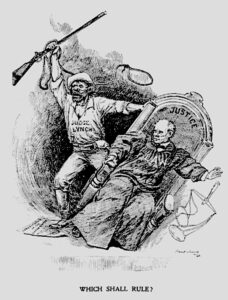
Palmer was a Stroudsburg, PA Quaker to be exact.
I really enjoyed your writing, thank you for trying to preserve this history. You mentioned:
“On Saturday July 17, a White woman there alleged an assault. Reportedly, bloodhounds tracked the assailant to a nearby hospital, where three Black men (left unnamed in all the sources I have yet seen) were found “in bed together,” and arrested.”
According to the website below, the three gentlemen that were placed in jail after the July 17th “crime” were identified as: George Troxler, Arthur Veasey and Willie Lee. They were successfully taken to Raleigh and held, escaping the Graham mob. I’m not sure of their fates.
https://redrecord.org/wp-content/uploads/2018/07/Durham_Morning_Herald_Fri__Aug_27__1920_.jpg