
 On June 11, at Southern Appalachian Yearly Meeting (SAYMA), I heard a rising young Friend, Christina Repoley, talk about her longtime leading to see the creation of a new Friends service program, to be called Quaker Voluntary Service, or QVS.
Having heard mentions of and references to this idea for several years, and Christina’s special concern for it, I was eager to hear about it from “the horse’s mouth,” so to speak. My expectation was that with this much time for gestation, the idea must be about ready to get off the ground.
It sounded like that at first. Christina spoke of the idea having roots as far back as 1998, when she joined the Quaker Youth Pilgrimage to England’s “1652 country,” where Quakerism emerged. It took more definite form in 2003, and since then she has visited with the Mennonite Central Committee (where, in my view, they know how to do this volunteer service thing right), and consulted with various Quaker worthies here and in England.
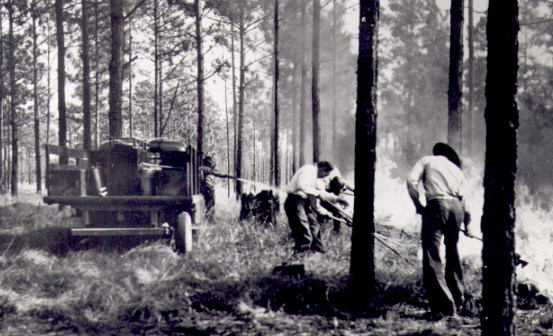
Conscientious Objectors in world War Two doing alternative service.
By 2008, she was in seminary and learning about some previous efforts to start such a program, and then taking part in a consultation at Pendle Hill. A steering group emerged from that meeting, which has been in conversation since, and this coming weekend (June 25-27) an initial board of directors for QVS will meet, again at Pendle Hill.
As I say, I began the evening with great expectations. By the end, however, I was feeling much more cautious. That’s because, despite Christina’s enthusiasm and dedication, some big questions still hovered unanswered over the concept; and when they were asked, the answers indicated they had not yet been addressed; which was not good, especially this far along.
Here are the questions:
First, how does the QVS leadership plan to manage the “killer issues,” that sank the previous version of a Quaker service program?
These killer issues are three: 1) affirming (or not) the presence of open GLBT persons 2) insisting (or not) on celibacy or marriage-only sex for of-age heterosexuals. And 3) requiring (or not) a Christian identity for the program and/or participants.
Of course, these issues are alive and unwell across the Quaker spectrum. I wouldn’t expect QVS to resolve them. But managing them in their bailiwick had better be part of their policy framework.
“Managing” them means having policy responses worked out in advance, which they are prepared to articulate and stand up for, having carefully weighed the costs and benefits. Otherwise, the history of other similar efforts indicates these persistent conflicts will tear at the program’s fabric and morale; and once morale is gone, the rest is likely to follow.
A previous program, Quaker Volunteer Witness was sunk by just such a combination: fights over Christian “identity” and participation by gays alienated much of the institutional support, sapped morale and bogged down recruiting and fundraising. It was not pretty to watch. (Two brief accounts of the associated controversies can be found here and here.)
Sure, I have opinions on what the optimum policies on these vexed matters for the new QVS might be; but let the new QVS board to come to their own conclusions – as long as they don’t dither or equivocate about them. Because they won’t wait.
Neither will the other major unanswered question about QVS, which is: how will it be financed? Where will the money come from, not only for a launch, but to keep it going?
I was troubled to learn that after all the discussion and discerning, there does not appear to be any clarity about this most mundane of matters either. The most we heard about funding was Christina’s description of how last year the QVSers submitted an application to a Quaker fund for a large grant.
They had high hopes for the grant, she said: the application seemed well-prepared, and they had enthusiastic letters of support from several eminent Friends.
But QVS did not get the grant, or even part of it. The most money they have collected came in the form of unsolicited donations sent in after Christina published an article about the idea in the “FGC Connections” newsletter.
This report was also very discouraging, on several counts.
First of all, fundraising is basic. It’s what turns ideas into actions, and actions into ongoing programs. Second of all, the spontaneous response to Christina’s article about QVS suggests that there are Friends ready to respond to a clear and organized call for support.
But third, fundraising, especially for an ongoing, long-term effort, calls for more than enthusiasm and dedication: it requires skills and planning. One can learn these skills, including planning. But as the old chestnut goes, to fail to plan is to plan to fail; and QVS financial planning is still a worrisome unknown.
Personally, I think the Quaker fund likely did the QVSers a big favor by turning down their grant application. That’s because the program will need to built its own ongoing financial base if it expects to last. And the sooner it gets to building it (like from the start), the better.
All these items precede the perhaps more interesting questions of organizing and administering the QVS program itself: finding projects, attracting and orienting volunteers, communicating about it to Friends and others. Those matters are probably more fun to talk about; but to focus on them prior to dealing with the others is like trying to build a house from the attic down, rather than from the foundation up. There are problems with that.
So as the QVS board gathers and gets down to its work, here’s hoping they will dive directly into these knottier matters which are so critical to their hopes of success.
I wish them well. It’s been forty years since the collapse of the legendary Quaker workcamp program that only senior citizen Friends now remember, but with depthless gratitude, and hope for some kind of revival or resurrection. How the QVS leaders manage the killer issues, and organize for serious fundraising should tell most of the story about how much of those hopes can be safely pinned on their new venture.
And please Friends, remember, you’re builders now, so: foundation up, not attic down.
Friends, I agree with Chuck. The Mennonnites know how to do
volunteer service right. Yet I say the Church of the Brethren
does it even more right, at least for Friends.
Brethren Volunteer Service is now more than 60 years old.
They send volunteers to projects around the country for two-year
periods (including two or three months of training), and to
projects overseas for three years or more. They are open
to members of all churches and none. They require no
confession of faith. Nor do they require any signed oaths
about sexual behavior. (Of course, when on project, one
must do in Rome as the Romans do. This is true in any
existing Quaker work-camp program I know of, including
African Great Lakes Initiative.) If one works in the U.S.A.,
often the volunteer can be rewarded after service with a
substantial Americorps college scholarship. They even
have projects already in Quaker or part-Quaker organiza-
tions, such as Center on Conscience & War and Quaker
Service in Belfast.
Here is an existing peace-church volunteer-service program
that should be perfectly acceptable to most Friends. I used
it in the 1960’s, when doing alternative service. Friends
would be more than welcome now.
I’m sure that BVS needs more money; so if Friends started
to use BVS in any numbers, we should contract with BVS
for its services. No doubt BVS would be willing to set up
a special orientation program for Friends once or twice a
year, if there were enough of us. (They already do this
for the most evangelical Brethren.) I think that the con-
tracting agency should be AFSC. This would get AFSC
back into the business of Quaker volunteer service, and
raising money among Friends to pay for it.
And if BVS is not acceptable to Friends, we still must not
give up, for there are countless ways for younger (and
older) Friends to do volunteer service right now. Save
some money. Raise some money in one’s own Friends
meeting. If this isn’t enough, seek a small grant from
the Clarence Pickett Fund. Then offer to do volunteer
service with a Quaker organization that interests you,
whether Friends Committee on National Legislation,
or Friends Journal magazine, or Bolivian Quaker
Education Fund, or African Great Lakes Initiative, or
—-for that matter—-Quaker House of Fayetteville.
I don’t think you’ll be turned down by everyone.
Thanks for this summary of where the QVS is headed. You are correct that funding is so important. And Friends are NOT so good at talking about money. That’s because money is the biggest “clearness” ofall. The places we put our money says more than all of our minutes, when it comes to putting our Faith into Practice.
The SAYMA YM we attended where you heard Christina speak had as its theme” Discerning the Way” and the clearness process seems to be a key tool used by Friends to help with that so important issue.
Could it be that fundraising is a form of cleanness that QVS has not attempted? Maybe they want to run QVS like a monthly meeting where we approve a budget and then pray that the money will come?
I, to believe that if we are Spirit led the money will come. Yet, for something like QVS you points are well taken. If the issues you describe are not resolved before the fundraising starts, then people will wonder whether the leading is from the Spirit, for surely they are not suprising questions? So let’s encourage QVS to walk where Quakers fear to tread.
And they need to remember, that you have to ASK before you can receive.
Sales Training 101 anyone? This is what I use (and you know well).
https://secure.sandler.com/eventcalendar/show/?prid=83106×tamp=1278516600&siteid=74802
Frends, my comment has been up for two weeks and nobody has
replied. So I ask again. Why do we need a big program of
Quaker Volunteer Service? The Church of the Brethren already
has one going for us that almost all Friends should find com-
pletely satisfactory. Let’s tell our young people about it, in
every Quaker meeting and school. In many cases, BVS
volunteers are eligible for substantial Americorps scholarships
after their service. No doubt BVS would set up a special
orientation for Friends. Of course, Friends should pay for
the privilege of using BVS in numbers; the Brethren certainly
need the money; we can raise it for AFSC to pay them.
The whole thing is an example of re-inventing the wheel.
BVS has been around, very successful, for more than 60
years. The Church of the Brethren is a great group. They
are far more ecumenical, both internally and externally,
than the other peace churches. They have on annual
conference for the whole world, which makes its decisions
by majority vote. They decided 15 or 20 years ago, I
think, to allow gay and lesbian marriages. Tneir
evangelical members hated this decision, but the church
did not splinter.
What we DO need, I think,is an information service that
would collect and publish information about as many as
possible of the opportunities for Quaker volunteering
and Quaker internships that now exist. There are
African Great Lakes Initiative workcamps in Rwanda.
Burundi, and Kenya. There are FUM workcamps in
Cuba, and FUM service opportunites for teachers of
English in Palestine and Belize. AFSC has had a person
in Burundi for years. QUNO has interns in Geneva, and
FCNL has interns in Washington. Center on Conscience
and War uses volunteers, and so does Quaker House
of Fayetteville. Many yearly meetings have summer
camps, and often they welcome volunteers to work in
the off-season. The Quaker missions on American
Indian reservations could use volunteers. One could
go on and on in this way. A little info service, with
maybe a half-time staff person, could spread this
information around, by computer and on paper, to
Friends meeings and schools everywhere in North
America. Now this would be something small, but
might be very useful. Jeremy Mott
Hi Jeremy,
Perhaps you should write to Christina and see why she does not want to use the various groups you mention above. I could give you several answers but that doesn’t really mean much, does it, as it is not my leading.
Her email address is: christinarepoley@gmail.com
Regards,
Free
QVS is now a successful program and has been going on awhile. My daughters boyfriend & others I met went through it, and they have the added perk of being able to attend Earlham School of Religion free of charge after if they wished.
Perhaps if Chuck Fager had anything positive to say more people would have supported it earlier on. Perhaps some trust was due the newly formed board to work out these issues, rather than blaming and shaming Christina whose shoulders it did not rest on. How about giving people a chance? They did work it out & it’s a wonderful program. Chronic faultfinding is a fault & is not a way to see that of God in another who is having a leading.
Hi SueLynne, I just want to point out that this blog post you are replying to is from 2010, 13 years ago. I stand by what was written then; but there’s been a lot of experience in the meantime; QVS is due for an update report.