
Quakers: “Cannot Learn War Any More”; Or Maybe We Can.
Christian History Magazine is out with their latest issue, featuring “The Surprising Quakers.” And among the articles is one about the “Peace Testimony” entitled “We Cannot Learn War Anymore,” by your humble blogger.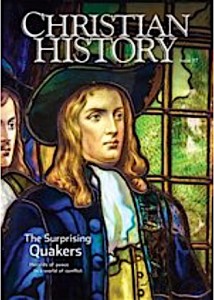
(By the way, you can download a free copy of the issue at the link above; in it you’ll also find articles by some other Quaker writers, including fellow Tarheel Max Carter.) I’ve long been interested in the history of what we now call the “Peace Testimony.” And I’ve discovered some surprising facts and non-facts about it.
Here’s a fact/non-fact that surprised me: The “Peace Testimony:” is advertised as being as old as Quakerism. But if that’s so, why is there no listing of it in the first several generations of Quaker Books of Discipline? It’s not there!
(You can check that here: there’s an Index of topics listed in early printed Disciplines, and look it up: “Peace” is not on it.)
That’s because the testimony was not about Peace; it was about War. And the content was pretty simple: Quakers are to keep out of wars.
But late in the 19th century, the understanding and emphasis changed drastically. War came to be compared to a disease, like measles; and the goal of the witness was to eradicate it.

This change in outlook was perhaps best expressed by one of my Quaker heroes, Lucretia Mott, in an 1876 speech, where she declared:
“If we believe war is wrong, as everyone must, then we must also believe that by proper efforts on our part, it can be done away with.”
That’s a very different, and much more ambitious agenda than simply staying out of wars. But it’s now widely accepted as being what the Peace Testimony always was about.
But that’s not all: along with the shift to what could be called the “public health” approach to peace, judgments about practicing the testimony were “privatized”: before 1861, donning a military uniform was grounds for disownment, with no excuses & little wiggle room.
But since the U.S. Civil War, it’s been up to individual Friends whether they went to war when their country called — and the truth is, most Quakers of military age did sign up and go. We hear more about the ones who said no; but –like it or not — for 160 years, they’ve been a distinct minority of American Quakers.

This historic change has not been well-charted by historians. I tried to track the shift in a summary way in this article. Here are some excerpts from the piece, in hopes of whetting your interest:
A letter of self-preservation directed to King Charles II by Margaret Fell and George Fox in 1660 started it all. Brief excerpts from the letter appear today in the Quaker books [of] Discipline and Faith and Practice. In part the excerpts read:
We utterly deny all outward wars and strife, and fightings with outward weapons, for any end, or under any pretense whatsoever. … The Spirit of Christ, by which we are guided, is not changeable, so as once to command us from a thing as evil, and again to move us unto it … [it] will never move us to fight and war against any man with outward weapons, neither for the Kingdom of Christ nor for the Kingdoms of this world. … Therefore, we cannot learn war any more.
These few sentences are foundational for Quakers. They are a kind of Quaker scripture, drafted by Quaker founders, preserved by Friends of all branches, and recited by Quaker faithful for three and a half centuries. But the truth about the Quaker peace testimony cannot be contained in a few sentences that are in fact altered from the original 1660 letter. In this discrepancy we glimpse the actual history of Quaker pacifism—a much more tangled, ambivalent, and compelling saga.
The original letter actually starts out: “All bloody principles and practices, as to our own particulars, we utterly deny; with all outward wars. . . .” Like other radical groups, Friends in England in 1660 were powerless, facing persecution by a newly restored monarchy that feared dissenters would plot coups. The letter to Charles hoped to ward off this persecution (it didn’t succeed, but that’s another story). The letter noted that while the Quakers had foresworn violence, they did not expect their rulers to do so: “Therefore in love we warn you [King Charles] for your soul’s good, not to … turn your sword backward upon such as the law was not made for, i.e., the righteous; but for sinners and transgressors, to keep them down.” This mention of the ruler’s sword rephrases Romans 13, familiar verses that are important in Western political history, having been often used as scriptural sanction for official state violence.
The 1660 letter affirms a desire to live “under the power ordained of God for the punishment of evildoers, and for the praise of them that … live a peaceable and godly life.” Far from banning the use of violence altogether, the Quakers relinquished the sword to the government—and also pointed out their own piety, with the hope of being spared that same sword.
QUAKERS IN POWER
Moreover, once across the Atlantic, Quaker settlers in Rhode Island not only coveted worldly power but achieved it. The colony’s 1672 election produced a Quaker governor and a majority of Quakers in the assembly. Friends held the bulk of local political power for many years afterward.
This novel development (almost a decade before William Penn began his “Holy Experiment” in Pennsylvania) was soon endorsed by no less than Quaker founder George Fox himself. He visited Rhode Island in 1672, as an honored guest of the Quaker governor, and praised the new Quaker government as a righteous triumph.
Yet with righteous power also came the matter of bearing the biblically prescribed sword against evildoers. In England Quaker worldly power was still unimaginable. But in Rhode Island, rulership (and its sword) were in Quaker hands. What were they to do with it?
In 1672 Rhode Island, there were threats of invasion by French and Dutch warships and thick forests inhabited by increasingly restive native tribes. In the summer of 1675, natives launched massive, region-wide assaults against white settlers in New England.
Historian Meredith Baldwin Weddle evoked the terror Quakers felt: “. . . the fear of violence shredding all certainty and all expectations. … For the Quaker, alone in his small house, miles perhaps from a neighbor, fear and horror faced down the ordained love for his enemies. . . .”
We don’t know if the Friends in office underwent much soul-searching. We do know they adopted the first-ever conscientious objector statute, exempting from militia duty those whose religious scruples forbade bearing arms; and then they went to war.
How did they reconcile this warmaking with the antiwar pronouncements of 1660? Apparently they didn’t bother. After all the 1660 letter contains both sentiments . . . .
Quakers: “Cannot Learn War Any More”; Or Maybe We Can.
 [NOTE: I’ve described the impact of the Civil War on Quaker pacifism in more depth in the book, Remaking Friends. More information about the book is here.]
Thanks, Chuck.
Very helpful clarifying of the record. I tend to be an absolutist on the pacifist thing… Like so many not born into Quaker households, I came to the Society of Friends through (my understanding of) the Historic Peace Testimony. They were an inspiration to me in keeping alive the normative practice of the Christian church in its first 3 centuries.
I also realize that Friends had been around a good decade (with some Quakers being part of the Parliamentary army) before the 1660 crisis demanded that they distinguish themselves from the Fifth Monarchy Men and armed insurrectionists… even those claiming to fight for “the Kingdom of Christ.”
It is, indeed, helpful to see how the Testimony evolved, and what were the circumstances that led a select few (not waiting for a Yearly Meeting and duly appointed committees) to gather and hammer out and deliver this classic statement. It is, indeed, foundational for me… in that it’s rooted in “The Spirit of Christ,” not in a secular calculus of what might work in human relations and governance, or a sentimental humanism..
We also need to be reminded of the massive abandonment (individually though not corporately) of that Testimony in the crisis of the Civil War, and then the development of avenues for acknowledging that the young men had indeed acted out of unity with their Meetings and their history, who were then accepted back in. I have not, however, been happy with the “it’s totally up to you” aspect of it being optional, rather than normative.
But I celebrate that there has always been a “faithful remnant” which has upheld this distinctive teaching/practice (shared with others in the Peace Church tradition) even when the bulk of Quakers of military age may have answered the call of the State rather than the Gospel.
Oh, by the way…. you may want to edit/change this apparent Freudian slip:
[quote]
And among the articles is one about the “Peace Testimony” entitled “We Cannot Learn Anymore” …
[end-quote].
If Christ has come to teach his people himself, we obviously musst remain open and teachable!
Warm regards, —DHF