
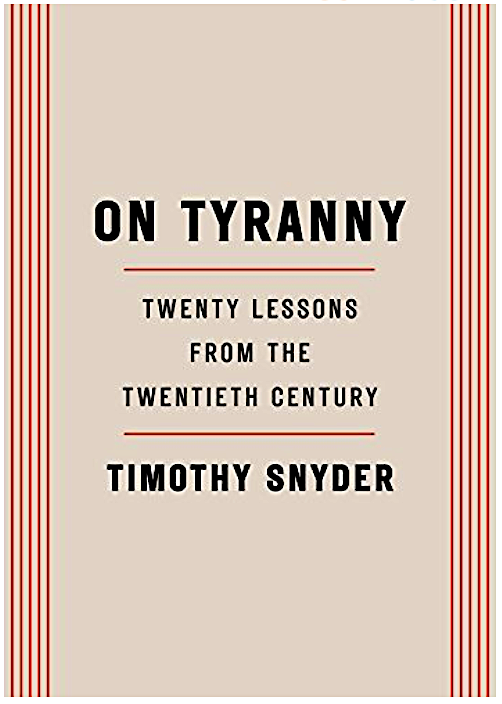
I picked up Timothy Snyder’s On Tyranny the other day. I had read excerpts from it; this time it was cover to cover.
It’s concise; reading only took a little over an hour. But it was more than worth it.
 In fact, I’d say it was necessary for me.
I needed to read it because I’m persuaded that local and state governance in much of the United States is approaching, or even sliding off the cliff into an abyss of authoritarianism. Our runaway Supreme Court appears ready to give the whole country a major shove, starting with reproductive rights and following up with blows to many other of our remaining liberties.
Others could add issues to this list, but that’s not my purpose here. Most of us can also see that crouched right behind the court is an allied political insurgency which has already mounted one authoritarian coup attempt, and is preparing another as I write. Many pollsters and pundits are predicting that its electoral prospects are burgeoning like the beginning swirls of political tornados that will touch down explosively in November.

I won’t predict any political races here. Whatever happens then, the authoritarian drive will continue. Moreover, many of the structures and support for a successful American authoritarianism are here now, piecemeal, or under construction, but increasingly interlocked. The parallel terrorist violence it spawns, continues to pile up bodies, as now in a Buffalo supermarket.
Snyder does not offer a recipe for thwarting this process. I wonder if booksellers saw this as a marketing flaw. After all, most other related books bear upbeat titles along the lines of, How Our Democracy is Going to Hell in a Handbasket—And How YOU can STOP and REVERSE the Direction in a Mere Six Months (And Keep the Handbasket as a memento or for use in laundry and shopping).
Snyder does not seem to be a fan of that approach. He is a historian who has studied the decline and destruction of democratic (and near-democratic) systems in many nations, particularly in the twentieth century. In On Tyranny he has distilled this career of scholarship into 20 short chapters, some brief enough to be better described as oracular or aphoristic. Despite its brevity, the book is all business, and Snyder’s mood is not upbeat.
One of his premises is that tyranny often establishes itself on the installment plan. But once in control, it is hard to deconstruct. Snyder notes that the Soviet tyrannies lasted nearly 70 years. The Nazi Reich went down after a mere 12, but toppling it took a world war.
Snyder doesn’t dwell on the USA’s domestic system of racial fascism that took bloody possession of the American South in the 1870s. But he could have: it lasted nearly a century, and for most of that time had formal or de facto federal backing. Pieces of it still persist, have metastasized far from the South, and its revival is more than a quivering needle on our social geiger counters.
Neither is On Tyranny a handbook for overthrowing authoritarian regimes. Such will be needed, but are different projects.
Instead, On Tyranny is a crucial schematic for those now called to the Long work of surviving tyranny. How do we resist and endure its repression and pillage? And if we cannot soon end it, then how do we preserve and pass on the resistance spirit that someday will, knowing that “someday” may be a long time coming?
I didn’t realize it, but I needed such a blueprint. It helped me clarify and focus better on what I have already been doing along this line, and think more clearly about how to pursue it further. I don’t claim to be a model “Snyderite,” but hope my effort can be one earnest example.
Among Snyders’s 20 points, two stood out for me. One is Number 2 – “Defend institutions.” Snyder:
It is institutions that help us to preserve decency. They need our help as well. Do not speak of “our institutions” unless you make them yours by acting on their behalf.
Institutions do not protect themselves. They fall one after the other unless each is defended from the beginning. So choose an institution you care about—a court, a newspaper, a law, a labor union—and take its side.
We tend to assume that institutions will automatically maintain themselves against even the most direct attacks. . . . The mistake is to assume that rulers who came to power through institutions cannot change or destroy those very institutions—even when that is exactly what they have announced that they will do. . . .
Sometimes institutions are deprived of vitality and function, turned into a simulacrum of what they once were, so that they gird the new order rather than resisting it. . . . It took less than a year for the new Nazi order to consolidate. By the end of 1933, Germany had become a one-party state in which all major institutions had been humbled.
Humbled: including the press, which was turned into a tool of systemic lies, imperial war and racist genocide.
I had sensed much of this imperative already. But “institutions” are numerous and various. I touch and am touched by many daily. Which ones can and should I work to defend? And how?
It didn’t take me long to see what my answer was: the institution I needed to work to defend was (is) journalism, the ”free press.” I spent much of my working career in it, under various umbrellas, and continue to do so, in part by this blog, in ostensible “retirement.”
As an institution the press has been under assault for years, from many directions: the hemorrhage of financing, readership and jobs; infiltration by disinformation and propaganda; plus in many places, including the USA, violence and murder.
Further, on our outlaw Supreme Court, two justices have voiced support for loosening press libel protections. That would further undermine press freedom.
Okay, so I feel summoned to join its defense, enlist in Snyder’s Legion, mount my steed and gallop into the fray.
The reality is more mundane: concretely, I found myself redirecting much of my former charitable and activist donations into subscriptions to newspapers and journalism-oriented magazines; mostly online.
That shift in spending, I realized, occurred mostly subconsciously: “Shift donations to subscriptions” was not on a New Years Resolution list.
But it fit — it fit me, and the moment. In years past, particularly before 2016, I recall searching for ways to evade the paywalls being erected around major news websites. Yet one by one I gave that up: what they were doing was important, not only in the abstract, but to me personally. And as 2016 crashed into 2017, they were all under increased attack by powerful, and often ruthless forces.
But who am I kidding? My media budget is paltry; it won’t save any newspaper. Jeff Bezos could rescue the Washington Post in 2013 with pocket change from his Amazon mega-bankroll. My subscriptions merely put drops in as many topflight buckets as I can. But they do support and thus help defend those institutions.
I don’t just subscribe; much of my time is now devoted to keeping up with them, interpreting it, following up on what is published, and sharing some of the most striking or challenging reports, here and elsewhere as way opens. This could be a full-time occupation, and if I were younger and more hale, it likely would be.

There are many other institutions in a similar plight. Other supporters/defenders will make different choices among them, and defend them in their own ways.
The second of Snyder’s mandates that spoke to me was related:
Number 15 – Contribute to good causes. Be active in strong organizations, political or not, that express your own view of life. Pick a charity or two and set up autopay. Then you will have made a free choice that supports civil society and helps others to do good. . . .
I have done this. The two groups I chose are Quaker-related, because they express and help shape my view of life. While they sometimes speak on public matters, they are not “political.” I hope and believe they help others to do good, while mostly keeping a low public profile.
Snyder: When Americans think of freedom, we usually imagine a contest between a lone individual and a powerful government. . . . But one element of freedom is the choice of associates, and one defense of freedom is the activity of groups to sustain their members. This is why we should engage in activities that are of interest to us, our friends, our families. These need not be expressly political: Václav Havel, the Czech dissident thinker, gave the example of brewing good beer.
Who knew that Czech Marxists brewed bad beer along with worse politics? Snyder contends this was no small matter:
Snyder: The anticommunist dissidents of eastern Europe, facing a situation more extreme than ours, recognized the seemingly nonpolitical activity of civil society as an expression and a safeguard of freedom.
They were right.
In the twentieth century, all the major enemies of freedom were hostile to non-governmental organizations, charities, and the like. Communists required all such groups to be officially registered and transformed them into institutions of control. Fascists created what they called a “corporatist” system, in which every human activity had its proper place, subordinated to the party-state.
Today’s authoritarians . . . are also highly allergic to the idea of free associations and non-governmental organizations.
In sum: let us learn to resist, endure, protect the remnants of freedom, pass them on.
I’m not a beer drinker, Czech or otherwise, but I’ll raise a tankard to that, and to Timothy Snyder. If we get through this, On Tyranny will help.

He has just released a second edition with several chapters devoted to the conflict in Ukraine.
How am I supposed to keep up??
Thanks, Chuck, for raising up “On Tyranny”.
Maybe we can share your questipn about how to Resist Tyranny by sharing what each of us are doing?
Yes! I support news media with $$$. Radip show “On the Media” on WNYC.
Focus more on local politics. How i do that:
1. Pick one of the two major political parties to become active.
2. Show up all year long.
I have been actively supporting my county Democratic Party. As an Executive Committee member i have been helping to select /elect candidates and protect our local public servants.
Am also working to rename our county from Douglas to Douglass. (Long Story)
Dear Friends, The world needs our presence and peacemaking skills. Meet people who want what to expand Democracy. Become a valued team member by showing up.
Dear Readers,
Please Write and tell us what you are doing to resist tyranny.
Thanks, Free. Yes, other readers who have benefited from Snyder’s book are welcome to let us know how they’re working this out.
But I must add a caveat:
After 50+ years of discussion on evolving Quaker witness, as proprietor of this site, I hereby decree that no comment will be posted which boils down to urging us to “write to Congress.” If that’s the most one can think of, some extended homework remains to be done before turning to the keyboard.