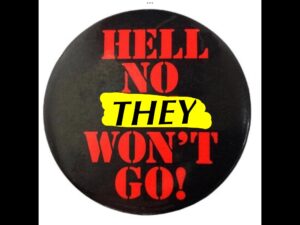
Say Hello to The New “Antiwar” Movement: It’s Already Winning
Back in the day, the Vietnam years, resisters against the military draft could muster an occasional bit of whimsy. A favorite button was about beer.
But if truth is the first casualty of war, for many of us whimsy and a sense of humor were soon missing in action too. Draft resistance became a mass movement: marches, sit-ins, draft files turned into bonfires, show trials of high profile protesters. It was a gripping, sometimes heroic, often grim time, and as the war dragged on, not a lot of laughs. In 1970, a movie was released called “Suppose They Gave a War and Nobody Came?”Billed as a comedy-drama; it was a total flop.
Phil Berrigan, left, and his brother Dan, burning draft files in Catonsville Maryland, May 1968. Both served jail sentences for their witness.
When the resisters achieved their goal and the draft finally ended in June 1973, my own reaction was more a sense of bitter, exhausted relief than anything else.
It shows that military recruiting is way down, so much so that the force is shrinking:
“[A] perilous recruiting crisis began just after the United States fully withdrew from Afghanistan . . . and it shows no sign of abating anytime soon. As a result, the U.S. military is shrinking, not because of any strategic choices, but simply because there aren’t enough qualified volunteers — and that may have enormous implications for the U.S. strategic position in an increasingly uncertain and dangerous world.
How bad is the recruiting crisis? During the last fiscal year, the Army missed its recruiting goal by 15,000 active-duty soldiers, or 25 percent of its target. This shortfall forced the Army to cut its planned active-duty end strength from 476,000 to 466,000. And the current fiscal year is likely to be even worse. Army officials project that active end strength could shrink by as much as 20,000 soldiers by September, down to 445,000. That means that the nation’s primary land force could plummet by as much as 7 percent in only two years — at a time when its missions are increasing in Europe and even in the Pacific . . . .
[Like so many Pentagon statistics, these figures don’t quite add up: from 476000 to 445000 is a decline of 31000, not twenty. That’s equal to losing two or three army divisions, without firing a shot.]
Why the big slide? Besides the Afghanistan withdrawal, the authors’ top villain is Covid and its lingering aftermaths of depression, anxiety, missed schooling, and youthful obesity. Then comes low unemployment.
All real enough. But none of these are within the easy control of either the generals or Congress, and from my standpoint they serve to bury the lede, the article’s real shocker: what is euphemized here as an increasingly drastic slump in “military propensity”. What’s that?
— the number of young people who are interested in serving in the military. Only 13 percent of young Americans said they would consider military service before the pandemic, and that already paltry figure shrank to just 9 percent last year. That number is simply not high enough to ensure the stable flow of recruits upon which the all-volunteer force relies.”
Why??
“First, the number of Americans expressing confidence in the U.S. military has plummeted in the past few years. To be clear, American confidence in almost all major U.S. institutions has declined, with data from Gallup showing that it reached an all-time average low of just 27 percent in 2022. Compared to that dismal statistic, the fact that 64 percent of survey respondents expressed confidence in the military last year is a strong endorsement indeed.
Yet that figure was 72 percent in 2020 and 69 percent in 2021 — marking an 8 percentage point drop in only two years. More disturbingly, the Reagan National Defense Survey found even steeper declines, with confidence in the U.S. military dropping from 70 percent in 2018 to just 45 percent in 2021 (before rebounding slightly to 48 percent in 2022).
Second, there are some early indications that fewer people in and around the military are willing to recommend military service to young people. In 2019, almost 75 percent of military families said they would recommend military service to someone they care about. Yet that figure dropped to just under 63 percent in 2021, another sharp decline in just two years. . . .
What the authors are doing here, without saying it outright, is describing a movement. Not an anti-draft movement, but a young Americans’ anti-join-the-military movement. It’s big, it’s nationwide, it’s having real impact — and perhaps worst of all (for the Pentagon), it’s spontaneous and completely unorganized. As far as I can tell, we surviving veterans of the Sixties can claim exactly zero credit for it.
Back in the Day, the White House knew (or thought they knew) how to handle anti-military resisters: the FBI spied on and infiltrated the activist groups; jailed the most visible protest leaders, such as the draft file-burning Berrigan brothers, and shot down a random but exemplary sample in places like Kent and Jackson State.
But now, who would they arrest? Walking (rather than marching) past a recruiting table without stopping is not a crime. There are no rallies to spy on, no organizers’ offices for the FBI to infiltrate.
But it’s definitely a movement, a growing mass moving away from enlistment. Besides, the authors admit the brass are heavily on the defensive facing it, about a long-running epidemic they had successfully downplayed and ignored for decades:
[T]he ever-increasing rates of sexual assault in the military became far more widely known after the tragic disappearance and death of Specialist Vanessa Guillen in 2020, and the subsequent disciplining of 14 Army officials at Fort Hood. Indeed, in a fall 2021 survey, 30 percent of Americans aged 16 to 24 said that the possibility of sexual harassment or assault was one of the main reasons why they would not consider joining the U.S. military.
Here again they’re fudging. Guillen’s case was gruesome and horrible, but there have been battalions of victims like her, on bases across (and outside) the country.
Christine Horne, whose mother was murdered by her green beret father in 1973 at Fort Bragg, at Quaker House in 2007
While I was Director at Quaker House near Fort Bragg (shortly to be renamed Fort Liberty), we had to deal with a continuing epidemic of such fatal assaults. Besides the awful loss of lives, the military’s tradition of denial and deflection still endures, but now has essentially ruined its credibility.
What to do? The authors have a laundry list of ideas, that mostly sound aspirational (“recruit more women”; “stop excluding pot smokers”; “let troops get the A-word”), and more likely to enrage the congressional crazies than turn into actual policies or magnets for Generation Z or Z+ 1. And in the end, the authors don’t sound at all optimistic:
War Resistance: Gen Z Edition
For 50 years, the U.S. military has relied upon an unbroken stream of willing volunteers to fill its ranks in times of peace and war. However, most of the trends that have created the present recruiting crisis will not change anytime soon, and if left unaddressed, they could soon threaten the ability of the all-volunteer force to protect the nation. . . ,
So without urgent action to improve eligibility and increase propensity, the military may find itself continuing to involuntarily shrink for wholly non-strategic reasons and may soon be too small to address the growing security challenges facing the United States in the next few years and beyond.
Urgent action? What about —??
A return to conscription—??
Hush Now! As they say in the South. That, they admit —
—is neither desirable nor politically viable, since as we often like to joke, the only groups in America who oppose a draft are Democrats, Republicans, and independents.
Hey! Maybe the sense of humor my generation lost while marching on the Pentagon, some general found stuck in a corner of one of their endless hallways.
NOTE: The article is by: Lt. Gen. David W. Barno, U.S. Army (ret.), and Dr. Nora Bensahel, who are visiting professors of strategic studies at the Johns Hopkins School of Advanced International Studies and senior fellows at the Philip Merrill Center for Strategic Studies. They are also contributing editors at War on the Rocks.
And a hat tip to Bill O’Connor, our North Durham correspondent.

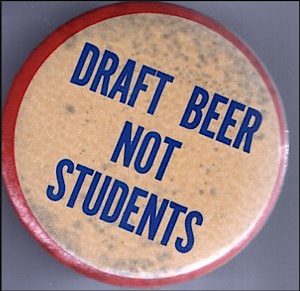
 Back in the day, the Vietnam years, resisters against the military draft could muster an occasional bit of whimsy. A favorite button was about beer.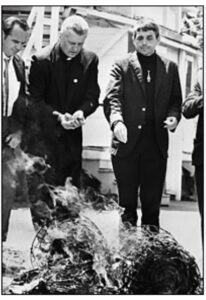
ever-increasing rates of sexual assault in the military became far more widely known after the tragic disappearance and death of Specialist Vanessa Guillen in 2020, and the subsequent disciplining of 14 Army officials at Fort Hood. Indeed, in a fall 2021 survey, 30 percent of Americans aged 16 to 24 said that the possibility of sexual harassment or assault was one of the main reasons why they would not consider joining the U.S. military.