

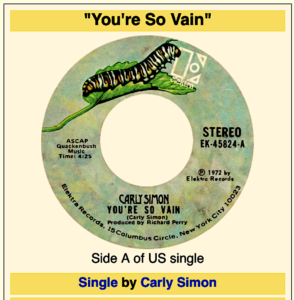
The best part for me about the total solar eclipse I actually saw (on July 10, 1972), came several months later, in Carly Simon’s wonderfully bitter tune “You’re So Vain,” and the line about the cad she was sticking it to went to Saratoga New York for a horse race, and then:
“You flew your Lear Jet up to Nova Scotia,
To see the total eclipse of the sun . . . “
That’s what I did.
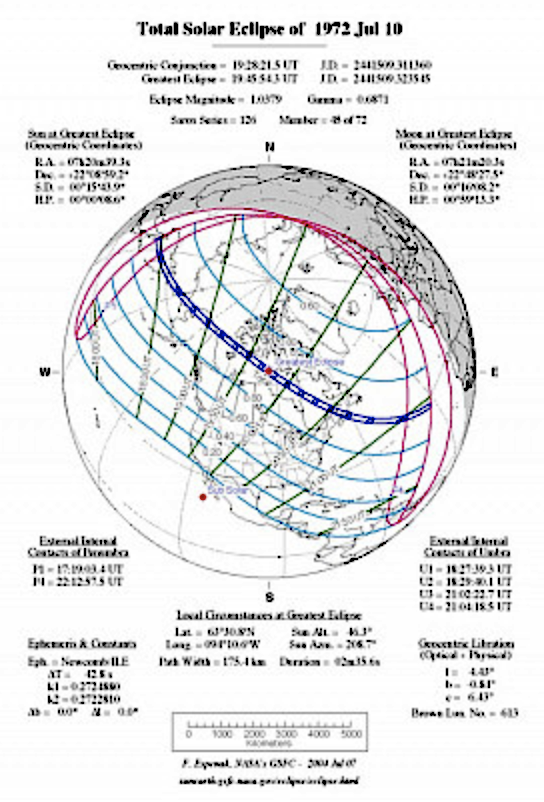
Well . . . not in a Lear Jet, and with no stop in Saratoga. But the event was widely hyped, like this time, and my friend David and I decided we had to see it — not part of it, but the whole darn thing. So we took his jeeplike car and headed out from Boston, leaving spouses and kids behind, figuring we could make it up to Nova Scotia in a day. I was really pumped to see the day go dark; I insisted that we find the track of completion, and see it there, somewhere away from the crowds.
 Those were the good old days, when you could get across the border without a passport, and the map we looked at (no GPS) showed that Nova Scotia was close, just a short hop beyond Boston harbor.
Of course, that was only true “as the bird flies,” or if you were in your Lear Jet. In our four-wheeler, it turned out to be 800 miles, almost as far as Columbus Ohio in the other direction. So it took us longer; and July was warm, even that far north.
 To pass the miles, we wondered at the occasional signs celebrating some group called the United Empire Loyalists. Finally we got there, and with an hour or so to spare. The event started about 4 PM their time. We wound up in a large stubbly field, well northeast of Halifax, not far from the Atlantic coast. Only a few people were scattered around, so we had successfully avoided the crowds. We parked and walked out into the field, put on our heavy sunglasses, and waited. We also had a box with a hole in it, that we could see the reflection in safely.
It turned out though, that in place of the big crowds of humans, our observation spot was a magnet for other, less painfully polite Canadian residents: swarms of bugs, mosquitoes and all sorts of creepy flying things. (I heard that half of them buzzed in French, but didn’t believe that; they all seemed to like Anglophone-American flesh just fine.) So we were occupied with waving our arms and slapping at them while the solar disc started mooning us.
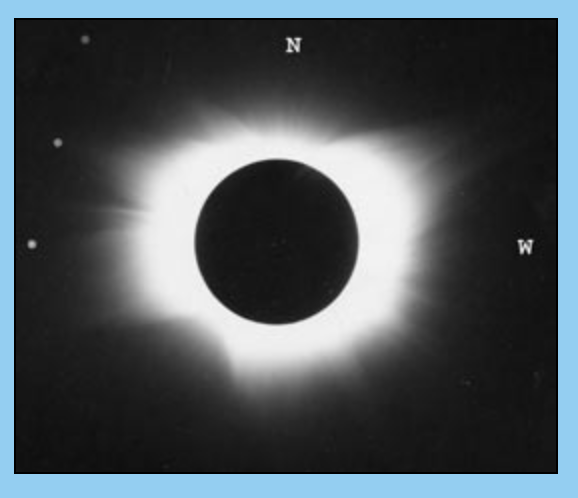
 And finally, it was time. I peered into the box: yep, the two heavenly bodies were lit up and getting it on. So I looked outside, not right up at it, but all around, to get a real feel of day turned night.
And that’s when I realized we had been bamboozled.
It wasn’t night. It wasn’t even twilight. Instead it was more like a medium gray cloud cover; just a bit dim.
The only perceptible difference was that the slight dimness seemed to juice the bugs. They appeared to be flying faster at us, and feeling more bloodlust. But maybe that was illusion, or hysteria.
And suddenly it was over.
Yeah. The total eclipse we had chugged 800 miles to see, lasted less than two freekin minutes. Then the sun was peeking out, like it was coming from behind a passing thundercloud.
For me, it was a bust. One big, total, visual Ho-Hum.
And a heckuva long drive home.
Maybe it will be better in 2024. But I doubt it. Do full solar eclipses change the way they look? The forecasts indicate that the, er, climax on high still doesn’t last any longer than the ones on the ground.
Again, the track will cross Atlantic Canada. Visiting Nova Scotia would be nice (tho it’s still winter up there, and Canadians seriously know how to do winter). But I’m not even going to cross the street to find out what happens here in Carolina. The online chatterers will tell us all about it, probably trying to cover up their disappointment.
 But the journey in 1972 wasn’t a total loss. On the long haul back, David and I figured out who the United Empire Loyalists were — um, the Tory scum who got whipped and run out by our Revolution.
And then a few months later, there was Carly Simon’s song, with its stinging refrain: Well, you’re where you should be all the time — And when you’re not
You’re with some underworld spy or the wife of a close friend . . .
No underworld spies or borrowed wives here. And actually, heading back south again in the remnant of returned daylight that late Nova Scotia afternoon, these former refugees seemed to have done pretty well, sticking with the Queen, inventing delicacies like poutine, national health care, maybe hockey and all that.
In truth, through the years since, this ground-level comparison/contrast (except maybe for hockey) has stuck in my memory much more than that silly eclipse.

Quakers, especially the more well off, were a hotbed of Tory sympathizers, particularly on Long Island.
I guess you have to take the cosmic viewpoint to really appreciate how marvelous the eclipse yesterday truly was. In a mere six millenia, Luna will have moved far enough from Mother Earth that a total eclipse of the sun, seen from the ground, will be only historical legend. But by that time, I suppose we will have many other planets, many other moons, and many other suns besides Sol to contemplate eclipses among. In the meantime we may meditate upon the koan: times change, people don’t.
Here’s my take on it, from my own Facebook page. A very striking thing about the event was that as long as — and then after totality as SOON as — even a tiny scrap of the orb (not the corona) could be seen, it wasn’t dark. It was just a cloudy day. But when that last bit of the orb was blocked It was almost night. The dark and the cold were so sudden it was like walking into the cold room at the lab. And you couldn’t see the moon/sun with your eclipse glasses on. Maybe the spot you were at didn’t actually get quite to full totality? I’ve seen a not-quite-total eclipse before and found it interesting but not astounding. This was astounding. The crowds cheered.
“We had eight of the family in two cars and headed down on country roads to Caledonia, which is in the area we figured would have someplace nice for viewing and which we’d heard had blue skies. (A lot of the eclipse area in Ontario had complete overcast when today began.) We all had certified eclipse glasses. The clouds came and went but were gone enough that we had plenty of clear views as the eclipse progressed. We got in right at the start — in fact had time to snack on some munchies before getting caught up in the viewing — and saw the whole thing. What was most amazing was that totality brought very sudden dark and cold — it didn’t just get gradually darker and darker and cooler and cooler: the scrap of the full sun that was still showing was suddenly gone and the world was like an hour after sunset. The park lights came on. Jackets went on. And the birds went on and on — totally freaked out by these utterly out-of-place conditions. All most impressive. We were SO glad we went!”
One website says this: “A Partial Eclipse of magnitude 0.9851 will be visible from Halifax, Canada on July 10 1972.”
What you’re describing was not a total eclipse. I’ve been in the path of totality twice now and there’s literally no comparison between 99.9% and 100%.
I wouldn’t cross the street to see a partial eclipse. But I drove 10 hours both ways for this last one and it was incredible.
Also, how did you miss the one in 2017 that came through Carolina?