

South Korea: Hyper-Competitive and Childless
There are enough people to go around: eight billion now, compared to two billion less than a hundred years ago. Fifty-one million in South Korea, compared to only twelve million a hundred years ago. So why are South  Koreans obsessed about their low birth rate?
Lots of developed countries have low birth rates nowadays, especially in East Asia – Japan is 1.3 children per woman, China is 1.2 – but no other country is below 1.0. South Korea is not just leading the parade. It is so far out in front that it is almost out of sight.
The national anxiety about this is so great that South Korea’s President Yoon Suk Yeol has finally said the unsayable. His country’s citizens are “excessively and unnecessarily competitive,” he admitted – and that is why it has the world’s lowest birth-rate.
The steadily declining birth rate has been perceived as a ‘problem’ for almost two decades now, and various governments have thrown an estimated $286 billion at it with no effect whatever.
Nothing worked, and the birth rate is still falling fast. At the current rate of decline, it will be down to 0.5 in just five more years, at which point the country will only be replacing one-quarter of its present population.
What is driving this extraordinary collapse?
We know that it is not some peculiarity of Korean culture in general, because there is a control for this particular experiment: North Korea, which beneath a thin veneer of Communist ideology is a traditional Korean dynastic state. And the Democratic People’s Republic of Korea (to give its full name) has a birth rate of 1.8 children per completed family.
Whatever it is, it’s specific to South Korea – and what stands out is the sheer speed with which South Korea became a fully modern democratic society. It was still a dictatorship thirty years ago. It was still a very poor and poorly educated country fifty years ago. It was a war-torn wreck seventy years ago, and a downtrodden Japanese colony eighty years ago. Now it is in the same income bracket as Canada, France and Japan, but it made that transition three times faster than Japan did and social attitudes don’t change that fast. Even in Japan women face many challenges at work, but in South Korea they are virtually insurmountable.
Three quarters of South Korean women have a post-secondary education, but they are expected to leave work for at least two years after having a child. Even after that they face obstacles in getting back into the workforce at the same level – yet South Korea is the most expensive country in the world to raise a child, and one income is not enough.
The whole set-up is Japan squared: intense competition from the cradle onwards. Many Japanese parents hire tutors for their children or pay for extra-curricular classes and courses; all but two percent of South Korean parents do so. Add needlessly long working hours and very high housing costs, and many women decide that having a child is just impossible.
President Yoon Suk Yeol has diagnosed the problem, but it’s the kind of problem that would take at least a generation to solve. If South Korea took fifty years to fall into this trap, it will probably take at least that long to get out of it – and in fifty years, at this rate, the population will have shrunk by half.
There’s nothing wrong with having a smaller population in principle: nobody felt the country was empty in 1960, when the population (25 million) was half what it is now. The difficulty is going back down to a much smaller population very fast, because that turns the normal ‘population pyramid’ upside-down.
By 2075, the number of South Koreans of working age will have halved, and almost half the population will be over 65 and relying on that greatly shrunken workforce to support them. This is not a viable outcome.
The time to start putting a much higher value on women’s happiness and well-being is now, but it might also be a good idea to start encouraging mass immigration from countries with higher birth rates.
Gwynne Dyer’s new book is The Shortest History of War

The Guardian — February 28, 2024
South Korea’s fertility rate sinks to record low despite $270bn in incentives
Japan’s birthrate falling fast, too
Justin McCurry
Average number of births per woman falls to 0.72 in country that already has the world’s lowest rate, and has spent billions since 2006 to reverse the trend.
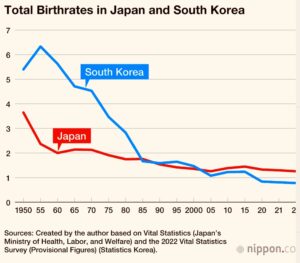
Reports that South Korea’s population had shrunk for the fourth straight year came soon after neighbouring Japan reported a record decline in its population last year, along with a record fall in the number of births and the lowest number of marriages since the end of the second world war.
The average number of children a South Korean woman has during her lifetime fell to 0.72, from 0.78 in 2022 – a decline of nearly 8% – according to preliminary data from Statistics Korea, a government-affiliated body. The rate is well below the average of 2.1 children the country needs to maintain its current population of 51 million.
Since 2018, South Korea has been the only member of the Organisation for Economic Co-Operation and Development (OECD) to have a rate below 1. In addition, South Korean women give birth for the first time at the average age of 33.6 – the highest among OECD members.
If the low fertility rate persists, the population of Asia’s fifth-biggest economy is projected to almost halve to 26.8 million by 2100, according to the Institute for Health Metrics and Evaluation at the University of Washington in Seattle.
Lim Young-il, head of the population census division at Statistics Korea, told reporters: “The number of newborns in 2023 was 230,000, which was 19,200 fewer than the year before, representing a 7.7% decrease.”
Since 2006 the government has invested more than 360tn won ($270bn) in programmes to encourage couples to have more children, including cash subsidies, babysitting services and support for infertility treatment.
The current administration, led by the conservative president Yoon Suk Yeol, has made reversing the falling birthrate a national priority, and in December promised to come up with “extraordinary measures” to tackle the situation.

But financial and other inducements are failing to convince couples who cite skyrocketing child-rearing costs and property prices, a lack of well-paid jobs and the country’s cut-throat education system as obstacles to having bigger families.
Experts have said that cultural factors are also responsible, including the difficulty working mothers have juggling their jobswith the expectation that they are mainly responsible for household chores and childcare.
South Korea’s major political parties are showcasing policies to stem population decline ahead of April’s national assembly election, including more public housing and easier loans, in the hope of dampening growing alarm that the country is facing “national extinction”.
Being married is seen as a prerequisite to having children in South Korea, but marriages are also falling, with the cost of living often given as the main reason.
South Korea is not alone in the region in struggling with a rapidly ageing population and a lack of children.
The number of babies born in Japan in 2023 fell for an eighth straight year to a new low, government data showed this week, a year after the prime minister, Fumio Kishida, warned that the stubbornly low birthrate would soon threaten the country’s ability “to continue to function as a society”. The problem, he added, “cannot wait and cannot be postponed”.
The health and welfare ministry said 758,631 babies had been born in Japan last year – a 5.1% decline from the previous year and the lowest number of births since statistics were first compiled in 1899.
The number of marriages fell by 5.9% to 489,281 couples, falling below a half million for the first time in 90 years – one of the key reasons for the declining birthrate.
Many younger Japanese say they are reluctant to marry or have families due to poor job prospects and living costs that are rising faster than salaries, along with a corporate culture that makes it difficult for both parents to work.
Japan’s population of more than 125 million is projected to fall by about 30% to 87 million by 2070, with four out of every 10 people at age 65 or older.
The chief cabinet secretary, Yoshimasa Hayashi, said the declining birthrate had reached a “critical state”.
He told reporters: “The period over the next six years or so until 2030s, when the younger population will start declining rapidly, will be the last chance we have to try to reverse the trend. There is no time to waste.”