
[NOTE: i’m somewhat slow on the uptake, but numerous shocks of 2022 have pounded home the sense that the principal architect of our increasingly dominant regime of minority rule is the Supreme Court. To get more up to speed on this process, I’m reading Senator Sheldon Whitehouse’s fine new book, The Scheme. Whitehouse has been sounding the alarm for years. More recently, columnist Jamelle Bouie has taken up the cry with historical depth and trenchant eloquence.
Realizing what’s happening right under our noses is one thing; stopping it is another. These article excerpts may help thoughtful readers in the work of finding practical remedies; that work will not be quick or easy.]
The Supreme Court Is Turning Into a Court of First Resort
Dec. 7, 2022 — Excerpts:
 By Jamelle Bouie, Opinion Columnist
Last week, the Supreme Court granted a writ of certiorari “before judgment” in Biden v. Nebraska, which will determine the legality of the president’s student loan debt relief program. . . .
Biden v. Nebraska marks the 18th time since 2019 that the court has granted certiorari before judgment. It is, as Vladeck writes, a “remarkable shift.”. . .
According to Mark A. Lemley, a law professor at Stanford, the Roberts court, with its conservative majority, is an “imperial” Supreme Court, undermining the power and authority of the other branches of government, as well as weakening the power of lower courts to act and make decisions.
“The court,” Lemley writes, “has taken significant, simultaneous steps to restrict the power of Congress, the administrative state, the states and the lower federal courts.” It gets its way, he continues, “not by giving power to an entity whose political predilections are aligned with the justices’ own, but by undercutting the ability of any entity to do something the justices don’t like.” (Emphasis added.)
In the case of administrative agencies, this means a new, extra-constitutional test — the “major questions” doctrine — that “seems to be designed to allow the court to reject significant agency actions that are within their grant of power but that the agency implements in ways the court doesn’t like,” such as, Lemley notes, in West Virginia v. E.P.A, which limited the agency’s power to protect the environment.
In the case of Congress, this means rulings that restrict congressional power to create new causes of action — for people to seek legal redress for forms of injury Congress might recognize with legislation — and rulings that restrict the ability of Congress to create new executive agencies with independent leadership.
In the case of the states, this means rulings that impose new limits on the power of states to “regulate in areas they have long been able to, from public health to public safety.”
And in the case of the federal court system, this means procedural transformations — like granting certiorari before judgment or the increasing use of the so-called shadow docket — that hamstring lower federal courts.
They do so by “bypassing longstanding procedural and substantive rules and its own doctrine in order to reach out, take, and decide major legal questions that either are not presented at all or have not proceeded through the courts to establish a record.”
The upshot of all of this, Lemley writes, is a court that is “consolidating its power, systematically undercutting any branch of government, federal or state, that might threaten that power, while at the same time undercutting individual rights.” (Emphasis added.)
This, I think, is a useful way of thinking about the current Supreme Court’s aggressive disregard for its own rules and tradition regarding case selection, methodology and precedent. The conservative majority is working to make the court the leading institution in American politics, with total control over the meaning of the Constitution and its application to American life.
Americans can and should challenge this. . . .
The first step toward challenging the Supreme Court’s power grab is to recognize the basic fact that, as the law professor Eric Segall has written, the Supreme Court is not actually a court. Yes, the justices work in a courtroom, wear robes and decide cases. But the court, he says, “functions much more like a political veto council than a court of law” and the justices “decide cases more like a traditional council of elders than typical judges.”
To see the truth about the Supreme Court is to see that it is not the ultimate arbiter of meaning, holding forth on how we must organize our political lives. It is to see, instead, that it is a political institution, jockeying for power and influence among a set of political institutions. It is to see that the Supreme Court exists to serve American democracy, and when it does not, then it can and must be checked by us, the people. . . . Washington Post Magazine
Kenji Yoshino
While the Supreme Court has long agreed that unenumerated rights exist and should mostly be protected . . . the agreement ends there. The hottest area of controversy . . . concerns the question of how the court discerns which unenumerated rights it will protect. Two major factions have emerged in this battle royal: what I’ll call the backward-looking camp and the forward-looking camp.
Alito insisted that the Dobbs decision did not implicate other rights. However, that stance ignores how judging actually works. Given that the court has embraced this backward-looking approach, any right not “deeply rooted in this Nation’s history” is now ripe for reconsideration.
Justice Clarence Thomas’s concurrence in Dobbs rendered this explicit in calling for the reconsideration of other substantive due process cases. He called out Obergefell, Lawrence and Griswold by name.
For these reasons, it’s not fearmongering to be concerned about the continued life of the constitutional rights to same-sex marriage, to same-sex sexual intimacy and to contraception. Indeed, in the wake of Dobbs, politicians swiftly took up the court’s invitation. Sen. Ted Cruz (R-Tex.) declared that “Obergefell, like Roe v. Wade, ignored two centuries of our nation’s history.” The attorney general of Texas stated that should the court overturn Lawrence v. Texas, he would defend Texas laws criminalizing same-sex sexual activity between consenting adults. Sen. Marsha Blackburn (R-Tenn.) similarly questioned the status of the right to contraception, calling Griswold “constitutionally unsound.”
If the Supreme Court continues down its current path, there will be two consequences. The first will be that many individuals from historically marginalized groups will lose protections they once thought were now beyond debate. The second will be that the court will lose an important tool to update the Constitution. While the first is obviously critical, it’s the second that may ultimately be more destructive.
The Constitution was forged by White, property-owning men — and plagued by status-based exclusions that made it fall far short of what today would be considered a democratic document. As our nation becomes more diverse — and more aware of its own diversity — that legitimacy deficit will only become more glaring.
A proponent of the court’s Dobbs approach could understandably respond that these weaknesses should be cured in other ways. The most intuitive remedy would be to amend the Constitution itself to be more responsive to contemporary society. But the incredibly stringent procedures for doing so make it difficult to imagine that a constitutional amendment relating to minority rights could pass today.
Another perhaps more intuitive way to update the Constitution is through the equal protection clause. However, this clause has also been limited by the courts over time. The Supreme Court has not, for instance, shown any concern for the poor under the equal protection clause, leaving that work to its unenumerated rights jurisprudence.
In the end, the court’s future handling of unwritten rights may force a reckoning. If it seeks to withdraw all rights save those that existed in 1791 or 1868 (when the two due process clauses were ratified), then it will increasingly find itself out of step with present-day America.
The ultimate stakes here are not just about a particular right, or even about unenumerated rights generally. They are about whether the Constitution will continue to draw the fealty of a nation that has changed dramatically over the past several centuries — and whether this founding document, or perhaps even America itself, can truly last for the ages.
Kenji Yoshino is a law professor at New York University School of Law and co-author of the forthcoming book “Say the Right Thing: How to Talk About Identity, Diversity, and Justice.”
From the new book by Senator Sheldon Whitehouse, The Scheme:
To understand how dark-money forces have remade our courts and weakened our democracy, look no further than the Supreme Court’s current membership. All six of the conservative majority are affiliated with the Federalist Society, a dark-money group that played an oversized role in indoctrinating, grooming, auditioning, and selecting justices for the Court and in shaping what they do there.
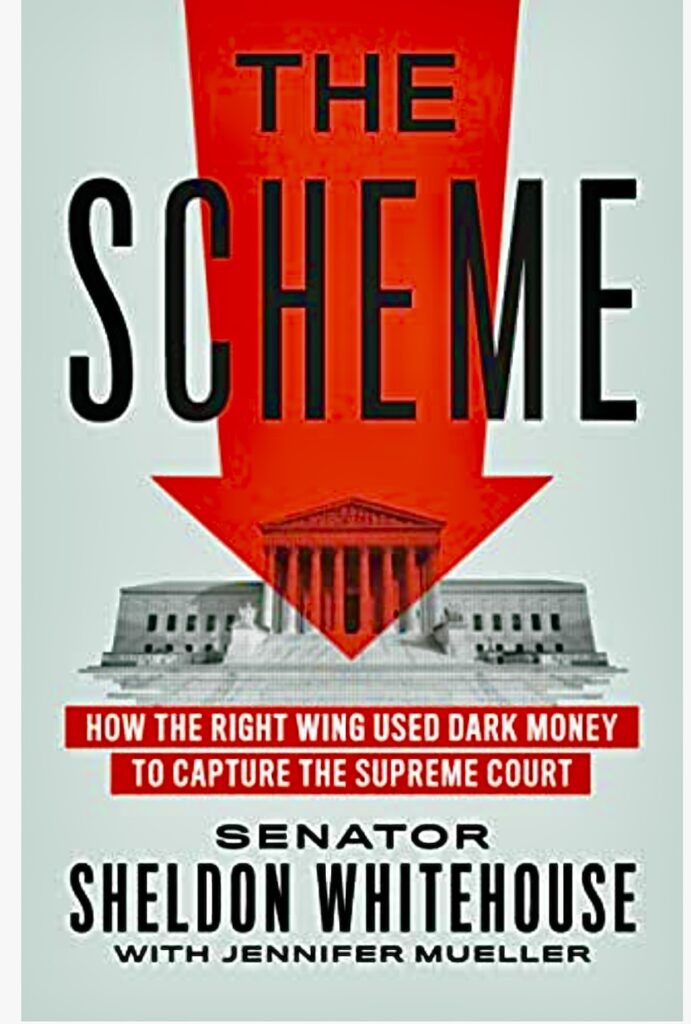 Five of those six were confirmed to lifetime appointments on our highest court by such a scant Senate majority that the senators approving their confirmation represented fewer Americans than the senators who opposed their confirmation. These justices embody minority rule. . . .
The [court’s] influencers are a class that occupies itself with favor-seeking from government and wants rules of engagement that make government amenable to its influence; regular, ordinary people mostly just want a government that can and will resist that special-interest influence.
This tension is not new. A hundred years ago, the “influencers” seeking to manipulate the political process represented mills and railroads. A thousand years ago, they were feudal barons and greedy courtiers. Today they are major players in the financial, pharmaceutical, insurance, technology, and fossil fuel industries.
The players may have changed, but the game’s the same. . . .. Now, as always, the last thing the big influencers want is a robust, functioning government that actually honors the will of the people. Instead, they want power, and they want it without public accountability.
Sadly, research confirms that they have been wildly successful. According to a recent study by professors at Princeton and Northwestern Universities, “the preferences of the average American appear to have only a minuscule, near-zero, statistically non-significant impact upon public policy.” And polling shows that regular working people now see their democracy failing to work for them. People on both the right and the left “generally agree that people like them, working people, the poor, and small businesses don’t have enough power in Washington, and that political lobbyists, Wall Street, large businesses, and the wealthy have too much influence.”
By a margin of seven to one, they believe that the Supreme Court will back big business over an individual, rather than vice versa. The win rate of corporate interests before the Roberts Court confirms their intuitions. . . .
Truly, our present Supreme Court is The Court That Dark Money Built. The forces behind that dark money built it for a reason. . . .
Capture is a well-documented phenomenon. . . . For decades, this sordid practice was focused on regulatory agencies. It would have been indecent to think of our courts of justice, let alone our Supreme Court, as just another agency to be captured.
But once someone had that idea, once that Rubicon of indecency was crossed, once powerful forces turned their arsenal on the Court, little stood between the Court and those weapons of capture.
Once the decision was made to capture it, the Court fell with almost no resistance at all. Regulatory capture became Court capture. . . . .The Supremes as Useful Idiots: Suckering Sam Became this Lobby’s Hobby
The payoff of this capture caper came early, and but for a providential attack of conscience, could have stayed under radar, But then, as the Washington Monthly puts it:
Last week, in interviews with The New York Times (with documents to support his account), Schenck revealed what he had given the covert name “Operation Higher Court,” a brilliantly successful exploit aimed at penetrating the U.S. Supreme Court. Under Schenck’s tutelage, his agents (actual American millionaires of pious inclination whom he recruited for this purpose) gained special seats at oral arguments, prayer sessions and dinners with the justices, and opportunities to vacation with them. . . .
Vladimir Putin must wish that Maria Butina had succeeded so well!
Higher Court’s proceeds included unparalleled access to the justices and, according to Schenck, literally top-secret information: the result in Burwell v. Hobby Lobby Stores. This case held that for-profit corporations and businesses have the “religious” right to exempt themselves from providing contraceptive services to their female employees. Schenck told the Times he received advance word of the result on June 4, 2014, giving him more than three weeks to prepare a public relations campaign to support the opinion when it appeared in public on June 30. Schenck’s documents appear to show that Wright, one of a pair of real estate millionaires whom he had recruited to befriend the justices, told him she had this inside information immediately after she and her husband dined at Alito’s home.
In response to the revelation, Alito issued an angry denial.
The revelation of this operation comes at a bad time for America’s beleaguered high court, which has seen its prestige tumble in public opinion surveys—and among lawyers and members of Congress—since the May leak of Alito’s preliminary opinion in Dobbs v. Jackson Women’s Health Organization, in which the conservative justice swept aside a half century of constitutional protections for the right to choose abortion. That leak sparked a savage backlash—one so predictable that the Court had closed off its plaza with an unscalable fence within hours of the leak. (Alito himself has denounced the leak for putting his own life and that of the Court’s other conservative justices in danger.)

According to the Times account, Schenck has repented of his decades of anti-choice advocacy. He notified Chief Justice John Roberts last June of the leak and suggested that, since Roberts had ordered an investigation of the Dobbs leak, he might also want to know about the Hobby Lobby leak. So far, Roberts has not responded publicly.
That is in keeping with the fact that the loudly proclaimed investigation by the Court’s marshal of the Dobbs leak has produced to date … well … the word that comes to mind is bubkes.
A good intelligence operative can find the weak spot in an adversary’s security. Thus, consider the brilliance of case officer Schenck’s opening move. He found the Court’s crucial vulnerability to be, of all things, the august Supreme Court Historical Society.
A less likely scene of intrigue has rarely presented itself. Worthy events sponsored by the society sometimes leave their audiences (or at least me) at the edge of a coma. But like any nonprofit group anywhere, the Supreme Court Historical Society is eager to augment its treasury with disinterested gifts from grateful patriots. Large gifts gained Schenck’s agents invitations to schmooze the justices at the society’s events, which, Schenck revealed, eventually led to an invitation for Steve Green, the president of Hobby Lobby, to attend the Court’s legendary holiday party in 2011. Green would later be the lead plaintiff in the Hobby Lobby case, in which Alito wrote with great sympathy about the Green family’s religious sincerity.
What can we learn from this tawdry episode? We learn that Supreme Court justices, like other humans in positions of power, are subject to influence and temptation. We also learn that shame alone is an inadequate sanction against the arrogant and powerful. Like the late Justice Scalia, Alito and Thomas have answered criticism with lordly silence and continued refusal to recuse (Thomas) or simple sneers (Alito). . . .
Unlike elected officials—or even prominent executive appointees—the justices enjoy near-religious deference from everyone in their orbit. They need never meet with the public or anyone who might question their greatness; need never account for their behavior off the bench to the public or Congress; need not release their travel or meeting schedules unless they wish to; and need never be questioned about their explanations . . . the most recent transcript on the news media section of its [web] site is an August 2019 speech by the late Justice Ruth Bader Ginsburg.
Would the Anglo-American edifice of ordered liberty collapse if the Court offered regularly scheduled tours of its historic building? What if justices made regular appearances to take questions from the public? Would the rule of law collapse if the justices revealed the names of those they meet with in chambers? And, most important, how has the nation allowed its most powerful court to exempt itself from the ethics rules that apply to judges of lower courts?
Nearly a year ago, during the oral argument in Dobbs, Justice Sonia Sotomayor wondered from the bench what effect a reversal of Roe would have on the Court itself: “Will this institution survive the stench that this creates in the public perception that the Constitution and its reading are just political acts?” A year later, that stench has become rank; it smells to heaven. The institution is internally dysfunctional and externally aggressive, angrily demanding public obeisance while reaching for more unreviewable power. Its crisis endangers the country that the justices purport to serve.
This cannot continue; one way or another, the Court must change.
How to change it remains the task. Congress could do it; yeah, right.
But less formally, the continual thickening of the stench adds pressure. After all — the Dobbs decision’s authors now have to take some account of an unbroken string of five electoral rebukes of their opinion in the midterm elections. (Actually one could stretch that string to seven, counting earlier voter rebukes to similar state bans in Colorado and Mississippi. (MISSI-freekin-SIPPI???)
Further, the cumulative exposure by investigators and whistleblowers such as Schenck, Whitehouse, Bouie, the January 6 Committee and other aggressive reporters is critical. Their exposure of ongoing corrupt and arguably illegal or even seditious activities involving the court, further deepens the “stench” and undermines the court’s already abysmal reputation, and lays the groundwork for what will at some point become a critical mass.
If one sets out to take the Olympian view of what is happening here, this deepening decay of the court’s legitimacy is very dangerous for the pubic weal. Senator Whitehouse quotes Lincoln on this point:
“If the policy of the government upon vital questions affecting the whole people is to be irrevocably fixed by decisions of the Supreme Court, the people will have ceased to be their own rulers, having to that extent practically resigned their government into the hands of that eminent tribunal.”
True enough. But we’re not living on Mt. Olympus. If the midterms and outside resistance to Dobbs suggest anything, it is a rising public rebuke to the presumption that the American public is prepared to thus cease ‘being their own rulers, and practically resign their government into the hands of a bloc of six other than eminent extremists.
More posts on “The Scheme” and the rightwing capture of the Supreme Court:
- The Big Read: “Supreme Beings” — Taking on the Architects of Our Emerging Judicially-Spawned Authoritarian Order
- More on “The Scheme” — Part 1
- “Shotgun” Scalia: A study in Supreme Corruption & Impunity
- The Scheme: The “Captured” Supreme Court Is Stealing Our Right to Jury Trials