

Sheldon Whitehouse, in The Scheme:
 Beyond protecting polluters, the [Supreme Court’s] Roberts Five have weakened antitrust protections, shielded corporate executives from shareholder suits, protected drug manufacturers from state tort laws, taken away fair pay protections from entire categories of workers, restricted class actions that redress low-dollar mass frauds (like adding a small wrongful charge to a million customers’ bills), and made it more difficult for individuals to sue companies that harmed them.
 It’s almost as if the Republican majority didn’t want corporations to have to face the people they’ve harmed in front of juries.
Which brings us to mandatory arbitration.
Companies like to say that arbitration is just like court except it’s generally conducted in secret with little regard for precedent and few procedural safeguards.
Plus, arbitrators’ decisions can’t be appealed.
Oh, and the arbitrator is selected–and paid for-by the company that is on the other side of the table. But other than all that, arbitration is just like court!
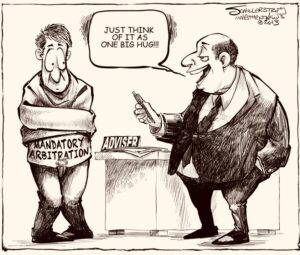 Arbitration is sold as a great convenience, and it can be, for disputes between big corporations. But when it’s a big corporation against a little individual, the system is rigged. One arbitration group was so rigged that attorneys general from several states got a court order putting it out of business.
Mandatory arbitration is a corporate stratagem to steer people away from public courtrooms into private, corporate-funded “dispute resolution” — on the corporations’ terms, with arbitrators chosen by them. It is now nearly standard in employment and consumer contracts with big corporations. Thank the Roberts Five for that.
Remember when Wells Fargo surreptitiously opened 3.5 million bogus bank and credit card accounts in the names of real customers?
A jury trial would have shone a public spotlight on the bank’s chicanery, but instead the fraud went on for years because whenever the bank’s customers complained, they were shunted into mandatory confidential arbitration. As long as the process was secret, Wells Fargo had every cynical incentive to continue its bad behavior.
Protected in arbitration, it didn’t have to worry about public shame or (as eventually happened) catching the eye of federal regulators. All it had to do was calculate the price of occasionally having to pay out to the odd “client” versus the value of the fraud overall.
Arbitration tilts the scales against workers as well as customers. The National Employment Law Project estimates that in 2019 alone, mandatory arbitration helped employers who committed wage theft keep $9.2 billion from employees earning less than $13 an hour. Cornell University professors found:
“Employees are much less likely to win their claim under arbitration (21.4 percent) than they are in federal 36.4 percent) or state (51 percent) courts. And even when they do win, they tend to recover much less money than they would in court: a median of $36,500 in damages under arbitration, compared to $176,000 in federal courts and $86,000 in state courts.”
Sweet deal for the corporations.
My Senate colleagues and I found that arbitration allows thousands of cases to be “snuffed out each year without anyone noticing.” For example, we reported, according to an American Association for Justice study of arbitration cases from 2014 to 2018:
-
- Only 1,909 consumers won a monetary award over the five-year period. That works out to just 6.3 percent of cases arbitrated over the five years resulting in consumers winning a monetary award.
- Of the 60 million employees subject to forced arbitration, only 11,114 — 0.02 percent-tried to pursue a dispute in forced arbitration. Just 282 of these employees were awarded monetary damages over the five-year period.
- Forced arbitration clauses allow nursing homes to avoid accountability for everything from negligent care to sexual assault. Over five years, consumers pursuing nursing home claims won a monetary award in only four cases
- Consumers pursued 6,012 forced arbitrations involving financial claims, claiming at least $3.7 billion in damages. They won monetary awards in just 131 cases (2.2 percent), totaling $7.4 million–0.2 percent of the claimed damages.
The Roberts Five have taken the hundred-year-old Federal Arbitration Act and warped it far beyond its original purpose, making the Arbitration Act a weapon for powerful and wealthy interests systematically to deny ordinary individuals, like employees and customers, access to a jury of their peers.
It’s been a veritable torrent of partisan 5-4 arbitration decisions. In 14 Penn Plaza v. Pyett, the Roberts Five said unionized employees could be forced to have their age discrimination claims heard in arbitration. In Rent-A-Center v. Jackson, they said that the very arbitrator whose legitimacy is challenged can decide if an arbitration agreement is “unconscionable” (adopting, as Justice Stevens noted in his dissent, a rule that neither party asked for but the Roberts Five just made up). In Lamps Plus, Inc. v. Varela, they prohibited an employee from bringing class-action arbitration unless the company explicitly agreed to it (how often do you think a company does that?).
In AT&T Mobility LIC v. Concepcion, they overturned a state consumer protection law and allowed companies to block consumers from bringing class-action arbitrations to remedy low-value/high-volume frauds. In American Express Co. v. Italian Colors Restaurant, they reversed long-standing Supreme Court precedent that contractual arbitration clauses are enforceable only so long as they actually give individuals the opportunity to vindicate their rights. And in Epic Systems Corp. v. Lewis, they said that employers could force employees to arbitrate away labor rights granted by law.
That’s six cases, each decided 5-4, each with only Federalist Society justices in the majority, each making it harder for workers and consumers to have their day in court.
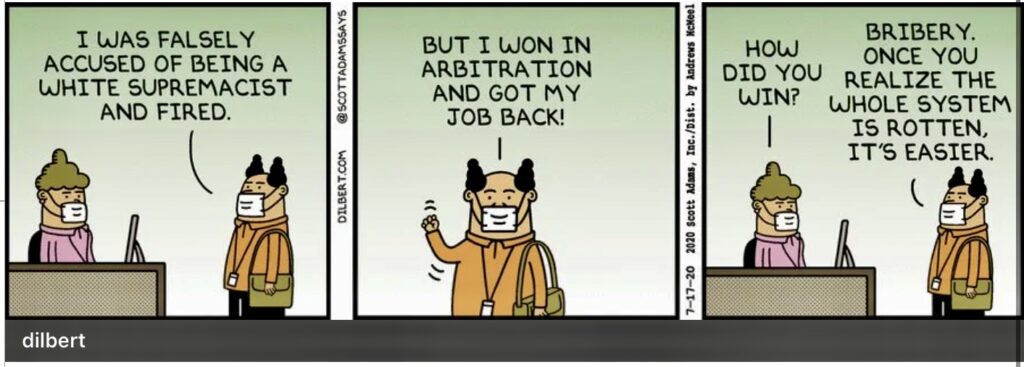 It is easy to see why big-money special interests would want to move as many cases out of court as possible.The jury is intended to dethrone the powerful and wealthy, to make them come down and stand (annoyingly to them) equal before the law. Juries remain the one corner of our constitutional system that rich special interests haven’t figured out how to capture.
As former Chief Justice Rehnquist explained, “the founders of our Nation considered the right of trial by jury in civil cases an important bulwark against tyranny and corruption, a safeguard too precious to be left to the whim of the sovereign, or, it might be added, to that of the judiciary.”Juries weed through facts, evaluate witnesses, and determine fault in matters as simple as a car crash and as complex as an industry-wide class action. Even when cases settle before going to trial, the risk to companies that their conduct will be reviewed by twelve ordinary citizens helps ensure they negotiate in good faith.
As attorney general, I came to appreciate the function juries serve in our constitutional system. Juries shore up our democracy by getting citizens involved. They are a direct popular exercise of constitutional power, and a reminder that with power comes responsibility.
There is a reason that the play Twelve Angry Jurors continues to be performed nearly seventy years after it was first released as (in a sign of the times) Twelve Angry Men. Watching Americans from different walks of life come together to deliberate and find a way to resolve the question before them is … well, it’s what America is supposed to be about.
Yet the number of federal jury trials has plummeted in recent decades. Corporate special interests squawk about juries as if they were a bug in the system. They systematically attack and smear the trial bar—the lawyers who bring cases against them.
In fact, their complaints demonstrate that the system is working as our Founders intended. I said as much in an amicus brief to the Supreme Court in one of its more recent cases that ended up extending corporate arbitration “rights”:
The very annoyance of the “more powerful and wealthy” that they should be subjected to equality in the courtroom; the very intensity of their desire to divert conflicts away from juries to forums where their power and wealth gives them more advantage—these are predictable and positive attributes of the civil jury’s role as the element of government designed to resist “the encroachments of the more powerful and wealthy citizens.”
These complaints are not a reason to assist in that diversion.
This Court should not—now or ever—be a party to degrading a constitutional element of government just because that element’s proper operation provokes yawps of complaint from “the more powerful and wealthy citizens” whose “encroachments” it was designed to restrain.
To disable an element of our Constitution because it is not working would be a daring task indeed; to disable it because it is working would be anathema.
I dwell on the Roberts Five’s fixation with mandatory arbitration because forcing people away from juries is a big deal. The Seventh Amendment actually gives the American people a constitutional right to those juries that the Court so blithely lets corporations take away.
It’s bad enough that a majority of the Supreme Court bands with corporate forces to shut the courthouse doors to ordinary citizens; it’s worse that they do so with barely an acknowledgment that they are denying Americans a constitutional right. Some “originalists.”
Previous posts on “The Scheme” and the rightwing capture of the Supreme Court:
- The Big Read: “Supreme Beings” — Taking on the Architects of Our Emerging Judicially-Spawned Authoritarian Order
- More on “The Scheme” — Part 1
- “Shotgun” Scalia: A study in Supreme Corruption & Impunity