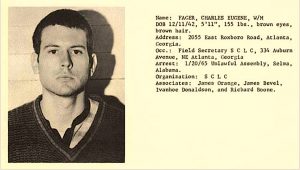
On Meeting Mrs. Septima Poinsette Clark─ Atlanta, December 9, 1964
On Meeting Mrs. Septima Poinsette Clark─ Atlanta, December 9, 1964
I sit down quietly in the chair, The older woman smiles and light
Reflects off frame glasses and gold rose earrings, the voice
Is like, is like the whisper of tires on a faroff nighttime highway Or maybe that of a Negro woman of sixty-six
Which it is.
She inhales to speak, I raise
My fine young journalistic pen, prepared to summarize Her story into ink traces,
To finish my entry blank in the Biographical Sweepstakes: “Tell us, in 150 words or less,
The substance of her life”; I am, of course, confident─
The smile fades back into equilibrium, and she says calmly: “My Father was a slave.”
I see, yes─the pen moves to the paper: M-Y-F-A-T-H-E-R-W-A-S-A-S-L-A─
Ahh, ha ha ha,
No, something isn’t quite right, She didn’t even blink.
Voice steady
My Father─
Hands quiescent in her lap My Father─
Breathing is regular My Father─
Oh no.
You see, my father was a normal, middle-class guy like every- body else,
You understand that don’t you Mrs.–
My Father was
Yes, Yes, I know, but surely you can understand the difference was only superficial, just an accident of history that yours happened to be
─a slave (why in hell won’t she blink)
Well it was his own damn fault, wasn’t it─after all he must have known the Truth, because
My Father was
The Good Book, you know, says that
Ye shall know the Truth, and the Truth shall make you─
─a slave.
Say that’s kind of a clever twist there Mrs.─ Ahh, ha ha ha. …
Lay down your pen and sniffle for shame, boy─ You there, the intellectual snot-nose,
Mucus running from your pen and you With the cheek to call it ink.
But then, you have been to a university
and so of course you know all about slavery
You even wrote a thousand-word paper on it (for extra credit, that is)
“… basically a part of the economic system, the indispensable
supply
Of cheap labor for the harvesting of the cotton crop.. ”
But you missed the chapter in the non-required readings about
how to face a calm old woman who can look you in your smooth white face and say
My Father
And not even blink you say could you talk just a little slower please ma’am
I didn’t get that last part your father was a what
─a slave.
Just like my father except for one or two of those little accidents of History, heh heh
My aren’t we an educated magnanimous liberal christian, boy─ Go to the rear of the class, get out the dictionary and look up
the following six words,
then write for the next three hundred years after school is
out on the new whiteboard with the black chalk the following sentence which you may have run across some where in your supplementary extracurricular living:
My father was not a slave, That’s it, only at the end,
Put a question mark.

SELMA STREETS – February, 1965
by Charles Fager
Here along the Selma streets Old men like tree stumps, Young men like defaced pillars,
Whiskers and hair grease and dirty overalls, Keeping impassive hopeless vigils,
Fraying edges on society’s old, but not discarded clothes.
I spring upon them, a dangerous animal, Dressed in new overalls and enthusiasm, Hands full of transmigrated dynamite caps:
ONE MAN-ONE VOTE the caps read,
They offer no resistance when I pin the explosives on reluctant lapels, But then, of course, they never have.
“Come on down to the courthouse, come on come on… Nobody’s gonna hurt ya………………. ”
I’m right of course, nobody’s ever gonna hurt them anymore, but that’s not what I’m talking about, not even what I’m thinking….
“Yeah, OK (they don’t say Boss Man or Mr. Charlie (thank God?)), sure, “Ah’ll be downnere inna fewww minuss, sure
“Inna fewww minussa, sure “Inna feww, sure
“Suresuresuresuresu”
Heads nod, graying whiskers flicker in and out of shadow, but the eyes say Go away go away, please now just go ahead on away;
The eyes look around me, over, beside, through, but not at, because I don’t Really exist, can’t exist, mustn’t exist (I’m thinking about
socioeconomic factors, the effects of a political aristocracy,
the philosophy of dynamic nonviolence and, of course, the existential value of
the local Negro religion, yes, professor, you see, as I explained fully in the footnote on page 47 of my thesis and as we can clearly see from MacElvain’s quite valuable remarks on the subject……….. ).
The walk back up to the listonclay cafe seems longer than when I came down the street, perhaps because the ragged lines of men (Children of what God?)
The sure, yeah OK men still are standing there, New buttons still offending their lapels,
Eyes still looking, perhaps now a bit more carefully, over, under, around and through,
Then at me when I’m past, but I see them doing it (go away go away go away) Words to an unsung spiritual, prayer of the nonchurchgoers, the Movement of Those no longer able to move.
Into the cafe, darkness and dirt, filthy flannel figure bending
Across the counter, observing the half-full beer glass as if
It held the answer and maybe it does; I spring again FREEDOM NOW button poised “Come on down to the courthouse fella, come on come on,
Nobody’s gonna hurt ya, whattsa matter, are ya afraid of losing your job–
(I am of course ready with my arguments to show that one must have courage, one must not be afraid to risk everything, one must)?”
But when he turns these eyes upon me (not over, under, around or through) and whispers, says, “Ain’t got no job,”
And turns back to the more understanding beer glass, Filthy flannel in the dark and dirt,
Only my mouth continues, throwing up a smokescreen until I can
Get away, away, get away quick, outside and past the
Dying tree stumps, defaced and crumbling pillars,
Glances at the periphery accusing me: you there, boss man,
How do you, O young white man of faith, deal with the substance of Things Hopeless, the Evidence of the Things that are Seen;
But I just walk on in my new overalls, and think of socioeconomics, And don’t say anything.
UNTITLED – SELMA, MARCH 1965
The trooper car is, of course, waiting when you get back to your car:
“Hey you” (flashlight beam, reflections off uniform brass, neck hairs fluorescent in headlight glare) “where you think you’re goin?”
To freedom. To heaven (to hell?) To anywhere. To–
“To the church.” (clear your throat quickly so your voice doesn’t falter) Yes, of course: to the church.
“Lessee your identification and the registration on that car… ”
Pull out the wallet and start the charade, let them examine your driver’s license etc., with extreme and exaggerated care, of course they have to get on the radio and check the car out through
Birmingham, outside agitators are an unsavory lot and it’s more than likely stolen;
But while you’re standing there, looking carefully off down the
nighttime street, notice the other trooper looking at you intently, intently:
“Where you from, Charles?” (listen to the question: something rings in it besides antagonism, there is more than one query in the words; look up at him quick, how can you answer without exposing the concealed questions?)
“Well (you want to say give me thirty seconds to think over my answer(s) at least)–“
“What,” interrupts the other trooper, “does that button mean?” and he points:
GROW--white letters on black background, Get Rid Of Wallace, what else, but you won’t say that, you don’t need to get beat up tonight, and besides you know that he asked it because he too heard some (not all) of the other questions
in his partner’s voice; so you have to answer him satisfactorily without letting it tear down the little bridge the other has extended.
“Well GROW refers to the philosophy of the whole movement
…” etc., etc., and so on, it’s hard, but the other trooper is still peering so the bridge is still there.
“MmmminmHhmmmm,” the questioner says; he of course
knows what it really means, but your straightfaced baloney throws him temporarily off balance.
Silence in heaven (and earth) for the space of about half an hour (minute). Then–
“Where’d you say you were from?” Listen again:
Reach out:
“Well, I was born” (yes I hear you) “and then we went” (can you give me your hand?) “and after that we” (just for a moment) “when I finished college–“
He nods a little and you know he heard; so did the other, and his guard is up:
–“Why don’t you get a good job back where you came from, and quit messin’ around down here?”
It was too good to last……. Just try to retreat with dignity and
without burning the bridge’s remains….
“Yeah, there’s other ways to settle this than in the street,” the other, his guard also now up, joins in. . .
There isn’t any answer for this, so just look down at the muddy street.
He hands you back your license and finishes up the charade: “Tell your boss to get some identification on this car, and we’re
Not letting anybody into the church. Only the sheriff could do that.”
Copyright © by Chuck Fager