
[Midday wrap-up: Three short but trenchant items (with an extra about the boreal Forest), covering wars (present and maybe future); climate change tipping points; and not least, why confronting Gov. Ron DeSantis’s racist war on “woke” head-on is a big progressive mistake. Check them all out!]
# 1-Wars & Rumors of War: Looking to the hard lessons learned in Ukraine for how to head off war with China
War between the Chinese and Americans is ‘not inevitable, although it is certainly possible
Gwynne Dyer · Columnist — Feb. 3, 2023

“I hope I am wrong. My gut tells me we will fight (with China) in 2025,” declared U.S. Air Force General Mike Minihan last weekend.
He didn’t mention what his crotch told him, or if he ever consulted his head on the matter.
“(China’s President Xi Jinping) secured his third term and set his war council in October 2022,” Minihan explained. “Taiwan’s presidential elections are in 2024 and will offer Xi a reason. United States’ presidential elections are in 2024 and will offer Xi a distracted America. Xi’s team, reason and opportunity are all aligned for 2025.”
Just why China would attack in 2025 if all that stuff is happening in 2024 is left a bit unclear — maybe the Chinese are just chronically slow off the mark, but it’s always a mistake to engage too closely with this sort of guff. However, it is definitely getting harder to avoid.
Last October, for example, Admiral Michael M. Gilday, the Chief of Naval Operations, said that the U.S. should prepare to fight China in 2022 or 2023. (Only 11 months left!)
In the previous year Admiral Philip Davidson, then the head of the U.S. Indo-Pacific Command, predicted that China would invade Taiwan by 2027. A relative optimist then, but that period is now known in the trade as “the Davidson window.”
As for the think-tank analysts writing in the foreign policy journals, they are producing articles about the coming war with China at the rate of at least two a week. (I read them, so you don’t have to.) Some of them also supply blood-curdling predictions of war to the mass media whenever required — and, if it bleeds, it leads.
This is fostering a fatalistic belief that a war between China and America is inevitable not only in the United States, but, to a lesser extent, also in China.
It is not inevitable, although it is certainly possible.
War is possible because the great powers are always measuring their potential military power against each other. It doesn’t have to be linked to any particular threat or interest: the U.S. military, for example, justify their focus on China simply because it is a peer competitor or a pacing challenge.
It is specifically possible between the United States and China because there is a disputed border, the classic trigger for war. The United States supports Taiwan’s choice to remain separate as the democratic will of the great majority of the population. China ignores that and claims Taiwan on the grounds that it is historically Chinese territory.
This is precisely how Russians persuaded themselves that they have a historic right to Ukraine, although the great majority of Ukrainians consistently vote to remain independent. Moreover, the Russians (or rather, Vladimir Putin) acted on that belief and invaded Ukraine. Why wouldn’t China (or rather, Xi Jinping) do the same to Taiwan?
One reason might be that Xi is less deluded than the Russian leader. Another is that he already has too much on his plate: a huge, but rapidly declining, population; an economy that has sunk into stagnation and is unlikely to resurface; the horrible example of how the invasion of Ukraine worked out for the Russians.
But it could be argued, of course, that Xi is badly in need of a way to distract the public from its growing discontents. A rapid and relatively bloodless conquest of Taiwan that reunites the Motherland could buy him years of political credit with the increasingly fractious populace. How can you guard against that?
Not by traditional nuclear deterrence, which deals in threats so terrifying that they are unbelievable until the moment they are actually fulfilled — at which point both sides are facing megadeaths. Less dangerous and more persuasive would be the kind of policy that NATO is currently pursuing on Ukraine.
Make sure that Taiwan has enough weapons and well-trained troops to contain an initial sea and airborne assault by China for at least a few weeks. The fact that Taiwan is an island protected by a substantial sea passage makes this possible.
Strengthen the American fleet and air forces in the western Pacific to make them capable of operating within range of Taiwan, so they can escort supply ships through the inevitable Chinese blockade. But let no American or allied soldier set foot on Taiwan or engage in direct combat with the Chinese.
Gradually improve the quality of the weapons you give Taiwan so China’s footholds become increasingly insecure.
Wait. Pray if you wish.
We don’t know if that will finally work in Ukraine, let alone in Taiwan. But, if the Taiwanese can rearm and retrain their forces fast enough, they would stand a decent chance of containing and ultimately repelling an attack — or, even better, deterring one.
There are no better options.

#2-Climate- Tipping Points: Will Steffen got the big picture of climate change right and it focused on the importance of tipping points
Gwynne Dyer — February 8, 2023
Tipping points, when climate change effects become become difficult to reverse, are now widely identified as the most dangerous aspect of the global warming problem.
Climate scientists have a heavier responsibility to get it right than most scientists because what’s at stake may be almost everything we care about.
Getting even the minor details right is hard and important. Getting the big picture right is immensely complicated and critically important.
American-born professor Will Steffen, who died in Australia last week, was a big picture guy. Based mostly at the Australian National University in Canberra, but in contact with scientists around the world, he worked on the biggest picture of all: where is the climate system taking us?

Steffen’s greatest skill was bringing other scientists together in that enterprise. The informal, gradually expanding group that he and a few colleagues created has given us the concept of planetary boundaries and identified the tipping points that may overwhelm our efforts to limit the amount of CO2 in the atmosphere.
What has continuously preoccupied that group for the past 20 years was the fact that the mainstream predictions of warming showed a very smooth and steady rise in the average global temperature, driven almost entirely by human emissions of greenhouse gases. Not good, but at least no surprises.
Whereas the dissenters, drawn from a wide variety of disciplines, suspected that the Earth System’s response to the warming would be much more complex.
“I had eight years working with the best ecologists around the planet and, quite often, we’re talking about abrupt shifts in ecosystems,” Will Steffen told me last year. “If the Amazon rainforest shifted due to a combination of heat and drought, it wouldn’t be a smooth process. It would be droughts, fires, a lot of CO2 emitted and then a slow rebuild of a new ecosystem.
“That was true for the boreal forest as well.
[NOTE: What’s the “boreal forest”? If that’s your question too, see the Addendum below.]
And we were talking about marine biology, which again appeared to show abrupt shifts in the past. I was also working with some people who studied ice sheets and they were saying that some of the ice sheets, like West Antarctica, could melt quite abruptly.
“So it got me interested in this whole idea of tipping points in the Earth System and how they might affect the trajectory of the climate. It was a hard go to get these accepted by the physical climate people, but they were missing some important stuff.”
All the founder members – Will Steffen, Johan Rockström, Katherine Richardson, Tim Lenton, Hans Schellnhuber, Jim Hansen, Paul Crutzen and 22 others – were involved in writing the influential 2009 paper “Planetary Boundaries: Exploring the Safe Operating Space for Humanity.’
That paper broached the notion of specific thresholds in the Earth System that might trigger abrupt and radical climate change, if crossed. The authors stayed in touch, examining the horrifying implications of potential abrupt upward lurches in the global temperature and, by 2016, they were working on an even more alarming report.
Tim Lenton explains:
“It was a fairly sizable group of us that have been friends and collaborators for more than a decade now. We’d been researching the possibility of different tipping points in the Earth’s climate system and it was natural that we would ask: ‘Is there a global tipping point? Is there an instability of the whole climate?’
“You know, we burn a certain amount of fossil fuel, warm the planet up a certain amount, but then the feedbacks within the climate system start to amplify that to a degree that the climate change becomes almost self-propelling because carbon is being released from degraded ecosystems, permafrost and so on.
“We’re not alone in being concerned about that, but we came together to raise a flag: that this is a risk that can’t be ruled out. And if it’s a risk that can’t be ruled out, then let’s have a go at trying to work out how big a risk it is.”
The group’s 2018 paper, “Trajectories of the Earth System in the Anthropocene,” nailed the new perspective down at all four corners. Tipping points are now widely identified as the most dangerous aspect of the warming problem. That’s deeply discouraging because we still don’t know exactly where they all are — but, far better to know about them than not.
Today, our never-exceed warming limits (an aspirational target of never more than 1.5 C and a hard target of never more than 2.0 C) are generally justified on the grounds that they are thought not to cross any of the tipping points. What was once heresy is now doctrine.
There remains a mountain of work to be done, but the climate perspective has shifted in the right direction. As Katherine Richardson said, “It’s this transition from local empirical data to studying global climate interactions that is the real crux. It can make you feel a little bit schizophrenic.”
But Will Steffen did more than his share to enable the transition.
Addendum: What’s the “Boreal Forest”?
Wikipedia: “The world’s boreal zone is often called “circumpolar” because it circles the Northern Hemisphere, forming a ring around the North Pole, just south of the Arctic Circle. Countries with forests and land in the boreal zone include Canada, the United States, Norway, Sweden, Russia, China and a few others. . . .
The boreal forest (or “taiga”) is the world’s largest land biome. The boreal ecozone principally spans 8 countries: Canada, China, Finland, Japan, Norway, Russia, Sweden and the United States. It is typically comprised of coniferous tree species such as pine, spruce and fir with some broadleaf species such as poplar and birch.
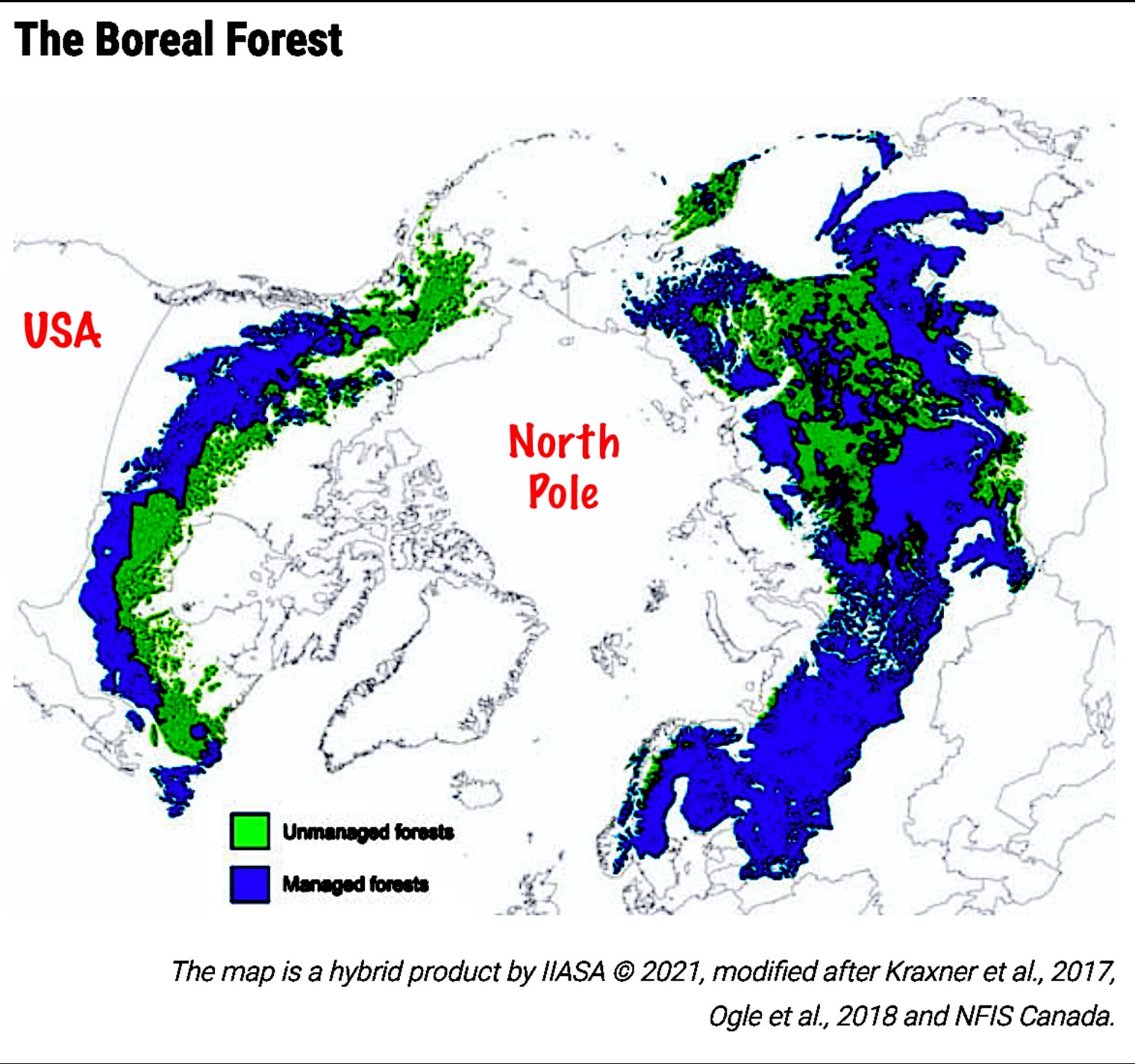 The circumboreal belt of forest represents about 30% of the global forest area, contains more surface freshwater than any other biome, and has large tracts of unmanaged forests across the high-latitude regions of Canada, Russia, and the United States. From a biological perspective, boreal forests are defined as forests growing in high-latitude environments where freezing temperatures occur for 6 to 8 months and in which trees are capable of reaching a minimum height of 5 m and a canopy cover of 10%.
Boreal forest ecosystems have evolved under the constraints imposed by a short growing season and severe winters during which snow cover may last for several months. About one-third of their extent is underlain by permafrost. As noted above, most boreal landscapes are characterized by a low diversity of tree species [mainly conifers and pines] . . . . This low tree diversity belies the thousands of species of living organisms that thrive within boreal stands.
Boreal forests also provide critical services to local, regional, and global populations. Communities, including those of Indigenous people, benefit from ecosystem services provided by the forest for fishing, hunting, gathering, leisure, spiritual activities, medicines, and economic opportunities. In addition, more than 33% of lumber and 25% of paper on the export market originate from boreal regions. Globally, boreal forests help regulate climate through the exchange of energy and water. They are also a large reservoir of biogenic carbon on a level comparable to, if not greater than, that of tropical forests.
Climate Change Impacts
During its relatively brief history since deglaciation, the boreal forest has experienced many fluctuations of its climatic environment. The current warming trend experienced by northern latitudes is, however, unprecedented in its speed and projected amplitude, and is also more pronounced than in the rest of the world.
Resulting impacts are numerous and include the melting of permafrost, changes in tree growth rates, increased incidences of wildland fire, and changes in the dynamics of insect outbreaks. The causal links among these changes and their implications for the functioning of the boreal forest and the services it provides to local and global populations are not yet completely understood.
#3 -Politics: Ron DeSantis Likes His Culture Wars for a Reason
By Jamelle Bouie — Jan. 24, 2023
By no means is any of this [the DeSantis culture/racial/transphobic war agenda] trivial or unimportant. Florida is the third-most-populous state. To launch a war on vaccines or use state power to harass transgender students is to make life difficult, even dangerous, for thousands of people.
And yet there is a reason DeSantis has made these issues, and virtually nothing else, the platform from which he hopes to build national power. By leaning into high-profile battles as a culture warrior par excellence for the most reactionary segment of the American public — last year, to give another example, he picked a fight with the Disney corporation — DeSantis has made himself the hero of conservative elites and the bête noire of liberals and Democrats without so much as mentioning his radical and unpopular views on social insurance and the welfare state.
As a congressman, serving three terms from 2013 to 2018 (when he ran for governor), DeSantis was one of the founders of the House Freedom Caucus, the most hard-line and conservative faction in the House Republican conference, now in the spotlight because of its leadership battle with Speaker Kevin McCarthy and its driving role in using the debt ceiling to force spending cuts on an unsuspecting public.
DeSantis was an especially fierce opponent of so-called entitlements and other forms of federal aid. He helped lead the effort to shut down the government over funding for the Affordable Care Act in 2013 and the same year voted to pass a budget resolution that would have cut more than $250 billion from Social Security and Medicare over a decade. In 2017, like most other Republicans, he voted to repeal the Affordable Care Act and to cut taxes on corporations, high earners and wealthy heirs.
DeSantis believes, according to his 2011 book, “Dreams From Our Founding Fathers: First Principles in the Age of Obama,” that the framers of the Constitution “strived to construct a system of government that prevented government-mandated wealth redistribution.” Turning his attention to the Affordable Care Act and the federal bureaucracy, DeSantis condemns both as “administrative despotism” that have exerted “stifling constraints on the whole of society.”
And while he doesn’t take direct aim at the New Deal and its offspring — the whole book is framed as an attack on the Obama administration — his arguments against redistributive policy should apply as much to Social Security as they do to Obamacare. It is not for nothing that Florida is one of 11 states that has not adopted the Medicaid expansion.
Yes, as governor of Florida, DeSantis has eagerly used a windfall of Covid relief funds to strengthen his political position in the state, with bonuses for emergency medical workers and new money for environmental protection. But that does not mean he has changed his thinking on these larger questions of federal spending.
The upshot of all this is that DeSantis’s opponents should, as much as possible, refuse to play his game. You don’t have to confront him on his terrain. You could instead force him to acknowledge or account for his other, more unpopular political commitments. Interestingly, this is the approach that Donald Trump might take to rebuff DeSantis in a Republican primary contest. “One area in which Trump and his allies smell that kind of weakness in DeSantis is on Social Security,” Rolling Stone reports. Trump, it should be said, used this strategy to great success against his Republican opponents in 2016.
It might be too much to ask liberals and Democrats to take a lesson from the former president, but here they should. The best way to neutralize DeSantis as a political force might be to spend less time on cultural conflict and more time making the clear case that if given the chance, he would slash what’s left of the safety net and use the proceeds to help the rich stay rich. [Emphasis added.]
Thanks for the addendum re the boreal forest! Important stuff. I live in the boreal forest (yes, literally — my backyard and sideyards are woods), and the changes I’ve seen over the years are deeply distressing. Far fewer insects. Far fewer birds, partially but not entirely due to fewer insects. Wholesale deaths of some tree species. Very. Scary.
1. The US and Europe’s initiatives to manufacture their own chips is an acknowledgement of China’s ability to prevent other countries doing to China what the NATO countries have done to Russia. The NATO response to Russia, in turn, is likely the major factor that will prevent Xi from taking action (in order to distract from the problems at home). As always, follow the money.
2. Thanks! New information, inspiring.
3. I am grateful that DeSantis’ opponent will be a throwback meat-and-potatoes politician who doesn’t scare off independent voters as well as suburban, non-ideological GOP voters.
Thanks, Chuck, for one heck of a round-up!
Hank