
Christian Peacemakers
Kidnapped in Baghdad
When I saw that headline, John Stephens had already called me with the news: Quaker Tom Fox and three other members of the Christian peacemaker Teams’ group (CPT) in Baghdad had been kidnapped.
John’s call came just after Thanksgiving, late November, 2005. I was driving south from New York City, headed back to North Carolina.
A few months earlier, in the summer of 2005, John had been an intern at Quaker House in Fayetteville, North Carolina, where I was Director. When he applied for an internship, I asked for a letter of reference; it came by email from Tom Fox, in Baghdad.
John described in his essay how he knew Tom, from work. I met Tom at Langley Hill Friends meeting in McLean, Virginia, where we were both members. I didn’t know him especially well, but his children were the same ages as my younger two. The four of them grew up in that meeting, conspiring to torment a generation of First Day School teachers, on many a First Day morning. Tom was also very kind to me at some moments of personal need.
 Tom’s path to Iraq and a lonely death there was straightforward. We talked about it in August, 2005 when I saw him for the final time.
It was at the annual sessions of Baltimore Yearly Meeting, our regional Quaker conference, in Harrisonburg Virginia.
Spiritually, Baltimore Yearly Meeting had long been home to both of us. The body operates three summer camps, and Tom had been active with them, serving as cook at one. He had also been a “Friendly Adult Presence” (or FAP) with the yearly meeting’s youth group, even filling in as interim youth staffperson for a period.
At the yearly meeting sessions, he frequently worked with the children’s program. Indeed, if it had not been for his leading toward CPT and Iraq, any biography of Tom would have been much more about youth work than peace witness as such.
When we met in Harrisonburg in 2005, Tom was between tours in Iraq, and we shared a meal and did some catching up.
We talked first about kids, as older dads will do. In the early 2000s, our sons started a Quaker Hip Hop group called the Friendly Gangstaz Committee. The band caused quite a stir in our small, staid Quaker world, with its startling, shouted renditions of well-worn hymns like “Simple Gifts.” Tom and I chuckled ruefully about that.
We also talked about work. From that same faith community, Tom and I had traveled somewhat parallel (winding) paths, trying to get the meaning of texts like, “Blessed are the peacemakers,”(Matthew 5:9) and “seek peace and pursue it.” (Proverbs 34:14)
How do you “pursue peace” in a violent world? My own seeking had led, after a series of conventional jobs, to Fayetteville and Quaker House, a long-standing peace project hard by Fort Bragg, one of the largest U.S. military bases.
Tom had grown up in Chattanooga, Tennessee, then, to avoid the Vietnam draft, won a spot and did twenty years in the Marine Corps band in Washington DC, playing bass clarinet.
Band members wore uniforms, but skipped most combat training for band practice; their mission was making music at top-level soirees for Pentagon and Washington bigwigs – so Tom was about as unmilitary a soldier as one could feature.
He began attending Friends meetings during this time; we met at Langley Hill Meeting in McLean Virginia, near CIA headquarters.
After the Marine band, Tom became a baker and assistant manager at a growing health food supermarket, where he met John Stephens. Tom was good at all this, and his bosses wanted him to move up in management.
But Tom heard a “different drummer,” especially after September 11, 2001. With at least two wars on, he felt called to “pursue peace” in a concrete way. After much prayer and reflection, he joined the Christian Peacemaker Teams.
CPT sets out to bring the “weapons of the spirit” into the front lines of conflict, places where death and life are but a hair’s breadth apart. Tom’s first assignment took him to Iraq. For a respite, he visited the Occupied Territories of Palestine.
Work in Iraq was dangerous, in a region where conflicts seem hopelessly intractable. Tom stuck with it. Then, as the Iraq occupation shifted from the foolish illusion of “mission accomplished” to the grinding facts of guerilla and civil war, he headed back there.
After Tom was kidnapped, along with Canadians James Loney and Harmeet Sooden, and British pacifist Norman Kember, the late, unlamented conservative radio host Rush Limbaugh sneered that “part of me likes this,” because, “I like any time a bunch of leftist feel-good hand-wringers are shown reality.”
What’s striking in this comment is not only the mean-spiritedness, but also the ignorance. Tom certainly knew the reality of Baghdad’s dangers, firsthand. He had talked frankly about them over our last August supper. Tom was calm but clear about it: kidnapping, torture, murder were daily fare on all sides there.
How could he be so offhand about it? I don’t know, except to say: that was Tom.
Illusions? Not in CPT. It was a CPT team, after all, that brought the first reports about the torture and abuse at Abu Ghraib prison to reporter Seymour Hersh. They had also seen other unarmed humanitarian workers in Iraq kidnapped and some killed.
But there’s more to it than simply experience. The Christian Peacemaker Teams take their identity seriously. Their namesake, after all, was another unarmed troublemaker in an occupied Middle Eastern nation, who was tortured and then suffered a gruesome public execution. One other phrase that comes to mind is Matthew 10:24: “The disciple is not above his master, nor the servant above his lord.”
Impending Execution of Captives
But such quotations roll too easily off the tongue. When John Stephens called about the kidnapping, I wanted Tom and his colleagues released, safely, and NOW. But what, John and I asked each other, could we do to help free them from 6200 miles away?
John was calling from home in Virginia, where he does web work as a consultant. We kept returning to this question over the next few days — and we were not the only ones — intensity was rising as a deadline for the captives’ execution approached.

Experts in crisis situations advised informally that the best approach was to raise the prisoners’ public profile, and seek as much public outcry for their safety as possible. That would raise the political cost to the kidnappers of harming or killing them. There were no guarantees, we understood that. But it was an alternative to blind panic or paralysis.
Talking this over with John on the evening of December 1, an idea surfaced: what about creating a website and an online petition calling for their release? John’s career had shifted from stacking organic produce to computers. His skills as a webweaver, and such was the accessibility of the internet that within only two hours, he had a site, www.freethecaptivesnow.org up and running, with a petition and links to public statements calling for the release of the four captives.
For the first several days of December, there was a growing international chorus of such statements, even from very militant Muslim groups, supporting the CPT workers and their release. Our online petition, along with another, soon gathered more than 50,000 signatures from around the world. There were vigils and rallies. While we were terrified for our friends, the swelling response made this a tense but hopeful period.
The deadline passed, but a video showed they were still alive.
-
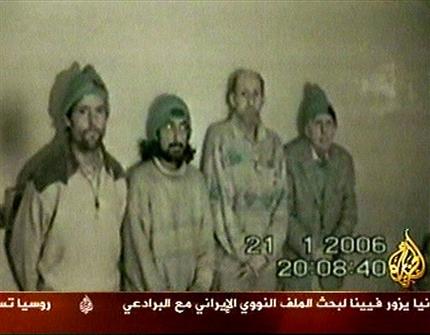
From left: James Loney (Canada), Harmeet Sooden (New Zealand), Tom Fox (USA), and Norman Kember (UK), January 21, 2006 hostage video After December 8, when a second deadline for executing Tom and the others passed without killings, momentum shifted. The flurry of statements died down; news reports dwindled and became routine.
From Baghdad, this meant an ominous silence about our friends, amid the noise and cries of ongoing civil war. For John and me, at our website, a frantic effort to beat a deadline was replaced by keeping a vigil.
Every night for the next thirteen weeks, either John or I (or both) would scan dozens of wire service reports for news of Tom and the others.
This work was disorienting and humbling for me. My partner Wendy had only recently moved in. I lay down beside her every night, warm with domestic tranquillity, but with a head full of mocking echoes the latest brutalities in the war; peacenik privilege, one might call it. I could only imagine what was happening to Tom and the others. (The reality, we learned later, was awful: every night they were chained together with no relief.)
We posted about what we found: with only a few exceptions, the news was “no news,” which we hoped was “good news.”
The exceptions were when the gloomy videos of the four were released; at least they were still alive, but looking increasingly haggard. Then, on March 7, 2006 a new video showed only three – minus Tom.
On March 10 came the dispatch we dreaded most: confirmation that Tom had been murdered. (We were told that early reports he had been tortured were not confirmed by a later autopsy.) The only relief from this loss appeared on March 23, when the other three captives were freed by British commandos.
Who killed Tom Fox? And why?

Few other than the ones who pulled the trigger know the truth, and one wonders how much even they understand. Speculation abounded, of course, with many of my more left-leaning friends imagining a CIA-sponsored conspiracy to silence these noisy pacifist dissenters. Yet from the reading and interviews I have done, the most probable guess seems much more mundanely sordid: it was likely all about money.
The videos showing Tom and the others were issued by a previously unknown group, “the Swords of Righteousness Brigades.” This name is very likely a fake, a cover for a criminal gang, which simply kidnapped them for ransom. There was, as John and I learned while keeping our vigil, a sizeable kidnapping industry in Iraq. Many Iraqis have been thus abducted for profit, as well as citizens of numerous other countries.
James Loney felt the ransom was wanted to help finance the guerilla insurgency. Many other observers feel that while the kidnappers are Muslims, and many have likely suffered from the invasion and occupation, these crimes appear to be only loosely connected to religious or political grievances. Rather, they are more a specimen of organized crime gangs mushrooming in a devastated and lawless society.
From this “profit-seeking” perspective, taking CPT team members was not a particularly good “investment”: the group has pledged not to pay, and not to ask anyone else to. Moreover, none of the four had a personal fortune to plunder. But the gang likely figured that regardless of such brave declarations, given enough pressure, someone would eventually cave in and pay. (Harmeet Sooden later told a New Zealand press conference that he suspected a ransom had been paid for him and the other survivors, despite vehement government denials.)
But if the kidnappers were after money, why kill Tom? There are a number of hypotheses:
- One, to show the friends and supporters of the other three that the kidnappers meant business. Some other hostage killings – for instance, that of longtime relief worker Margaret Hassan, an Iraqi citizen originally from Ireland – were evidently staged to show recalcitrant governments that ransom demands were truly life and death matters.
- Or two: because Tom was an American, and as a veteran had a US military ID card, he was a certified “enemy,” and one for whom the US government would not pay. That made him disposable.

Tom’s military ID opened doors, and may have been his death warrant. - Or three: if the kidnappers couldn’t get ransom from Tom’s family or government, maybe they recouped something by selling Tom to another Iraqi insurgent gang, one willing to pay for the privilege of shooting a military-identified American. (It is all-too easy to imagine their derision at his protests that he was a musician, not a fighter.)
Again, no one knows, but these are plausible explanations for the inexplicable.
With Tom’s death and the freeing of Jim Loney, Norman Kember and Harmeet Sooden, our www.freethecaptivesnow.org website morphed into a memorial and an archive (still up), and we wound up our nightly vigil.
I felt more than a little guilty about moving on, as the daily discipline of focusing on Iraq’s ongoing agony had brought home in cruel detail how many thousands more men and women there were being kidnapped, held, tortured, and some killed, by factions from all sides, amid a bloody confusion of agendas.
Our nightly reviews also, bit by obscure bit, made clear that despite the continuing stream of upbeat Pentagon communiques, the Iraq occupation was turning from a morass into quicksand, and headed for stalemate or failure.
With Tom gone, and the other CPTers free, I was abandoning these legions, to return to some semblance of everyday routine. In truth, I can only hang my head and cite the Qur’an, Surra 4:110: “And whoever does evil or wrongs himself but afterward seeks Allah’s forgiveness, he will find Allah Oft-forgiving, Most merciful.”
Tom Fox’s Legacy, Let Your Life Preach
Yet Tom’s story does not stop there. In the founding saga from which his CPT team took its marching orders, death was a tragedy, but not the end of the drama. Further, Tom was a Quaker, and in this tradition, “be patterns, be examples,” and “let your life preach” are among our oldest and most venerable mandates.
In his memory, I compiled and published a small book, Tom Fox Was My Friend. Yours, Too. It was a memorial and a tribute, meant primarily for study and reflection. I believe Tom would recognize and approve such a project.
In the book’s pages, various persons reflected on passages from Tom’s writings, or their memories and impressions of him, and offered comments on the patterns and examples of this remarkable, foreshortened life.
“This was the quote today in my planner,” Tom wrote, “as I considered the tragedies both great and small, personal and global we are all dealing with. . . . The only ‘something in my life’ I can hold onto is to do what little I can to bring about the creation of the Peaceable Realm of God. It is my sense that such a realm will always have natural disasters. It is the ‘man-made’ disasters that we are called upon to bring to an end.”
Tom sought to hold on to hope wherever he was. This was a difficult task in the regions where he chose to work.
The book was meant particularly for group study and reflection. But it, and Tom, are mostly forgotten now. Which is too bad.
Of one rare encouraging incident, in Palestine, Tom recalled in a blog entry, “Here was a seed that can take root. Here were people working through their anger and coming out the other side committed to peace. Here were people listening to their hearts and listening to each other. Here a tiny part of the Peaceable Realm was created. Here was the justice of God taking shape.”
Sixteen years later, can that also happen here?
I can get it from Amazon, but I’d rather use a Quaker bookshop!
Good luck in finding one. And while seeking, here are two queries to ponder:
1. Amazon, with all its faults, made the book possible. Is scorn the appropriate response to that contribution?
2. Amazon, with all its faults, has kept it available, at a modest price,long after most Friends have forgotten it and Tom. Is boycott really the suitable attitude to this service?
I’m not scorning or boycotting Amazon. I use it often.
I was wondering if I could buy it from a Friends’ Bookshop somewhere.
Love your posts!
I’m so glad you’re reminding us of Tom’s legacy. He’s a genuine Quaker saint and Friends should be reminded of that.
Thanks again and again for your fine work, Chuck.
“… he felt called …”
Are we followers of Spirit, able to decide for ourselves where we are called, or are we servants of Spirit, going where we are called?
Thank you for sharing your experiences with/of John Stephens, a faithful servant of Spirit.