

[NOTE: Anybody, especially a church bureaucrat or official, who tells you that Big Christianity, Catholic & Protestant, is not cracking apart over LGBT and associated issues, is either terribly under-informed, or putting you on. Such happy-or “We (& Jesus)-can work-it-out” talk is red-flag stuff, a warning that either their competence or their candor, or both, is in serious, maybe fatal doubt.
The two articles below are emblematic of this ongoing tumult: one is by a self-described “Asian American apostate” from American evangelicalism. The other is by a writer for a journal that has long advocated for purges of open LGBTQ Catholics and Anglicans, along with their straight supporters.
They are offered here as continuing food for thought.]

A scathing critique of the evangelical culture at a Christian university in pre-Trump America.
By Kathryn Post — April 18, 2023
(RNS) — R. Scott Okamoto still believed in Jesus the first time he strode onto the campus of Azusa Pacific University, an evangelical Christian school in Southern California, for a job interview in 1998. Fifteen years later, he left without a job or his faith.

But in his debut book, “Asian American Apostate: Losing Religion and Finding Myself at an Evangelical University,” Okamoto explains that his experience granted him more clarity and sanity about religion and Christianity in particular than he had enjoyed before.
“Asian American Apostate” is an inside look at the mosh of underground LGBTQ groups, right-wing Christian beliefs and the unlikely alliances operating on campus in the decades before the Trump era.
Okamoto’s scathing critique is also an account of how enduring a white-centric culture allowed him to become a “self-actualized Japanese American.”
Religion News Service spoke to musician and podcaster Okamoto about the book. This interview has been edited for length and clarity.
RNS: Why did you continue to teach at an evangelical university after you’d lost your faith?
Ninety-nine percent of what I was doing was teaching English at the university level. The last 1 or 2% was what they call faith integration. I felt very qualified to do that because even as I was losing my faith, I was still integrating their faith into what we were studying. I felt good about helping students who were very fundamentalist evangelical broaden their understanding of their faith, the same way I had, and I saw a lot of myself in them. It was just tough on me because I had to grin and bear the horrible things that were said.
I also really wanted to support the Asian American/Pacific Islander population that was invisible and very marginalized. And there was an LGBTQIA underground club. They had no institutional support, and they knew they could be kicked out if they were caught. I was deeply involved with them. So I had a lot of reasons to stay, even though I wanted to leave at the end of every year. It was taxing on my soul.
RNS:You write that your time there in the early 2000s gave you “a front row seat to the coming of the era of Trump.”
Christians worship Donald Trump because he’s wealthy. If he wasn’t a billionaire, they wouldn’t listen to him, but they believe God has blessed him. Tied to that is this attitude of hatred for people who are different from them. There was a real shift between the end of that happy “born again” phase of the late 1990s and the rise of Fox News. My students would come to class ready to crucify anyone different than them, especially gay people or people of color. At first, there were just a few students here and there, then (campus) clubs started to push this xenophobic, racist narrative.
Students would try to argue that Saddam Hussein was responsible for 9/11. The most popular argument I remember was that taking prayer out of schools in the 1960s led to all the bad things that happened since. When I would point out bad things did happen before the ’60s, it didn’t matter. They weren’t looking for conversation.
So when I hear Tucker Carlson, and everyone’s shocked, my view is that he’s just building on what has already been built up in evangelical culture.
RNS: You chose not to name the university in the book. Why?
The last thing I wanted was for this book to be a hit piece on APU. It could be any evangelical school. The academic world is not compatible with evangelical culture. They say it is, and they want it to be, but they don’t want to teach Shakespeare, they don’t believe in science. They have to get stacks of exemptions from Title IX just to get their accreditation.
At some point, you have to ask, what’s the point? If you want to be a university, be a university, the way the Catholics do. They hire all manner of professors and accept all students.
Evangelicals say the professors have to believe all the same things, but they don’t really mean it. Students are supposed to go to chapel and sign a statement of faith, but they’ll bring in football players from big schools and won’t make them go to chapel. They want all the appearances and perhaps privileges of being an excellent academic institution, while winking and nodding to the evangelical culture, saying, “Really this is just an indoctrination center to send out good Christian kids with a degree.”
RNS: You say the emergence of the gay-straight alliance forced you to choose a path you’d previously had the privilege to avoid.
The school had a kind of don’t ask, don’t tell policy, as long as people weren’t being overtly in support of gay students — because, let’s be real, there were no discussions about trans or nonbinary students during this time. I could point students in the direction of resources outside of Azusa Pacific. Obviously, it wasn’t enough. It’s pretty sad when the only ally you can find is a cis het English professor who didn’t decry homosexuality as a mortal sin. So when the kids decided they wanted to make an underground group, they approached me to be their sort of unofficial faculty adviser.
I sat and cried with so many students who whose parents or friends had disowned them because they’d come out. It definitely meant exposing myself to higher scrutiny from the school, but it was bigger than whatever career I was trying to forge. I had a place of privilege because my wife made more money than me. I was ready to help them.
RNS: The events you write about took place more than a decade ago. Why write about them now?
When I first started writing everything down, back in maybe 2010, it was just therapy for me. I thought, the world needs to see the truth about evangelicals, but I didn’t want to write a book that was just negative, because I had seen so much positivity both inside and outside of APU. I hope what comes through in the book is the concept of building bridges between people who don’t agree. I’m still in touch with dozens of students, some of whom made huge strides in their development as human beings to be more caring, more open and accepting. That only happens through, I think, relationships. I wanted to shine light on the problems of the school, but also offer some kind of hope.
RNS: Who were you writing this book for, and what takeaways do you hope they have?
I am not really writing this for evangelicals. I wrote the book for anyone who’s intellectually curious about an inside look to this culture. My story has a lot of identity issues that a lot of us deal with in America. Finding our people is a universal problem. But I’m definitely writing for the people who are getting out of faith or are sitting in their churches thinking, “This is toxic, this is problematic.” There is a way out.
Anglicans, Catholics, and “The third great crisis in Christianity”
The Spectator
Dan Hitchens — 08 April 2023
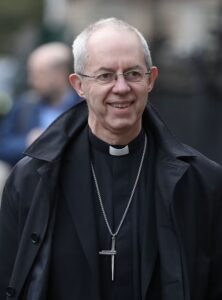
After he anoints the King next month, Justin Welby’s thoughts will perhaps turn to his own future. If Anglican gossip is to believed, Welby plans to step down to make way for a new Archbishop of Canterbury once the new Supreme Governor has been crowned. You could hardly blame him for wanting a quiet life: the divisions within the Church of England are more acute now than at any time since he was enthroned ten years ago.
Ever since February, when the C of E’s parliament, the General Synod, voted to introduce blessing services for same-sex couples, conservatives have been up in arms. The Church of England Evangelical Council, an umbrella body for the large and energetic evangelical wing, has announced that it feels ‘compelled to resist’ a policy which, if introduced, would represent ‘a departure from the faith which is revealed in the Holy Scriptures’.
Church leaders in Africa have threatened to break from the Anglican Communion entirely.
Welby’s problems are not limited to England. After the Synod’s decision, a group of 12 Anglican archbishops from the conservative Global South Fellowship of Anglican Churches issued a statement saying they no longer recognise the C of E as the ‘mother church’ of Anglicanism nor Welby as the ‘first among equals’.
Church leaders in Uganda, Kenya and Nigeria have threatened to break from the Anglican Communion entirely. ‘History is about to repeat itself,’ said Archbishop Henry Chukwudum Ndukuba of Nigeria. ‘The Anglican Church is at the threshold of yet another reformation, which must sweep out the ungodly leadership currently endorsing sin, misleading the lives of faithful Anglicans worldwide.’
Welby says he is ‘extremely joyfully celebratory’ about same-sex blessings, but will not personally conduct any such services: an attempt at fence-sitting which, according to the Global Fellowship of Confessing Anglicans – a global network of conservative Anglican churches – has ‘violated his consecration vows’ to defend Christian doctrine.
Two big London churches have suspended their financial contributions to the Diocese of London, which supports the new policy. Vaughan Roberts, the much-respected rector of St Ebbe’s, Oxford – who incidentally describes himself as ‘same-sex attracted’ – has said that Oxford’s bishops, who take an especially progressive line, may not preach or receive communion at his church.
From the other direction, Welby has complained that members of the Commons have ‘threatened’ him with parliamentary action to force his hand on gay marriage. Ben Bradshaw, the Labour MP for Exeter, recently presented a ten minute rule bill to enable C of E clergy to conduct same-sex weddings.
Whether or not the bishops realised before February that they were opening Pandora’s Box, they seem to have realised it now: according to an accidentally leaked photograph from a recent meeting, among the possible developments they are contemplating is ‘Not just fracture of C of E but complete disintegration.’
It is all a far cry from 21 March 2013, when Welby was enthroned in his new office on a wave of general goodwill. He would be, it was hoped, a great unifier: conservative, but flexible; an Old Etonian with a certain polished charm, but also someone who spoke movingly of his own troubled family history and experience with grief; a former oil industry executive, but with a social conscience. If anyone could bring peace to a divided Church, people said, it was him.
Two days before Welby’s enthronement, Pope Francis was inaugurated in Rome. He was also hailed as a bridge-builder who would help Christians find a path between extremes; a natural communicator who would speak to non-believers and the faithful alike. The secular media loved him, sometimes absurdly so. Elton John called him ‘my hero’.
Time and again, the Pope has made bizarre or ambiguous statements about long-established teachings
Now, the Pope Francis show has become exhausting. Time and again, he has made bizarre, ambiguous or divisive statements about long-established Catholic teachings, then refused to clarify his meaning. The splits in the C of E have been mirrored in Catholicism as liberals clash with conservatives and accusations of heresy fly.
It recently emerged that the late Cardinal George Pell, formerly one of the most powerful Vatican officials, wrote an anonymous memo describing Francis’s pontificate as a ‘catastrophe’. That view is extremely common among clergy, including senior clergy – though most keep it to themselves. But instead of healing the divisions, the Pope has blamed them on the small community of Latin Mass traditionalists and launched a crackdown on the Church’s ancient liturgy.
Where did it all go wrong? How in the past ten years have the divisions in Anglicanism and Catholicism only deepened under two leaders once championed as unifiers? Both men have sometimes spoken as though the truth is a secondary matter for Christians, less important than a spirit of inclusivity, and have acted as though, with enough cheerfulness, common sense and bureaucratic reform, some middle path could be found. On the subject of women bishops, Welby was asked by Giles Fraser before his election, how do you square the circle? ‘Well,’ he quipped, ‘you just look at the circle and say it’s a circle with sharp bits on it.’
Pope Francis has blown holy smoke over many issues – divorce, the nature of Confession and the Eucharist, LGBT concerns, the morality of the death penalty, the relationship between Christianity and other religions. He has succeeded only in fostering divisions without committing himself to any clear position. He, too, has offered a circle with sharp bits on it. And it turns out the sharp bits are painfully sharp.
The situation was summed up by the Cambridge historian Richard Rex, who suggests that there have been three great crises in the history of the Church. The first, in its early centuries, revolved around the question ‘What is God?’. That is to say: how many natures were in Jesus Christ, how many persons in the Trinity, and so on. Then, during the Reformation, ‘What is the Church?’. The third crisis, he argues, is happening now, over the question of ‘What is man?’. This relates – as he memorably puts it – to ‘an entire alphabet of beliefs and practices: abortion, bisexuality, contraception, divorce, euthanasia, family, gender, homosexuality, infertility treatment…’
On these issues, Catholic tradition at any rate is clear, and to adopt progressive values would be, in effect, to give up on Catholicism. Conservative Anglicans would say the same for their faith. But progressivism has a religious fervour of its own. Hence the impossibility of bridge-building – and hence the failed promise of Welby and Francis’s attempts at unifying leadership.
Pope Francis with Justin Welby, 14 June 2013 (Getty Images)
Both sides, of course, believe God is with them. But in human terms, the two are evenly matched. Progressives have the weight of respectable opinion on their side, as well as the media, politicians and the big NGOs. Conservatives tend to have the confidence of youth because – somewhat unexpectedly to those who remember the 1960s – it is often the younger generations who are most doggedly attached to the old doctrines. Kate Forbes, the 33-year-old SNP politician much criticised recently for her conservative beliefs on sexual morality, is a vivid example of the type.
Often these people relish their counter-cultural status. The rector of St Helen’s Bishops-gate – one of the London Anglican churches which has suspended its payments to the diocese and has also announced a ‘state of broken partnership with the House of Bishops of the Church of England’ – recently described the parish’s 11- to 18-year-olds group: ‘around 120 in regular attendance… young men and women seeking to live godly lives in accordance with God’s word in a highly sexualised culture. A number of the youth group lead Christian Unions at their own schools, in face of considerable opposition from secular teachers.’
Conservative believers suspect that the traditional teachings may have a new appeal to a society counting the cost of the sexual revolution. Bishop Jill Duff of Lancaster, a critic of the C of E’s new policy, emphasises this point. ‘Most of my ministry has been served in deprived urban areas,’ she has written. ‘Local women my age were astonished that I believed sex is for marriage. “You mean I’m worth it?”’
The patterns of church growth and decline suggest that the next century will see dramatic institutional upheaval. In Britain, for instance, while the Church of England continues to see a severe decline in Sunday attendance, the expanding churches – the Vineyard Movement, the Elim Pentecostal Church – tend to be conservative in doctrine, evangelical in style and founded in the 20th century.
Internationally, meanwhile, it is in the global south where faith is growing, to the extent that European Catholic parishes are often led by African clergy. Last year I visited a very middle-class Home Counties parish. The new Nigerian priest began his sermon: ‘Of course, when we sit down to pray, the Devil at once sits down beside us.’ The congregation shifted slightly in their pews. Lands once evangelised by Portuguese Jesuits or Victorian adventurers are now sending their own missionaries to the new heart of darkness that is the modern West. The medium-term future, in other words, is almost impossible to foresee.
The short-term future is not much clearer. Pope Francis has no obvious successor; it could be a conservative like the Hungarian Peter Erdo, but the names who most often appear in the frame – Cardinals Pietro Parolin and Seán O’Malley, for instance – are notable for their reassuring blandness. Whatever else the cardinal electors want, they long for some respite from the endless disputes of the Francis years.
As for Welby’s successor, the most prominent bishops – Stephen Cottrell of York and Sarah Mullally of London – are firmly on the liberal side of the present debate. The next archbishop might be a less well-known face: there’s speculation about such names as Guli Francis-Dehqani, Bishop of Chelmsford, who first came to Britain as an asylum seeker from Iran, or the likeable Mark Tanner, Bishop of Chester, who has a great deal of parish experience. What is certain is that this time nobody will be talking about a new era of unity.
Dan Hitchens is a senior editor at First Things. He is currently co-writing a book about Dr Johnson, and writes The Pineapple Substack.