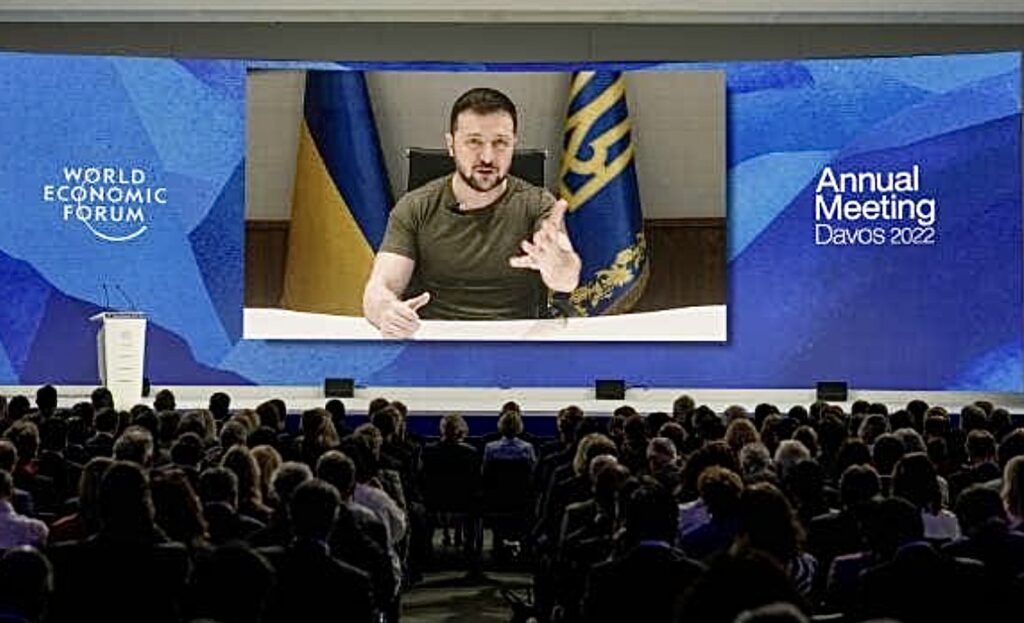
“NOTE: The shift can be felt even here, thousands of miles away: Russia’s nonstop shelling and bombing is wearing down Ukrainian forces in its eastern regions. They are retreating, taking many casualties. The “wise men” of Davos, and some national leaders of allied nations were talking of concessions to Moscow to get the war over with. the almost giddy optimism of six weeks, two months ago has been crumbling like so many Ukrainian buildings. President Zelensky is defiant; but what now?

From the Washington Post: Ukraine suffers on battlefield while pleading for U.S. arms
‘They’re just raining down metal on us,’ said a soldier fresh from the front line where Russia is advancing
By Siobhán O’Grady, Paul Sonne, Max Bearak and Anastacia Galouchka
May 29, 2022 — ET DONETSK OBLAST, Ukraine — The ambulances hurtled into the parking lot one after the other, each carrying wounded troops directly from the nearby front line. . . . . About 10 wounded soldiers arrived at this hospital in eastern Ukraine in less than an hour Sunday morning — the latest military casualties as Ukrainian forces, outgunned by Russia in the country’s east, continue to lose territory at a critical moment in the war.
Soldiers also helped one civilian woman with leg wounds out of a military ambulance.
The Washington Post is withholding the name and precise location of the hospital out of concerns from staff members that it could be targeted by Russian forces.

“Seventy people from my battalion were injured in the last week,” said a soldier and ambulance driver just outside the hospital gates who identified himself only as Vlad, 29.
“I lost too many friends; it’s hard for me. I don’t know how many. … It’s getting worse every day.”
The night before, he said, the shelling was so loud he hardly got any sleep. “It’s all artillery bombing down,” he said. “All the wounded are coming from shrapnel. Most guys in the trenches haven’t even seen the enemy face-to-face.”
They were gearing up to provide additional support for the soldiers battling the Russians head-on, preparing for a worst-case scenario in which Russian forces continue or accelerate their current advance. That would be a potential turning point on the battlefield.
It would come at a particularly desperate moment for the Ukrainians. Kyiv is already enraged that some Western voices are floating the idea of ceding territory to Moscow. And the Biden administration is taking weeks to decide whether to provide heavier weaponry that could aid Ukrainian troops at this critical juncture in the war.
“Everyone’s tired,” said Bohdan, a 30-year-old soldier and officer in the battalion who spoke on the condition that only his first name be used and his precise position not be given. “But we are ready to stand and protect until the last man.”
In recent days, Russian troops have captured the towns of Svitlodarsk and Lyman and have closed in on Severodonetsk, a large regional hub, where Russian forces have entered a hotel on the city limits. If Russian troops manage to encircle and take the city, Moscow would occupy nearly all of Ukraine’s easternmost Luhansk region, which makes up roughly half of Donbas.
“I mainly hope the boys don’t get encircled in Severodonetsk,” Bohdan said of his fellow troops. “They need more guns, they need more weapons.”
If he could send one message to Washington, he said, it would be this: “Help us with weapons. The most important is antiaircraft. Close the sky — it’s the civilians who are suffering the most.”
The situation in the country’s east marks a shift from an earlier stage of the war, when staunch Ukrainian defenses forced a broad Russian retreat in Kyiv and other areas, increasing confidence among Ukrainians and their Western backers about the prospects of all-out victory over a poorly organized and equipped Russian force.
Having now regrouped, Russian troops are making incremental but steady progress in their campaign in the east and are regularly employing heavy flamethrowers and long-range artillery that Ukrainian forces lack, leaving Kyiv on the back foot. Though Ukrainian resistance has made the fight a slog for Russian forces,
Moscow is inching closer to encircling Ukraine’s biggest strongholds in the Donbas region, while fighting on territory contiguous to Russia with easier supply lines.
In a video address early Saturday, Ukrainian President Volodymyr Zelensky said the situation on the battlefield in Donbas was “very difficult,” with Russian forces attacking Ukrainian positions with “maximum artillery and maximum reserves.”
“We are defending our land insofar as the defense resources we have today will allow. We’re doing everything we can to strengthen them — and we will strengthen them,” Zelensky said. “If the occupiers think Severodonetsk or Lyman will be theirs, they are mistaken. Donbas will be Ukrainian.”
For weeks, Zelensky and other top Ukrainian officials have been asking the United States to provide multiple launch rocket systems, or MLRS, which would give Kyiv the ability to strike targets from much farther away and a better chance of resisting the assault in the east.
U.S. officials and congressional staffers told The Post on Friday that the administration is preparing to send the weaponry and could announce the move as early as this week, but the White House must still make a final decision on the transfer.
Some White House officials had expressed concern that providing MLRS weaponry with a range of more than 180 miles would allow Ukrainian forces to hit targets far into Russian territory, potentially prompting an escalatory response from Moscow, but the White House is now comfortable managing that risk by withholding the longest-range ammunition for the system, a senior U.S. official told The Post.
Whether the weaponry will get to Ukrainian forces in time to stave off a significant defeat in the east is now unclear, as Russian forces unleash a wave of attacks with gruesome weaponry on Ukrainian positions, forcing an exodus of people from the country’s embattled easternmost regions.
In an Instagram post on Friday, Andriy Yermak, head of the Ukrainian presidential administration, said Ukrainian forces needed the weaponry “yesterday,” as well as other systems that have been requested, such as air defense systems and tanks. . . .
Outside the hospital Sunday, men who were recently wounded in Severodonetsk lamented the difficult conditions on the ground. “We need more Javelins,” said Lapa, 26, who spoke on the condition that he be identified only by his call sign.
On Saturday, he said, many dead soldiers slain in fighting nearby were carried out. Now, he said, “Ukrainian soldiers are pulling back.” He was at the hospital to be treated for a fracture in his leg and a wounded arm. Another soldier in his unit, who identified himself as Adik, 41, had broken ribs. A bloody bandage covered the side of his head where he had been hit with shrapnel.
“They’re just raining down metal on us,” Lapa said. Nearby, a 25-year-old with his head wrapped in a bandage puffed on a cigarette. He goes by Koleh and had recently hit a mine, he said, although he didn’t know how exactly he ended up wounded. Severodonetsk, he added, “is the worst.”
Ukrainians waiting for help away from the front lines are suffering too.
On Saturday, at the train station in the eastern city of Pokrovsk, a hub where civilians have arrived to evacuate from cities across Donbas, four elderly women lay crammed side-by-side in the back of a van, a mix of dirty blankets and pillows covering their frail legs. Underneath, they wore nothing but diapers.
Hours earlier, volunteers had evacuated them from a nursing home in Chasov Yar, a small town less than 50 miles from Severodonetsk. Now, one by one, they moaned and wailed in pain as they were lifted onto pieces of tarp and carried from the van into an evacuation train heading west — a trip their caretakers hoped might save their lives.
“They’re shooting a lot, they’re bombing a lot,” said a woman named Halya, who was 73 and missing the lower half of her right leg. “Now the war has gotten to us and it’s gotten a bit scary.”
Many elderly evacuees — all with red bracelets strapped around their wrists — said they did not know exactly where they were going. One said her family was trapped nearby in occupied territory. Another couldn’t speak at all, tears streaming down her face as she grasped the hands of two reporters.
On a main road heading east from the city of Dnipro on Saturday, even a gas station attendant urgently appealed to a Washington Post reporter for more support from the United States — begging for antiaircraft weapons to help protect her two sons serving on the front line near Donetsk. At a nearby checkpoint, a Virgin Mary statue draped in a Ukrainian flag sat propped up high, another plea posted beneath her: “Pray for Ukraine.”
As Ukrainian forces seek to hold the line, officials in Kyiv have been disheartened to see suggestions from the West that Ukraine should give up part of its territory to satisfy Russian President Vladimir Putin and end the war.
For days, top Ukrainian officials have been fending off suggestions from European leaders, former secretary of state Henry Kissinger and the New York Times editorial board that Kyiv should enter talks with Russia and make concessions. [Kissinger says Ukraine should cede territory to Russia to end war]
French President Emmanuel Macron and German Chancellor Olaf Scholz have been pushing peace talks, and top Italian officials submitted a peace plan to the United Nations that would freeze the current front lines, leading to a significant loss of territory for Ukraine.
Ukrainian officials believe that any concessions to satisfy Putin now will only lead to Russia regrouping and launching a far more vicious war against Ukraine in the future.
Mykhailo Podolyak, an adviser to Zelensky, told The Post that the Ukrainian government refuses any plan other than a military loss for Russia on the battlefield.
“If Russia doesn’t lose, they won’t have any internal transformation,” Podolyak said. “A Russia that doesn’t lose will, on the contrary, be more chauvinist and have an even more revanchist outlook, because they will hate us for humiliating them in front of the rest of the world … and, accordingly, in two years they will come back and kill us even more brutally.”
Zelensky, who said Kissinger was living in 1938 — a reference to attempts to appease Adolf Hitler before World War II — chided “great geopoliticians” trying to give away parts of Ukraine in a post on Instagram on Saturday, saying they were unwilling to see the people who live in those territories as real people. “Ordinary Ukrainians. Millions of those who actually live in the territory they propose to exchange for the illusion of peace,” Zelensky said. “You must always see people. And remember that values are not just a word.”
Commentary: Old men at Davos
By Gwynne Dyer – May 29, 2022
‘What happens in Davos stays in Davos’, they say – or at least it should stay there, because some foolish things are said at the ‘World Economic Forum’, the annual conclave of the rich and famous. Well, the rich, the famous, and this time also the very old, because both George Soros and Henry Kissinger graced the Swiss ski resort with their presence.
Former US secretary of state Henry Kissinger, 98 years old, was playing his favourite role of wise and world-weary adviser preaching ‘realpolitik’ (political realism) to the young and naive. (Everything is relative, and the ‘young’ at Davos are somewhat older than they are elsewhere.)
Kissinger warned the United States and the West not to seek an embarrassing defeat for Russia in Ukraine, predicting that it could worsen Europe’s long-term stability. He therefore wanted the West to force Ukraine into negotiations with Russia based on the pre-invasion borders that Russia conquered in its 2014 attacks.

A recent poll found that 82 per cent of Ukrainians think their country should not sign any of its territory away in return for peace with Russia. Researchers at the Kyiv International Institute of Sociology found that only 10 per cent of respondents found it acceptable for Ukraine to concede territory to achieve peace.
Mykhailo Podolyak, adviser to President Volodymyr Zelensky, tweeted: “As easily as Mr Kissinger proposes to give Russia part of Ukraine to stop the war, he would allow (Moscow) to take Poland or Lithuania away. It’s good that Ukrainians in the trenches do not have time for listening to ‘Davos panickers’.”
The Ukrainians are still high on their victories against Russia around Kyiv and Kharkiv in the north. However, the war in the east is more like a scaled-down version of the trench battles of the First World War: brutal artillery wars of attrition that Zelensky recently estimated are killing a hundred Ukrainian soldiers a day. It could be more.
Zelensky also revealed that “tens of thousands of Ukrainian men and women” have been killed already, and the economy is a wreck. Fifteen per cent of the population has taken refuge abroad, and the $40 billion in military and financial aid just voted by the US Congress will last Ukraine six months at best.
So Ukraine may end up deciding for itself to accept a peace deal that restores the pre-February border and lets Russia keep its earlier conquests. However, Russia is not even making that offer yet, and it is not Kissinger’s place to suggest forcing Kyiv to make such concessions. As for ‘not embarrassing Russia’, it damn well should be embarrassed.
At the other extreme, we have George Soros, a sprightly 91, who warned the assembled masters of the universe (Earth chapter) that Russia’s invasion of Ukraine threatens to be the “beginning of the third world war” and could spell “the end of civilisation.”
Soros threw a lot of other things into the pot as well – the climate emergency, the spread of autocratic regimes, the Covid pandemic – so by the end it wasn’t clear whether he thought the Ukraine war alone could bring down civilisation. But it was a doom-laden speech, to say the least.
It must seem to Soros that his whole life’s work is collapsing, because he has spent the past three decades and most of his fortune trying to encourage open and democratic societies, especially in Eastern Europe. But it didn’t work in Hungary (where he was born), it hasn’t worked in Russia, and now Ukraine’s freedom and democracy are under attack.
I met Soros in late August of 1989 in Budapest, when everything seemed bright and new and full of promise. Communist-ruled Hungary had just opened its borders to the west, and I interviewed a radical anti-communist student leader called Viktor Orban who took me to meet his new patron, George Soros.
Soros questioned me eagerly about the Soviet Union, where I had spent most of the summer, and I told him change was on the way very soon. And it all arrived on schedule: the fall of the Berlin Wall, democracy in the ‘satellite’ countries of Eastern Europe, the collapse of the Soviet Union. He was delighted, as was I and hundreds of millions of others.
Now it’s not glad, confident morning anymore. Orban is a populist ‘soft’ dictator in Hungary, Russia has turned into a hard dictatorship, Xi will probably get his third term and become China’s permanent ruler this autumn, and Donald Trump may be back as US president in 2024.
But even a full Russian conquest of Ukraine (which is very unlikely) would not cause a ‘Third World War’. The ‘end of civilisation’ is not nigh. It’s never as good as it looks to young, hopeful men, and it’s rarely as dark as it feels to disappointed old men.