

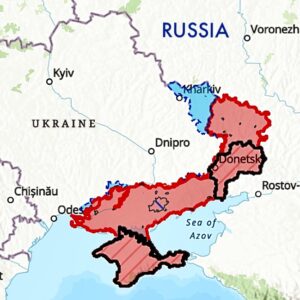
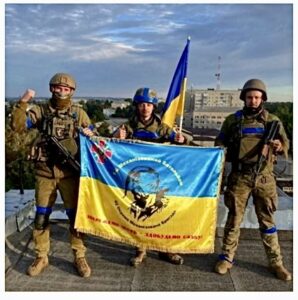
KHARKIV, Ukraine (AP) — Ukraine kept the counteroffensive momentum in its war against Russia going Monday, saying it liberated one village after another and claiming that in one region it pushed the invaders back right up to the border in a lightning military move that stunned many.

“In some areas of the front, our defenders reached the state border with the Russian Federation,” said the regional governor of the northeastern Kharkiv region, Oleh Syniehubov. Russian troops crossed the border in the region on Feb. 24, the first day of the invasion.
Russia acknowledged the military developments by saying it was regrouping. As throughout the war, military claims were hard to verify independently.
After Sunday’s attacks by Russia on power stations and other infrastructure that knocked out electricity in many place across Ukraine, Kyiv authorities also said that electric power and water supplies have been restored to some 80 percent in the Kharkiv region.
The buoyant mood was also captured by a defiant President Volodymyr Zelenskyy on social media late Sunday, comments that immediately went viral.
“Do you still think you can intimidate, break us, force us to make concessions? Did you really not understand anything? Don’t understand who we are? What we stand for? What we are talking about,” Zelenskyy exhorted.
“Read my lips,” he continued. “Cold, hunger, darkness and thirst for us are not as scary and deadly as your ‘friendship’ and brotherhood.’”
He added: “We will be with gas, lights, water and food… and WITHOUT you!”
Yet even amid the ebullience, the casualties kept mounting. Ukraine’s presidential office said Monday that at least four civilians were killed and 11 others were wounded in a series of Russian attacks in nine regions of the country. The U.N. Human Rights Office said last week that 5,767 civilians were killed so far.
The Russians continued shelling Nikopol across the Dnieper from the Zaporizhzhia power plant, damaging several buildings there and leaving Europe’s largest nuclear facility in a precarious position.
The turn of events and all–important reversal of initiative was backed up by international observers who warned of dire times ahead for Russian troops. It stood in sharp contrast to the first days of the war when Russian troops were moving toward Kyiv’s doorstep.
“In the face of Ukrainian advances, Russia has likely ordered the withdrawal of its troops from the entirety of occupied Kharkiv Oblast west of the Oskil River,” the British defense ministry said Monday, signifying a major advance by Kyiv. “Ukraine has recaptured territory at least twice the size of Greater London,” it said.
The British said that likely will further deteriorate the trust Russian forces have in their commanders. Ukraine’s initial move on the southern Kherson area, drawing the attention of enemy troops there, before pouncing on more depleted Russian lines in the northeast beyond Kharkiv has been seen as a great military move so far.
Even around Kherson, Russia is struggling to bring forces across the Dnipro River to stop the Ukrainian offensive there, the British military said.
It added: “The rapid Ukrainian successes have significant implications for Russia’s overall operational design. The majority of the force in Ukraine is highly likely being forced to prioritize emergency defensive actions.”
The Washington–based Institute for the Study of War said Monday that Russia likely lacks the reserve forces it needs to bolster its defenses in Ukraine.
While the war likely will stretch into next year, the institute believes that “Ukraine has turned the tide of this war in its favor” by effectively using Western–supplied weapons like the long–range HIMARS missile system and strong battlefield tactics. “Kyiv will likely increasingly dictate the location and nature of the major fighting.”
The bombardment ignited a massive fire at a power station on Kharkiv’s western outskirts and killed at least one person. Zelenskyy denounced the “deliberate and cynical missile strikes” against civilian targets as acts of terrorism.
“Russia’s apparent response to Ukraine liberating cities and villages in the east: sending missiles to attempt to destroy critical civilian infrastructure,” U.S. Ambassador to Ukraine Bridget A. Brink wrote.
Separately, the Zaporizhzhia Nuclear Power Plant in the Russia–occupied south completely shut down in a bid to prevent a radiation disaster as fighting raged nearby.

More: Excerpts from the Institute for the Study of War Daily Update:
Russian Offensive Campaign Assessment
September 11, 10pm ET
Ukrainian forces have inflicted a major operational defeat on Russia, recapturing almost all Kharkiv Oblast in a rapid counter-offensive.
The Ukrainian success resulted from skillful campaign design and execution that included efforts to maximize the impact of Western weapons systems such as HIMARS. Kyiv’s long discussion and then an announcement of a counter-offensive operation aimed at [the distant southern] Kherson Oblast drew substantial Russian troops away from the sectors on which Ukrainian forces have conducted decisive attacks in the past several days.
Ukraine’s armed forces employed HIMARS and other Western systems to attack Russian ground lines of communication (GLOCs) in Kharkiv and Kherson Oblasts, setting conditions for the success of this operation. Ukrainian leaders discussed the strikes in the south much more ostentatiously, however, successfully confusing the Russians about their intentions in Kharkiv Oblast. Western weapons systems were necessary but not sufficient to secure success for Ukraine. The Ukrainian employment of those systems in a well-designed and well-executed campaign has generated the remarkable success of the counter-offensive operations in Kharkiv Oblast.
The Ukrainian recapture of Izyum ended the prospect that Russia could accomplish its stated objectives in Donetsk Oblast. After retreating from Kyiv in early April, the stated Russian objectives had been to seize the complete territory of Luhansk and Donetsk Oblasts.. . .
Russian forces managed to take Severodonetsk on June 24 and Lysychansk on July 3 after a long and extremely costly campaign but then largely culminated, seizing no major settlements and little territory. The Russian position around Izyum still threatened Ukrainian defenders of Slovyansk, however, and retained for the Russians the opportunity to return to the attack on the northern sectors of the arc . . . .
The loss of Izyum dooms the initial Russian campaign plan for this phase of the war . . . .
The Ukrainian pressure in Kherson combined with the rapid counter-offensive in Kharkiv presents the Russians with a terrible dilemma of time and space. Russia likely lacks sufficient reserve forces to complete the formation of a new defensive line along the Oskil River, as it is reportedly trying to do before Ukrainian forces continue their advance through that position if they so choose. . . .
The current counter-offensive will not end the war. The campaign in northeast Ukraine will eventually culminate, allowing the Russians to re-establish a tenable defensive line and possibly even conduct localized counterattacks. Ukraine will have to launch subsequent counter-offensive operations, likely several, to finish the liberation of Russian-occupied territory. The war remains likely to stretch into 2023.
Ukraine has turned the tide of this war in its favor. Kyiv will likely increasingly dictate the location and nature of the major fighting, and Russia will find itself increasingly responding inadequately to growing Ukrainian physical and psychological pressure in successive military campaigns unless Moscow finds some way to regain the initiative.
Key Takeaways
— Ukrainian forces have inflicted a major operational defeat on Russia, recapturing almost all Kharkiv Oblast in a rapid counter-offensive
— Ukrainian authorities shut down the last active reactor at the Zaporizhzhia Nuclear Power Plant on September 11.
— The Russian Ministry of Defense confirmed that Russian forces are withdrawing from positions throughout all but easternmost Kharkiv Oblast.
— The success of recent Ukrainian counteroffensives likely contributed to the Russian announcement that annexation referenda will be indefinitely postponed.