
These drones are produced by AeroVironment Inc., an unmanned weapons maker based in Arlington VA.
A PR release at their website added some details:
“Switchblade drones are single-use weapons. U.S. army officials have described them as akin to flying shotguns, meant to explode when hitting their targets and not recoverable once launched.
“Kamikaze drone is quite an apt description: the technology is much the same as the hand-launched tactical reconnaissance drones also supplied by AeroVironment, except that it’s on a one-way mission with an explosive warhead,” David Hambling, author of Swarm Troopers: How Small Drones Will Conquer the World, told Newsweek.


They can be fired from tubes and launched in the air like mortar shells, and they are able to hit Russian targets from 25 miles away. They can be programmed to hit targets automatically and they are quite fast at doing so, dashing at speeds between 100 and 115 miles per hour.
Once the drone reaches its target, it detonates its warhead containing explosives. Any strike can be blocked by a “wave-off” option that allows operators to abort a mission if civilians are close to the target.”
The U.S. could be sending Ukraine either or both of two types of Switchblade drones that are available to the country: the Switchblade 300 and the 600.
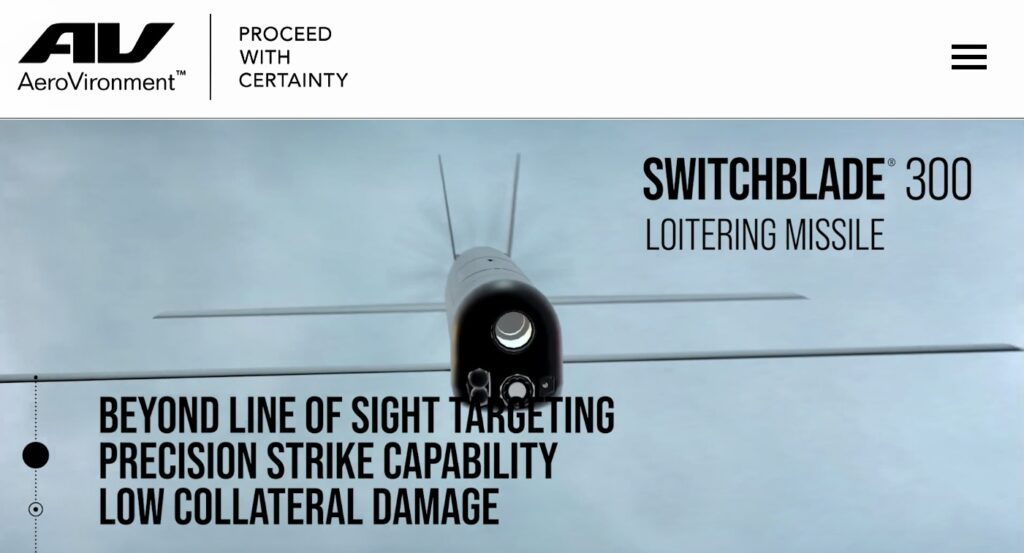
The drones would allow Ukrainian forces to hit beyond-line-of-sight targets with lethal effects, and “neutralize multiple-launch rockets and artillery units,” according to Hambling. . . .
“They were permitted in situations where other less discriminating weapons would have caused too much risk of collateral damage,” Hambling added. But despite “thousands of them been used in Iraq, Afghanistan and Syria,” Hambling said, “the U.S. military never discusses their use and no video has ever been released as far as I know.”

From the Washington Post:
By Jennifer Hassan, Dan Lamothe and Annabelle Timsit — March 17 2022

President Biden is ramping up efforts to help Ukraine fight back amid Russia’s invasion, announcing an extensive new package Wednesday that he said would “provide unprecedented assistance” to the country. The increase in military aid includes a delivery of 100 Switchblade drones, small and precise weapons packed with explosives that are able to strike targets in “kamikaze” fashion, according to a U.S. official.
What are Switchblade drones?
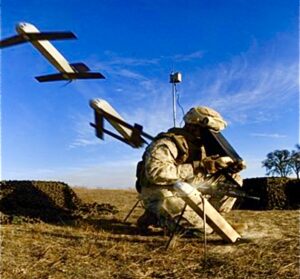
They are single-use weapons — small, unmanned aircraft that are launched from a tube, and that experts say are capable of inflicting significant damage. The drones have blade-like wings that emerge and unfold when the device is launched.
Switchblade drones are cheaper than most U.S. drones, and come in two sizes, according to AeroVironment, the manufacturer. The Switchblade 300 model weighs about five pounds, flies up to 15 minutes at a time, and is designed to be carried in a backpack, assisting small infantry units tracking the Russians’ movements.
The Switchblade 600, by comparison, weighs about 50 pounds, flies up to 40 minutes and is known as a “loitering missile” that can target armored vehicles. It is not yet clear which version the United States will be sending to Ukraine. . . .
How do Switchblade drones work? “
The tube is set up like a little mortar on the ground,” Steve Gitlin, who served as AeroVironment’s chief marketing officer, said during a 2020 interview in which he described the product.
“Using the ground control system, the operator launches it. It exits the tube. Its wings spring open.”
“Its propeller spins up, and it starts flying in the direction the operator wants it to and streaming live video back to that operator, viewable on the screen in the middle of that hand-control unit,” he continued, adding that once the threat is identified, “they then designate that target on the control station screen, and the Switchblade then navigates itself in the terminal guidance mode and detonates on to that target.”
Gitlin said that the Switchblade is also able to follow the target, changing direction if necessary.
The drones are unique in their ability to hover above a potential target, strategically waiting for the right moment to conduct a precise strike.
They are part of a category of weapons known as “loitering munition,” said Ingvild Bode, an associate professor at the Center for War Studies, a research group within the University of Southern Denmark, because they “are designed to loiter over battlefields, within potentially quite a broad geographical area, where they search for a particular class of target,” such as radars.
“When they have found the target, [they] launch themselves onto it” — hence the “kamikaze” label.
Their small size and weight make them stand out, Bode said, as does their ability to launch a strike on a target autonomously. While humans are often involved in confirming a strike remotely, she said their operating systems are “technologically capable of doing that on its own, and I think that is the big difference.”
What impact could the drones have on the war in Ukraine?
The U.S. offer of 100 switchblade drones is “quite a lot,” Bode said, but “we’re not talking about a number that would win the war for Ukraine.”
While they would not be “decisive,” the drones could help Ukrainian forces defend more territory against Russian incursions, she said, provided they are not shot down.
A senior U.S. defense official, speaking on condition of anonymity under ground rules set by the Pentagon, said that he would not rule out that more of the drones could be sent to Ukraine in future shipments, in similar rolling fashion to how the Pentagon has been sending antitank missiles and shoulder-fired antiaircraft weapons.
On paper, switchblade drones can be more precise than many of the weapons used by Russian and Ukrainian forces, such as fire bombs. But “because there is so much uncertainty about how the AI targeting algorithms these systems include actually function, and whether they can function effectively in urban warfare, we don’t know whether they’ll be more effective” in this particular war, Bode said. . . .
Where are Friends led in response to such a weapon?
On the one hand, the Ukrainians have had no way of stopping the artillery of the Russian troops, much if not all of it guided artillery — used purposely against civilian targets. This weapon changes the equation.
On the other hand: peace, not war. Lives are lives, including the Russian troops operating the artillery.
Being forced to confront situations that push or overwhelm our conceptualization and concretization of the movement of Spirit — toward peace, away from war — is a good thing, as we are forced beyond our stale concepts, back into connecting with Spirit in the present moment.