

 A 2019 (pre-Covid) survey of U.S. protestant pastors showed that nine out of ten held some kind of services on Wednesday evenings.
The pandemic likely reduced that number, but for many churches, it’s still a thing. And if you kept up with the extra-long speakers list for DNC Day 3 (my copy listed 37 names, but still missed a few), it would hardly be a surprise to find a sprinkle of Wednesday churchgoers among them.
Maybe that explains why, when the midweek marathon adjourned after midnight, amid all the hubbub, I had heard, not one but two homilies from the podium (and maybe missed a few others).
Outside media, with its pronounced secular tilt, hasn’t seemed to notice. I couldn’t find any news coverage of these two speeches (other than YouTube videos).
So as a public service, they are excerpted & summarized below.

The first was by New York Congressman Hakeem Jeffries. He’s not a household name, but if the Dems regain the House this year, he’s in line to be Speaker.

Jeffries is also a lifelong member of Cornerstone Baptist Church in Brooklyn.
In his brief talk, where Jeffries emphasized the rigors of the Dems’ high stakes campaign, he paraphrased (or riffed on) Psalm 30:5:
”In the scripture, the Book of Psalms tells us, that weeping may endure
during the long night, but joy comes the morning.
Here’s how we do it:
Strategize on Sunday;
Meet the moment on Monday.
Take it to ‘em on Tuesday.
Work it out on Wednesday.
Thank the Lord on Thursday.
Fight the power on Friday.
Set it off on Saturday.
Get a few hours of sleep. . . .
And wake up the next day,
And do it all over again.
Until Joy,
Joy,
Joy,
Comes in the morning.”
The other message, more like a conventional sermonette, was delivered by Transportation Secretary Pete Buttigieg, who is a straight-up Episcopalian, and has been a congregant at the Episcopal Cathedral of Dt. James in South Bend Indiana. He was fleshing out a stark contrast between the post-transition Democrats and the Trump campaign:

Buttigieg (Summary excerpts):
Their campaign can be summed up in one word: darkness.
Darkness is what they are selling.
But I just don’t believe that America is in the market for darkness. I believe that America today is ready for a better kind of politics.
Yes, politics at its worst can be ugly, crushing, demeaning. But it doesn’t have to be. At its best, politics can be empowering, uplifting . . . .
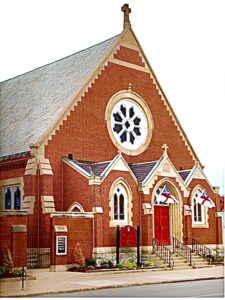
My faith teaches me that the world isn’t made up of good people and bad people, but rather that each of us is capable of good and bad things.
And I believe leaders matter because of what they bring out in each of us, the good, or the bad.
Right now the other side is appealing to whatever is smallest in you.
They’re telling you that greatness comes from going back to the past. They’re telling you that anyone different from you is a threat. They’re telling you that your neighbor or nephew or daughter who disagrees with you politically isn’t just wrong, but is now the enemy.
I believe in a better politics, one that finds us at our most decent and open and brave.
The kind of politics that Kamala Harris and Tim Walz are offering.
And as you have felt these many days, that kind of politics just feels better to be part of. [Applause]
There is joy in it, as well as power.
And if all of that sounds naive, let me insist that I have come to this view not by way of idealism, but by way of experience, the experience of my unlikely career: someone like me serving in Indiana; serving in Washington; serving in uniform.
Yet I’m thinking of something much more basic— I’m thinking of dinnertime at our house in Michigan, when the dog is barking, and the air fryer is beeping and the Mac and cheese is boiling over and it feels like all the political negotiating experience in the world is not enough to get our three-year old son and our three year-old daughter to hush wash their hands and sit down at the table.
It’s the part of our day when politics seems the most distant. And yet, the makeup of our kitchen table, the whole existence of my family is just one example of something else that was literally impossible as recently as 25 years ago, when an anxious teenager growing up in Indiana wondered if he would ever find belonging in this world.
This kind of life went from impossible to possible. From not just possible to real, to —almost — ordinary, in less than half a lifetime.
But that didn’t just happen: it was brought about, through idealism and organizing . . . And yes, by politics, the right kind of politics. . . That makes an impossible dream into an everyday reality.
I don’t presume to know what it’s like in your kitchen. But I know, as sure as I’m standing here, that everything in it . . . all of it compels us to demand more of our politics than a rerun of some TV wrestling death match.
And this November we get to choose . . . our president. . . But most of all, we get to choose a better politics. . . . That is what awaits us when America decides to end the Trump politics of darkness once and for all . . .[applause]
There was plenty of fine, even history-making speechifying Wednesday night. But I didn’t want these two gems to go unnoticed.

CBS NEWS: Protest march Wednesday night ended safely and peacefully, Supt. Snelling says
CHICAGO (CBS) — Another protest for the Palestinian cause was held in Chicago Wednesday, the third day of the Democratic National Convention.
This protest began at Union Park and took to marching on the Near West Side near the United Center.
The crowd for the protest was large and mostly peaceful. Men, women, and young children took part.
They marched trying to raise awareness about their message—which calls for stopping all U.S. funding to Israel and ending the War in Gaza.
The protesters spent about two and a half hours rallying, and then took to the streets for nearly two hours.
“The organizers wanted a peaceful protest,” said Snelling. “They had marshals who kind of policed the crowd themselves—so when they saw someone getting out of line, their marshals got people back in line.”
Marching protesters made their way to the new Damen Green Line station, and dispatch reports indicated that participants may have blocked the entrance.
Video showed police detaining a woman on the Damen Green Line stop platform. Multiple social media reports indicated that a crowd of people banged on windows and yelled, “Let her go!” after police arrested or detained a woman at the Damen Green Line stop.
Protesters later advanced east to the Ashland Green Line station, where police were seen confronting a man waving a Palestinian flag. It appeared a protester climbed the piling for the ‘L’ structure.
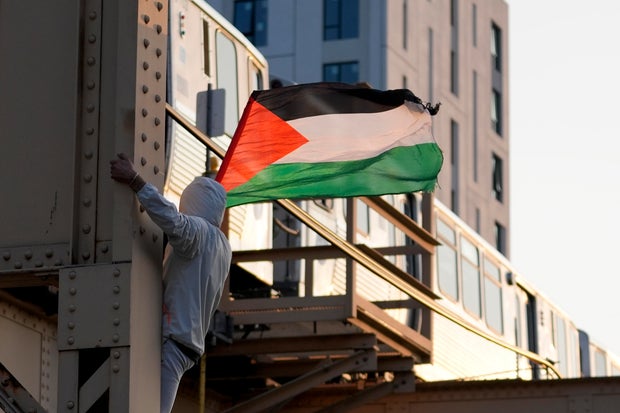
Social media showed a parade marshal later intervening.
“Seeing all the cops here, everyone behaves, nobody does everything rowdy,” said Chicago protester Aamer Jaleel.
Snelling said the protest went smoothly Wednesday because safety was discussed.
“When we have these conversations on safety and what’s going to keep everybody safe, and we’re working together, this is how it turns out. It turns out no arrests, no violence, peaceful protest—this is how people got their voices heard.”
Thursday morning, Snelling confirmed there were no arrests during the march, and he credited protest organizers for working with police to make sure the event remained peaceful.
“It shows that when you have some type of contact and collaboration with those who are organizing, that you can have a peaceful First Amendment gathering, and that’s what happened yesterday,” Snelling said.
Parallel to DNC, a Chicago interfaith vigil mourns the loss of life in Gaza
Activists who have been protesting at the Democratic National Convention over the war in Gaza took time out to mourn and draw strength from their varying faiths.
CHICAGO (RNS) — On Tuesday night (Aug. 20), thousands of cheering delegates packed the United Center to hear former President Barack Obama and other dignitaries lend their support to Vice President Kamala Harris’ bid for the Oval Office.
About 20 minutes away, along Chicago’s lakeshore, a more solemn gathering was being held. There, as the sun set and the city’s skyline lit up, about 100 people from different faiths gathered to remember those killed in Gaza over the past 10 months in a vigil hosted by the American Friends Service Committee, a Quaker organization.
Small clusters of older women and men, some wearing kaffiyehs, the familiar Palestinian scarf, greeted one another with hugs. Families with kids and young activists made their way to the lakefront, where they were met with a table topped with battery-powered votive candles, pins reading “Remember Gaza” and AFSC literature. On the ground stretched a long, wide ribbon, marked with the amounts spent on military spending around the world and serving as an illustration of the American military budget compared with that of other countries.
The words “Remember Gaza,” drawn in red and green chalk, adorned the concrete walkway along the lakefront near where the group gathered, sitting on a series of high steps facing the water.
For months, many in the gathering had been protesting, making calls to elected officials, watching accounts of the war in Gaza and raising their voices in support of an end to the conflict. Now, they were taking time to stop and to find refuge in their faith and the bonds of friendship.

“I believe many of us have souls that are tired,” said Jennifer Bing, national director of the U.S. Palestine Activism Program for the AFSC, adding that many of the activists gathered were worn out from the news of bloodshed in Gaza, or from protesting and making calls for a cease-fire that many feel have gone unheeded.
“Our weary souls need to be nourished by our community of the faithful,” Bing said. “We hold each other up so we may continue to work for a world we still believe is possible.
A series of speakers from different faith groups, some with family or colleagues in the Palestinian territories, then spoke to the gathering. Some read poems or offered prayers, while others shared stories of loved ones lost to violence.
Among the first speakers of the evening was Laura Boyce, AFSC’s associate general secretary for U.S. programs. For Boyce, advocacy for Palestinians reflects her Quaker belief that “there is that of the divine in all people.”
Above all, Boyce and the AFSC want to be “very clear that we need to see a cease-fire.”
While the city of Chicago is bustling with rallies and protests this week, Boyce said this interfaith vigil complements other such solidarity actions by offering a quiet change of pace. For her, this is just one of many ways to work toward the ultimate goal of a cease-fire and arms embargo.
During the vigil, Boyce read a message written by Firas Ramlawi, an AFSC colleague in Gaza, addressed to those gathered at the vigil. Ramlawi sent his thanks and said the “unwavering support and steadfast belief in our just cause” was a grounding constant for him, said Boyce.
Thank you for highlighting much I was not aware of, things I have missed amid the waterfall of words.