When Good Trouble Got Serious: John Lewis- at the Pettus Bridge, 1965 — And TODAY
In early February, 1965, I was jailed for 10 days in Selma, Alabama after being arrested in a peaceful march in support of voting rights for black citizens. Along with several dozen others, I slept on a concrete floor in a near-freezing prison camp, and subsisted on two daily servings of blackeye peas or beans and dry cornbread with water. It was tough, but I thought of it as “paying my dues,” and a kind of initiation ritual for a civil rights rookie. (Only much later did it get a more fitting name; “Good Trouble.”)
Once released, I resumed my place as a newbie footsoldier in the uneasy coalition organizing the voting rights campaign. I was with Dr. King’s Southern Christian Leadership Conference (SCLC), who were working with a cadre of radicalizing, mostly college age activists in the Student Nonviolent Coordinating Committee (SNCC). John Lewis was SNCC’s chairman.
Just then the focus of attention was shifting from Selma to Marion, a smaller town half an hour northwest, where marches by local blacks had been met with a much more violent response.
Left, Jimmie Lee Jackson. Right, former state trooper James Fowler, who shot him.
On the night of February 18, a Marion native, 27-year old Jimmie Lee Jackson, a part-time farmer and woodcutter, joined a nighttime voting rights protest after trying to register and being refused. The march was attacked by a gang of whites, and in the melee Jackson was shot in the stomach by a state trooper when he went to the aid of his aged grandfather, who was being beaten.
Reaction to the Marion attack was strong and nationwide. The Alabama authorities helped keep this indignation at white heat, first by pushing a resolution through the state senate supporting the repression. Then the state troopers’ hardline commander, Col. Al. Lingo, served Jackson in his hospital bed with a warrant charging him with assault and battery, and intent to murder one of his men.
Late the next Thursday night, with Jackson in the hospital fighting a virulent infection, Dr. King’s tactical chief James Bevel suddenly burst into the single room I shared with my wife Tish in the house owned by Mrs. Amelia Boynton, a local civil rights stalwart.
Bevel flipped on the light, startling us awake, and began talking rapidly, as if resuming a conversation that had been going on only a few moments before.
Blinking in the abrupt brightness, we heard him say that the next step for the movement had to be a march, not to the courthouse in downtown Selma, or even in Marion, but rather from Selma all the way to Montgomery, fifty miles east down U. S. Highway 80 through adjoining Lowndes County.
It was, on the face of it, a frightening plan: Lowndes County was known as a place where violence against would-be black voters and their advocates was swift and terrible. The county population was three-fourths black, yet in 1965 not a single person of color was registered to vote there.
Lowndes was also almost completely rural: Hayneville, the county seat, was a mere hamlet, and the main road, Highway 80, wound its way through long stretches of swamp, with thick growths of trees and bushes on both sides, providing perfect cover for potential bushwhackers.
Bevel acknowledged the hazards, but moved quickly past them to focus on the logic of his plan, which was clear: Jackson had been attacked by state
Alabama Governor George Wallace.
troopers, who were based in Montgomery. The racist voting regulations were also made there, by the legislature. A notorious segregationist governor, George Wallace, spewed vitriol about “outside agitators” from his office in the all-white capitol. And with the public attention now focused on Alabama, any attacks on such an epic march would only increase the pressure for change.
All this, Bevel insisted, made Montgomery the most legitimate target for a serious effort to petition the government for redress of grievances. And it was time.
In a few minutes, having heard our approval of the idea, Bevel just as abruptly hurried out into the night.
This episode was exciting and puzzling; As greenhorns, Tish and I were not used to being consulted on matters of high strategy, and certainly not at such an hour. But it turned out that Tish and I were only two of many: it was part of Bevel’s style to try out such ideas on various people, to test the waters, refine the plan, and figure out how best to present it to the mass movement audience.
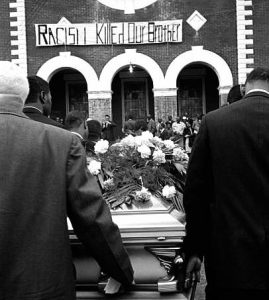
The time for such a presentation came quickly: The next morning, February 26, Jimmie Lee Jackson died.
‘Racism Killed Our Brother’ reads a sign hung in front of church as pallbearers carry the casket of Jimmie Lee Jackson, Marion, Ala., into a Selma church for memorial services. Jackson was shot in an assault on a peaceful demonstration in Marion February 24, 1965 and claimed he was shot by a state trooper.
SNCC’s local leadership objected to the march plan, as being more of a publicity stunt, which would quickly end in disarray and many casualties.
But the grim news marked a turning point: whatever reluctance was felt by SNCC, Dr. King and local activists about Bevel’s audacious plan was swept away by the reaction to Jackson’s death.
Against this background, when Bevel stepped into the pulpit of the little Marion church for Jackson’s second funeral there on February 28, his eloquence was enriched by anger. He built on a line from the biblical Book of Esther, 4:4, that “I must go see the king,” followed by repeated urgent calls that “We must go to Montgomery and see the king,” The calls were all but irresistible.
Later that same day, Dr. King announced that yes, there would be a march to Montgomery, beginning one week later, Sunday, March seventh. Although SNCC still officially shunned the march, John Lewis — who had been arrested numerous times and beaten up more than once — said he would join it as an individual.
Bevel’s sense of tactics and timing proved to be uncanny. More than once in his previous sermons, he had told us that he, like many other black people in the South, might be light on formal education, but that he was an expert in one subject above all: “I study my white folks. I know ‘em.”
This finely-honed intuition, based on lifelong observation (and hard experience) rightly told him that the tensions among white leaders and their more dangerous followers were moving steadily toward some kind of climax, and the Montgomery march plan would jack up the intensity by several notches.
Once it became clear there would in fact be a march attempt, it was also obvious that Governor Wallace could not allow it to happen. His administration, indeed the whole state, was taking a tremendous public beating in the wake of Jimmie Lee Jackson’s death. Wallace could not afford to see its reputation further sullied by more bloodshed.
But Wallace was in something of a box, because he also knew his state troopers could not be relied on to deal with the pilgrimage peaceably. Their commander, Col. Al Lingo, was in fact maneuvering secretly with Selma’s militant sheriff Jim Clark to set up a confrontation with the marchers that both men had long been itching for. They wanted it to happen outside the Selma city limits, where that pusillanimous Wilson Baker could not interfere.
Baker was a harbinger of a kind of Southern white “moderate”, determined to prevent public violence when the press was around, and open to coerced compromise with integration. Baker, along with Lingo and Clark, knew that their more violent white supremacist camp followers had caught the scent of impending attack, and were migrating toward the city to join in.
At movement headquarters, Brown Chapel AME Church, we smelled trouble too, and it made our preparations for the march somewhat half-hearted. We didn’t do much in the way of serious logistical planning for a fifty-mile trek by several hundred people. That’s because few of us figured the march would get very far; we all expected to be arrested before we got out of town.
Actually, we hoped to get arrested before we went much past the bridge; better a few more bleak nights in the county jail or Camp Selma, where the walls let in the winter chill but at least kept terrorists out, than days of trudging through the ominous grey-green of the Lowndes County woods and swamps, where dozens or hundreds of snipers could easily hide.
These apprehensions were reinforced on Saturday, March 6, when a small group of progressive white Alabamians, gathered in Selma to show support for the movement,. They were was attacked by other whites near the courthouse, and the Selma police, under Wilson Baker, narrowly averted a full-scale riot.
A billboard erected near the Pettus bridge by local neo-Confederates
At Brown Chapel, we didn’t know whether to be relieved or more afraid when we heard, later that same day, that Wallace had issued a proclamation forbidding the Montgomery march, as “not conducive” to traffic and commerce in the state.
Actually, the prospects for violence were increasing hourly. Wallace had, in his way, done his best: he did order his troopers to disperse the march peacefully, once it crossed the Pettus Bridge away from downtown over the Alabama River. Jim Clark had been lured away for a weekend talk show appearance in Washington. With Wilson Baker also taking a few days off, Selma’s Mayor Joe Smitherman had pledged full cooperation with the governor’s plan.
But Smitherman was a rookie, in office only several weeks. Baker, the veteran, sensed that a double-cross and real trouble were coming. On his return he told the mayor he did not want his men taking part in any action on or beyond the Pettus bridge, where the troopers and Clark’s sheriff’s posse would be massed. Baker proposed instead that he arrest all the marchers right after we left the church, thus keeping us out of the troopers’ clutches entirely.
When Smitherman insisted he had confidence in the governor’s pledge of peaceful dispersal, Baker threatened to resign on the spot, and only relented when Smitherman agreed to sharply limit the police presence at the bridge.
My SCLC comrades and I didn’t know about this confrontation then, or at least I didn’t. But as Sunday morning came and would-be marchers gathered at Brown Chapel, the prospect of violence hung in the air like a thick fog. Homemade bedrolls were piled near the church dais, and we listened to instructions on how to deal with tear gas, which we heard had been issued to the troopers.
Our expectation was that the march would proceed in two or three waves, one following another as marchers were arrested. As the final round of singing and pep talks were being made in the church, the SCLC staff gathered in the parsonage next door, to get our own marching orders.
As there were too many of us for the living room furniture, most, including me, sat cross-legged on the floor. Dr. King had said he would lead the march, but he wasn’t there. This was another sign of the prospect of trouble: I believed Dr. King was not afraid for himself; but I also knew his inner circle was afraid for him, and protected him as best they could. They had, I figured, somehow kept him away.
In his absence, Andrew Young gave us our instructions. He went around the circle, assigning this one to the first wave, that one to the second. Finally he got to me.
I looked up at him, trying, I am sure without success, to mask my fear. The sensation was not so different from what had come over me after my last arrest, when I sat staring at Jim Clark’s boots and holstered pistol before learning my fate.
Yet the sense of being a recruit in a nonviolent army, which I had felt before, was once again clear: feeling fear before battle was not shameful, and despite it I would carry out my orders then, as I had for previous marches.
But Andy was merciful. Gazing down at me, he murmured something about my needing to deal with the press, and assigned me to the second wave. As he moved on I tried, probably with no more success, to disguise my relief.
Andy, Bevel and Hosea Williams flipped coins to see who would lead the first wave, and Hosea lost.
In a few moments we were back in the church, where Hosea, looking very solemn indeed, led the crowd in a round of “God Will Take Care of You.” I wasn ‘t convinced.
While SNCC still officially disclaimed the march, John Lewis was in its front rank as an individual — and a prime target.
Then, bedrolls hoisted, and with Lewis beside Hosea at the lead, the marchers filed out of the church, down Sylvan Street toward the bridge.
Wilson Baker had been told that Col. Al Lingo would meet Jim Clark in Montgomery on his return from Washington, and keep him busy there until the march was over. Instead, Clark and Lingo arrived at the east end of the Bridge just in time to urge the troopers and Clark’s possemen, many of these on horseback, onto the attack.
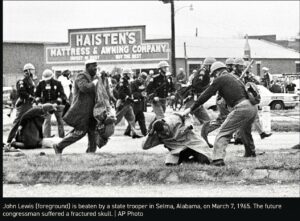
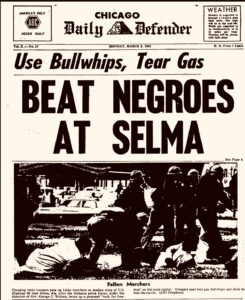
The marchers were beaten and tear-gassed at the east end of the bridge, then chased back across the span and through downtown Selma. Troopers and possemen, some swinging bullwhips from their saddles, pursued them all the way to the segregated Carver housing projects surrounding Brown Chapel.
Baker tried to stop Clark once he got near Sylvan Street, but the sheriff elbowed angrily past him and the melee continued unabated. Baker ordered his police out of the area, to prevent them from taking any further part in the violence.
Mrs. Amelia Boynton, my landlady, was in the march, and was knocked unconscious in the attack.
I watched the initial assault from the bluff across the river, where I had ridden with someone who had a car. As the cries of the marchers moved back across the bridge, the mist of tear gas drifted our way, bright white in the midday sunlight.
We soon drove off to catch up, taking back streets first to Good Samaritan Hospital, a small facility in a black neighborhood run by Catholic missionaries. Looking in briefly, we saw the emergency staff, wide-eyed and grave, coping with chaos, as hysterical marchers streamed in, rubbing their eyes, crying, bleeding, and limping.
Once at Brown Chapel, we figured the second wave would be getting ready, and it would shortly be my turn. Heading back, I was grim but resolved, and also a bit ashamed at having been spared; after this, I would be ready to face whatever they were dishing out.
At the church, though, there was only more chaos: People rushed up and down the steps, some yelling defiance, throwing bottles and rocks toward the deputies and vowing to get their guns and retaliate.
Seeing troopers and possemen still circling the church, it was obvious that heading off further escalation was the most immediate need. I joined a few others who went from one end of the steps to another, pleading for everyone to go inside, prodding and pushing them toward the doors.
Finally most of the people were inside, and I followed them. The church was full of acrid fumes, evaporating from the marcher’s clothes and skin. My eyes were soon burning and I was coughing up tear gas with the rest.
Although this photo was from 1961 in Mississippi, it shows how dogged and fearless John Lewis was in facing racist violence. (Also how consistent he was in wearing ties to protests.)
But before long Hosea Williams mounted the podium, his face dripping where he had rinsed off the gas. His denunciation of the brutality was in full throat, and helped refocus the crowd’s attention away from outside.
Hosea was soon joined by John Lewis, whose skull had been fractured by the trooper’s clubs, but who refused treatment until he had added his voice to Hosea’s. Significantly, his message was that it was unconscionable that Lyndon Johnson had just announced that he would be sending U.S. troops to Vietnam to escalate the purported defense of freedom there, and not be sending them as well to Alabama to defend us. We roared our outraged agreement.
Soon there was another staff meeting at the parsonage. Again seated on the floor, most of us were spectators to a heated telephone conference, in which Hosea, Andy, and others debated loudly with each other and Dr. King, somewhere on the other end, about what to do next.
They quickly conceded that there would be no immediate second wave. Instead, the question was now whether to march again the next day, Monday, or wait until Tuesday and in the meantime try to mobilize supporters from around the nation to join us. Those on the phone, once the shouting died down, finally agreed that Tuesday was the day. . . .
. . . Our march finally did get across the bridge and to Montgomery. (That story is elsewhere.) The near-term outcome was a legal landmark, passage of the Voting Rights Act, which soon began to change the South, and America. Four presidencies, positive and progressive overall, were made possible by it. It also brought many new faces of color into Congress. In 1987, John Lewis joined them, and served in the House for 33 years.
He didn’t forget his past: in 2009 he was arrested in a protest for relief of Darfur famine, and in 2016 he helped stage a 26-hour sit-in in Congress to bring pressure for better gun safety laws.
He served long enough, regrettably, to see a relentless campaign of reaction turn the political tide against the landmarks the Selma campaign had built from the courage, the sacrifice and endurance of the heroic black men and women of Selma, most of whose names are not known to history
By mid-2020, the hope that a reckoning and renewal might follow the murders of George Floyd, Breonna Taylor and so many others, flickered, flared, and then was snuffed out, largely by reactionary judges, and hostile administrations. That was the same turbulent summer when John’s body gave out, as all of our bodies shall do.
But as his body failed, John’s spirit endured, and is still with us. His last key message keeps echoing. It’s short, and maybe doesn’t have the shivering ring of Dr. King, Frederick Douglass, or Barack Obama. Yet it remains before us, true to our moment, and here it is again: “Good trouble.”
Can you say it with me? “Good trouble.”
In Selma we had a simple related call and response:
The speaker said, “What do we want?”
Everyone shouted “Freedom.”
The speaker said, “When do we want it?”
Everyone shouted “Now!”
And then the speaker said, “Where do we want it?” “Selma Alabama!”
Today I’m going to update this, with two easy changes:
“What do we want?” — “GOOD TROUBLE!”
“When do we want it?” NOW!
“Where do we want it?” — EVERYWHERE!
Note: much of this post is adapted from the book Eating Dr. King’s Dinner. More information about the book is here.
Related
One thought on “When Good Trouble Got Serious: John Lewis- at the Pettus Bridge, 1965 — And TODAY”
I have in a mind a different kind of Good Trouble: building person-to-person connections in society that cut-across the usual socio-economic-educational divide starting with a universal form of greeting: “how are you doing?”
Class differences are used by politicians to create electoral division. Building connections across class differences reduces their ability to create division.


 In early February, 1965, I was jailed for 10 days in Selma, Alabama after being arrested in a peaceful march in support of voting rights for black citizens. Along with several dozen others, I slept on a concrete floor in a near-freezing prison camp, and subsisted on two daily servings of blackeye peas or beans and dry cornbread with water. It was tough, but I thought of it as “paying my dues,” and a kind of initiation ritual for a civil rights rookie. (Only much later did it get a more fitting name; “Good Trouble.”)
 It was, on the face of it, a frightening plan: Lowndes County was known as a place where violence against would-be black voters and their advocates was swift and terrible. The county population was three-fourths black, yet in 1965 not a single person of color was registered to vote there.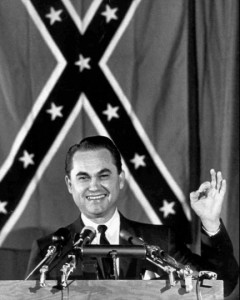


 While SNCC still officially disclaimed the march, John Lewis was in its front rank as an individual — and a prime target.
 marchers were beaten and tear-gassed at the east end of the bridge, then chased back across the span and through downtown Selma. Troopers and possemen, some swinging bullwhips from their saddles, pursued them all the way to the segregated Carver housing projects surrounding Brown Chapel.

 They quickly conceded that there would be no immediate second wave. Instead, the question was now whether to march again the next day, Monday, or wait until Tuesday and in the meantime try to mobilize supporters from around the nation to join us. Those on the phone, once the shouting died down, finally agreed that Tuesday was the day. . . .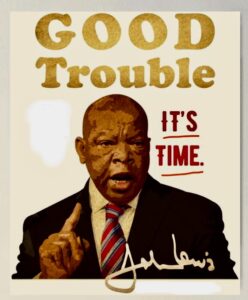


I have in a mind a different kind of Good Trouble: building person-to-person connections in society that cut-across the usual socio-economic-educational divide starting with a universal form of greeting: “how are you doing?”
Class differences are used by politicians to create electoral division. Building connections across class differences reduces their ability to create division.