

When I was working with liberal Quakers, I led many workshops, gave many talks.
As a highlight, once a group was warmed up and in good spirits, I often evoked loud (but nervous) laughs by taking a quick three-question, raise-your-hand survey. It’s apropos to my subject, so here it is, complete:
- “First question: how many here have read all or most of the Bible?”

NOTE: NOT a liberal Quaker billboard . . . (If half the hands went up, that was a lot.)
- “Okay, Second: how many here would identify as a Christian — and you get to define what ‘Christian’ means?”
(Typically less than half the hands went up, often much fewer.) - And then, the kicker:
“Fine. Now, how many here listen to NPR?”
(Almost always, EVERY hand went up. Then came the nervous laughs.)
 As the chuckles faded, I drove the point home: “Isn’t this wonderful? Once American Quakers, even we liberals, were divided into factions, with names such as ‘Hicksites’ and ‘Orthodox’ and ‘Gurneyites’ and ‘Wilburites’ and so forth.
But now we’re all this one big happy family.”
More snickers, but the sarcasm was sinking in. My point: maybe living in a monoculture had a down side.
In fact, I believed it did. To the point that, in mid-2004, I swore off NPR, cold-turkey, after almost 30 years. (I kept the liberal Quakerism; but that’s another story.)
For many of those three decades, I had been deep into NPRworld. Before it ended, I had lived in New York, Boston, San Francisco-Palo Alto, inside the D. C. Beltway; Philadelphia and State College PA, plus near the Triangle region of North Carolina. I had attended Quaker meetings in all these places, traveled long distances to numerous others in the national network of liberal Quakerdom.
In all this to-ing and fro-ing, I had come to realize that, from coast to coast, border to border, my “faith community’s” connective tissue, what it essentially breathed and fed on — was a media monoculture, like guppies in a fishbowl. The cultural medium in which we lived, moved, and had our “spiritual” being, was —NPR.
And for many years, I was all-in with this. NPR’s personal impact was magnified because I didn’t watch much TV, and its cross-country companionship got me through many long drives between Quaker events. And while working as a writer near D. C., I interviewed Scott Simon, the Quake-ish star of its Weekend Edition
 And I was once interviewed by Bob Edwards on a weekday morning. Later, in central Pennsylvania, I spent a few months behind the mic at WPSU in State College, reading the weather and dropping needles on Brahms and Beethoven.
But rather than a fishbowl, I found that the better metaphor for NPRism is the proverbial bubble, or the grain farmer’s silo.
Yet this silo was rapidly evolving into the miniaturized equivalent of a virtual reality headset. Worn faithfully and in tote bag disguise, it was flashed like an ID badge of authenticity among my beloved liberal Quakers, accepted from East to West.
That worked for me for a long time. And then, not all at once, like in B.B. King’s blues classic, the thrill faded and then was gone.
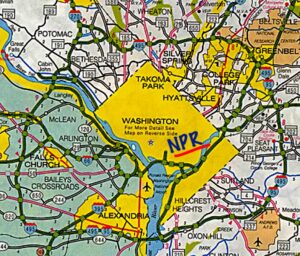
I began to notice that in this virtual reality, everything important happened (or didn’t) in or near Washington. Further, that all such things were considered and explained by a tight circle of bland cognoscenti, with a definite Ivy League tilt. Among them “reporting” mainly meant talking to each other while deigning to share their inside gentry status with us in the boonies.
As the new millennium dawned, this shtick grew increasingly tiresome. I was especially annoyed by its accompanying facade of “noncommercialism.” But replacing commercials with 96-hour marathons of fundraising pleas made one yearn to hear about golf shoes or discount ED pills for a spot of relief. (I’m still in therapy for my coffee-mug phobia spells.)
Then there was the politics. Rightwingers raged about NPR as a font of leftist subversion. Who were they kidding?? To me it hovered just a tiny, carefully modulated, and cumulatively maddening micro-smidgen to the left of the reigning Beltway consensus.
Which was no longer enough for me. In part because all the while, NPR’s smug insularity helped its audience live in bubbled denial about the slow and steady rise of a reactionary resistance, until that movement became an earthquake, impossible to ignore — and is now wreaking its vengeance on all of us.
I had seen this reaction coming (see this post, and numerous others), and chafed at the blinkered groupthink NPR’s provincialism enabled.
My breaking point came with three events in spring of 2004:
— NPR was left $200 million or so by the widow of the founder of McDonalds; this mega-windfall was at first fine with me: now, I figured, they could assemble a lean, mean independent investigative reporting team, to rake up and deliver serious scoops of bipartisan muck from the bountiful supplies thereof in their hometown.
Instead, they built a new office building downtown, amid the lobbyist-and-PR jungle, to literally cement their place in the establishment media.
— Then they flunked the courage test when news of rampant wartime prisoner abuse (aka war crimes) leaked from Abu Ghraib in Iraq, Guantanamo Bay, and a series of secret “black sites.” The “mainstream” media long and meekly avoided use of the proper, accurate term for what was happening (i.e., torture) and NPR was among this timorous spineless herd.
— Finally, in April 2004, a “progressive” radio network, Air America, was launched, aiming to fill this gap of go-along gutlessness, and raise the alarm about the rising reactionary tide.
I leaped for it, and have never looked back. (Air America soon failed, but Heaven then smiled and sent us podcasts, so my audio range is now as wide and varied as I could wish.)
But enough about me. The topic here is why, even now that the MAGA dobermans have sunk their fangs into NPR’s federal subsidies, I think the network will nonetheless overcome the loss.
The reason is simple, though it may not yet have occurred to many of the network’s fans.
It is this (& pardon my language): capitalism.
Or in radio jargon: commercials.
Yes, if NPR goes honestly commercial, and the right people there know how to hustle, I believe it can survive. Or at least, if well-managed, it has a fighting chance.
After all, while its audience has declined from the 2018 peak of 30 million weekly, in 2022 it was still more than 23 million (Pew research figures). Even thus reduced, 23 million pairs of ears is not chopped liver.
Sure, the end of federal funding may mean some cuts, in coverage and staff. Yet the federal slice of NPR’s income is reportedly not much more than ten per cent, the loss of which should not be fatal.
The biggest shock would likely be cultural, the giving up of NPR’s utterly phony above-the-unseemly-scramble-for-cash-philanthropic-gentry mindset. Will the 23 million desert them if “All Things Considered” begins to consider such things as real estate investing, and new burger deals at drive thrus? I seriously doubt it.
Why? This: while I lack inside sources at NPR, I do know a little something about nonprofit fundraising. Above all, I know that in the successful shops, near the C-suites there are offices in which bright, well-paid but low-profile staffers spend all their time and considerable skill looking and hustling for money.
Since it has lasted 60 years, NPR either has some of these folks, or knows the URL for Zip Recruiter. And commercial advertisers have money.
Yet even as I think NPR will weather this storm, I must admit I’m unlikely to return to the fold.
As a thought experiment, though, I’ve started a list of potential changes at NPR which might pique my interest. Here FWIW, are a few:
How to (maybe) make NPR appealing to me:
1. Decenter the Beltway: Sell the building & move HQ out of D. C.,at least far enough that commuting to work from there is impractical. (Note to beancounters: this could save NPR a bundle of money.) Resettle in a 2nd or 3rd tier city — not Chicago or LA. (How about North Carolina?)
2. Revive my McDonald’s windfall fantasy: leave a bureau in DC, with a hard focus on original investigative reporting, especially corruption, with targets from all parties. (They’ll stay busy.)
3. NPR can keep some of the foundation money, but it won’t be enough. So dump the philanthropic framing & DC-centric corporate culture. Replace it with more Bob Edwards & unpretentious soul, less Ivy; this will likely take years.
4. Ditch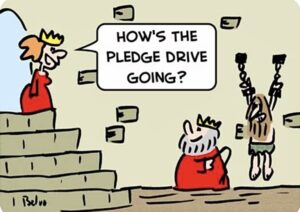 the fund drive marathons. At once. Forever. (I really wanted this to be #1.)
5. Own up to the fact that your “underwriters” are actually advertisers, and resize the staff & programming to fit the realistic budget the market and actual audience demand will support, letting the chips fall.
6. Seek out and highlight new on-air talent that is reliable but not a condescending snooze to listen to. This is hardly a new or outsider idea. In a 2024 email to a public media newsletter, Doug Nadvornick, Program Director at Spokane Public Radio in Washington state, said: “I welcome any attempt to reduce NPR’s heavy emphasis on wonky political process and ‘insider’ coverage that gets so tiresome day after day.” (Amen, bro.)
7. And not least, NPR execs and board members should re-read & ponder the writings of Uri Berliner on the tragedy of woke.
Sure the MAGA regime is mega-racist, and to be fought against every day. But the sad truth is that too much of DEI is/was more like shooting up Ivermectin to beat Covid: a bundle of quack cures as bad as the disease. (I say this as a certified Sixties civil rights veteran with scars & receipts; I’ve never let go of The Dream, but I’m sure relieved that I wasn’t listening to NPR in the throes of its righteous frenzy.)
So after 20 years away, with plenty of varied & stimulating media input, I don’t know if these changes would draw me back; but I’d applaud them anyway.
As to what my beloved but thoroughly siloed & bubbled liberal Quakers will do if their NPR security blanket & vox dei begins to fray or stutter? — Well, that transition could be tough, but on dusty shelves they will find some long-neglected resources that have a record of being useful in coping with such an exodus.
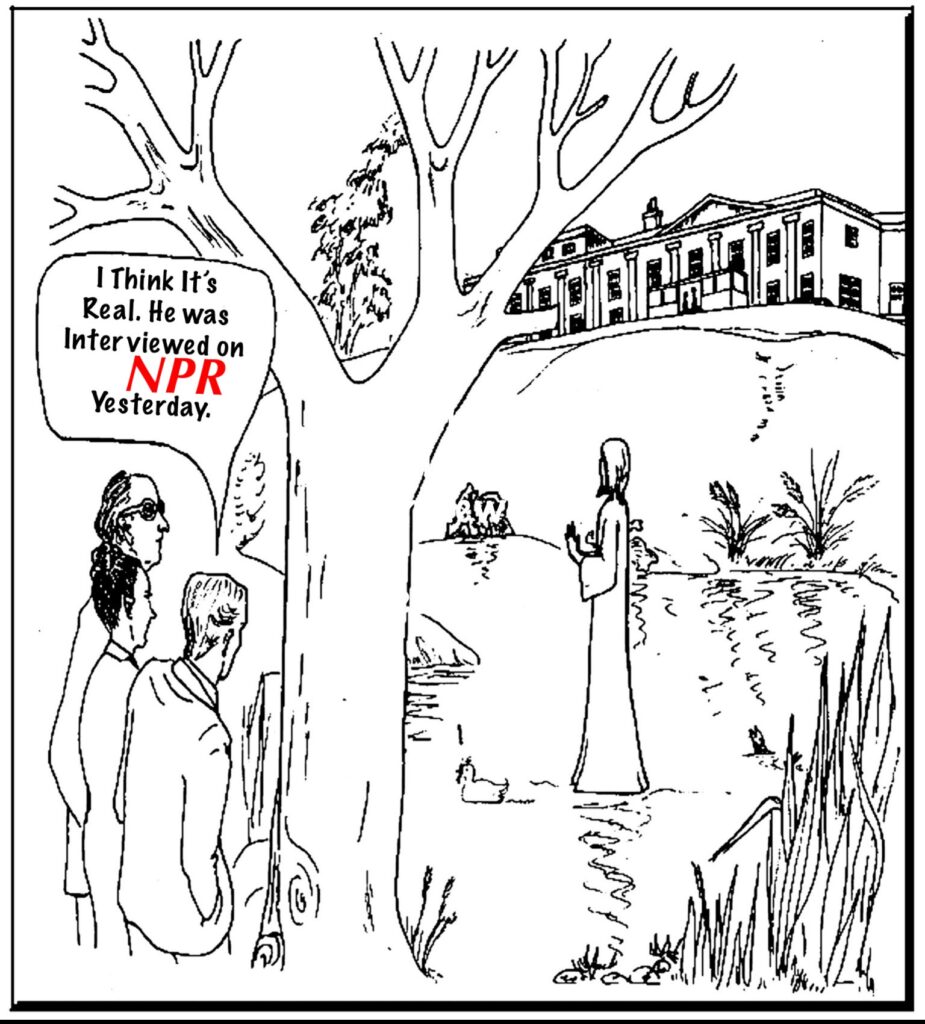
Indeed, maybe a few might go really radical, and try reading the Bible.
Very well said. I never thought about the DC centrism, but you are indeed correct.?
Thanks, Mark. During my NPR years, I spent two years working on the Hill (in the belly of The Beast). That time was good in some ways, and Congress is a necessary (evil?), but it really reinforced my sense how out of whack and lame most big media was in covering it. It permanently cured me of the real malady (mass psychosis) known as “Potomac Fever.”
I. F. Stone’s method of intellectually surviving DC: he had a desk in the Library of Congress (as a Distinguished Research Scholar). I doubt the DC cognoscenti frequent the LOC.
I don’t know about the radio folks, but I.F. Stone was one of my models and superheroes: my interview with him from about 1970 is elsewhere on this blog.
Well if NPR goes belly up CBC will still be available for group think.
Totally agree with this. It was their fundraising methods that turned me off permanently.