

 [NOTE: the essay below is one of 61 chapters in a new book, The Quaker World, published in November 2022 by Routledge. I am posting it here as a witness to the conviction that such Quaker scholarly and historical work should be widely and conveniently available. Unfortunately, in its present form, it is not.
That’s because the price of The Quaker World (ranging from US$200-$250 online) puts it out of reach for almost all ordinary readers and Quaker meetings as well. I was honored to have my work included in the volume, but can’t accept that it will be thus sequestered inside a profiteering publishing model which will ensure that it will be seen by practically no one.
I call on other contributors to the book to make arrangements for the wide distribution of their work, so those in the real Quaker world can get the benefit of their labor and insights. Friends, your work deserves it, and such distribution, I believe, is the necessary completion of the ministry your work embodies. Do not let your lamps be hidden under this outlandishly-priced barrel.
I also call on the editors, and other professional Quaker scholars, to leave behind the price-gouging “academic” publishing model, and get future such projects into print (on paper & online) at reasonable, modest prices. This call relates to Friends’ testimony of Simplicity and plainness. The Quaker World is the third such doorstop-thick omnibus volume to appear in recent years on a similar basis: if my Meeting were to buy all three, it would cost close to $750 just for three volumes. It is hard to express how counterproductive such projects are: “ridiculous” is one of the milder terms that occurs.
“Unnecessary” also. Today’s publishing technologies put far better options within easy reach. For that matter, their use does not require vows of scholarly poverty: instead, they make it possible for all parties involved to be reasonably compensated from book sales while keeping prices modest. Thee won’t get rich at this, Friends; but do we need to be reminded that Friends long crusaded, not without some success, to replace an economy built on unpaid labor?]

 From The Quaker World, Chapter 9: Progressive Friends: Shaping the Liberal Quaker past and present
Chuck Fager
The Progressive Friends were an American Quaker reform movement that appeared in the 1840s. They took form in the aftermath of the major division of U.S. Quakers, called the Great Separation of 1827.
Beginning in Philadelphia, the 1827 separation divided Friends into two opposed groups: the more numerous became known as Hicksites, after the well-known Quaker preacher Elias Hicks, who was their inspiration but did not want to be their leader. Hicks called for a reform of Quaker structures and beliefs, to recover what he considered the original authenticity of Quakerism.
Hicks’s opponents came to be called Orthodox Quakers (or Friends), because they represented the Quaker establishment, organizationally and theologically. Both aspects were important, and disputed. (Ingle, QIC)
Theologically, the Orthodox were being influenced by the rising evangelical outlook, especially among Protestant middle and upper class churchpeople. It emphasized the emerging biblical literalism, the blood atonement of Jesus, and a drive for enforced uniformity of belief in the Quaker community.
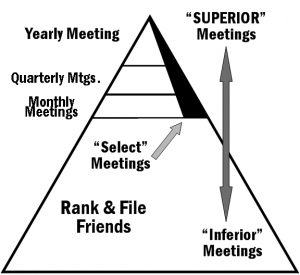
Organizationally, the Orthodox Friends clustered at or near the top of what was then a sharply defined hierarchical form of Quaker church governance. The currently widespread notion that Quakerism was an equalitarian movement is anachronistic and fictional; within two decades of its founding, the Society of Friends was nothing of the sort. Its 19th century books of Discipline made this long-established hierarchy plain:
The connection and subordination of our meetings for discipline are thus: Preparative meetings are accountable to the monthly; monthly to the quarterly; and the quarterly to the yearly meeting. So that if the yearly meeting be at any time dissatisfied with the proceedings of any inferior meeting; or a quarterly meeting with the proceedings of either of its monthly meetings; or a monthly meeting with the proceedings of either of its preparative meetings: Such meeting or meetings ought with readiness and meekness to render an account thereof when required. (Kuenning)(Emphasis added.)
The moves by this “Quaker Establishment” to enforce evangelical orthodoxy in belief, and silence critics such as Elias Hicks, were the matches that lit the tinder of 1827’s conflagration.
 After the split, both groups retained the top-down structure. (Kuenning) But some nascent Hicksite liberals hoped for a loosening of disciplinary strictures, which were many, and led to frequent individual disownments for what some deemed petty offenses, such as attending weddings that were not Quaker. (Palmer 12, 101) One of these hopeful Hicksites was an eloquent young mother, Lucretia Mott, born on Nantucket Island but settled with husband James in Philadelphia. Her preaching in meetings was steadily gaining confidence and attracting more attention.
Mott’s hopes strengthened in the 1830s when she learned about, and was strongly drawn to, the new movement called abolitionism. By then U.S. Quakers had been against owning, buying or selling enslaved persons for fifty-plus years. But their corporate stance as to abolishing the institution was hedged about and very equivocal. As an 1842 epistle from the Hicksite Baltimore Yearly Meeting Elders’ put it:
We earnestly and affectionately intreat our Friends and brethren every where, to pause and deeply reflect upon the consequences, before they commit themselves in any degree, by countenancing or entering into associations founded upon principles, or governed by motives, inconsistent with the mild, forbearing, and peaceable spirit of the Gospel. We may rest assured that all attempts to effect the liberation of the slaves, by coercive measures, will be met, as they already have been, by a counteracting force, and if persisted in, will finally lead to violence—perhaps to bloodshed. . . .
“May we therefore, beloved Friends, retire to the Divine Gift within ourselves, and seek after that “wisdom that is from above which is first pure, then peaceable, gentle, and easy to be entreated, full of mercy and good fruits, without partiality, and without hypocrisy.” May we study to be quiet, and mind our own business; and may we carefully avoid putting forth our hands to a work, to which we have not been divinely called, least like one formerly, we bring death upon ourselves, and be the means of bringing destruction upon others.” (Fager, 2013, pp. 58-64)
This call to personal purity and group quietism on ending slavery was soon backed up by Hicksite Establishment power: many Hicksites who joined the burgeoning abolitionist groups were disowned or hounded into resigning, in what I have called the Great Purge. (Fager, 2014, Chapters Two & Three, esp. pp. 29-32). Similar attitudes were expressed against joining with other growing reform movements of the era: temperance, and women’s rights prominent among them. (“Admonitory Address”) The reforming spirit was basically at odds with this Quietist Quaker tradition which persisted among both Hicksites and Orthodox.
Nevertheless, Lucretia Mott became active in all three movements. She also read widely among insurgent Protestant thinkers, and joined them in questioning aloud biblical literalism and evangelical doctrines, in favor of what she called “practical Christianity” (aka reform) and “the law of progress” as a truer goal than some otherworldly “salvation.” (Mott, 1848)
This new religious thinking reinforced her doubts about the legitimacy of the hierarchy of the Quaker “select meetings” which ever more firmly and oppressively opposed both the new movements and the new beliefs. As she wrote in 1841 to a close friend,
“I have long noticed that difficulties in our Society have had their origin in our Select Meetings, humbling as is the fact. Perhaps if their power were more limited, one cause of dissensions would be removed. ‘Tis true we often have good meetings together, but what is there that ought to be regarded as secret? I am more and more prepared for their discontinuance.” (Hallowell. P. 218)
Her ire did not flag with time. In1852 Mott complained to her cousin Nathaniel Barney about, “What feeble steps have yet been taken from Popery to Protestantism! Our Ecclesiastics, be they Bishops or Quaker Elders, have still far too much sway. Convents we have yet, with high walls, whose inmates having taken the veil, dare not give range to their free-born spirit, now so miserably cramped and shrouded.”(Palmer 213)
Mott rapidly became nationally known as a public speaker, in a time when women speaking in public to mixed male-female (then called ‘promiscuous”) audiences was still seen by most as scandalous (Cromwell, 117; Perry 160f). But she was not alone in her advancing views. And other Hicksites protected her against several attempts by Establishment elders to silence or disown her. (Palmer 108, 113, 158, 161, 169, 432; Hallowell 292-4)
Besides which, by 1842, the dissent she spearheaded was taking off on its own, first in Ohio and Michigan. In Ohio’s Green Plain Quarterly Meeting, a group of abolitionist-minded reformers, including one named Joseph Dugdale, proposed to abolish their body of life-tenured recorded ministers, who as per the Discipline, met privately as a “select meeting,” within yet unaccountable to the meeting at large. While that proposal was dismissed out of hand by yearly meeting officials, to the north, Michigan Quarter —another abolitionist hotbed — somehow managed to get the job done, and abolished its “select meetings” entirely.
Michigan Quarterly Meeting to Genesee Yearly Meeting, 1843:
“this meeting considering the Meeting of Ministers & Elders no longer beneficial to us, have discontinued it, and we cannot feel a duty to resume that Meeting. And we are desirous of having the [Yearly Meeting] Discipline so revised as to make that order no longer obligatory upon us. The women’s meeting concurring.” (Bradley, 1963)
Both these insurgent Quarterly Meetings paid for such temerity: their “superior” yearly meetings (Indiana for Green Plain) and Genesee, in western New York) laid them down, i.e., abolished them. (Bradley; and Fager, 2014, pp. 32-34) But in both locations, the disowned insurgents soon organized new groups, also called “yearly meetings,” with the addition of “congregational (i.e., no “Select” hierarchy), or “Progressive”, as their revised religious lodestar.
It took Genesee Yearly Meeting’s elders six years, until 1848, to bring the hammer down on the Michigan rebels. (Wilson) During that time, the United States had won a war with Mexico which brought several more states into American territory, which expanded and intensified the struggle over the expansion of slavery.
When Genesee acted, about 200 of those attending their session walked out and then formed the Waterloo Progressive Friends Yearly Meeting. (Bradley, pp. 95-108) They had the support of the rising abolitionist star, Frederick Douglass. Also among them were five of the six women who also took time to gather in a kitchen to organize the first national convention on women’s rights, in the nearby village of Seneca Falls. One of the five was Lucretia Mott. (Palmer, xxivf, 166f)
The Progressive movement soon expanded its reach to Philadelphia Yearly Meeting. There it was spurred by conflict among Hicksites over holding abolitionist meetings in meetinghouses. (Fager, 2013, pp. 5-8) Establishment Friends had numerous objections to such gatherings: the speakers were typically not Quaker, and such outside connections were still to be shunned; many were “hirelings,” preaching for pay, something Friends then abhorred; and their messages typically involved calls to do things like support the Underground Railroad, which were illegal in the South and in danger from mobs in the North. (Fager 2013, pp. 58-64, 76f)
The underground was a very live issue around Marlborough Meeting, southwest of Philadelphia. It was close to the borders of Maryland and Delaware, both slave states, from which frequent escapes made for a brisk and tumultuous illicit runaway traffic. In June 1852, the Marlborough elders obtained arrest warrants for Oliver Johnson, an abolitionist speaker, and four local Friends, who were then arrested when they tried to have Johnson speak in the meetinghouse. This incident was not actually violent, but was shocking, and came to be known as the “Marlborough Riot.” (Wahl. 1975, p. 45) In the aftermath, several dozen Friends were disowned by Marlborough and nearby Kennett Meeting for abolitionist activism.

The rebels’ response was to organize a new Pennsylvania Yearly Meeting of Progressive Friends in nearby Longwood. (Pennsylvania, 1853) This group became the largest and longest-lasting of Progressive Friends outposts, and the only one which built a meetinghouse which still stands. Its Clerk for the first ten years was Joseph Dugdale, one of the Friends disowned in the laying down of Green Plain in Ohio. He had also attended the Waterloo Progressive sessions, before moving to Pennsylvania. (Dugdale, 1849)
Longwood was also the group which produced the most detailed Progressive manifesto, the Exposition of Sentiments. (Fager, 2013, pp. 420-433) This remarkable 6500-word document deserves to be much better known [Full text here.] It was as influential in its liberal Quaker stream as was the more famous, only slightly longer, and one might say notorious Orthodox-drafted Richmond Declaration of Faith of 1887 (The Richmond Declaration). Besides endorsing such social reforms as temperance, abolition of slavery and ending war, the Exposition also called for sweeping changes in Quaker polity and governance, among them the abolition of “select meetings,” an end to the recording of ministers, a rational approach to understanding the Bible and doctrine, and replacing the sacral “peculiar people” Quaker identity with an individual-centered spirituality.
To call the Exposition’s program radical is an understatement. The document, though enthusiastically adopted at longwood’s initial session, was binding on no one, its name soon forgotten by most. Yet its key tenets persisted, and proved seminal and formative for generations.
The Progressives never kept a membership list; one did not join them, but simply attended. Annual gatherings at Longwood sometimes drew crowds of thousands, to hear speakers such as William Lloyd Garrison and Sojourner Truth. Lucretia Mott was one of many Friends who took part there for years, while still active in her Philadelphia Hicksite meeting. She often visited other Hicksite meetings, where she preached the Progressive gospel among her other reforms. In this way, the Progressives became not an institutional rival to the Hicksites (as were the Orthodox) but an ongoing, spreading influence.
Further, their sessions were not like traditional Quaker gatherings – little time for worship, maximum time for formal lectures and debates over resolutions, called “Testimonies,” which were passed or defeated by majority votes. Topics ranged widely over the varied terrain of reform and its associated interests; a major one for some years was spiritualism. (Jones, Rufus. 1921, Vol. 1, pp. 224-226)
Soon enough the Civil War engulfed these Friends, along with the rest of the country. This cataclysm evoked major changes. Longwood Friends had twice appealed to the President and Congress to shut down military bases and disband the navy (Fager, 2013, p. 58; cf also Pennsylvania, 1853, 1855); and many times they had vowed to find a peaceable way to end slavery.
But history was now drowning that hope in blood, and soon the tide of their opinion turned inexorably toward supporting Abraham Lincoln’s public duty to quell the “treasonable outbreak” of proslavery secession by all available means (i.e., war).
In June 1862, they even sent a delegation to Washington, bearing an appeal to the president, which they were able to deliver in person. (Pennsylvania, 1862, pp. 17-19) It urged Lincoln to issue an Emancipation Proclamation immediately freeing the slaves, as a means of hastening an end to the war. He received them and listened politely to the appeal.
 Many young Hicksite males also defied the pacifist meeting elders and joined the Union Army. When the survivors returned, a handful were disowned, but more were accepted back if they asked.
The official Quaker condemnation of war remained; but the judgement of whether to take part de facto became a matter of individual judgment. This shift in discipline was seismic: it ended the Great Purge, and was soon followed by the shedding by Hicksites of most other Quaker “peculiarities.” (Fager, 2003)
In 1860, the Progressives opened a new front: Joseph Dugdale moved to Iowa, and settled in Mount Pleasant. The town’s appeal was enhanced by the presence of a Hicksite meeting, under the care of Baltimore Yearly Meeting, nearly a thousand miles east. Mt. Pleasant Friends courted Dugdale, whose reputation had evidently preceded him. He told them plainly he remained a Progressive Friend in his views. They were fine with that, and soon he was their Clerk, and once again an “official” Hicksite Friend. (Dugdale, 1863; Palmer, p. 349)
This restoration proved fateful. In 1875, Mt. Pleasant became part of the new Illinois Hicksite Yearly Meeting. Dugdale helped write its first Book of Discipline, (Fager, 2014, pp. 117-120; cf. Illinois Yearly Meeting, 1878), which showed a strong Progressive influence: it sharply curbed the role and significance of recorded ministers, and gave up the practice of disowning those who married “out or unity” (i.e. took non-Quaker spouses).
The two other members of that drafting committee were also prominent figures: Jesse Holmes, another Iowan, who had supported Progressives in Ohio and New York, and whose son, Jesse Jr., born in 1864, was to play an important future role (Wahl, 1979, cf. Fager, 2014, Chapters 17-26); and Jonathan Plummer, the new Illinois Clerk. It was Plummer who conceived and floated the idea of cooperative gatherings (not unlike Progressive annual meetings) among Hicksite yearly meetings (Illinois Yearly Meeting, Minutes,1878, p.15) The first such cooperative “general conference” was held in Ohio in 1882, and Plummer’s idea was the seed that grew into Friends General Conference. (Warren)
By the 1880s, the other Progressive bodies had dissipated, except for Longwood, which was then more of an annual forum for “Progressive” ideas than anything else. But the movement’s influence had now become pervasive among Hicksites, its internal reform agenda kept alive and advanced by younger Friends linked to its heritage.
Perhaps the most notable of these younger successors was Jesse Holmes Jr. Raised in Nebraska, he moved east for graduate school and soon joined the faculty of the Hicksite-founded Swarthmore College near Philadelphia (Wahl, 1979). There he was a vocal and activist fixture for forty years. He was also a fixture in both Friends General Conference and Philadelphia Yearly Meeting.
In the Yearly meeting, he was on the committee which in 1918 succeeded in abolishing the recording of ministers (PYM Minutes, 1917 & Friends Intelligencer, Sixth Month 1, 1916, p. 346). And in FGC, he was on another committee which in 1926 produced a Uniform Discipline for the then-seven Hicksite Yearly Meetings. (FGC, 1922; cf Friends Intelligencer, 10th Mo 28, 1922,p. 684)
This Uniform Discipline quietly codified almost every particular of the Progressive intra-Quaker agenda enunciated in the 1853 Longwood Exposition of Sentiments, from the abolition of recording, a congregational yearly meeting polity, to rationalist theology and Bible study, and individual-centered religion. Most had already been adopted piecemeal by the member groups.(Uniform Discipline)
Holmes bears one further distinction, almost eerie in its symmetry: In 1927, he became the last Clerk of the Longwood Progressive Friends (Wahl, 1979), which still held annual meetings in the Longwood meeting house.
A kind of apostolic succession can be traced here, from Lucretia Mott who helped launch Longwood, to Joseph Dugdale who first clerked it, then took the ideas to Iowa, where he met and worked with John Plummer and Jesse Holmes Sr. to birth Illinois Yearly Meeting and FGC. Now this long circle closed with Jesse Holmes Jr. having helped draft the ratifying Progressive documents, back in Longwood, for what proved to be its final acts. (Fager, 2014, pp.185)
Its work done, Longwood was laid down in 1940 after 87 years, (Daily Local News) though the building still stands, and is used as a tourist information center (Brandywine). Holmes Jr. died in 1942. (Wahl, 1979, p. 433)
The Progressive Friends, as we have seen, gave short shrift to organizational niceties. Nor did they care much for history: their lodestar was Progress, ever ahead, ever coming to pass, or being impeded by reaction. They did not write their own history. The same goes for other American liberal Friends. Thus it is no accident that most major Quaker histories have been written by authors shaped in the Orthodox streams: they do believe in history, sacred history first, with Quaker history, at least theirs, filling small but not trivial chapters thereof.
In mid-1920, an article, “Congregational or Progressive Friends: A Forgotten Episode in Quaker History,” appeared in the Bulletin of Friends Historical Association (now called Quaker History). The Bulletin was published at Haverford College, the Orthodox-founded school near Philadelphia, and the article was written by Haverford professor Allen C. Thomas, its Editor.
The article is the earliest one I’ve found in a scholarly journal about Progressive Friends. It’s also a prime illustration of the Progressives’ poor treatment in Quaker historiography.
Allen Thomas was correct that by 1920, the Progressive Friends groups in western New York and Michigan, which he deals with, were long gone, and records of their existence and work were few and hard to find.
However, as Thomas’s article was being written and put into print, actual living Progressive Friends gathered for their Yearly Meeting less than 25 miles away, at Longwood in June, as they had for more than sixty years. The sessions drew large crowds, and major speakers included socialist leader Norman Thomas, and W.E.B, DuBois. “DuBois,” wrote a local reporter with tantalizing understatement, “lived up to his erudite yet militant reputation . . .” (Unidentified news clipping dated June 7, 1920, in the Chester County PA Historical Society “Longwood” files.)
Forgotten? Indeed not. But beneath notice? The inference is hard to rebut.
In the standard histories, when they are mentioned at all, the Progressive Friends are seen as a minor, mid-nineteenth century separation out of some of the Hicksite yearly meetings, an ephemeral and irrelevant splinter.
Consider: Elbert Russell’s History of Quakerism gives them one paragraph (Russell. 370-71), as does Barbour and Frost’s The Quakers (Barbour & Frost, p. 181). Rufus Jones, in The Later Periods of Quakerism, Vol. II, relegates them to a summary footnote (Jones, 1921, 596), while neither John Punshon’s Portrait in Grey nor the evangelical Walter Williams’s The Rich Heritage of Quakerism mentions them at all.
Most surprisingly, Howard Brinton, whose ancestral Chester County turf includes Longwood, stated flatly – and erroneously — in his perennially bestselling Friends for Three Hundred (& Fifty) Years, that, “no further separations occurred among [the Hicksites after 1827].” (191)
The distinguished scholar Thomas Hamm, in his 2003 survey, The Quakers In America, continues this tradition, devoting only two paragraphs to the movement. (His book, God’s Government Begun, which surveyed mid-nineteenth century utopian community experiments in the Midwest, offers a much better sketch. [Hamm, 1995, esp. Chapters Three & Six]) For that matter, as this sketch was prepared (Winter 2021), no scholarly history of the Hicksites had yet appeared, though one was reported to be nearing completion – being written, of course, by an Orthodox-oriented historian.
Thus until very recently, the published remains of Progressive Friends history were few and slight, a scattering of journal essays and short sketches in a couple larger histories. The few detailed studies were by Albert J. Wahl, beginning with his unpublished doctoral dissertation from 1951. In his pioneering and deeply researched work, however, Wahl deals only with the pre-Civil War period, and ignores spiritualism.
Wahl extended his account of Longwood in an article (Wahl, 1975), and his biography of Jesse Holmes Jr. (1979). Wahl does not mention the FGC Uniform Discipline of 1926, which codified the Progressive impact. By the late 1930s, the Uniform Discipline was essentially lost and completely forgotten. When accidentally rediscovered in 1999, its existence (indeed, the very concept) was a complete surprise to both the staff of the main archive of Hicksite Quakerism at Swarthmore College, and the FGC Centennial Committee. (Fager, 2000)
Not until 2014 were the first volumes published that encompassed the full arc of Progressive/Congregational Quaker history, from 1842 to 1940, based on original research: Remaking Friends, a narrative account, and Angels of Progress, a documentary collection, both by this writer.
Yet the Progressives’ history and influence are, once seen, undeniable, substantial, and continuing. Further, while the results are, as usual with history, ambiguous and arguable, they are far from played out.
[For further online reading on Progressive Friends:
“Progressive Friends: The Top Ten Reasons Why They’re The Most Interesting Quakers We Never Heard Of,” By Chuck Fager
“FGC’s ‘Uniform Discipline’ Rediscovered,” published in Quaker History, Vol, 89, Fall 2000. By Charles E. Fage
Getting Progressive With Sojourner Truth & Friends (blog post); Chuck Fager.
List of Sources
“Admonitory Address” to Indiana Yearly Meeting, reprinted as, “Pious Blackguardism,” in The Liberator, February 2, 1849, p. 17.
Barbour, Hugh & Frost, J. William. The Quakers. New York, Greenwood Press, 1988.
Bradley, A. Day. “Progressive Friends in Michigan and New York,” Quaker History 52 (1963): 95-103.
Brandywine Valley Tourism Information Center, https://tinyurl.com/yypmwwyj
Brinton, Howard. Friends for 350 Years. Wallingford, PA: Pendle Hill, 2002.
Cromwell, Otelia. Lucretia Mott: The Story of One of America’s Greatest Women. Cambridge: Harvard U. Press, 1958.
Daily Local News, West Chester PA, September 9, 1940; and Longwood 1940 Program flyer
Dugdale, Joseph, Letter to William Lloyd Garrison, January 3, 1863, in Joseph Dugdale Correspondence, cdm-HC_QuakSlav-3791 , Friends Historical Library, Swarthmore College.
Dugdale, Joseph, “Reform among the Quakers.” The Anti-Slavery Bugle, August 18, 1849. reprinted in The Liberator, October 26, 1849, p. 172.
Fager, Chuck. Angels of Progress: A Documentary History of the Progressive Friends. Durham NC: Kimo Press, 2013.
Fager, Chuck. “FGC’s ‘Uniform Discipline” Rediscovered. Quaker History, Vol. 89, Fall 2000, pp. 51-59. Online at: http://quaker.org/quest/uniform-1.htm
Fager, Chuck. Remaking Friends: How Progressive Friends Changed Quakerism & Helped Save America. Durham NC: Kimo Press, 2014.
Fager, Chuck. “Speaking Peace, Living Peace: American Quakers Face the Civil War.” 2003, Baltimore Yearly Meeting. Online at: https://tinyurl.com/y4lh9kl8
Friends General Conference (aka FGC), Proceedings, 1922, 1926.
Friends Intelligencer, Sixth Month 1, 1918
Friends Intelligencer, 10th Mo 28, 1922
Hallowell, Anna Davis. James and Lucretia Mott. Life and Letters. Boston, Houghton Mifflin, 1884. Online at: https://archive.org/details/jamesandlucreti00hallgoog
Hamm, Thomas. God’s Government Begun. Bloomington: Indiana University Press, 1995.
Hamm, Thomas. The Quakers in America. New York: Columbia, 2006.
Illinois Yearly Meeting, Minutes, 1875-1890.
Illinois Yearly Meeting. Rules of Discipline and Advices of Illinois Yearly Meeting of Friends. Chicago: A.J. Goff & Co, 1878. Online at: http://tinyurl.com/mpobjfe
Ingle, H. Larry. Quakers in Conflict: The Hicksite Reformation. University of Tennessee Press, 1986.
Jones, Rufus. The Later Periods of Quakerism, Vol. 2, London, Macmillan, 1921.
http://archive.org/stream/laterperiodsofqu01joneuoft/laterperiodsofqu01joneuoft_djvu.txt
(Kuenning, Larry & Licia, Eds.) The Old Discipline: Nineteenth-Century Friends’ Disciplines in America. Farmington ME: Quaker Heritage Press, 1999.
Mott, Lucretia. “Lucretia Mott, The Law of Progress,” May 9, 1848
https://users.wfu.edu/zulick/340/mott.html )
Palmer, Beverly, Ed. Selected Letters of Lucretia Coffin Mott. Urbana: University of Illinois Press, 2002.
Pennsylvania Yearly Meeting of Progressive Friends (Longwood), Proceedings, 1853-1905.
Perry, Mark. Lift Up Thy Voice: The Grimke Family’s Journey from Slaveholders to Civil Rights Leaders. New York, Penguin, 2001.
Philadelphia Yearly Meeting (Hicksite; aka PYM), Minutes, 1917 & 1918.
Russell, Elbert. The History of Quakerism. New York: Macmillan, 1942.
“The Richmond Declaration of Faith, 1887,” in Indiana Yearly Meeting Faith & Practice, pp. 19-35: https://www.iym.org/file/18660580-ed4f-11ea-8884-cbb086c5411b
Thomas, Allen C. “Congregational or Progressive Friends: A Forgotten Episode in Quaker History,” Bulletin of Friends Historical Association, X (1920), 21-32. Online at: http://tinyurl.com/oju4acv
Uniform Discipline, Friends General Conference (aka FGC), 1926. Online at: https://tinyurl.com/y64m99yh
Wahl, Albert J. Jesse Herman Holmes: A Quaker’s Affirmation for Man. Richmond IN: Friends United Press, 1979.
Wahl, Albert J. “Longwood Meeting: Public Forum for the American Democratic Faith.” Pennsylvania History, Vol. XLII.1, January 1975. 43-69.
Wahl, Albert J. “The Congregational or Progressive Friends in the pre-Civil War Reform Movement.” Doctoral dissertation, Ed.D., Temple University, 1951.
Warren, Elizabeth. Jonathan Wright Plummer, Quaker Philanthropy. Bloomington IN, Author House, 2006.
Williams, Walter. The Rich Heritage of Quakerism. Newberg OR: Barclay Press, 1962, 1987.
Wilson, Brian C., Western Michigan University. “The Battle for Battle Creek: Sectarian Competition in the Yankee West” Paper delivered at the Conference of Quaker Historians and Archivists, 2012, Newmarket, Ontario. Online at:
http://quaker.org/quest/QT-23-Brian-C-Wilson-Battle-of-Battle-Creek-Quaker-Theology-Number-23.html
Thank you Chuck for all your work in resurrecting the Progressives influence on the arc of Quaker history.
The neglect of Progressives is testament to the secular nature of Quaker organizations. Sigh.