
BY DASHA LITVINOVA
Late Sunday Feb. 27, 2022
MOSCOW (AP) — From Moscow to Siberia, Russian anti-war activists took to the streets again Sunday to protest Russia’s invasion of Ukraine, despite the arrests of hundreds of protesters each day by police.
Demonstrators held pickets and marched in city centers, chanting “No to war!” as President Vladimir Putin ordered Russian nuclear deterrent to be put on high alert, upping the ante in the Kremlin’s standoff with the West and stoking fears of a nuclear war.
“I have two sons and I don’t want to give them to that bloody monster. War is a tragedy for all of us,” 48-year-old Dmitry Maltsev, who joined the rally in St. Petersburg, told The Associated Press.
Protests against the invasion started Thursday in Russia and have continued daily ever since, even as Russian police have moved swiftly to crack down on the rallies and detain protesters. The Kremlin has sought to downplay the protests, insisting that a much broader share of Russians support the assault on Ukraine.
But in addition to street protests, tens of thousands of people in recent days have endorsed open letters and signed petitions condemning the invasion. Celebrities and famous TV personalities spoke out against it, too. One online petition, launched hours after Putin announced the attack, has gathered over 930,000 signatures in four days, becoming one of the most widely supported petitions in Russia in recent years.
500,000+ refugees have fled Ukraine since Russia waged war
FIFA and UEFA suspend Russia from international soccer
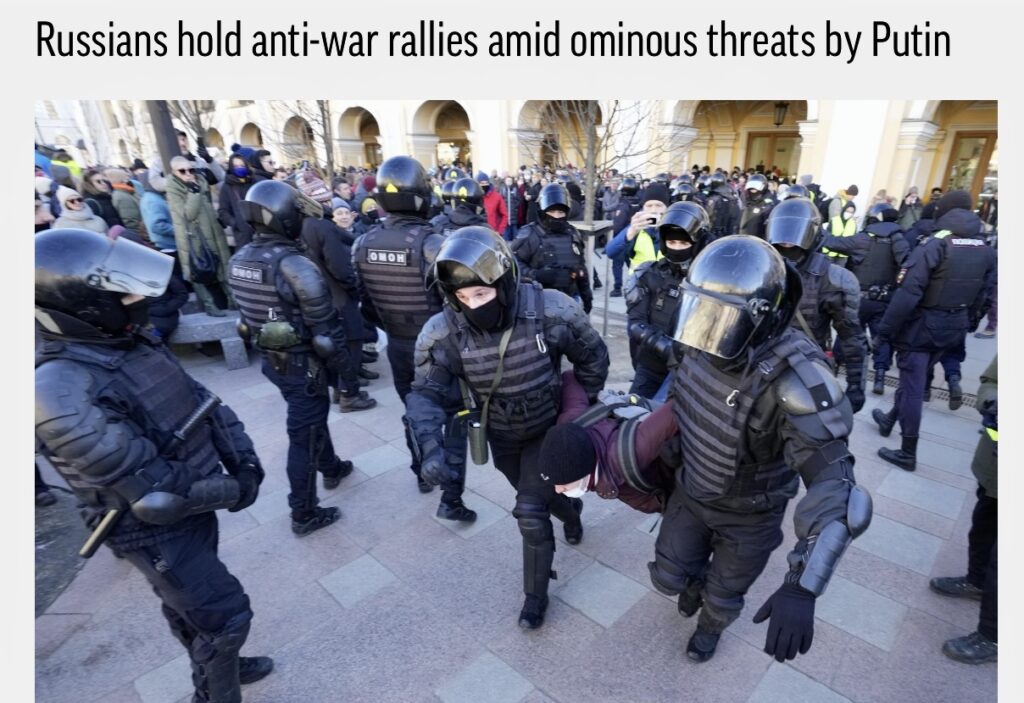
In St. Petersburg, where several hundred gathered in the city center, police in full riot gear were grabbing one protester after another and dragging some into police vans, even though the demonstration was peaceful. Footage from Moscow showed police throwing several female protesters on the ground before dragging them away.
According to the OVD-Info rights group that tracks political arrests, police detained at least 2,710 Russians in 51 cities for anti-war demonstrations Sunday, bringing the total of those detained over four days to nearly 6,000.
The day before, the U.S. and its European allies have warned that the coming round of sanctions could include freezing hard currency reserves of Russia’s Central Bank and cutting Russia off SWIFT international payment system. The unprecedented move could quickly plunge the Russian economy into chaos.
Ordinary Russians fear that stiff sanctions will deliver a crippling blow to the country’s economy. Since Thursday, Russians have been flocking to banks and ATMs to withdraw cash, creating long lines and reporting on social media about ATM machines running out of bills.
According to Russia’s Central Bank, on Thursday alone Russians withdrew 111 billion rubles (about $1.3 billion) in cash.
The anti-war protests on Sunday appeared smaller and more scattered than the ones that took place on the first day of Russia’s attack in Ukraine, when thousands of people rallied in Moscow and St. Petersburg, but their true scale was hard to assess and they seemed to pick up speed as the day went on.
“It is a crime both against Ukraine and Russia. I think it is killing both Ukraine and Russia. I am outraged, I haven’t slept for three nights, and I think we must now declare very loudly that we don’t want to be killed and don’t want Ukraine to be killed,” said Olga Mikheeva, who protested in the Siberian city of Irkutsk.
In Moscow and St. Petersburg, many people went to makeshift memorials for Boris Nemtsov, a top Russian opposition figure who was shot dead near the Kremlin on Feb. 27, 2015. Some brought flowers to honor Nemtsov’s memory, while others also held banners protesting the invasion of Ukraine, only to be detained minutes after taking them out.
Nemtsov, one of Russia’s most charismatic opposition figures, was a staunch advocate against the fighting in eastern Ukraine, where Russia-backed separatists have been battling with Ukrainian forces since 2014 in a drawn-out conflict that has killed more than 14,000.
Russian authorities in recent days have moved to stifle critical voices.
Speaker of Russia’s lower house of parliament Vyacheslav Volodin said the anti-war stance of “certain cultural figures” was “inappropriate” and “nothing short of a betrayal of your own people.”
Access to Twitter and Facebook has been restricted, and human rights advocates feared similar steps would soon be taken against YouTube.
Russia’s state communications and media watchdog Roskomnadzor on Sunday demanded that Google to lift restrictions imposed on YouTube channels run by several Russian state media outlets. The Network Freedoms rights group noted that Facebook’s refusal to comply with a similar demand this week led to restricted access to the platform.
The website of the Current Time, a Russian TV channel launched by the U.S.-funded Radio Free Europe/Radio Liberty that has been critical of the Kremlin, became unavailable Sunday after the channel reported receiving a notification from Roskomnadzor about blocking it.
___
Associated Press writers Vladimir Isachenkov in Moscow and Irina Titova in St. Petersburg contributed to this report.
Initial Report: Nearly 6,000 detained across Russia as anti-war protests enter fourth day, monitoring site says
From CNN’s Vasco Cotovio in Moscow
Russian authorities have detained a total of 5,794 people for participating in unsanctioned anti-war protests across the country, since the Kremlin ordered an invasion of Ukraine, independent monitoring site OVD-Info ** said on Sunday.
As of 3 p.m. ET, 2,650 people had been detained for protesting in 51 cities throughout the country, OVD-Info also reported, and 1,225 were detained in Moscow alone.
Under Russian law, large demonstrations require protesters apply for a permit, which has to be submitted no more than 15 but no less than 10 days before the event. Heavy fines — and in some cases even prison time — can be imposed on those who protest without a permit. Individuals are allowed to stage “single pickets,” which are solo protests but it is not unheard of for people to be detained for those as well.
On Thursday, Russia’s Investigative Committee warned that participation in any anti-war protest was illegal. It also said that offenses could be entered on participants’ criminal records which would “leave a mark on the person’s future”
**NOTE: About OVD-Info:
OVD-Info (Russian: ОВД-Инфо) is reported to be an independent Russian human rights media project aimed at combating political persecution.
Nonprofit organization! Non-governmental
Founded: December 2011
Headquarters: Moscow, Russia
Website: ovdinfo.org (in Russian),
History— Excerpt
OVD-Info was founded in December 2011 by Moscow journalist Grigory Okhotin and programmer Daniil Beilinson. They witnessed mass arrests of participants in the rally on December 5, 2011 against the rigging of parliamentary elections.
First, they posted on Facebook the total number of detainees and their names. Seeing the demand for their work, by December 10, on the eve of the rally on Bolotnaya Square in Moscow, they launched the OVD-Info website. The name of the project comes from the abbreviation Department of Internal Affairs (Russian: Отдел Внутренних Дел).[5][6]
Since February 1, 2013, the main partner of the project is the Memorial Human Rights Center.
On 29 September 2021 the Ministry of Justice of the Russian Federation designated OVD-Info as a “foreign agent”. Critics say the decision is designed to stifle dissent.
Most funding for the group is grants from the European Union
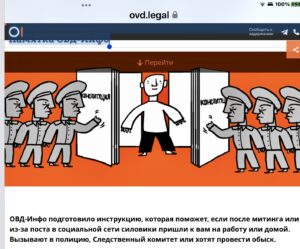
OVD-Info web graphic about reporting police searches after protests
Hi Chuck,
And over 10,000 Russian IT workers have signed an petition protesting the war on Ukraine: https://t.co/0dKwlspQrE
In Berlin, 100,000 protesters on Sunday.
Numbers count. Quaker’s don’t get it, however. It’s not ideas that count. It’s the numbers of those who “get” the idea that count. In every era, even the “Red Scare” era of McCarthy, the idea that what was happening was evil BS was extant. What was missing were numbers, working together.
As with a radio signal, strong signals get through, weak signals get lost in the noise. Listening to Spirit in contemplative worship is an art form in decreasing the noise in order to discern the signal. That’s why Quaker individuals are early to so many issues, even if their meetings (think: Lucretia Mott) lag behind.
Given the above, the moral question facing Quakers is: how can we bring Spiritual Community, where listening to the heart led by Spirit is both method and goal, to all — not just those suited to the art form of contemplative worship?
Thank you for this. I left my Quaker meeting after forty-some years, partly owing to my own spiritual shift of gravity and frustration with covid-worsened experience. How do you reckon Friends’ reliance on virtuality figures in the passivity to allude to?
David Morse, formerly of Storrs Friends Meeting, in CT.