
“The conflict in Ukraine is all about religion and what kind of Orthodoxy will shape Eastern Europe and other Orthodox communities around the world (especially in Africa). Religion.
This is a crusade, recapturing the Holy Land of Russian Orthodoxy, and defeating the Westernized (and decadent) heretics who do not bend the knee to Moscow’s spiritual authority.
If you don’t get that, you don’t get it.
That’s Diana Butler Bass. She’s a distinguished scholar and analyst of religion, and a modern progressive Christian — raised Methodist, slid through a fundamentalist phase, snagged a church history PhD at Duke, and is now a sort-of Episcopalian.
Personally I’m no expert on either Orthodox churches or Ukraine.
But I do know this much: if you’re trying to make sense of the political chaos and hazards roiling our own American culture — if you don’t get the religious basis for much of it, you don’t get it.
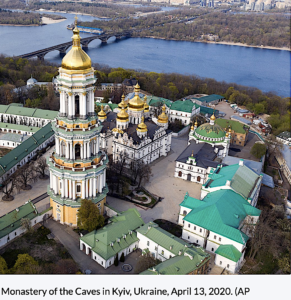
Russia and Ukraine and their feuding versions of Orthodoxy have been at this business a lot longer than the USA, so why aren’t there parallels?
There are, at least as far as having feuding religious factions trying to gain hegemony, and power there; er, I mean here. And for them, our tradition of separation of church and state, which many of us others believe came down from Sinai in Moses’s back pocket, is seen as just a decadent obstacle in their way to power, to be swept aside by any means necessary (looking at YOU, Supreme Court; and you, Steve Bannon).
So when I get a chance to gather some new understanding about this dimension of trouble in the world, I’ll grab it. My goal is to move from being an utter ignoramus to being maybe reasonably smattered about it.
I got such a chance this morning, at my small country Quaker meeting, 40 miles west of Durham, where Diana Butler Bass got her degree. At worship we had a visiting Presbyterian, Gary Simpson, deliver a message, and he told us about how the war in Ukraine had a very important religious dimension, and gave us a link to find out something about that.
We needed to know that, Simpson said, to roll back “the mischievous merchants of malice and misinformation.”
Well, I’m a total sucker for a slick bit of alliteration. And from there, one link led to another, and my clicks pointed straight at Diana Butler Bass on Substack:
In effect, the world is witnessing a new version of an old tale — the quest to recreate an imperial Christian state, a neo-medieval “Holy Roman Empire” — uniting political, economic, and spiritual power into an entity to control the earthly and heavenly destiny of European peoples.
The dream gripping some quarters of the West is for a coalition to unify religious conservatives into a kind of supra-national neo-Christendom. The theory is to create a partnership between American evangelicals, traditionalist Catholics in western countries, and Orthodox peoples under the auspices of the Russian Orthodox Church in a common front against three enemies — decadent secularism, a rising China, and Islam — for a glorious rebirth of moral purity and Christian culture.
In the United States, Trumpist-religion is most often framed as “Christian nationalism.” It is, indeed, that. But it is also more — it is the American partner of this larger quest for Christian internationalism. No one has articulated this more clearly than Steve Bannon, who, despite his legal troubles, remains a significant force as a kind of philosophical apostle in right-wing Christian circles for a neo-Christendom.
There have been a few bumps on the way to this Humpty-Dumpty hope of reassembling a Christian Roman Empire, however. Interestingly enough (and I’ll leave this to future historians to sort out), American evangelicals bought into this neo-medieval project wholesale, having been prepared for far right nationalism by their fondness for racial and gender hierarchies.
The most democratic form of Protestantism will evidently sell its soul to keep black people and women in their “place.”
[NOTE: she neglects to mention LGBTQs, who are definitely on the crusade target list.]
The hardest partner to recruit to neo-Christendom has been the Catholic Church. The election of Pope Francis in 2013 proved a major stumbling block for the emergence of a right-wing global political order.
The new Pope eschewed all such schemes in favor of opening up the church to the poor, outcasts, and the marginalized with a social vision that questions capitalism and the destruction of the Earth. Neo-medieval Catholics — often referred to as “trad Caths” — haven’t taken this well and have mounted a decade of resistance to Francis that may well culminate in something like the Avignon schism of the fourteenth century. So far, however, Pope Francis remains in charge.
Bass underlines some of the mind-bending aspects of our current situation: For instance, that the Pope may be one of the best allies the good people have to help impede this crusade. [Did I mention that Pope Francis is 86, not in perfect health, and surrounded by Bannonite schemers?] For another, we’re facing a “neo-medieval” resurgence, but one armed with all the latest electronic mind-control gadgets. And that it’s an international crusade.
On the other hand, there are anti-Putin and anti-Moscow/Putin Orthodox factions in Ukraine, who will keep praying and fighting for their religious (and national) independence long after the region’s maps may be redrawn by Putin’s tanks. How those big ecclesiastical cookies crumble will be fateful. Bass again:
The conflict in Ukraine is all about religion and what kind of Orthodoxy will shape Eastern Europe and other Orthodox communities around the world (especially in Africa). Religion. This is a crusade. . . . And, what does claiming that territory mean for Orthodoxy around the world? Will global Orthodoxy lean toward a more pluralistic and open future, or will it be part of the authoritarian neo-Christendom triumvirate?
We don’t know how this is going to unfold. But — here’s the key point — economic sanctions are unlikely to work if you believe your side is divinely sanctioned. That’s what Putin thinks he’s got: the approval of God.
You just know he wants to celebrate Easter — this one or next — in Kyiv.
And for that matter, the American merchants
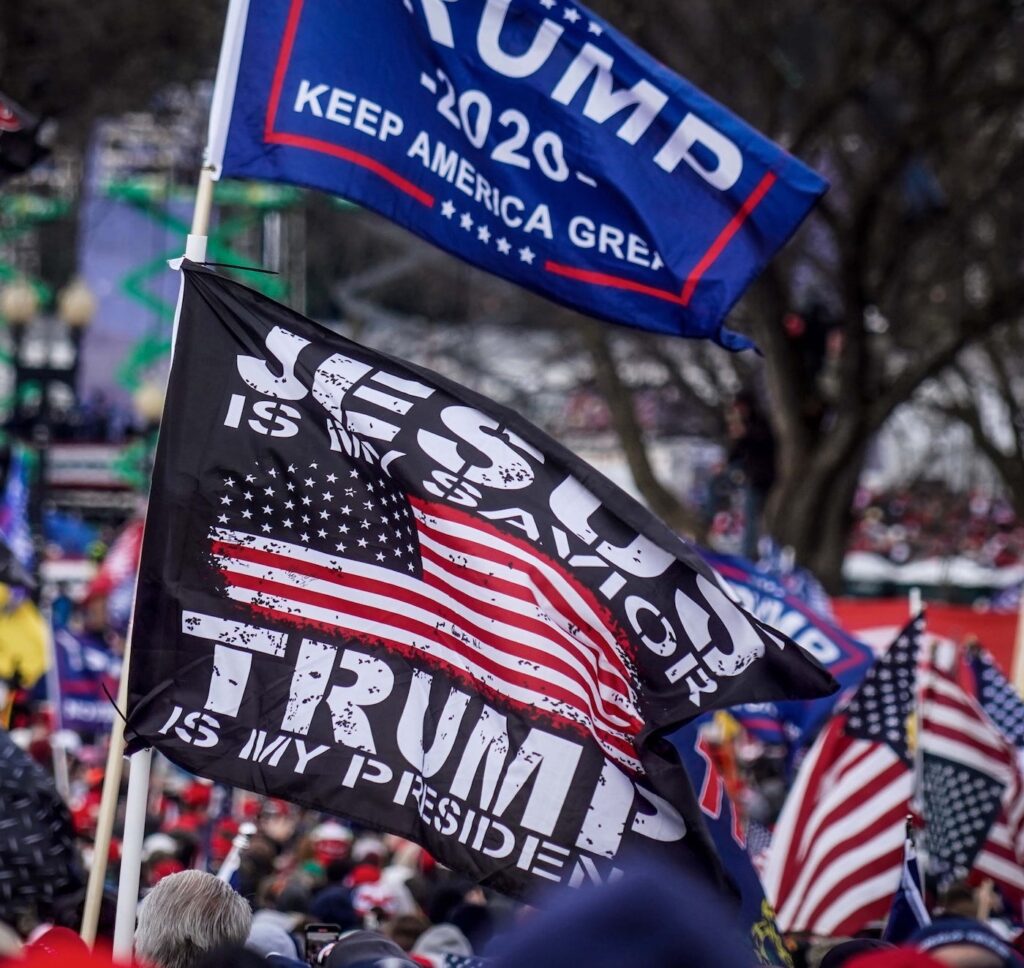
of mischievous mad malice and misinformation want to MAGA-fy the Easter Bunny and “medievalize” your and your children’s lives also. In the Name of God.
January 6 at the Capitol was not Ukraine; it’s 4800 miles away. But this week, that’s not as far as many might think.
Not that far at all.
Putin a Christian? This is the guy who headed the KGB under the Soviet government, which was dedicated to wiping out all religion. He’s not above using religiouslly motivated people, but himself? He’d celebrate Easter with a dip in the Black Sea, not with attending a mass in a cathedral in Kiev. IMO.
Julia, Putin is as much a “Christian” as #45 is. And look around — that’s “Christian” enough for many. (It’s also “Christian” enough to be turning many younger folks into “Nones” & “Dones.” Reverse evangelism: it works!)
I recall a speech by Putin under this very premise. He views Russia as the leader of the new Holy Roman Empire. Weather he actually “believes” or is simply using the imagery to appropriate a following (like Donald Trump did with white nationalist evangelicals) is irrelevant. There comes a time when men like him begin to believe their own lies/appropriations and the crowds follow.
I am somewhat familiar with this scenario. One of the first pro-Trump conversations I had was an apolitical person who did not watch news but was very articulate in articulating a Trump-Putin beneficial relationship.
Saturday, I was in a predominantly African-American group sharing bible verses “predicting” these Russian (by name) actions.
Thank you. Those foundational allegiances are particularly strong in the Slavic world but we underestimate them in our own sphere at the risk of misunderstanding political tidal influence.
BTW Chuck. Did you ever get that part for your washer-dryer?
No,[THE REST OF THIS COMMENT WAS DELETED AS A MATTER OF PUBLIC SAFETY]
The New York Times wrote about the tensions between the Ukrainian and Russian patriarchates on March 2, 2022. If Putin wins, the Russians maintain control over Ukrainian shrines. If Ukraine wins, the Ukrainians will kick the Russian patriarchate out.
https://www.nytimes.com/2022/03/02/world/europe/russia-ukraine-orthodox-church.html
Two women are quoted at the end of the article.
Marina Shuyeva, a doctor, gestured, with tears on her cheeks, toward the Russian tanks, and said, “They are not saving us. They are killing us.”
Darina Melnik, a former flight attendant and aspiring nun in the Orthodox Church, said, “I think people who really believe in God will not be violent. I understand our men who want to defend our country. But the Bible says, ‘Thou shalt not kill.'”
Of the soldiers fighting for Russia and Ukraine, she says, “I pray to save their souls. But we do not know what victory looks like in God’s eyes.”